

Control Line: Speed
Gene Hempel
The following account of the Speed portion of the recent Control Line World Championships in Pecs, Hungary, was provided by David Brewin, a member of the British F2A Speed team.
Overview
The 1986 Control Line World Championships were hosted by Hungary and held in Pecs, a good-sized town by European standards in the rolling hills of the southern part of the country. Pecs boasts a control-line flying site built for that purpose. It is located at the south end of town near a residential area and has two circles surrounded by poplar trees. These were used for the Aerobatic (F2B) and Team Race (F2C) competitions. F2D Combat was held at an undeveloped factory lot a quarter of a mile to the east. The F2A Speed competition, which is the focus of this report, was on a newly resurfaced apartment parking lot 150 yards to the west.
As would be expected in a country that has three of the top and most successful Speed fliers of recent times, the organization and execution of the Speed event were excellent. The man who has usually been the Hungarian Speed-team manager relinquished his duty in favor of being the contest director.
The timing and height-judging officials were sensibly located on the same radial point and provided with a seating ramp. A couple of criticisms concerned the absence of a three-minute circle clock and slightly underenthusiastic safety-pulling of the models.
The competition started at 8:00 a.m. every morning and, with very few reflights in each round, was finished by about 1:00 p.m., allowing the circle to be used for practice flying in the afternoon.
As often happens in competition, particularly at this level and when flying as a team (only team members are allowed to assist with each other's starting duties), the writer was unable to observe every flight. Rather than give a blow-by-blow account of each flight of the three rounds, the following is a general overview of the competition and technical observations.
Teams and equipment
#### Australia
- The Australians traveled the farthest and planned to continue on to the British Nationals after the World Championships.
- They suffered a drastic climatic change, having practiced in local winter conditions of 4–8°C and competing in weather about 30°C warmer.
- All flew nicely made asymmetric sidewinder models with suction fuel systems, short spans, and wide-chord wings by current standards.
- Rossi-powered Robin Hiern used a two-bladed carbon-fiber prop to record 254.95 kph, placing twenty-third.
#### United States
- The American team used models of similar size but with extremely short tail moments by contemporary FAI standards. Each team member's model was unique.
- All used sidewinder-type models with inboard-pointing cylinders and pressure-regulator-valve fuel systems.
- John Newton struggled to replicate his home speeds; a midnight practice session to improve his third-round performance proved unsuccessful.
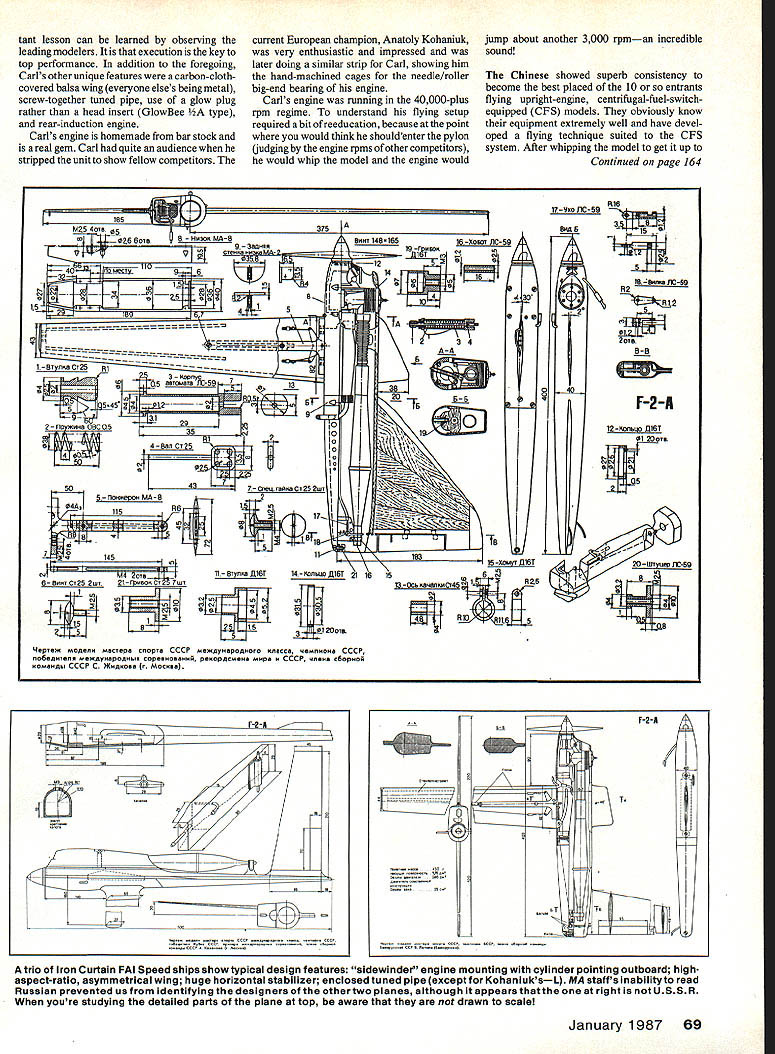
- Chuck Schuette demonstrated a cautious fuel-system approach: Carl Dodge patiently kept Chuck's engine running long enough to get airborne, and Chuck’s economical flying produced a 277 kph flight, good enough for tenth place.
- Carl Dodge’s setup was among the most individual: carbon-cloth-covered balsa wing (others used metal), screw-together tuned pipe, use of a glow plug (GlowBee #4 type) rather than a head insert, and a rear-induction engine. His homemade engine, machined from bar stock, ran above 40,000 rpm. Observing Carl required reeducation: at a point where others would have entered the pylon, he would whip the model and the engine would jump another ~3,000 rpm.
#### China
- The Chinese showed superb consistency and were the best-placed of the entrants flying upright-engine, centrifugal-fuel-switch (CFS) equipped models.
- They know their equipment well and developed a flying technique suited to the CFS system: after whipping the model to reach the first pipe level they would snap their arms out to momentarily release line tension, allowing the CFS to switch fuel supply and the engine to jump to the next pipe level.
- To accommodate tank location, CFS, and fuel shutoff, the engine was mounted on the inboard side with the tank behind the engine.
#### Hungary
- Hungarians flew their familiar asymmetric, outboard-cylinder sidewinder models with narrow-chord (2 in) and long-span (4 ft) wings.
- They continued to use wide-chord, thick-section maple propellers.
#### Italy
- The Italian Speed team did not attend and were sorely missed. They would have been all OPS-powered this year.
#### Poland
- Poland collected third-place team honors.
- Tomasz Chojnacki took a fine third place with a third-round flight of 286.39 kph; his preceding rounds had been zeroes.
- He was the top-placed Rossi entrant and used a large-volume tuned pipe and a wide-chord, single-bladed maple propeller.
#### United Kingdom
- Peter Halman (U.K.) built a new model for the Worlds with a machined pan, machined steel pipe, and a four-foot wing, using an MK1 Rossi crankcase fitted with his own piston and sleeve and a large outside-diameter crankshaft. He broke the U.K.'s FAI record in both the second and third rounds.
- David Brewin (attending a World Championship for the first time) put in a personal best of 252 kph. He was the only entrant using the OPS 2.5 cc engine. David’s model was originally built for the U.K. 3.5 cc Speed class and had been converted to 2.5 cc earlier in the year.
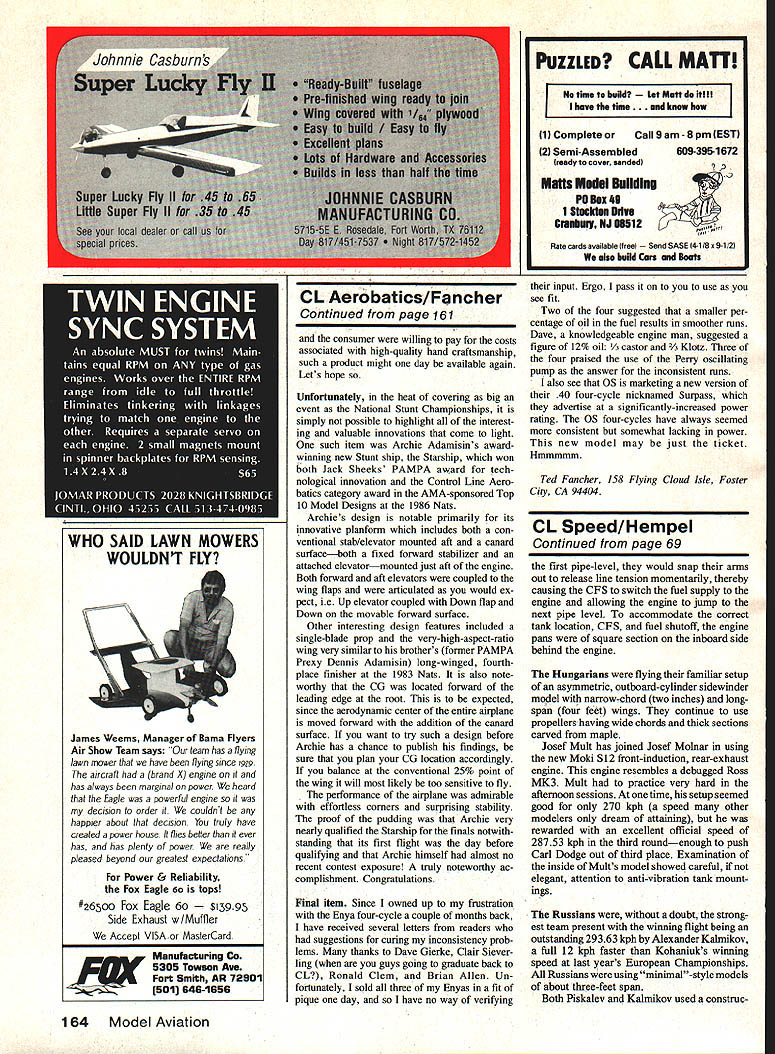
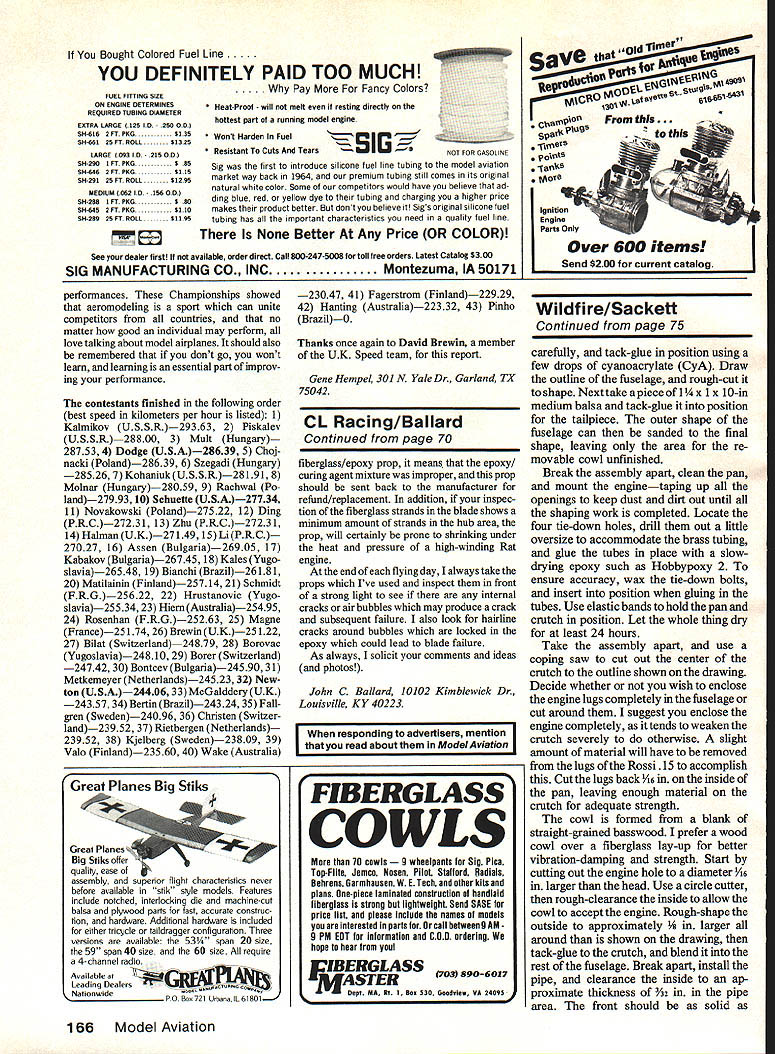
#### Russia
- The Russians were the strongest team present. The winning flight was an outstanding 293.63 kph by Alexander Kalmikov.
- All Russians used "minimal"-style models of about three-foot span.
- Both Piskalev and Kalmikov used a construction technique where the rear fuselage and tailplane are built onto the half-pan, with pan access via a two-part top cowl.
- All models showed careful attention to cooling of the header section of the tuned pipe.
- Carbon-fiber propellers were used, believed to be of constant pitch. In Anatoly Kohaniuk's case the pitch was believed to be in excess of 6.25 inches and as much as 6.75 inches.
- Kalmikov’s and Piskalev’s engines used a threaded collar to hold the head insert; in Piskalev's case it was tightened with great force. The heads featured replaceable glow elements.
- They used thick-walled aluminum tuned pipes of large volume:
- Maximum inside diameter: 30 mm
- Pipe length: 190 mm to the maximum outside diameter measured from the glow plug post; 290 mm overall
- Stinger: length 20 mm, inside diameter 4.5 mm
- These pipes likely helped models airborne because the engines were running a large induction period in the region of 230° opening and about 20° ABDC (after bottom dead center).
Notable individuals and equipment
- Carl Dodge’s engine was homemade from bar stock and was admired by fellow competitors. He demonstrated the engine by stripping it down; Anatoly Kohaniuk later showed him hand-machined cages for the needle/roller big-end bearing of his engine.
- Josef Molnar used the new MK3 .12 front-induction, rear-exhaust Rossi engine (a debugged Rossi MK3). He practiced hard in afternoon sessions and recorded an excellent official speed of 287.53 kph in the third round, which pushed Carl Dodge out of third place. Inside Molnar’s model showed careful anti-vibration tank mounting.
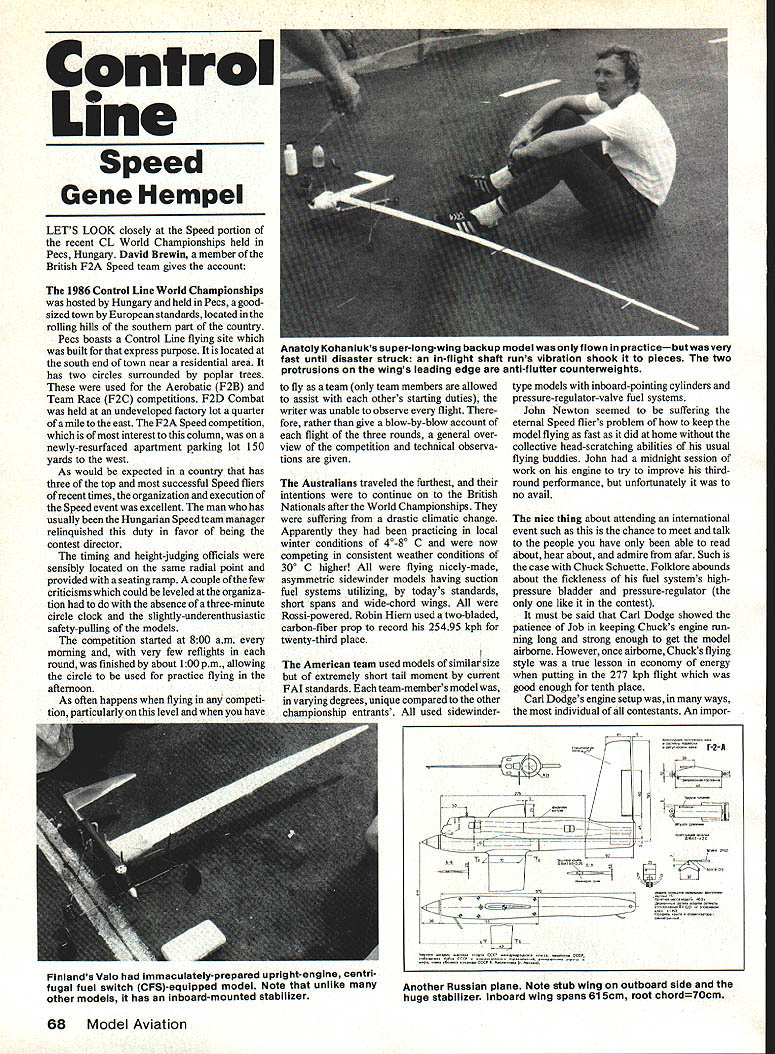
- Anatoly Kohaniuk’s backup model featured a wing-extension piece producing a span of over five feet. He noted the engine was not as strong as his primary plane, but the longer span allowed the engine to unload and the model to fly extremely fast—possibly approaching 300 kph. The long wing (fitted with 27° of anti-drift washout) made the model overly pitch-sensitive, causing it to kiss the ground and shake itself apart when run on a single-bladed propeller with only the counterweight present.
- Josef Mutz quipped that what was needed was a wing going all the way down to the control handle.
- Dick McGaldrey’s progress was hampered by travel restrictions prior to departure.
Technical lessons and observations
- An important lesson learned by observing the leading modelers is that execution is the key to top performance.
- Competitors showed a variety of approaches: sidewinder and outboard-cylinder designs, suction and pressure-regulator fuel systems, CFS systems, different tuned-pipe and propeller strategies, and both metal and wood wing constructions.
- Observing varied engine rpm behavior and tuned-pipe interactions revealed subtle throttle and whipping techniques used to step engines between pipe levels.
- Careful attention to tank mounting, vibration control, and tuned-pipe cooling was evident among top competitors.
Results highlights
- Winning flight: Alexander Kalmikov (Russia) — 293.63 kph
- Josef Molnar — 287.53 kph (third-round flight)
- Tomasz Chojnacki (Poland) — 286.39 kph (third place)
- Chuck Schuette — 277 kph (tenth place)
- Robin Hiern (Australia) — 254.95 kph (twenty-third place)
- David Brewin (U.K.) — personal best 252 kph
Closing
Thanks to the hosts for organizing the competition and the evening banquet, and congratulations to all contestants on their performances. These Championships showed that aeromodelling is a sport that can unite competitors from all countries, and that no matter how good an individual may perform, all love talking about model airplanes. Remember: if you don't go, you won't learn, and learning is an essential part of improving your performance.
Thanks once again to David Brewin, a member of the U.K. Speed team, for this report.
Gene Hempel 301 N. Yale Dr. Garland, TX 75042
Transcribed from original scans by AI. Minor OCR errors may remain.

