
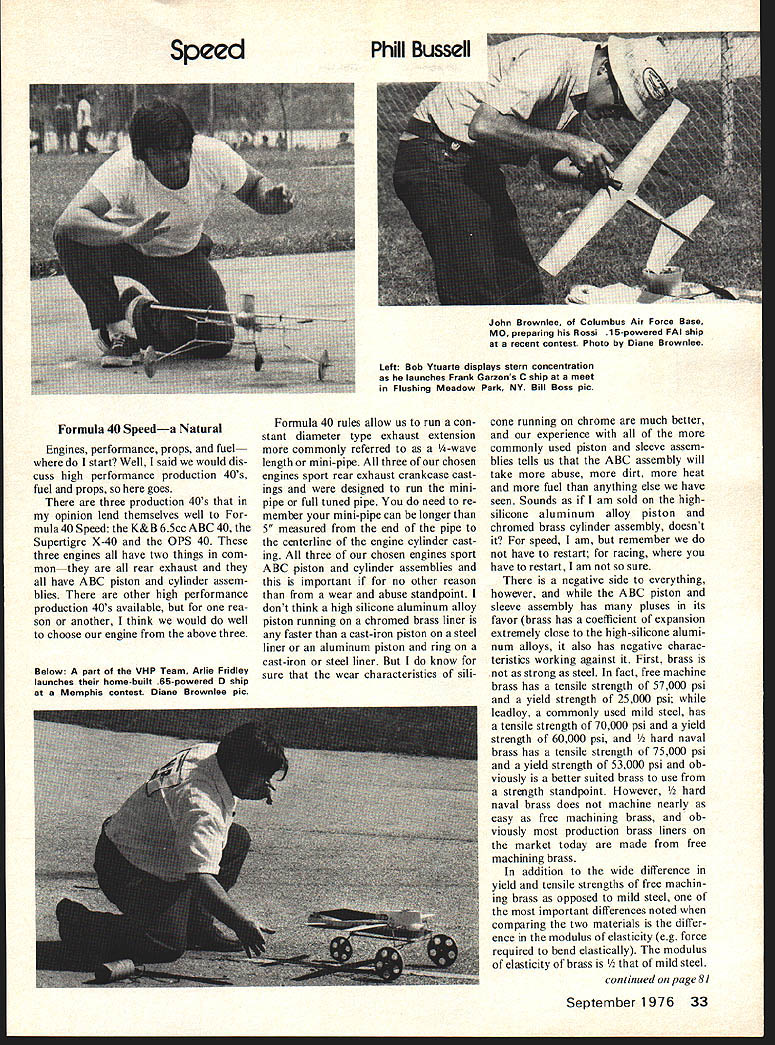
Control Line: Speed
Phill Bussell
Formula 40 Speed—a Natural
Engines, performance, props, and fuel—where do I start? Well, I said we would discuss high performance production 40's, fuel and props, so here goes.
There are three production 40's that in my opinion lend themselves well to Formula 40 Speed: the K & B .65cc ABC 40, the Supertigre X-40, and the OPS 40. These three engines all have two things in common—they are all rear exhaust and all have ABC piston and cylinder assemblies. There are other high performance production 40's available, but for one reason or another, I think we would do well to choose our engine from the above three.
Formula 40 rules allow us to run a constant diameter type exhaust extension, more commonly referred to as a 4-wave length or mini-pipe. All three of our chosen engines sport rear exhaust crankcase castings and were designed to run the mini-pipe or full tuned pipe. You do need to remember your mini-pipe can be longer than 5" measured from the end of the pipe to the centerline of the engine cylinder casting. All three of our chosen engines sport ABC piston and cylinder assemblies and this is important if for no other reason than from a wear and abuse standpoint. I don't think a high-silicone aluminum alloy piston running on a chromed brass liner is any faster than a cast-iron piston on a steel liner or an aluminum piston and ring on a cast-iron or steel liner. But I do know for sure that the wear characteristics of silicone running on chrome are much better, and our experience with all of the more commonly used piston and sleeve assemblies tells us the ABC assembly will take more abuse, more dirt, more heat and more fuel than anything else we have seen.
Sounds as if I am sold on the high-silicone aluminum alloy piston and chromed brass cylinder assembly, doesn't it? For speed, I am, but remember we do not have to restart; for racing, where you have to restart, I am not so sure.
There is a negative side to everything, however, and while the ABC piston and sleeve assembly has many pluses in its favor (brass has a coefficient of expansion extremely close to the high-silicone aluminum alloys), it also has negative characteristics working against it. First, brass is not as strong as steel. In fact, free machining brass has a tensile strength of 57,000 psi and a yield strength of 25,000 psi. Mild steel commonly used has a tensile strength of 70,000 psi and a yield strength of 60,000 psi. Naval brass has a tensile strength of 75,000 psi and a yield strength of 53,000 psi. Obviously better suited brass to use from a strength standpoint. However, 1/2 hard naval brass does not machine nearly as easy as free machining brass, and obviously most production brass liners on the market today are made from free machining brass.
In addition to the wide difference in yield and tensile strengths of free machining brass as opposed to mild steel, one of the most important differences noted when comparing the two materials is the difference in the modulus of elasticity (e.g. force required to bend elastically). The modulus of elasticity of brass is 1/2 that of mild steel.
CL Speed/Bussell
In simple terms, this means it takes exactly twice the force to distort mild steel as it takes to distort brass. You don't have to compare the tensile, yield and modulus of elasticity strengths of free machining brass and mild steel for very long before realizing brass is not nearly as strong and for that reason and others it should be obvious that brass cylinder liners should be thicker than ones made from steel. Up to now, none of the production engine manufacturers have taken this into consideration.
Brass will take little or no abuse from the would-be engine reworker. You can bend a brass liner if you use force when removing it from the crankcase casting—quicker than you can bat an eye. Also, if you are not careful in disassembly and assembly, it is easy to warp or bind the brass liner. Sometimes this is very difficult to detect, especially if your piston and sleeve assembly is set up on the tight side. Most of these ills are caused by the low yield strength of brass. Another negative factor working against the ABC piston and sleeve assembly is that it is (at least for us) very difficult to get the exact running fit we are looking for. I am not blowing smoke when I tell you it is possible to pick up 1000 to 2000 rpm over the average ABC assembly when you get the exact fit that runs and, because of the nature of the alloys used, you would turn gray if you waited around for the fits to run in, and when you start trying to lap or hone the fits you are after, you better have time, patience, knowledge, and money. You will make mistakes and mistakes cost money when you are involved with the heart of your engine. Ah! But once you get the fit you want, you can then sit back and enjoy it because the silicone and chrome then start to work in your favor. It will take leaner runs, more plug elements and hotter fuel than its counterparts and, barring major difficulties (extremely lean runs and extremely hot fuel), one piston and sleeve should last an entire speed season. Brent has used one ST X-15 with one piston and sleeve assembly since early 1975 and here we are right in the middle of 1976 and he is still using the same engine and same piston and sleeve and he is still going fast. We will discuss how we go about fitting ABC's later.
Tools: If you want to try your hand at improving the performance of an engine, certain tools are necessary. Contrary to popular belief, you don't need to have a machine shop full of expensive tools or be extremely knowledgeable of engine building to improve the performance of the average production engine. However, certain amounts of equipment and common sense are necessary. You might as well build yourself a good, strong running bench and build, or buy a metal running mount for your bench because you are going to spend many hours bending over a hot, loud running engine. You also need a good, accurate tachometer. Believe me, we have used them all from the stroboscope to the sound tach, to the red tach, to the light tach, to the direct-drive tach.
We prefer a good (expensive) direct-drive tach over the rest because it is easy to read, portable and, most important, dependable. I am sorry to say the light tachs are not very dependable and I strongly recommend that, if you seriously want to improve performance, you equip yourself with a good dependable direct-drive tachometer. Do not expect the local engine and hobby shops to be of any help in this department. Cam grinders, etc., will be starting and restarting hot cranked engines and hand starting a hot cranky high performance engine can be impossible.
If we are to compare engines, we need measuring instruments. A depth micrometer to measure head and piston clearance is a must. It is also important to have a 0"-1" micrometer or a 0"-6" dial vernier caliper. I use both, but for what we are going to try to accomplish in this article, I recommend a good 0"-6" dial vernier caliper as it is more versatile, faster, and, with patience, you can learn to use it almost as accurately as your micrometers.
We can now record performance and compare parts. A feeler gauge for setting rotor clearance is also handy. We use our Xacto knife and an old blade for deburring ports and removing flash from castings. A good cleaning fluid is necessary and lightweight machine oil to protect clean parts from oxidation is useful.
From time to time, you will want to alter your production piston and cylinder fit and I recommend that, at least for the inexperienced person, this be done by lapping. We use 1200-grit carborundum and/or white Dupont #7 polishing compound for this. Dupont #7 is water soluble and for this reason I recommend it. Other than the above mentioned, I can't think of anything else you will need. A degree wheel will be helpful but not necessary. Be sure to inspect everything with an inspection microscope to properly alter sleeve timing if it is necessary.
It will be necessary to be able to move the head on your engine in smaller increments than stock gaskets. I suggest that you make several gaskets from different sizes of shim stock. We play with head clearance to the point of making gaskets 200 or 300 at a time out of .004 in. brass, so as not to be inconvenienced while building engines. Custom-built thin .003 head gaskets and sleeve shims are available.
Transcribed from original scans by AI. Minor OCR errors may remain.

