
Control Line: Speed
Gene Hempel
JETS, AGAIN. This month's column covers two excellent bits of information concerning jet models. The first is a letter from Dimmitt Perkins of Houston, TX explaining how the evolution of sport jet fuel came about. The latter article explains a new torque unit designed by Jerry Thomas for Jet and D Speed models.
Here's Dimmitt:
About a year, maybe a year-and-a-half ago, Charlie called with the idea of a sport event for Jet. It was to be a low-key event to promote Jet models. You've run a couple of articles on proposed rules and model plans. When we got to discussing fuels, we agreed on several requirements. They were:
- The fuel should be easy-starting.
- It should have a wide combustion range so that metering jets would not be critical and also make possible operation with or without a pressurized fuel tank and in an upright or sidewinder model. This requirement would also reduce weather effects.
- It would be cheap.
- The ingredients should be easy to obtain.
Of the more common jet fuel ingredients, gasoline is certainly cheap but, with a flammability range of about 1.5% to 7.5% by volume in air, it can be critical with respect to metering jets—especially if run on pressure. Nitromethane-propylene oxide mixtures have good operating characteristics but definitely are not cheap. Methanol is relatively cheap, easy to obtain, and with its 6.7% to 36.5% flammability limits, it has a wider flammable range than most common fuel ingredients.
But methanol, by itself, is not a good jet fuel. It lacks range and power. Hydrocarbons like gasoline or benzene help here. Mike Hoyt used to run a fuel consisting of a 4-1-1-1 mix of methanol-benzene-nitromethane-propylene oxide. Benzene was generally increased if more laps were required. We didn't want to use benzene (had to get it and is generally considered carcinogenic), and we wanted to avoid nitro and prop, if possible, because of cost and availability.
Then I remembered that back in the Sixties when benzene was the fuel of choice I had an engine/airplane combination that would not run on straight benzene without burning valves. I had to run 50/50 benzene and white gas and give up a couple of mph. At my company we were working with benzene and MEK (methyl ethyl ketone), and one day I noticed that their physical properties were similar. Jet fuel? I tried it, and it worked. So why not try MEK in a sport fuel? MEK is available in paint stores.
By now we had a lot of things to try:
- gasoline
- kerosene
- Coleman fuel
- methanol
- MEK
- nitromethane
- propylene oxide
- maybe others
Charlie came to Houston twice, loaded with hardware and sidewinder airplanes, a test stand, and accessories. I dusted off my old upright, grabbed a bunch of accessories, and we went to Melrose Park for a day of testing. We'd mix a batch of fuel and check it out on the test stand to find both the right metering and the range of metering jets for suction feed and for pressurized tank. In all cases we found a good fuel mix we'd put in one test flight on a model with a suction tank and one with a model having a pressurized tank. In all cases the engine had a stock Dyna-Jet head and a stock retainer. The tailpipe had a fuel tank pressurizing fitting (Silvertrol) screwed in place, which was plugged with a square of fuel line when not in use. The flow connector used was either stock for "gasoline"-type fuels or drilled out to .055 for most fuels.
I can't tell you how many fuel mixes we tried that first session. It was a bunch, but there were only two or three that were worthy of an air test. The first session produced some bad news and some good news.
The bad news was that the cheap fuels, "gasoline"-type, did not work satisfactorily in both suction and pressurized tank systems—just as we expected. The kinda-good news was that we arrived at a good all-around sport fuel, but at $3.98 per gallon it wasn't exactly cheap. This mix was 35% MEK, 35% methanol, 15% propylene oxide and 15% nitromethane. Nitro and prop are not readily available.
Charlie and I kept in touch over the next few months, and we continued to discuss the fuel situation. In the meantime, I made a few calculations on fuel-mixture flammability range and decided a methanol-MEK mix with a high percentage of alcohol might give us the fuel we were looking for.
Charlie came back to Houston about six months after our first session, and we set up shop again. It did not take long before we hit on the 80% methanol, 20% MEK mix. Much to our surprise, we got a .010 range on metering jets on suction and pressure tanks in both upright and sidewinder models. The engine runs were steady and strong in all cases. We now had a good sport fuel—and at a cost of about $4 per gallon. The uprights are slightly harder to start on the fuel than the sidewinders because of the longer vertical fuel draw, but anyone who has built and flown uprights is familiar with the technique of tilting the plane to make the engine easier to start.
We had accomplished nearly all our goals. The only goal left unchecked was the effect of weather. We have not checked the fuel under a wide variety of weather conditions. Charlie did have some problems once, in Dallas, but didn't have time to sort it out. As I recall, Charlie said the humidity was high. In 38 years of flying, he has encountered three or four times when high humidity apparently contributed to hard-starting and/or flights lasting only a few laps. If anyone runs into this problem while using the 80/20 fuel, I'd suggest adding 10% propylene oxide or reducing MEK to 10% or 5%. We have yet to test these combinations.
If you have any questions concerning jet fuels, please refer to the end of the Speed column for Dimmitt's address.
Monotube Torque Control Unit (Jerry Thomas)
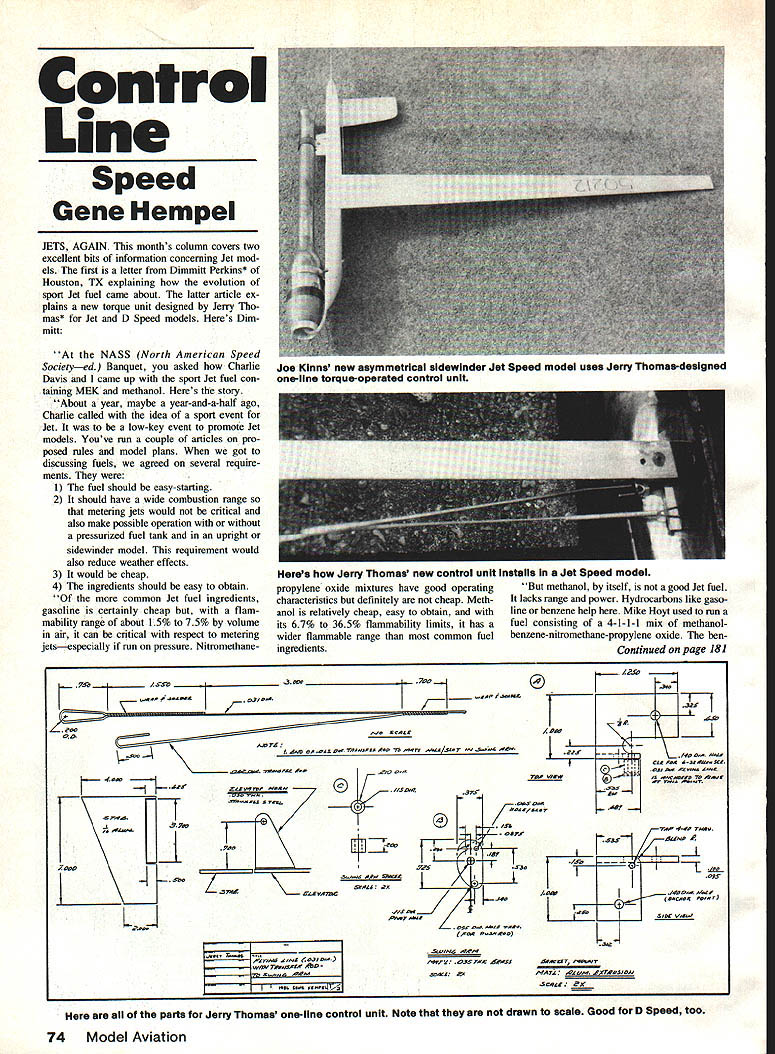
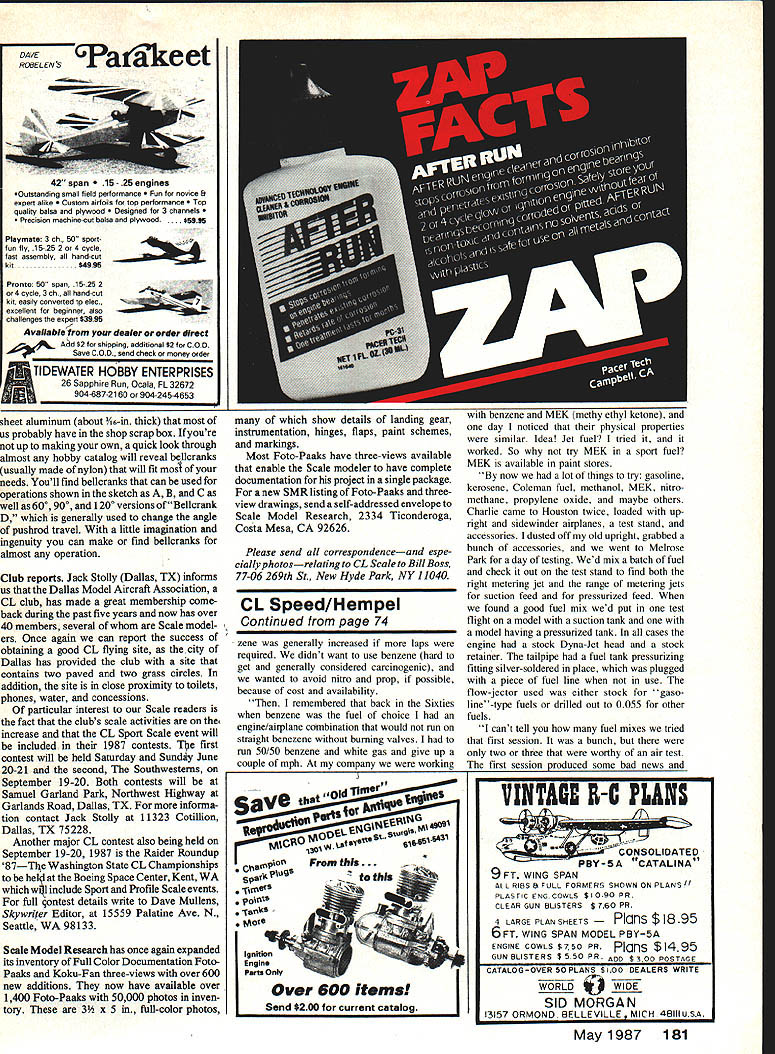
The next bit of information concerns a neat monotube torque control unit by Jerry Thomas. In his quest to design a super monotube connection to the model, he decided it should be simple and easy to construct. His idea of attaching the primary torque line to a swing arm allowed flying to a stationary point on the CG of the model and should pass all those hefty pull tests. Dale Kim has worked with Jerry Thomas on this project for several years and feels this is a better mousetrap. Also, the jet models constructed by Jerry and Dale utilizing this system fly extremely well. This type of system could also be applied to D Speed models.
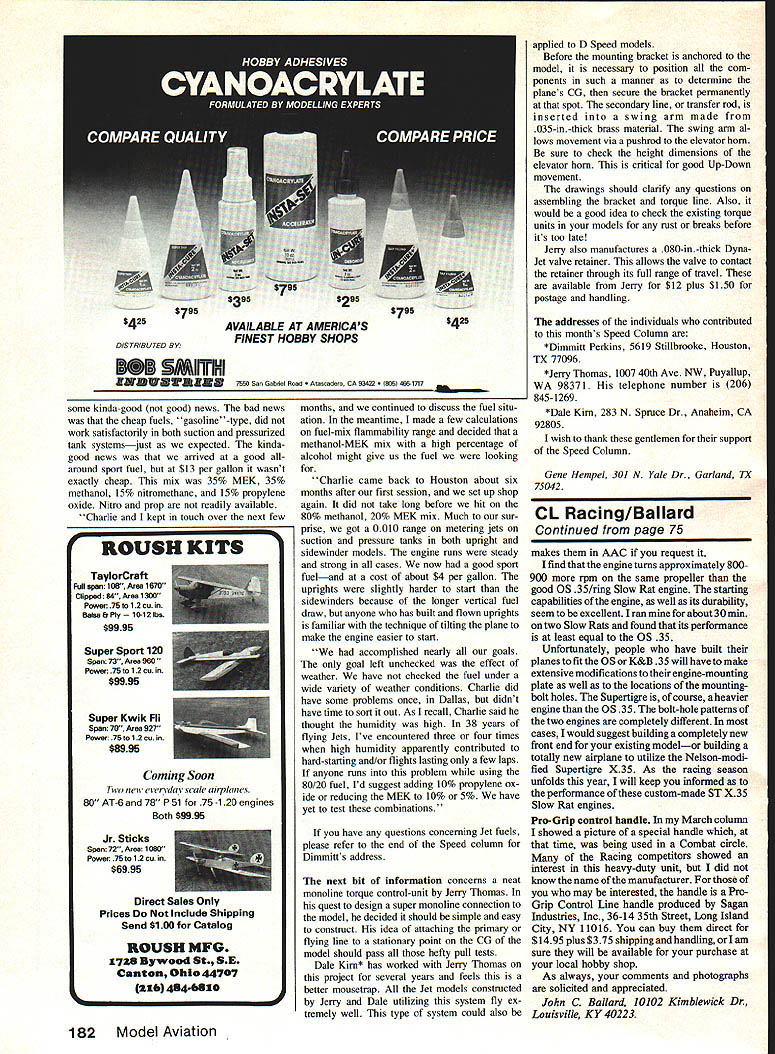
Before the mounting bracket is anchored to the model, it is necessary to position all the components to determine the plane's CG, then secure the bracket permanently at that spot. The secondary line, or transfer rod, is inserted into a swing arm made from .035-in.-thick brass material. The swing arm allows movement via a pushrod to the elevator horn. Be sure to check the height dimensions of the elevator horn. This is critical for good up-down movement.
The drawings should clarify any questions on assembling the bracket and torque line. Also, it would be a good idea to check the existing torque units in your models for any rust or breaks before it's too late!
Jerry also manufactures a .080-in.-thick Dyna-Jet valve retainer. This allows the valve to contact the retainer through its full range of travel. These are available from Jerry for $12 plus $1.50 for postage and handling.
Contributors / Addresses
- Dimmitt Perkins
5619 Stillbrooke, Houston, TX 77096
- Jerry Thomas
1007 40th Ave. NW, Puyallup, WA 98371 Phone: (206) 845-1269
- Dale Kim
283 N. Spruce Dr., Anaheim, CA 92805
I wish to thank these gentlemen for their support of the Speed Column.
Gene Hempel 301 N. Yale Dr., Garland, TX 75042.
Transcribed from original scans by AI. Minor OCR errors may remain.

