
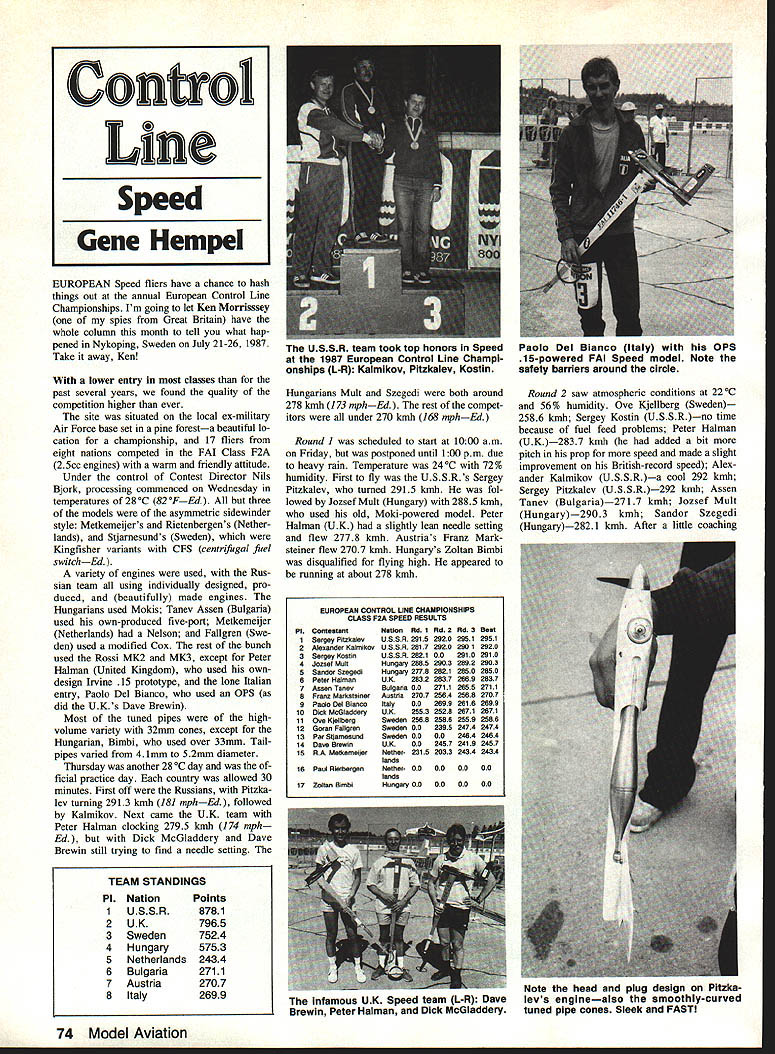
Control Line: Speed
Gene Hempel
European Speed fliers had a chance to hash things out at the annual European Control Line Championships. I'm going to let Ken Morrissey (one of my spies from Great Britain) have the whole column this month to tell you what happened in Nyköping, Sweden on July 21–26, 1987. Take it away, Ken!
Report — Nyköping, Sweden, July 21–26, 1987
With a lower entry in most classes than for the past several years, we found the quality of the competition higher than ever.
The site was situated on the local ex-military air force base set in a pine forest — a beautiful location for a championship. Seventeen fliers from eight nations competed in the FAI Class F2A (2.5 cc engines) with a warm, friendly attitude.
Under the control of Contest Director Nils Bjork, processing commenced on Wednesday in temperatures of 28°C (82°F). Three models of the asymmetric sidewinder style were the Metkemeijers, Rietenbergens (Netherlands), and Stjärnesunds (Sweden), which were Kingfisher variants with CFS (centrifugal fuel switch).
A variety of engines were used. The Russian team all used individually designed, produced, and (beautifully) made engines. The Hungarians used Mokis; Tanev (Assen, Bulgaria) used his own-produced five-port; Metkemeijer (Netherlands) had a Nelson; Fallgren (Sweden) used a modified Cox. The rest of the bunch used Rossi MK2 and MK3, except Peter Halman (United Kingdom), who used his own-design Irvine .15 prototype, and the lone Italian entry Paolo Del Bianco, who used an OPS .15.
Most of the tuned pipes were of the high-volume variety with 32 mm cones, except the Hungarian Bimbi who used over 33 mm. Tailpipes varied from 41 mm to 52 mm diameter.
Thursday was another 28°C day and was the official practice day. Each country was allowed 30 minutes. First off were the Russians, with Pitzkalev turning 291.3 km/h (181 mph). He was followed by Kalmikov. Next came the U.K. team with Peter Halman clocking 279.5 km/h (174 mph). Dick McGladdery and Dave Brewin were still trying to find a needle setting.
Round 1 was scheduled to start at 10:00 a.m. on Friday, but was postponed until 1:00 p.m. due to heavy rain. Temperature was 24°C, 72% humidity. First to fly was the U.S.S.R.'s Sergey Pitzkalev, who turned 291.5 km/h. He was followed by Jozsef Mult (Hungary) with 288.5 km/h using an old Moki-powered model. Peter Halman (U.K.), slightly lean on the needle setting, flew 277.8 km/h. Austria's Franz Marksteiner flew 270.7 km/h. Hungary's Zoltan Bimbi was disqualified for flying high; he appeared to be running at about 278.0 km/h.
Round 2 saw atmospheric conditions at 22°C and 56% humidity. Ove Kjellberg (Sweden) turned 258.6 km/h. Sergey Kostin (U.S.S.R.) had no time because of fuel-feed problems. Peter Halman (U.K.) posted 283.7 km/h after adding a bit of pitch to his prop, making a slight improvement on his British-record speed. Alexander Kalmikov (U.S.S.R.) recorded around 292 km/h. Sergey Pitzkalev (U.S.S.R.) also posted around 292 km/h. Assen Tanev (Bulgaria) achieved 271.7 km/h. Jozsef Mult (Hungary) turned 290.3 km/h. Sandor Szegedi (Hungary) ran 282.1 km/h. After a little coaching the remaining fliers improved their times.
Team Standings
- 1. U.S.S.R. — 878.1 points
- 2. U.K. — 796.5 points
- 3. Sweden — 752.4 points
- 4. Hungary — 575.3 points
- 5. Netherlands — 243.4 points
- 6. Bulgaria — 271.1 points
- 7. Austria — 270.7 points
- 8. Italy — 269.9 points
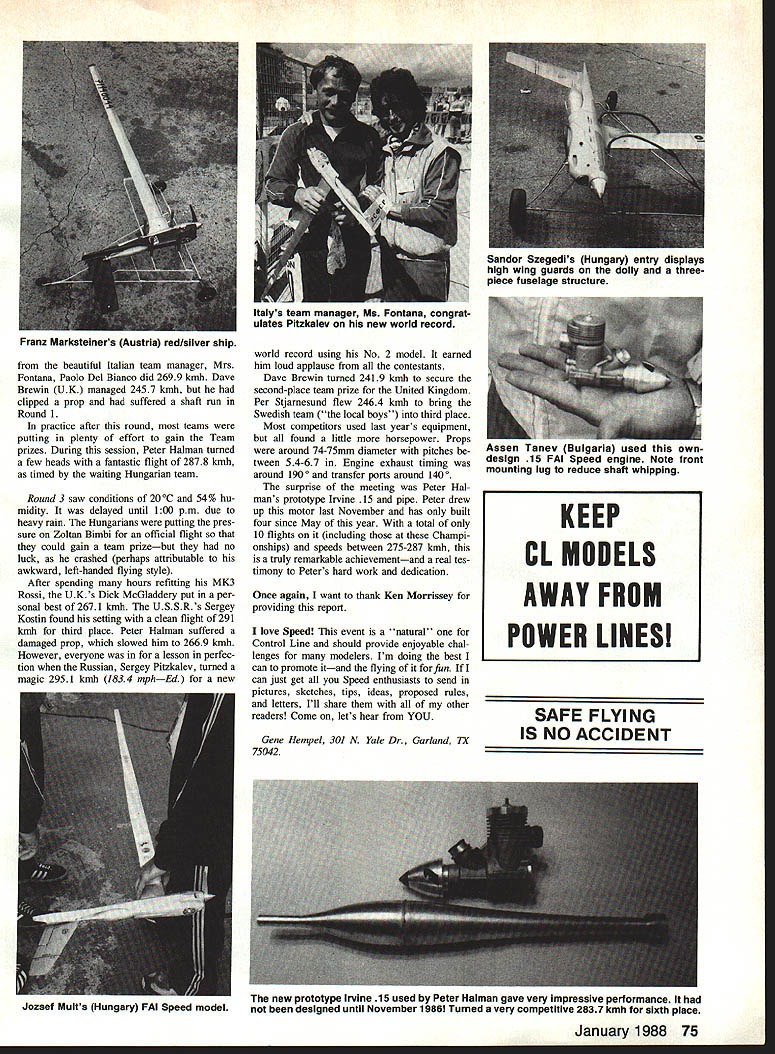
The surprise of the meeting was Peter Halman's prototype Irvine .15 and pipe. Peter drew up this motor last November and has only built four since May of this year. With a total of only 10 flights on it (including those at these Championships) and speeds between 275–287 km/h, this is a truly remarkable achievement — and a real testimony to Peter's hard work and dedication.
Most competitors used last year's equipment, but all found a little more horsepower. Props were around 74–75 mm diameter with pitches between 5.4–6.7 in. Engine exhaust timing was around 190° and transfer ports around 140°.
Once again, I want to thank Ken Morrissey for providing this report.
I love Speed! This event is a "natural" one for Control Line and should provide enjoyable challenges for many modelers. I'm doing the best I can to promote it — and the flying of it for fun. If I can just get all you Speed enthusiasts to send in pictures, sketches, tips, ideas, proposed rules, and letters, I'll share them with all of my other readers! Come on, let's hear from YOU.
Gene Hempel 301 N. Yale Dr., Garland, TX 75042.
Transcribed from original scans by AI. Minor OCR errors may remain.

