
Control Line: Speed
Gene Hempel 301 N. Yale Dr. Garland, TX 75042
Speed Scene
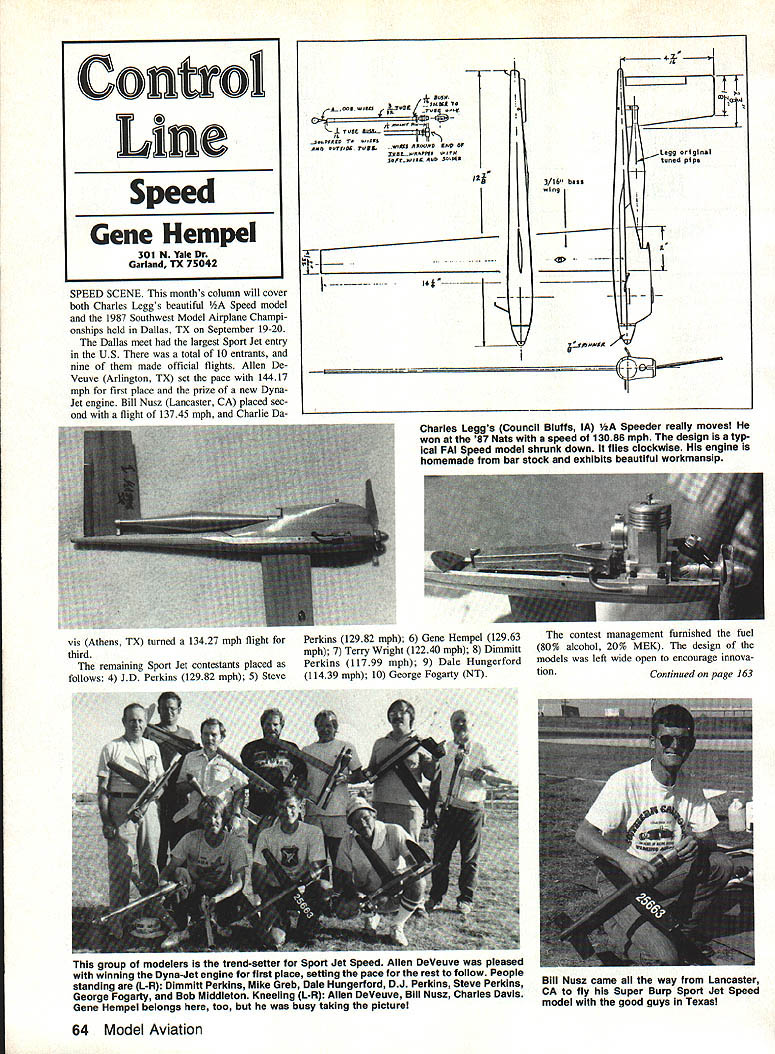
This month's column covers both Charles Legg's 1/2A Speed model and the 1987 Southwest Model Airplane Championships held in Dallas, TX on September 19–20.
The Dallas meet had the largest Sport Jet entry in the U.S. There were 10 entrants, and nine of them made official flights. Allen DeVeuve (Arlington, TX) set the pace with 144.17 mph for first place and the prize of a new Dyna-Jet engine. Bill Nusz (Lancaster, CA) placed second with 137.45 mph, and Charlie Davis (Athens, TX) turned a 134.27 mph flight for third.
Sport Jet results
- Allen DeVeuve — 144.17 mph (1st)
- Bill Nusz — 137.45 mph (2nd)
- Charlie Davis — 134.27 mph (3rd)
- J.D. Perkins — 129.82 mph
- Steve Perkins — 129.82 mph
- Gene Hempel — 129.63 mph
- Terry Wright — 122.40 mph
- Dimmitt Perkins — 117.99 mph
- Dale Hungerford — 114.39 mph
- George Fogarty — NT
Contest management furnished the fuel (80% alcohol, 20% MEK). The design of the models was left wide open to encourage innovation.
I have received numerous requests for copies not only from the United States but from all over the world. I recently acquired a set of plans for the World Finalist second-place finisher — the aircraft flown by the Dutch team of the Van Uden brothers. These plans are drawn on 10 mm squares so scaling is straightforward. The wording is in Swedish but can be easily translated into English.
One specific point I noticed: there is 2 mm of reflex built into the airfoil section at the elevator area. Several teams have been building in reflex so the pilot does not have to fly with up elevator.
I received this set of plans from Conrad Cloete of South Africa. If you would like a set, please send a self-addressed stamped envelope and I will forward a copy.
Internally connected flying wires
I have had inquiries about an easy method for installing internal wires in Rat or Scale Racers. Some competitors run the wires completely through the wing into the fuselage and mount them on buttons attached to the bellcrank. In recent years I have found this method somewhat cumbersome because it requires a hatch where the wing meets the fuselage, an area prone to contamination from fuel and exhaust that can lead to internal deterioration.
Instead, I attach lead-outs to the bellcrank and install the buttons on the ends of the lead-outs. By carefully constructing a rectangular installation area near the wingtip, about two inches inboard from the tip, the tedious task of installation is minimized; the hatch can be screwed down to contain both wires. Generally I put a spacer between the wires to prevent the buttons from touching or catching each other during rapid elevator movement, which could trip the fuel shutoff during racing. I enclose a photo of an internal line connection hatch which uses two small 2-56 screws to hold the hatch cover; the position prevents exhaust residue or refueling liquid from penetrating and soaking the wood.
In most cases, the line storage reel can be wound up and attached with a rubber band and a piece of foam rubber to the wingtip between rounds of racing. The wires can then be removed when the event is over.
This month I have enclosed some 1987 Nats photos showing the Fogg–Shahan team launching their Rat Racer. As always, your comments and questions are welcomed.
Observations from the Dallas meet
- The number of asymmetrical Jet models barely outweighed the standard upright type.
- Allen DeVeuve's winning model (upright) weighed only 22 oz with the engine — a low weight is the secret to speed for Jet models.
Record Ratio Speed results
(Registered performance listed as mph / % of record)
- Charlie Davis (Jet) — 205.63 / 96.57
- Bill Nusz (Jet) — 199.26 / 93.58
- Dimmie Perkins (Jet) — 197.94 / 92.96
- Gene Hempel (Jet) — 191.01 / 89.70
- Mike Greb (Formula 40) — 146.88 / 88.77
Sport .21 Speed
Participation in Sport .21 Speed was disappointing, with only three entries:
- Gene Hempel (Garland, TX) — 109.44 mph
- Mike Greb (Sulphur Springs, TX) — 98.00 mph
- Eric Tomachick (Fort Worth, TX) — 75.00 mph
1/2A Speed
Charles Legg of Council Bluffs, IA mailed a drawing of his 1/2A Speed model. The model placed first at the 1987 Nats (Lincoln, NE) with a top speed of 130.86 mph. It is essentially a European-type FAI Speed model scaled down.
- Materials: basswood throughout, except the stab is 3/32-in. hard balsa. A 1/4-in. aluminum plate is used in place of a full metal speed pan. J.B. Weld epoxy joins the plate to the basswood.
- Plate: serves as a mount for the monokote-type control horn. The wing is permanently mounted to the plate, eliminating the need to detach the control horn when servicing the model.
- Tank: slosh-mount fuel tank with rubber grommets via threaded studs mounted in wooden fuselage formers, allowing adjustable tank position. The fuel system is a suction/overflow design and seems to work well.
- Covering: entire model covered with 1/2-oz glass cloth.
- Wing: lifting-type airfoil at the root with 1° positive incidence; tip section is symmetrical with 0° incidence.
- Control gear: custom-made reverse monoline control unit mounted to the aluminum plate with a 1/4-in. wire pin. The model is balanced to hang about 1° nose out when suspended by the control line.
Charles indicated the model flies and glides well but tends to climb when the engine shuts off.
For more information write to: Charles Legg 11 Gayland Dr., Route 5, Box 58 Council Bluffs, IA 51501
Closing
The next edition of the "CL Speed" column will cover the development of the Dyna-Jet engine.
Transcribed from original scans by AI. Minor OCR errors may remain.

