
Control Line: Speed
Gene Hempel 301 N. Yale Dr. Garland, TX 75042
DYNA-JET HISTORY will be the subject of this month's column. It will be continued in my next (July) column. Gerald L. ("Jerry") Wiles (Bradford, OH) has graciously taken the task of writing an abridged history of this remarkable power plant for all modelers to enjoy. I have been asked many times how and who developed the Dyna-Jet engine.
"At long last, enclosed is my account of some of the history of the Dyna-Jet engine, as we discussed last year by telephone and letter. Also enclosed are a few pictures and descriptions pertinent to that account, selected and copied from the many 8 x 10 originals loaned to me by Bill Tenney and Jerry Nolin. Though Bill and Jerry checked my narrative for accuracy, the words and opinions are, for the most part, my own."
The Dyna-Jet and Its Manufacturers: An Abridged History
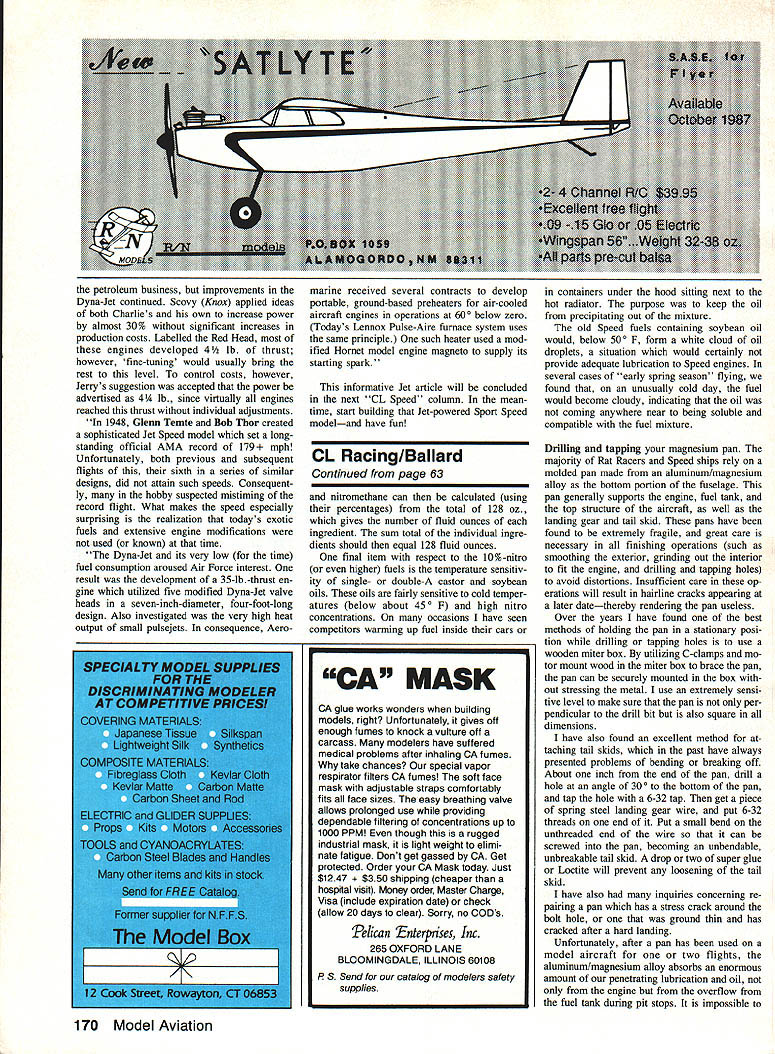
When William L. Tenney (WLT) formed the Aeromarine Company in 1945, his main purpose was to develop two-cycle engines of an advanced design. Charles B. Marks was his first employee, a cheerful, free-spirited man of many talents and a very casual outlook. Largely self-taught, Charlie performed many tasks at the company, including those of engineer, machinist, mechanic, draftsman, and others within his wide range of skills and interests. Incidentally, he was also extremely inquisitive.
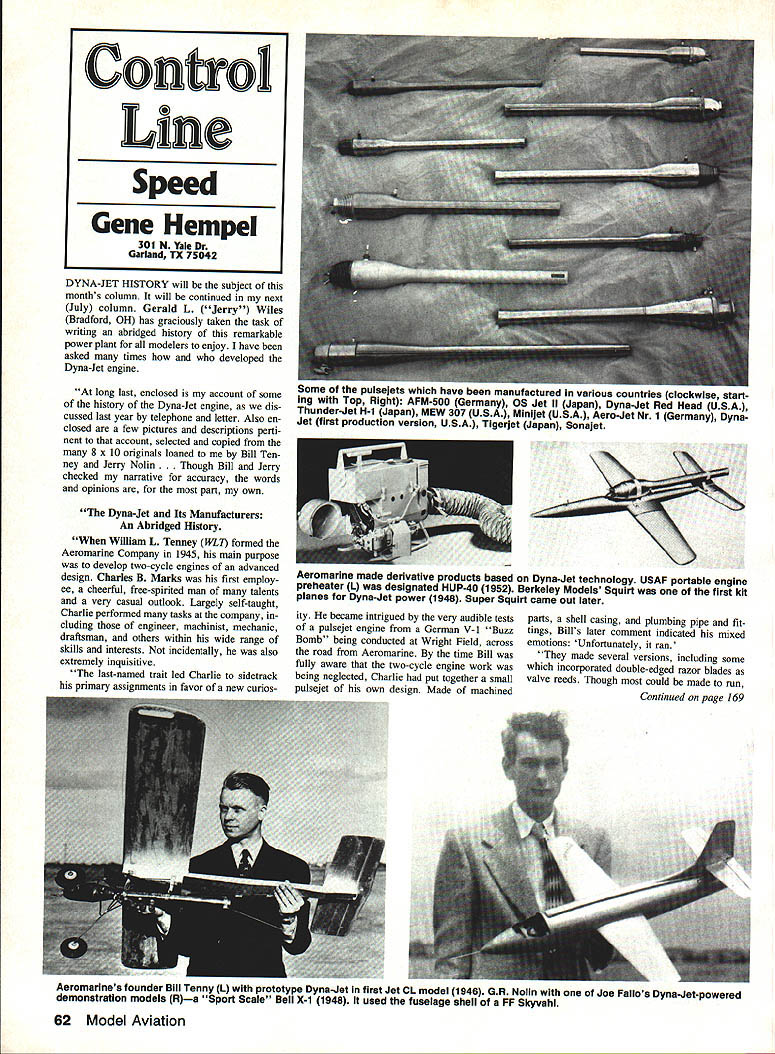
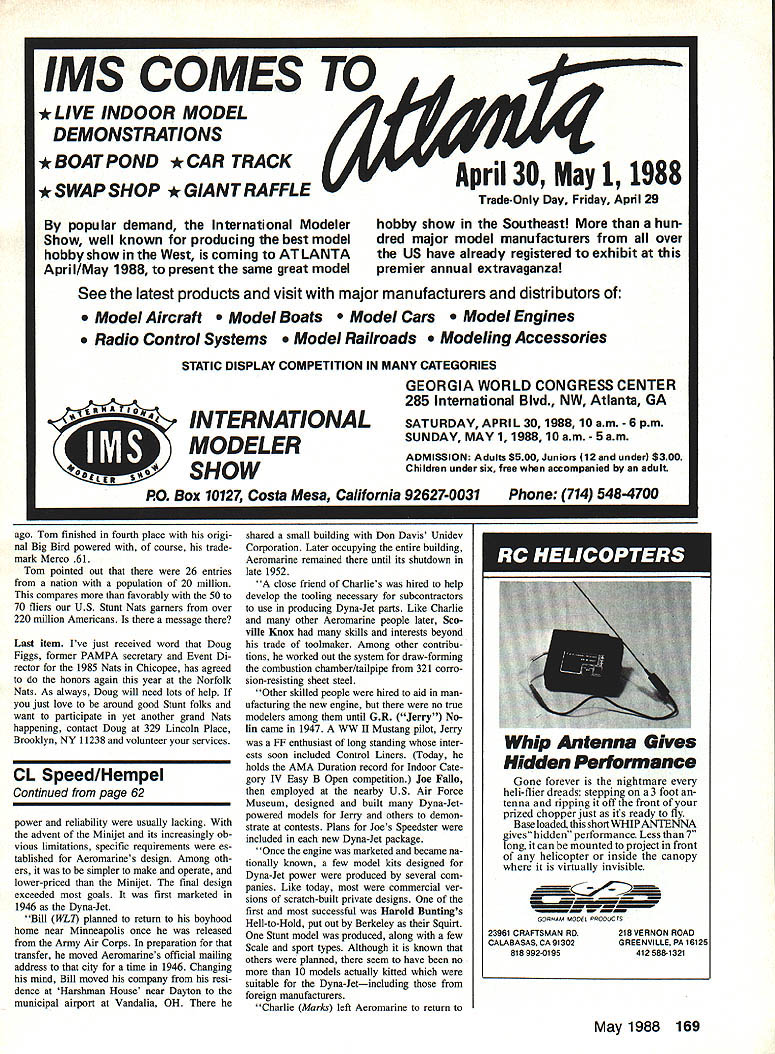
That inquisitive nature led Charlie to sidetrack his primary assignments in favor of a new curiosity. Aeromarine made derivative products based on Dyna-Jet technology. The USAF portable engine preheater was designated HUP-40 (1952). Berkeley Models' Squirt was one of the first kit planes for Dyna-Jet power (1948); the Super Squirt came out later.
Bill became intrigued by the very audible tests of a pulsejet engine from a German V-1 "Buzz Bomb" being conducted at Wright Field, across the road from Aeromarine. By the time Bill was fully aware that the two-cycle engine work was being neglected, Charlie had put together a small pulsejet of his own design. Made of machined parts, a shell casing, and plumbing pipe and fittings, Bill's later comment indicated his mixed emotions: "Unfortunately, it ran."
They made several versions, including some which incorporated double-edged razor blades as valve reeds. Though most could be made to run, power reliability was usually lacking. With the advent of the Minijet and its increasingly obvious limitations, Aeromarine established specific requirements for a new design. Among others, a simpler-to-make, easier-to-operate, lower-priced Minuet final design exceeded goals and was first marketed.
Later Improvements
Improvements in the Dyna-Jet continued. Scovy (Knox) applied ideas of both Charlie's and his own to increase power by almost 30% without significant increases in production costs. Labeled the Red Head, most of these engines developed 4 1/4 lb of thrust; with "fine-tuning" the rest would usually reach this level. To control costs, Jerry's suggestion was accepted that the power be advertised as 4 1/4 lb, since virtually all engines reached this thrust without individual adjustments.
Notable Speed Achievement
In 1948, Glenn Temte and Bob Thor created a sophisticated Jet Speed model which set a long-standing official AMA record of 179+ mph. Unfortunately, both previous and subsequent flights of this, their sixth in a series of similar designs, did not attain such speeds. Consequently, many in the hobby suspected mistiming of the record flight. What makes the speed especially surprising is the realization that today's exotic fuels and extensive engine modifications were not used (or known) at that time.
Air Force Interest and Contracts
The Dyna-Jet and its very low (for the time) fuel consumption aroused Air Force interest. One result was the development of a 35-lb-thrust engine which utilized five modified Dyna-Jet valve heads in a seven-inch-diameter, four-foot-long design. Also investigated was the very high heat output of small pulsejets. In consequence, Aeromarine received several contracts to develop portable, ground-based preheaters for air-cooled aircraft engines in operations at 60° below zero. (Today's Lennox Pulse-Aire furnace system uses the same principle.) One such heater used a modified Hornet model engine magneto to supply its "starting spark."
This informative Jet article will be concluded in the next "CL Speed" column. In the meantime, start building that jet-powered Sport Speed model—and have fun!
Miscellaneous Notes
Tom finished in fourth place with his original Big Bird powered, of course, by his trademark Merco .61. Tom pointed out that there were 26 entries from a nation with a population of 20 million. This compares more than favorably with the 50 to 70 fliers our U.S. Stunt Nats garners from over 220 million Americans. Is there a message there?
I've just received word that Doug Figgs, former PAMPA secretary and Event Director for the 1985 Nats in Chicopee, has agreed to do the honors again this year at the Norfolk Nats. As always, Doug will need lots of help. If you just love to be around good stunt folks and want to participate in yet another grand Nats happening, contact Doug at 329 Lincoln Place, Brooklyn, NY 11238 and volunteer your services.
Transcribed from original scans by AI. Minor OCR errors may remain.

