
Control Line: Speed
Gene Hempel
301 N. Yale Dr. Garland, TX 75042
Before continuing with the final portion of the history of the Dyna-Jet engine, I wish to thank the modelers who wrote me notes stating how they enjoyed my last (May) Speed column. These responses can be segregated by the major modeling interest of the writers approximately as follows:
- 80% from RCers
- 18% general interest
- 2% from the Speed fraternity
So, folks — you don't have to fly C/L Speed to write in! I welcome all inquiries from modelers interested in any aspect of the hobby.
Please remember the top-rated Speed contests to be held in Dallas, TX:
- June 25–26, 1988
- September 3–4, 1988
For more information, mail a SASE to me at the address given at the top of my Speed column.
In addition, Gary Frost (of Combat fame), along with the LaFayette Esquadrille Model Club, is having a Speed meet in St. Louis, MO on May 1, 1988.
Another excellent contest is the Northwest Regionals in Eugene, OR on May 28–29, 1988.
Without further rhetoric, let's move on to the conclusion of the Dyna-Jet article by Jerry Wiles.
Conclusion of the Dyna-Jet article (Jerry Wiles)
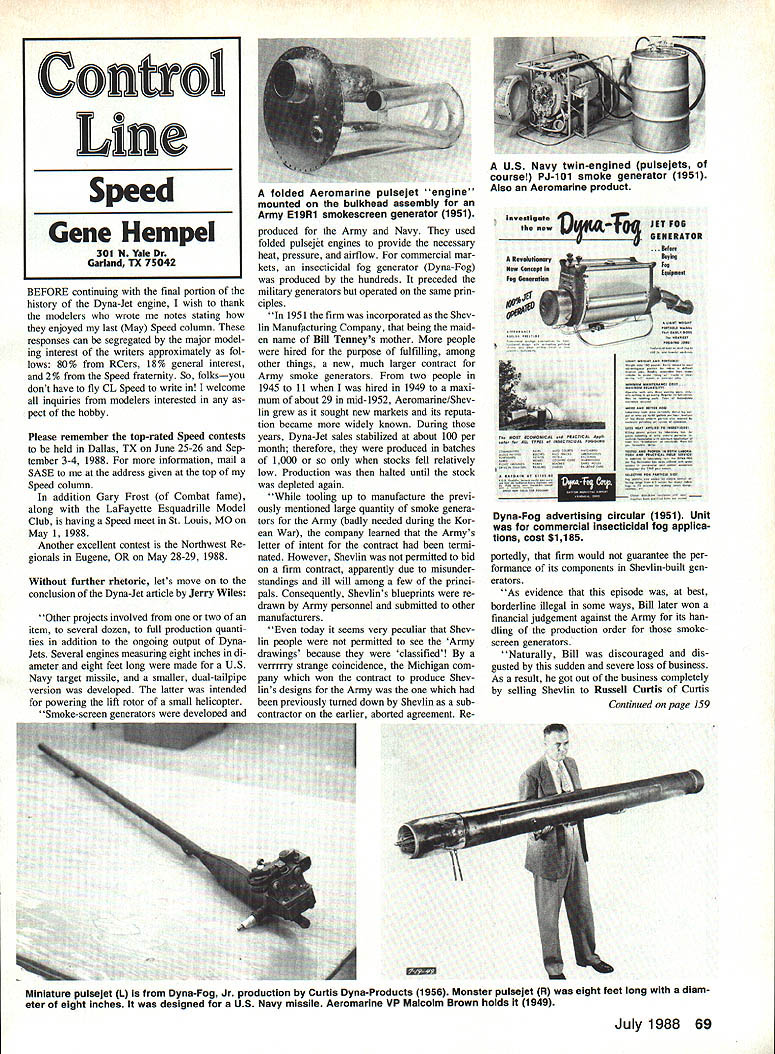
Other projects involved production runs from one or two of an item to several dozen, to full production quantities. In addition to the ongoing output of Dyna-Jets, several engines measuring eight inches in diameter and eight feet long were made for a U.S. Navy target missile, and a smaller, dual-tailpipe version was developed. The latter was intended for powering the lift rotor of a small helicopter.
Smoke-screen generators were developed and produced for the Army and Navy. They used folded pulsejet engines to provide the necessary heat, pressure, and airflow. For commercial markets, an insecticidal fog generator (Dyna-Fog) was produced by the hundreds. It preceded the military generators but operated on the same principles.
In 1951 the firm was incorporated as the Shevlin Manufacturing Company, that being the maiden name of Bill Tenney's mother. More people were hired for the purpose of fulfilling, among other things, a new, much larger contract for Army smoke generators. From two people in 1945 to 11 when work was hired in 1949 to a maximum of about 29 in mid-1952, Aeromarine/Shevlin grew as it sought new markets and its reputation became more widely known.
During those years, Dyna-Jet sales stabilized at about 100 per month; therefore they were produced in batches of roughly 1,000 only when stocks fell relatively low. Production was halted until stock depleted again.
While tooling up to manufacture the previously mentioned large quantity of smoke generators for the Army (badly needed during the Korean War), the company learned that the Army's letter of intent for the contract had been terminated. However, Shevlin was not permitted to bid on the firm contract, apparently due to misunderstandings and ill will among a few principals. Consequently, Shevlin's blueprints were redrawn by Army personnel and submitted to other manufacturers.
Even today it seems very peculiar that Shevlin people were permitted to see the Army drawings because they were "classified!" By a very strange coincidence, the Michigan company which won the contract to produce Shevlin's designs for the Army was the one which had been previously turned down by Shevlin as a subcontractor on the earlier, aborted agreement. Recently Shevlin brought suit and won a financial judgment against the Army for its handling of the production order for smoke-screen generators.
Naturally, Bill was discouraged and disgusted by this sudden and severe loss of business. As a result, he got out of the business completely by selling Shevlin to Russell Curtis of Curtis Aeromarine Products. Curtis rehired Paul Frank, Aeromarine/Shevlin's chief engineer, and helped transfer material and technology to Bedford, located in south-central Indiana, where eight Shevlin people (Paul included) went to work.
CL Speed/Hempel
At CAD, the Dyna-Fog and Dyna-Jet were returned to production after a long delay, and research was begun on smaller versions of both. Additionally, a pulsejet-powered steam generator was being considered. The drafting department was expanded by the hiring of a man who was working on his engineering degree. He was also familiar with the Dyna-Jet, having won many Jet Speed events in previous (and subsequent) years.
I refer to James Richmond, currently very active and successful in national and international indoor free flight competition.
A year and a half after our move to Bedford, only Paul Frank remained; the others of us had left for various reasons. Prototype small Dyna-Fog machines had been fabricated and their refinement begun in preparation for quantity production. However, all other research on pulsejet projects had been halted, including that on the smaller Dyna-Jet. Several years later, ironically, the modestly successful Japanese-made Tigerjet was placed on sale in this country.
A few years later, Curtis moved his company to Westfield, just north of Indianapolis, and changed the company name to Curtis Dyna-Products. Presumably this was an acknowledgement of the renewed importance to his company of the creations and ideas of Aeromarine and Shevlin. It remains so named today, although Mr. Curtis passed away a few years ago.
I am unaware of all the current projects and products of Curtis Dyna-Products, but I do know of extensive changes in the Dyna-Fog series. Only the Dyna-Jet is the same as years ago. It is probable that improved techniques have been adopted in some production steps, but so far as I can learn, every item in every Dyna-Jet ever produced is interchangeable with its counterpart in any other! Indeed, most of the parts in foreign clones (at least three of them) are also fully interchangeable—even to their use of U.S. standard threads in a "metricized" country! This, after 40 years of almost continuous production.
These days, successful competitors in Jet Speed extensively modify their engines. Among other things, they concoct fuel blends which "make a bigger bang" than does gasoline in this application. It seems safe to say, however, that as manufactured and properly used, the Dyna-Jet remains one of the easiest-starting, most consistent in performance, most reliable, safest, and most economical to operate of any miniature power plant ever placed in production!
Once again, I want to thank Gerald L. (Jerry) Wiles for sharing this fascinating bit of personal history with us.
I love those cards and letters (and photos) you send!
Transcribed from original scans by AI. Minor OCR errors may remain.

