
Control Line: Speed
Gene Hempel 301 N. Yale Dr. Garland, TX 75042
Getting started
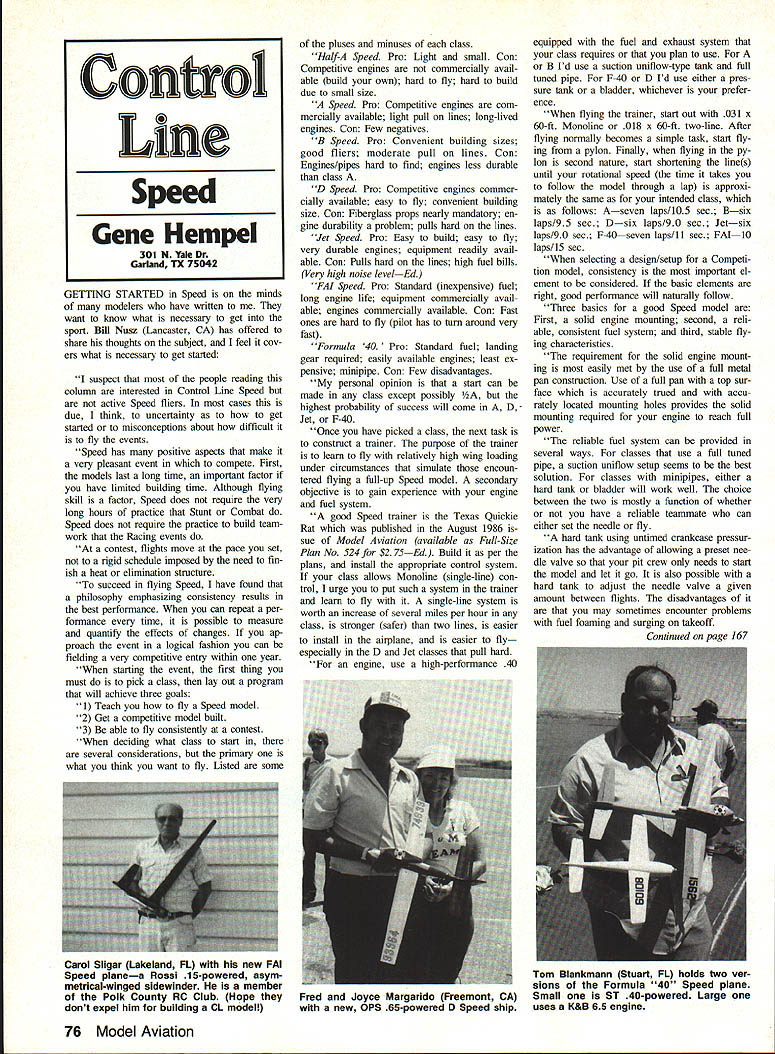
Getting started in Speed is on the minds of many modelers who have written to me. They want to know what is necessary to get into the sport. Bill Nusz (Lancaster, CA) has offered to share his thoughts on the subject, and I feel it covers what is necessary to get started.
I suspect that most of the people reading this column are interested in Control Line Speed but are not active Speed fliers. In most cases this is due, I think, to uncertainty as to how to get started or to misconceptions about how difficult it is to fly the events.
Speed has many positive aspects that make it a very pleasant event in which to compete. First, the models last a long time, an important factor if you have limited building time. Although flying skill is a factor, Speed does not require the very long hours of practice that Stunt or Combat do. Speed does not require the build teamwork that the Racing events do.
At a contest, flights move at the pace you set, not to a rigid schedule imposed by the need to finish a heat or elimination structure.
To succeed in flying Speed, I have found that a philosophy emphasizing consistency results in the best performance. When you can repeat a performance every time, it is possible to measure and quantify the effects of changes. If you approach the event in a logical fashion you can be fielding a very competitive entry within one year.
When starting the event, the first thing you must do is to pick a class, then lay out a program that will achieve three goals:
- Teach you how to fly a Speed model.
- Get a competitive model built.
- Be able to fly consistently at a contest.
Choosing a class
When deciding what class to start in, there are several considerations, but the primary one is what you think you want to fly. Listed below are some of the pluses and minuses of each class.
- Half-A Speed
Pro: Light and small. Con: Competitive engines are not commercially available (you must build your own); hard to fly; hard to build due to small size.
- A Speed
Pro: Competitive engines are commercially available; light pull on lines; long-lived engines. Con: Few negatives.
- B Speed
Pro: Convenient building sizes; good fliers; moderate pull on lines. Con: Engines/pipes hard to find; engines less durable.
- C Speed
Pro: Competitive engines commercially available; easy to fly; convenient building size. Con: Fiberglass props nearly mandatory; engine durability a problem; pulls hard on the lines.
- Jet Speed
Pro: Easy to build; easy to fly; very durable engines; equipment readily available. Con: Pulls hard on the lines; high fuel bills; very high noise level.
- FAI Speed
Pro: Standard (inexpensive) fuel; long engine life; equipment commercially available; engines commercially available. Con: Fast ones are hard to fly (pilot has to turn around very fast).
- Formula 40 (F-40)
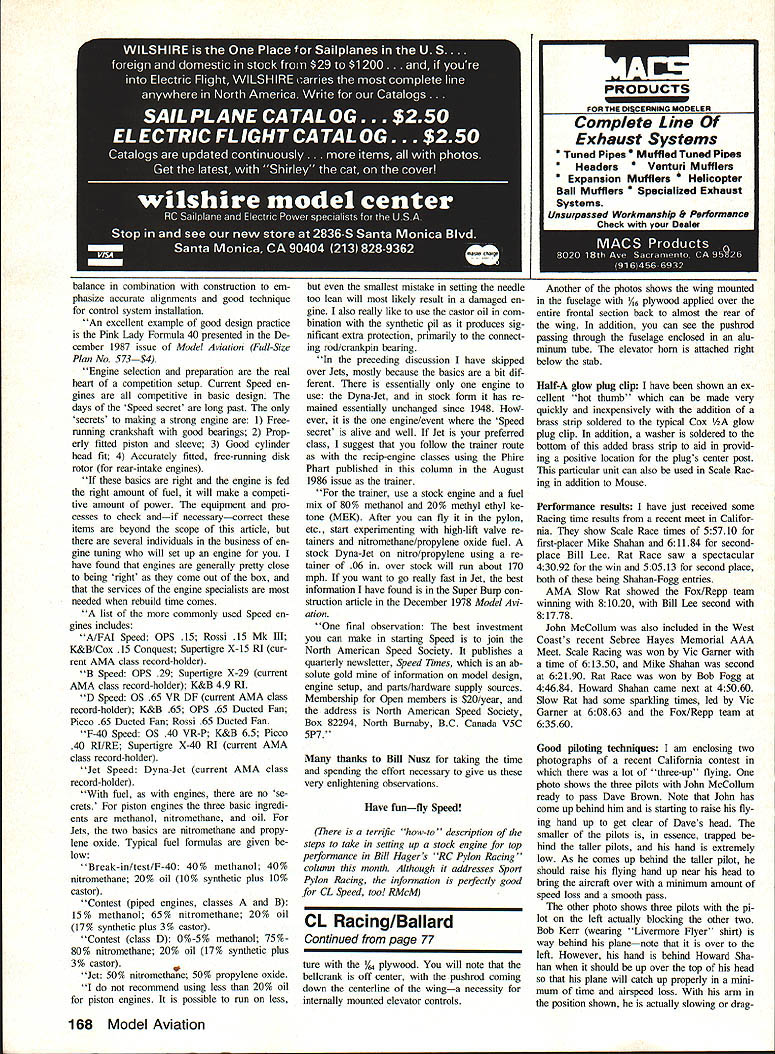
Pro: Standard fuel; landing gear required; easily available engines; least expensive minipipe. Con: Few disadvantages.
My personal opinion is that a start can be made in any class except possibly 1/2A; the highest probability of success will come in D, Jet, or F-40.
Trainer
Once you have picked a class, the next task is to construct a trainer. The purpose of the trainer is to learn to fly with relatively high wing loading under circumstances that simulate those encountered flying a full-up Speed model. A secondary objective is to gain experience with your engine and fuel system.
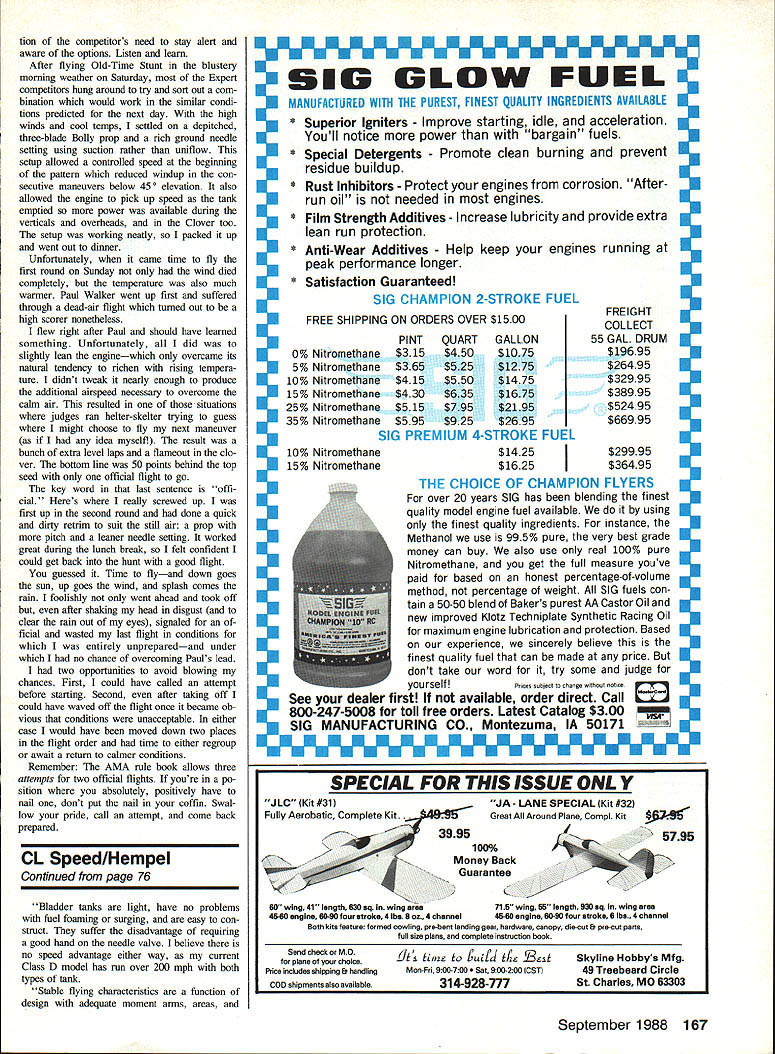
A good Speed trainer is the Texas Quickie Rat, which was published in the August 1986 issue of Model Aviation (available as Full-Size Plan No. 524 for $2.75). Build it as per the plans, and install the appropriate control system. If your class allows Monoline (single-line) control, I urge you to put such a system in the trainer and learn to fly with it. A single-line system is worth an increase of several miles per hour in airspeed, is stronger (safer) than two lines, is easier to install in the airplane, and is easier to fly—especially in the D and Jet classes that pull hard.
For an engine, use a high-performance .40 equipped with the fuel and exhaust system that your class requires or that you plan to use. For A or B I'd use a suction uniflow-type tank and a full tuned pipe. For F-40 or D I'd use either a pressure tank or a bladder, whichever is your preference.
Flying practice
When flying the trainer, start out with .031 in x 60 ft Monoline or .018 in x 60 ft two-line. After flying normally becomes a simple task, start flying from a pylon. Finally, when flying in the pylon is second nature, start shortening the lines until your rotational speed (the time it takes you to follow the model through a lap) is approximately the same as for your intended class, which is as follows:
- A: seven laps / 10.5 sec.
- B: six laps / 9.5 sec.
- C: six laps / 9.0 sec.
- D: six laps / 9.0 sec.
- Jet: six laps / 9.0 sec.
- F-40: seven laps / 11 sec.
- FAI: 10 laps / 15 sec.
Design and setup
Competition model consistency is an important element to be considered. If the basic elements are right, good performance will naturally follow. Three basics of a good Speed model:
- Solid engine mounting.
- Reliable, consistent fuel system.
- Stable flying characteristics.
The requirement for solid engine mounting is most easily met by the use of a full metal pan construction. Use a full pan with a top surface accurately trued and with accurately located mounting holes. This provides the solid mounting required for your engine to reach full power.
Bladder tanks are light, have no problems with fuel foaming or surging, and are easy to construct. They suffer the disadvantage of requiring a good hand on the needle valve. I believe there is no speed advantage either way, as my current Class D model has run over 200 mph with both types of tank.
Stable flying characteristics are a function of design with adequate moment arms, areas, and balance.
Common Speed engines
A list of the more commonly used Speed engines includes:
- A Speed: OPS .15; Rossi .15 Mk III; K&B/Cox .15 Conquest; Super Tigre X-15 R.I. (current AMA class record-holder).
- B Speed: OPS .29; Super Tigre X-29 (current AMA class record-holder); K&B 4.9 R.I.
- D Speed: OS .65 VR D.F. (current AMA class record-holder); K&B .65; OPS .65 ducted fan; Picco .65 ducted fan; Rossi .65 ducted fan.
- .40 R.I./F-40: Super Tigre X-40 R.I. (current AMA class record-holder).
- Jet Speed: Dyna-Jet (current AMA class record-holder).
Fuel
With fuel, as with engines, there are no "secrets." For piston engines the three basic ingredients are methanol, nitromethane, and oil. For jets, the two basic ingredients are nitromethane and propylene oxide. Typical fuel formulas are given below.
- Break-in/test/F-40: 40% methanol; 40% nitromethane; 20% oil (10% synthetic plus 10% castor).
- Contest (piped engines, classes A and B): 15% methanol; 65% nitromethane; 20% oil (17% synthetic; 3% castor).
- Contest (class D): 0%–5% methanol; 75%–80% nitromethane; 20% oil (17% synthetic; 3% castor).
- Jet: 50% nitromethane; 50% propylene oxide.
I do not recommend using less than 20% oil for piston engines. It is possible to run on less, but even the smallest mistake in setting the needle too lean will most likely result in a damaged engine. I also like to use castor oil in combination with synthetic oil as it produces significant extra protection, primarily to the connecting rod/crankpin bearing.
Jets
In the preceding discussion I have skipped over jets, mostly because the basics are a bit different. There is essentially only one engine to use: the Dyna-Jet, and in stock form it has remained essentially unchanged since 1948. However, it is the one engine/event where the "speed secret" is alive and well.
If Jet is your preferred class, I suggest that you follow the trainer route as with the reciprocating-engine classes using the Phire Hart published in this column in the August 1986 issue as the trainer.
For the trainer, use a stock engine and a fuel mix of 80% methanol and 20% methyl ethyl ketone (MEK). After you can fly it in the pylon, etc., start experimenting with high-lift valve re-stroking and nitromethane/propylene oxide fuel. A stock Dyna-Jet on nitro/propylene oxide will run about 170 mph. If you want to go really fast in Jet, the best information I have found is in the "Super Bump" article in the December 1978 Model Aviation.
Final observation and resources
One final observation: The best investment you can make in starting Speed is to join the North American Speed Society. It publishes a quarterly newsletter, Speed Times, which is an absolute gold mine of information on model design, engine setup, and parts/hardware supply sources. Open membership is $20/year. Address: North American Speed Society P.O. Box 82294 North Burnaby, B.C., Canada V5C 5P7
Many thanks to Bill Nusz for taking the time and spending the effort necessary to give us these very enlightening observations.
Have fun—fly Speed!
(There is a terrific "how-to" description of the steps to take in setting up a stock engine for top performance in Bill Hager's "RC Pylon Racing" column this month. Although it addresses Sport Pylon Racing, the information is perfectly good for CL Speed, too. — RMC)
Transcribed from original scans by AI. Minor OCR errors may remain.

