
Control Line: Speed
Gene Hempel
301 N. Yale Dr. Garland, TX 75042
Editor's note
Author Gene Hempel attended the World Championships as a team supporter. — RMcM
Overview
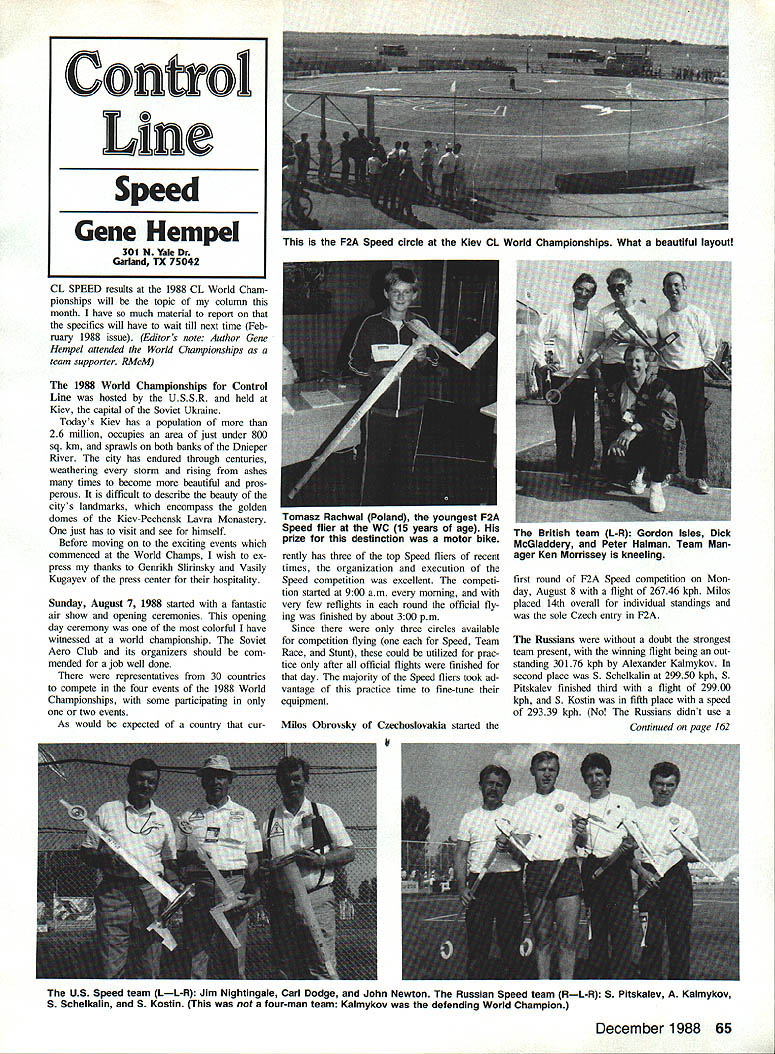
CL Speed results at the 1988 Control Line World Championships are the topic of this column. The 1988 World Championships for Control Line were hosted by the U.S.S.R. and held in Kiev, the capital of the Soviet Ukraine.
Kiev has a population of more than 2.6 million, occupies an area of just under 800 sq. km., and sprawls on both banks of the Dnieper River. The city has endured through centuries and is known for landmarks such as the Kiev-Pechersk Lavra Monastery. Before describing the on-field events, I wish to express my thanks to Genrikh Slirinsky and Vasily Kugayev of the press center for their hospitality.
Sunday, August 7, 1988, began with a fantastic air show and colorful opening ceremonies. The Soviet Aero Club and its organizers should be commended for a job well done. There were representatives from 30 countries competing in the four events of the championships, with some participants entered in only one or two events.
Competition format and scheduling
- The Speed competition was held every morning starting at 9:00 a.m.
- With very few reflights in each round, official flying typically finished by about 3:00 p.m.
- Only three circles were available for competition (one each for Speed, Team Race, and Stunt). Practice on the circles was allowed only after official flights were finished for the day, and most Speed fliers used that time to fine-tune equipment.
F2A Speed highlights
- Milos Obrovsky (Czechoslovakia) opened the first round on Monday, August 8, with a flight of 267.46 kph. He placed 14th overall and was the sole Czech entry in F2A.
- The Russians were the strongest team present. Top Russian flights included:
- Alexander Kalmykov — 301.76 kph (winning flight)
- S. Schelkalin — 299.50 kph (second)
- S. Pitskalev — 299.00 kph (third)
- S. Kostin — 293.39 kph (fifth)
- The Hungarians placed well as a team (second overall) with individual placings fourth, sixth, and 12th.
- The Chinese team showed superb consistency and finished third overall. Individual Chinese placings:
- Hibo Ding — 281.25 kph (11th)
- Shizu Sun — 276.92 kph (13th)
- Lianli Bi — 275.23 kph (16th)
- The Polish team placed fifth overall. Individual Polish placings:
- Andrej Rachwal — 282.13 kph (10th)
- Tomasz Rachwal — 272.73 kph (18th) — Tomasz, age 15, was the youngest contestant and won a Riga motorbike
- Tomasz Hojninac — 267.45 kph (23rd)
- The French team had:
- Jean Magne — 274.18 kph (17th)
- Roland Jarry — 254.23 kph (32nd)
- The United Kingdom team placed sixth overall. Individual UK placings:
- Peter Hallam — 285.49 kph (7th) flying a new model completed three weeks before the championships, powered by an Irvine .15 racing engine
- Gordon Isles — 267.45 kph (24th)
- Dick McGladdery — 266.66 kph (25th)
- The top American placings and team standing:
- Carl Dodge — 283.10 kph (9th) — top American
- Jim Nightingale — 276.50 kph (15th)
- John Newton — 270.47 kph (21st)
- The U.S. finished fourth in team standings.
Equipment and techniques
- The Russians used "minimal"-style models about 38 to 40 in. wingspan. Both Pitskalev and Kalmykov used a construction technique in which the rear fuselage and horizontal stabilizer are built onto the half-pan, with access to the pan via a two-part top cowl.
- All Russian models showed careful attention to cooling the header section of the tuned pipe. They used carbon-fiber propellers with varying pitch — approximately 6.0 in. at the hub tapering to 4.5 in. at the tip.
- Kalmykov and Pitskalev used a threaded collar to hold the head insert; Pitskalev tightened his collar very firmly. The cylinder heads featured replaceable glow elements. Tuned pipes were thick-walled aluminum of large volume with a maximum inside diameter of 30 mm.
- The Hungarians flew asymmetric, outboard-sidewinder models with narrow-chord tails and long wings of about 4 ft. span. They used wide-chord, thick-section maple propellers. Josef Mult and Sandor Serenyi flew the new Moki S12 front-induction, rear-exhaust engine, which resembles a Rossi MK3.
- The Polish and other competitors also used modified Rossi engines and large-volume pipes in some cases.
- Carl Dodge’s engine setup was among the most individual at the championships: a radical induction arrangement and the use of a glow plug instead of a head insert. He demonstrated and stripped the engine for fellow competitors, drawing a crowd.
Conclusion
Congratulations to all contestants for impressive performances. These championships showed that aeromodeling is a sport that unites competitors from many countries and that, no matter how good we are, we all enjoy talking about our airplanes. The closing banquet was a memorable occasion for saying goodbye and swapping patches and souvenirs. This championship will hold fond memories for me in meeting old friends and making new ones.
My next Speed column will cover some of the technical issues associated with FAI Speed.
(Note: Tables of individual and team performances are included in the "Competition Newsletter" section of this month's issue.)
Transcribed from original scans by AI. Minor OCR errors may remain.

