
Control Line: Speed
Gene Hempel 301 N. Yale Dr. Garland, TX 75042
Overview
Technical information on the FAI Speed models and engines used at the 1988 CL World Championships will be my topic this month and continuing for some time. I will discuss the Russian equipment first, since they were the dominant force at the World Champs.
Russian team — general
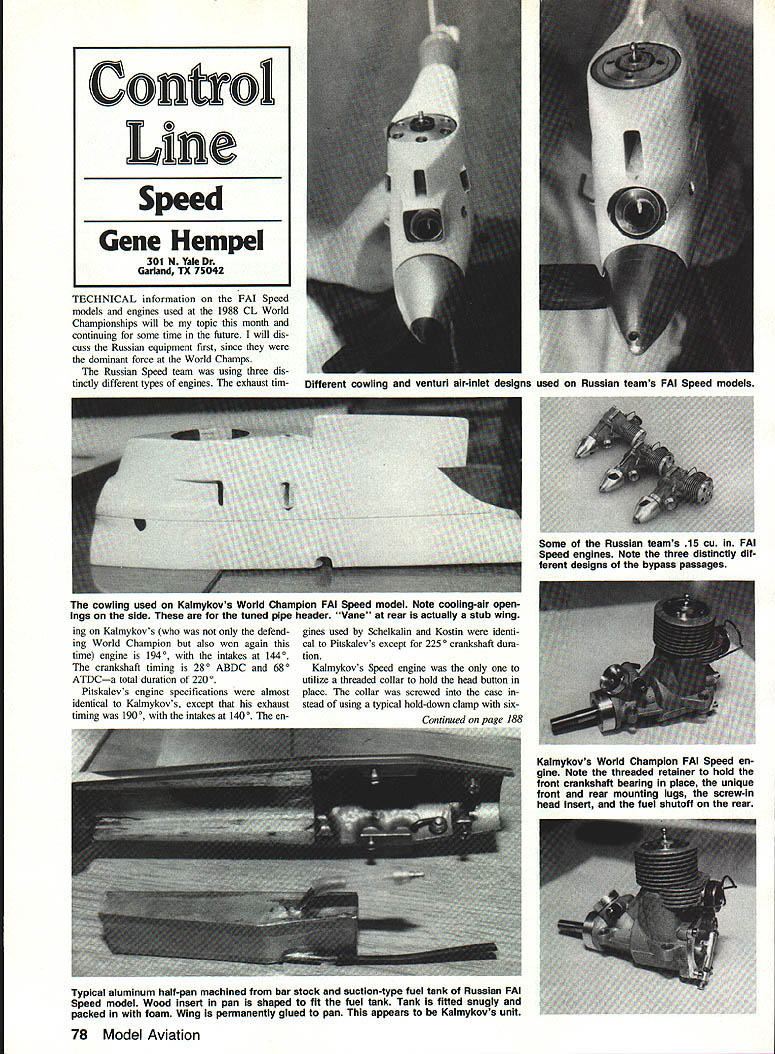
The Russian Speed team was using three distinctly different types of engines. There were variations in exhaust and intake timing, crankshaft timing/duration, piston/cylinder construction, pipe design, propellers, and fuel-pan/tank arrangements. They did not try to find one universal prop/engine combination; each prop was matched to a particular engine.
Engine timing and crankshaft
- Kalmykov (defending World Champion and winner in 1988):
- Exhaust timing: 194°
- Intake timing: 144°
- Crankshaft timing: 28° ABDC and 68° ATDC — total duration 220°
- Pitskalev:
- Exhaust timing: 190°
- Intake timing: 140°
- Other specs almost identical to Kalmykov
- Schelkalin and Kostin:
- Engines identical to Pitskalev’s except for a crankshaft duration of 225°
Some Russian teams ran 1.5 cu. in. FAI Speed engines.
Engine construction and features
- Kalmykov’s Speed engine:
- Used a threaded collar to hold the head button in place (screwed into the case instead of a six-screw hold-down clamp).
- Used a threaded retainer to hold the front crankshaft bearing.
- Featured unique front and rear mounting lugs and a screw-in head.
- An insert fuel shutoff was located at the rear bolt pattern.
- A four-point spanner wrench was used to remove the head for replacement of the glow plug or bearings.
- Cylinder sleeves were press-fit into the crankcase; removal required heating the case and a special tool.
- Some engines used ABC piston/cylinder assemblies (aluminum/bronze/chrome); others used AAC (aluminum/aluminum/chrome). Note three distinctly different designs of bypass passages.
Exhausts and tuned pipes
All Russian models used thick-wall aluminum tuned pipes of large volume with these typical dimensions:
- Maximum inside diameter: 30 mm
- Overall length: 290 mm
- Distance from plug to muffler connection: 190 mm
- Tuned-pipe chamber length: 70 mm
- Tuned-pipe header: 20 mm (the inside diameter at the header was smaller)
Propellers
All Russian models utilized carbon-fiber single-blade propellers. There was a variety of prop choices; for example, Kalmykov’s prop measured about 3.03 in. in length with a pitch at station one of roughly 5.5 in.
Fuel pans and tanks
- All fuel pans on the Russian models were machined from bar stock and then anodized.
- Typical designs included an aluminum half-pan machined from bar stock with a suction-type fuel tank.
- The Russian FAI Speed model often used a wood insert pan shaped to fit the fuel tank; the tank was fitted snugly and packed with foam.
- The Pitskalev and Kalmykov tanks had similar construction with snug-fitting inserts and foam packing.
- Tanks were not mounted in RTV (room-temperature vulcanizing silicone) to reduce vibration; instead, foam was stuffed around them. The tanks fit quite snugly into the model.
Air intakes and cowlings
- Cowlings were constructed in two parts with careful attention to cooling the header section of the tuned pipe.
- Carburetor air-intake designs varied: some models had round openings, others had variations of square openings.
Wings and control lines
- Wings were constructed from .010 aluminum sheet.
- Wingspan varied between 38 and 40 in.
- Wing chord at the fuselage was typically 55 mm, tapering to 30 mm at the tip.
- Wings were glued in place permanently; there was no way to remove the control lines from the bellcrank without removing the wing.
- The Russians reported they never had to replace a line on any of their Speed models.
Miscellaneous
- Note: RTV refers to room-temperature vulcanizing silicone material (examples available in the U.S. from GE and Dow-Corning).
Next column
My next Speed column will cover the Hungarian and British equipment.
Transcribed from original scans by AI. Minor OCR errors may remain.

