
Control Line: Speed
Sam Snyer
IN THE NEXT few months a portion of this column will attempt to impart the information necessary for a Junior or Senior to develop the skill, cunning and dexterity necessary to successfully compete nationally in Control Line Speed circles.
This first segment is devoted to the reliability of the pilot. The term "reliability" is an elusive devil and it requires very meticulous attention to detail. In order to gain this reliability requires a step-by-step process in the development of your equipment, techniques and knowledge.
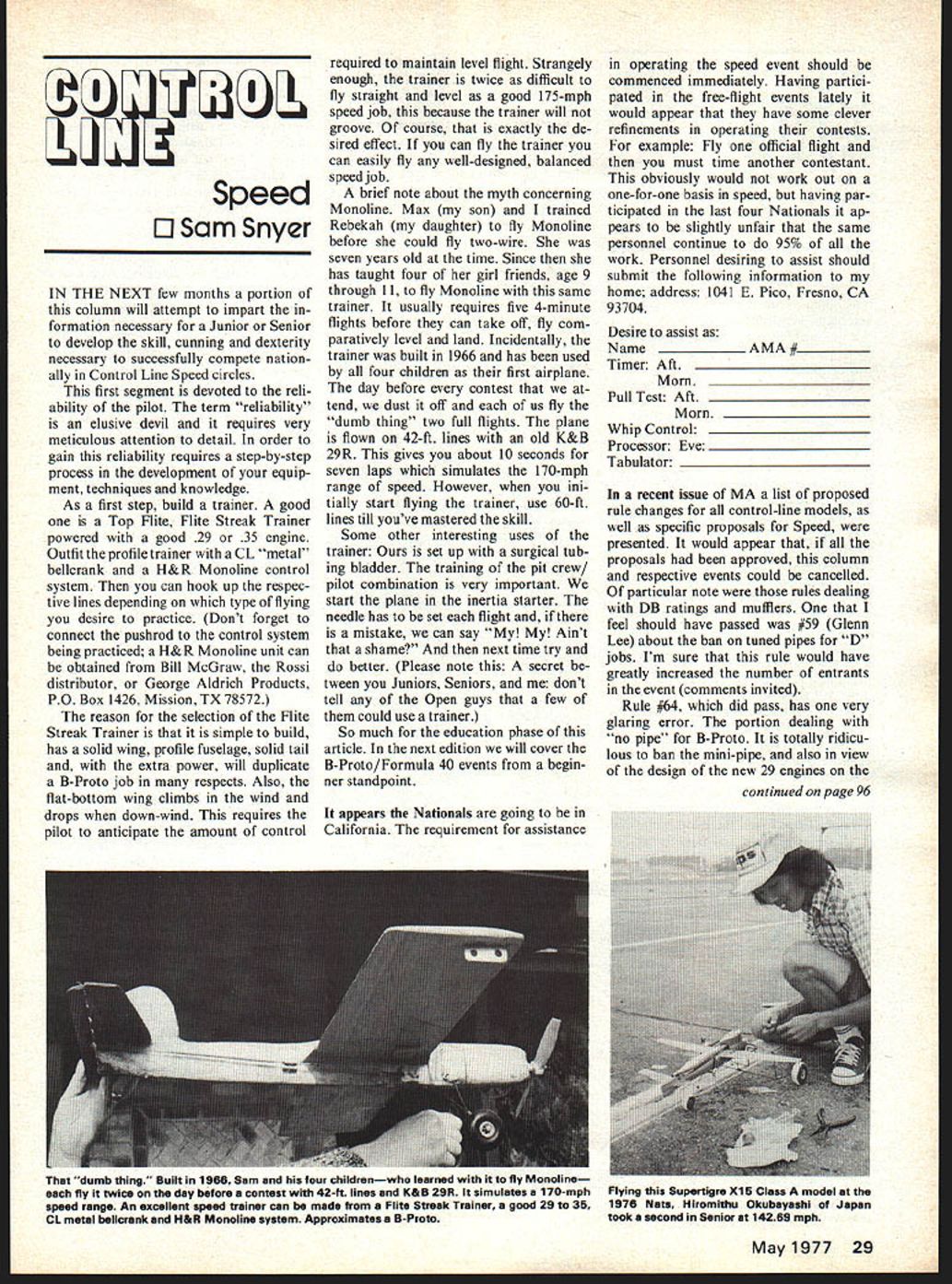
As a first step, build a trainer. A good one is a Top Flite, Flite Streak Trainer powered with a good .29 or .35 engine. Outfit the profile trainer with a CL "metal" bellcrank and a H & R Monoline control system. Then you can hook up the respective lines depending on which type of flying you desire to practice. (Don't forget to connect the pushrod to the control system being practiced; a H & R Monoline unit can be obtained from Bill McGraw, the Rossi distributor, or George Aldrich Products, P.O. Box 1426, Mission, TX 78572.)
The reason for the selection of the Flite Streak Trainer is that it is simple to build, has a solid wing, profile fuselage, solid tail and, with the extra power, will duplicate a B-Proto job in many respects. Also, the flat-bottom wing climbs in the wind and drops when down-wind. This requires the pilot to anticipate the amount of control required to maintain level flight. Strangely enough, the trainer is twice as difficult to fly straight and level as a good 175-mph speed job, this because the trainer will not groove. Of course, that is exactly the desired effect. If you can fly the trainer you can easily fly any well-designed, balanced speed job.
A brief note about the myth concerning Monoline. Max (my son) and I trained Rebekah (my daughter) to fly Monoline before she could fly two-wire. She was seven years old at the time. Since then she has taught four of her girl friends, age 9 through 11, to fly Monoline with this same trainer. It usually requires five 4-minute flights before they can take off, fly comparatively level and land. Incidentally, the trainer was built in 1966 and has been used by all four children as their first airplane. The day before every contest that we attend, we dust it off and each of us fly the "dumb thing" two full flights. The plane is flown on 42-ft. lines with an old K & B 29R. This gives you about 10 seconds for seven laps which simulates the 170-mph range of speed. However, when you initially start flying the trainer, use 60-ft. lines till you've mastered the skill.
Some other interesting uses of the trainer: Ours is set up with a surgical tubing bladder. The training of the pit crew/pilot combination is very important. We start the plane in the inertia starter. The needle has to be set each flight and, if there is a mistake, we can say "My! My! Ain't that a shame?" And then next time try and do better. (Please note this: A secret between you Juniors, Seniors, and me: don't tell any of the Open guys that a few of them could use a trainer.)
So much for the education phase of this article. In the next edition we will cover the B-Proto/Formula 40 events from a beginner standpoint.
It appears the Nationals are going to be in California. The requirement for assistance in operating the speed event should be commenced immediately. Having participated in the free-flight events lately it would appear that they have some clever refinements in operating their contests. For example: Fly one official flight and then you must time another contestant. This obviously would not work out on a one-for-one basis in speed, but having participated in the last four Nationals it appears to be slightly unfair that the same personnel continue to do 95% of all the work. Personnel desiring to assist should submit the following information to my home address: 1041 E. Pico, Fresno, CA 93704.
Desire to assist as: Name __________________________ AMA # ____________ Timer: Aft. __________ Morn. __________ Pull Test: Aft. __________ Morn. __________ Whip Control: ______________________ Processor: Eve. __________ Tabulator: ______________________
In a recent issue of MA a list of proposed rule changes for all control-line models, as well as specific proposals for Speed, were presented. It would appear that, if all the proposals had been approved, this column and respective events could be cancelled. Of particular note were those rules dealing with DB ratings and mufflers. One that I feel should have passed was #59 (Glenn Lee) about the ban on tuned pipes for "D" jobs. I'm sure that this rule would have greatly increased the number of entrants in the event (comments invited).
Rule #64, which did pass, has one very glaring error. The portion dealing with "no pipe" for B-Proto is totally ridiculous to ban the mini-pipe, and also in view of the design of the new 29 engines on the
CL Speed/Snyder
market. The new K&B 29 and the Super Tigre 29X are both super engines, but they have rear exhausts. If you don't use a mini-pipe how can one get the exhaust out of the airplane? It's imperative that this rule proposal be modified to include mini-pipes; otherwise, these newly-designed engines (the only ones appropriate for the event) will not be able to be used. The author finds this suggested rule change (#64) of minimal value, other than the weight restriction for safety purposes (comments invited).
I sincerely hope that all concerned fliers have notified their respective district reps, presenting their objections and suggestions. It's too late when the rule is passed. In addition, it might not be a bad idea to have a 24-month moratorium on rule changes applicable to control-line speed in order to obtain a status quo to allow us to evaluate our current position.
It would be appreciated if the following information would be provided by the readers in order to assist this column in presenting pertinent facts:
1) Name, address, phone number, of all editors that are currently producing articles and circulars on UC speed information.
2) Photographs of special designs, propellers and handy hints to be incorporated in this column.
3) Sources for obtaining Monoline equipment, speed pans, fuel switches, tuned pipes, and fiberglass propellers.
4) Engine specialists interested in obtaining engine rework, as well as a list of their customers who have been winners in the Nationals in the last two years using their engines.
Last, but not least, my daughter Rebekah (Jr. age 12) has been demanding equal time on the '76 Nationals report. She won first in C-Speed with a record flight of 164.77 mph, and first in B-Proto with a record flight of 132.35 mph. I promise we won't ever bring this up again.
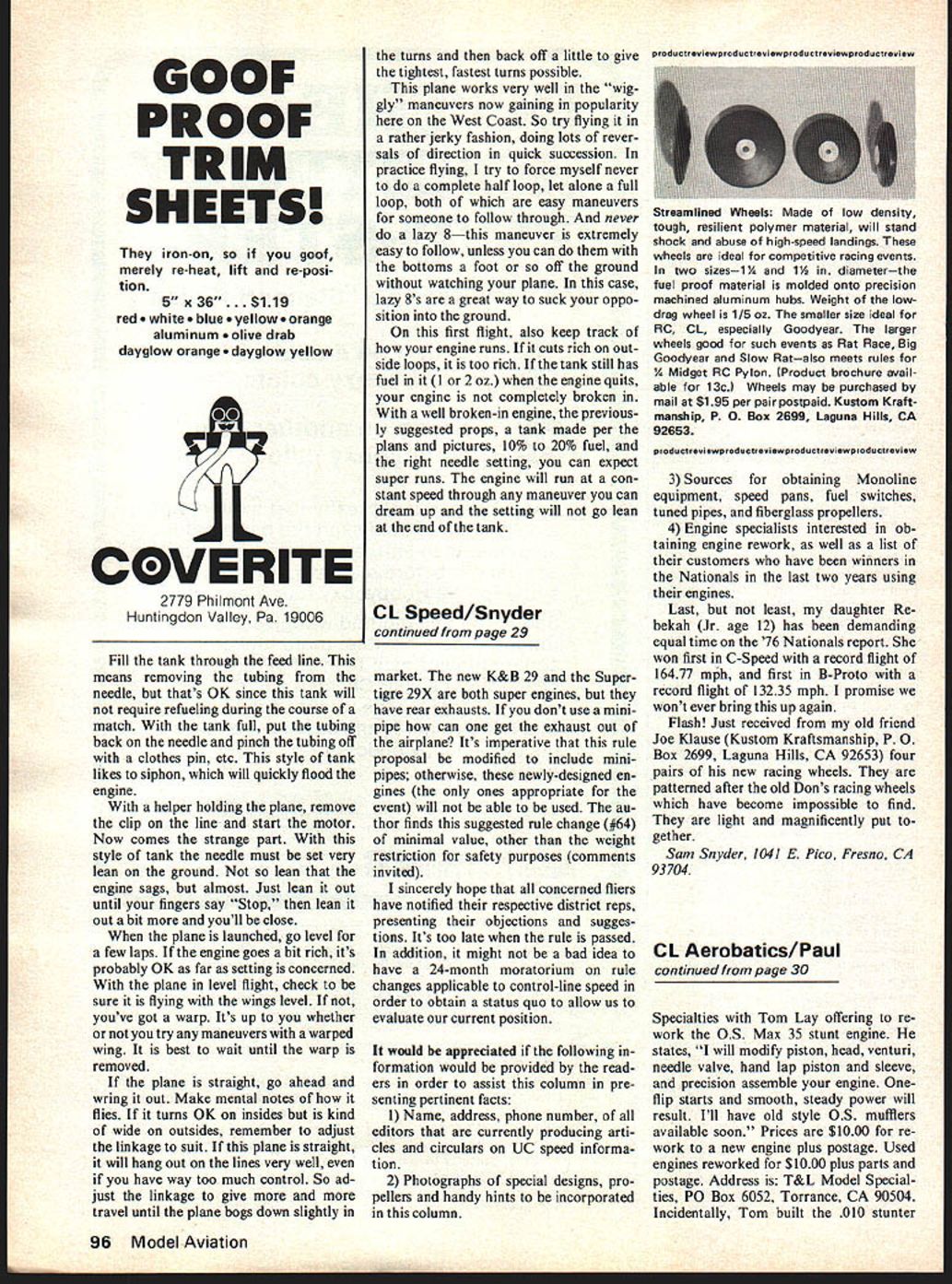
Flash! Just received from my old friend Joe Klause (Kustom Kraftsmanship, P.O. Box 2699, Laguna Hills, CA 92653) four pairs of his new racing wheels. They are patterned after the old Don's racing wheels which have become impossible to find. They are light and magnificently put together.
Sam Snyder, 1041 E. Pico, Fresno, CA 93704
Transcribed from original scans by AI. Minor OCR errors may remain.

