
Control Line: Speed
Gene Hempel 301 N. Yale Dr. Garland, TX 75042
Rules update
It appears from the results of the first round of voting on the Speed proposals that not enough of you wrote to your district Control Line Contest Board members and expressed your thoughts. This round of voting only proves that Speed is set up for the professional modeler with lots and lots of dollars. From my past experience with Speed, you need machine-shop capability — or access to one — to fly Speed. Let's face reality: nobody wants to give up his pet event for fear of losing the only accomplishment in his entire life span!
As my law professor told me one day as I tried to stay awake: "Only a fool lives in the past, for he fears the future."
Please send comments, contest activity reports, and especially photos of CL Scale activity to me at the address listed above.
Russian engine developments
New engine designs by the Russians are quite aggressive. This was evident from the number of different engine configurations shown to me by Anatoly Kohanivk at the 1988 CL World Championships. Anatoly is the chief engine designer for the Soviet Aero Club in Moscow. He indicated that each individual aero club in Russia is responsible for its own engine design(s), and that there were approximately 15 different engine designs in developmental stages.
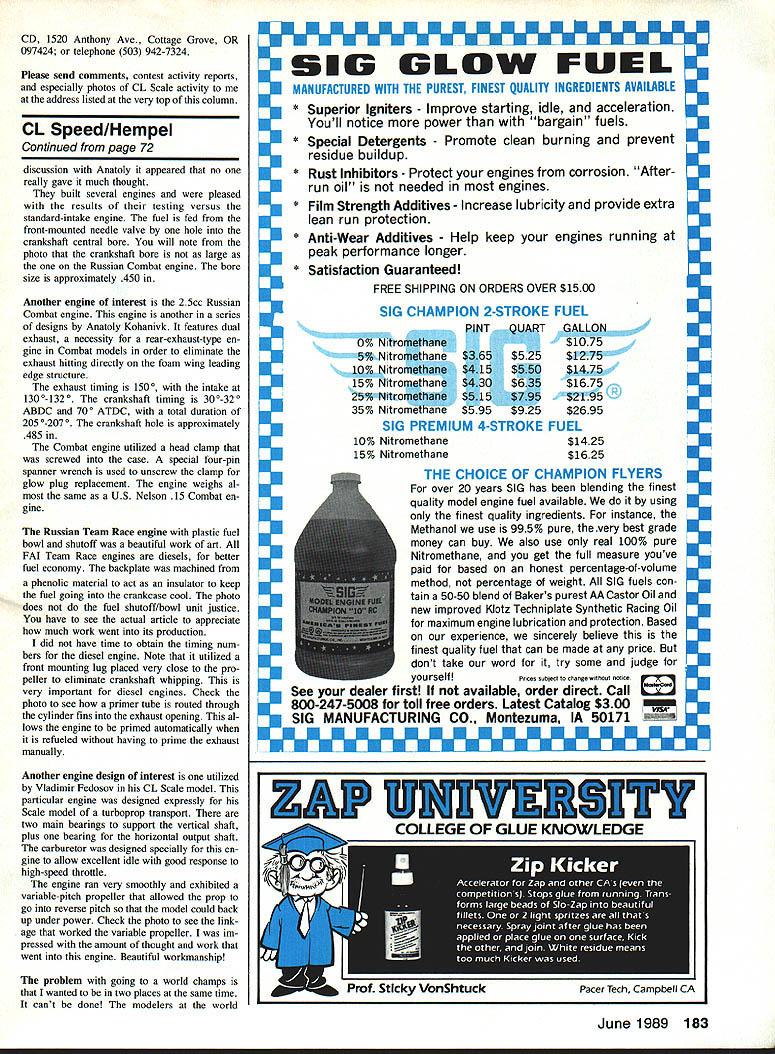
One design that aroused my interest eliminated a separate intake tube. The intake was straight through from the front into the crankshaft bore. A plate machined as part of the bottom end of the connecting rod acted as the valve for opening and closing the crankshaft bore to define the intake duration. The web on the side of the case seals the slit which allows the plate on the rod to pass through the side. The internal groove in the web was approximately 1.0 mm wide.
- Exhaust timing: 190°
- Intake timing: 140°
- Valve opening: 30° ABDC and 70° ATDC (total duration 210°)
The front bearing is held in place by a snap ring to keep the bearing from floating out of the case. The idea for the engine was to eliminate moving parts such as a rear rotor on the backplate. The question was whether the plate on the rod would create drag and lose power. After much testing, Anatoly and his team built several engines and were pleased with the results compared with a standard-intake engine.
Fuel is fed from a front-mounted needle valve through one hole into the crankshaft central bore. The crankshaft bore on this engine is approximately .450 in.
2.5 cc Russian Combat engine
Another engine of interest is the 2.5 cc Russian Combat engine, one of a series by Anatoly Kohanivk. It features dual exhausts — a necessity for rear-exhaust Combat models to prevent exhaust from hitting foam wing leading edges.
- Exhaust timing: 150°
- Intake timing: 130°–132°
- Crankshaft timing: 30°–32° ABDC and 70° ATDC
- Total duration: ~205°–207°
- Crankshaft hole: approximately .485 in
The Combat engine uses a head clamp that is screwed into the case. A special four-pin spanner wrench is used to unscrew the clamp for glow plug replacement. The engine weighs almost the same as a U.S. Nelson .15 Combat engine.
Team Race diesel and fuel system features
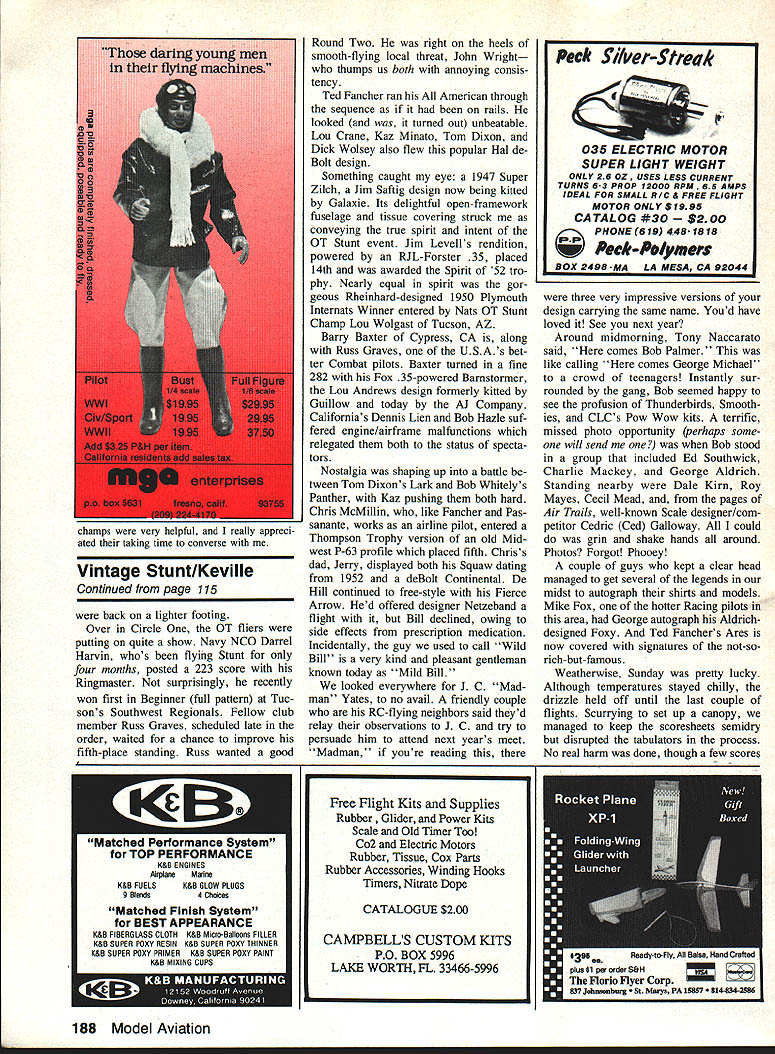
The Russian Team Race engine with a plastic fuel bowl and shutoff was a beautiful piece of workmanship. All FAI Team Race engines I saw were diesels for better fuel economy. The backplate was machined from a phenolic material to act as an insulator and help keep the fuel entering the crankcase cool.
The photos do not do the fuel shutoff/bowl unit justice — you have to see the actual article to appreciate the work that went into it. Note also the front mounting lug placed very close to the propeller to eliminate crankshaft whipping, which is especially important for diesel engines.
A primer tube is routed through the cylinder fins into the exhaust opening. This allows the engine to be primed automatically when it is refueled without having to prime the exhaust manually.
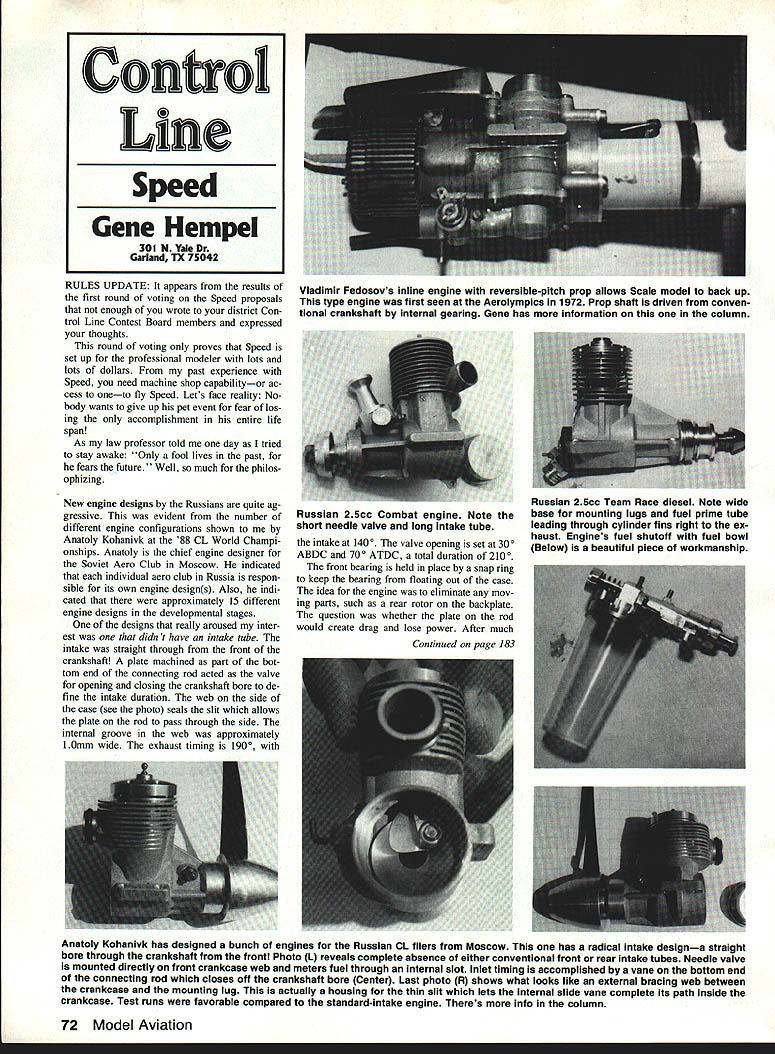
Vladimir Fedosov's CL Scale turboprop engine
Another interesting design was used by Vladimir Fedosov in his CL Scale model of a turboprop transport. The engine was designed specifically for the model and featured:
- Two main bearings supporting the vertical shaft, plus one bearing for the horizontal output shaft
- A specially designed carburetor that provided excellent idle and good high-speed throttle response
- A variable-pitch propeller that could go into reverse pitch so the model could back up under power
The linkage for the variable-pitch prop and the overall workmanship were impressive.
Closing
The problem with going to a world champs is that I wanted to be in two places at the same time. It can't be done!
Transcribed from original scans by AI. Minor OCR errors may remain.

