
Control Line: Speed
Gene Hempel 301 N. Yale Dr. Garland, TX 75042
Report overview
David Brewin of England is the author of this month's column. He reports on the Speed event at the 1989 European Control Line Championships held at Wigan, England on July 28–30.
The national teams of the European nations gather at the end of July every two years to determine a new European champion in each of the FAI Control Line classes F2A/B/C/D. These championships are held on odd years and are interleaved with the CL World Championships. While naturally no less important to the competitors, the Euro Champs tend to have a slightly more relaxed atmosphere because the smaller entry permits less stringent flying schedules and more time for furthering international friendships.
Venue and weather
The championships were held at the Three Sisters site in Wigan, a recreational area purposely built for "noisy sports" and supported by the Greater Manchester local government. The site is bounded by a narrow, twisting go-kart racetrack also used for motorcycle racing. The three original tarmac flying circles—one with a permanent wire mesh and jury tower—were supplemented with a fourth tarmac practice circle laid with help from the local government to support the champs.
Weather was a recurring theme. The Wigan Euro Champs four years earlier had seen overcast, cool, and windy conditions, and despite a hot, dry summer in 1989 the event again suffered poor conditions. The weather throughout the event could best be described as "flyable"—legal under the rules, but often not ideal. Over the three days the blustery wind stayed much the same, temperatures hovered around 18°–19°C, air pressure was about 1,015 mb, and humidity ran near 40% except when it rained.
Procedures and processing
Most competitors had their engines engraved for identification; models were weighed and flying surface areas calculated so that maximum wing loading could be determined. A fixed fuel weight of 25 grams (one ounce) was added to dry model weight to determine the load required for the line-pull test. Control line spacing at the handle and wingtip was also checked.
Stringent line-length checking at the start of the first round used apparatus nailed to the ground. Many competitors searched model boxes for extra line links to make up discrepancies unearthed during the checks.
Models, construction and measurements
- Most competitors' models had surface areas just under 6.0 square decimeters, wing spans about 900 mm, and weights around 560 grams.
- Exceptions:
- Sweden's Stjärnesund had almost 7.3 sq. dm. wing area.
- Some Hungarian models approached 7.0 sq. dm., featuring familiar narrow, long-chord wings (1,200 mm).
- Sandor Szegedi's 'A' model sported the longest wing at 1,430 mm and a tiny tip chord of 12.3 mm—narrow and not well suited to the day's weather.
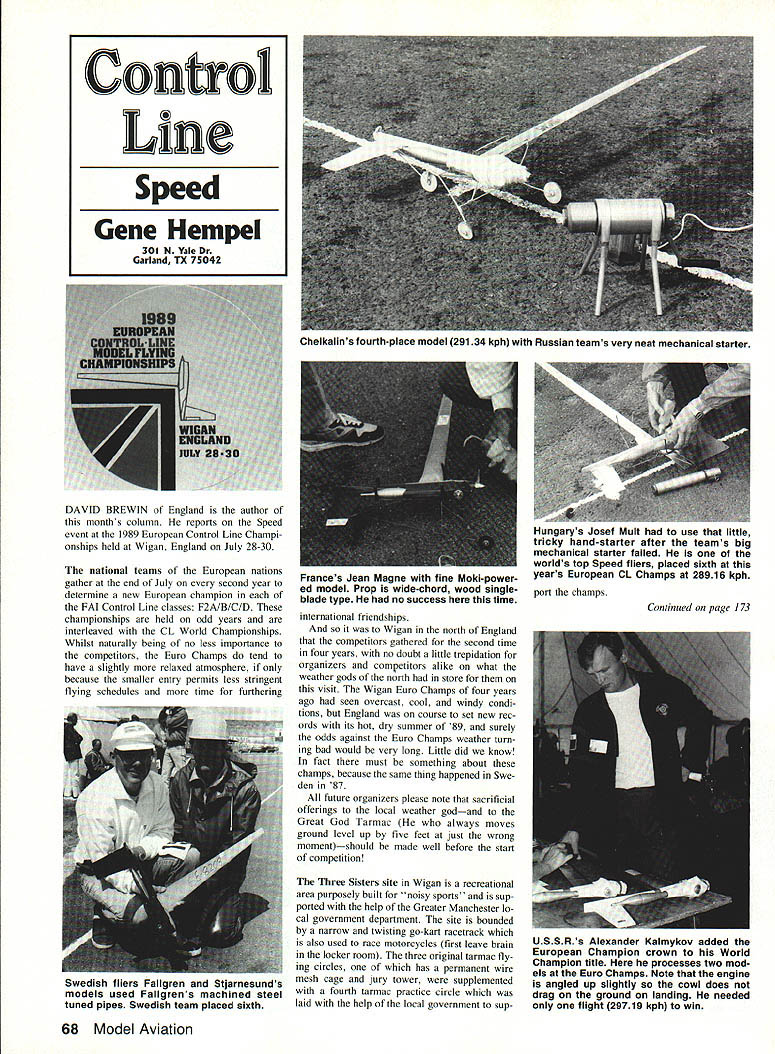
- The Russians used lightweight unitary-construction models of 900 mm span with rear fuselages permanently attached to the metal engine-mounting plate for rigidity and low weight. Kalmykov's model weighed about 460 grams dry and had a sensible margin above the minimum area allowed by the rules (5.2 sq. dm rather than the 5.0 minimum).
All Russian models were finished in white paint applied sparingly. The Russians claimed white models were easier for timekeepers to see and thus produced better recorded speeds. As lead timekeeper, the writer notes that while individual stopwatches do not necessarily run faster, the average of three watches can be lower because the models are easier to see, giving a small timing advantage.
A noteworthy British model, built by Dick McGladdrey, combined a fixed rear fuselage manufactured from rolled mira-lite plywood and a narrow-chord 1,200 mm wing. The design achieved a flying weight under 500 grams through careful mass control in design and manufacture rather than exotic materials.
With the exception of two competitors, most models were outboard-engine, asymmetric wide-sidewinder types with suction-feed fuel pick-up from a rear tank.
Engines and props
A good variety of engines were present; F2A is no longer exclusively Rossi territory.
- Kalmykov and Pitskalev used their own Chilcon engines, which feature widely spaced mounting lugs. Kalmykov ran his engine at about 1.8 bhp (possibly conservative).
- Chelkalin used his own Chilcon engine with a 13 mm-diameter shaft and three balls in the rear bearing running directly on the shaft. The shaft was dynamically balanced with tungsten weights.
- The entire U.K. team used the Irvine .15 engine and pipe; the engine is relatively new and not yet widely developed into competition trim by other fliers.
- The Hungarians ran Moki engines; Moki development engineer "Bimbi" supported the team and displayed many Moki examples during bad weather.
- Italians used OPS power, with the Collombini team transferred from last year's Rossi camp.
- Rossis and Mokis were split fairly evenly among the remaining competitors.
Propeller choices varied by team. Hungarians favored wide-chord, thick-section rock-maple single-bladed props, while most others used thin carbon-fiber blades.
Competition summary
There had been much pre-event talk about whether the U.S.S.R. team would exceed their Kiev 1988 speeds, with 310 kph commonly forecast. Some even expected the U.S.S.R. team to dominate so completely they did not support the event, but the actual results were lower than the most optimistic forecasts.
A second line of thought expected several contestants to exceed 300 kph and possibly cause upsets. Names mentioned included Hungary's Josef Mult and Sandor Szegedi, Peter Halman of Britain (developer of the Irvine .15), and Dick McGladdrey, who had posted over 290 kph in prior practice.
The first three final placings were effectively settled in the first round:
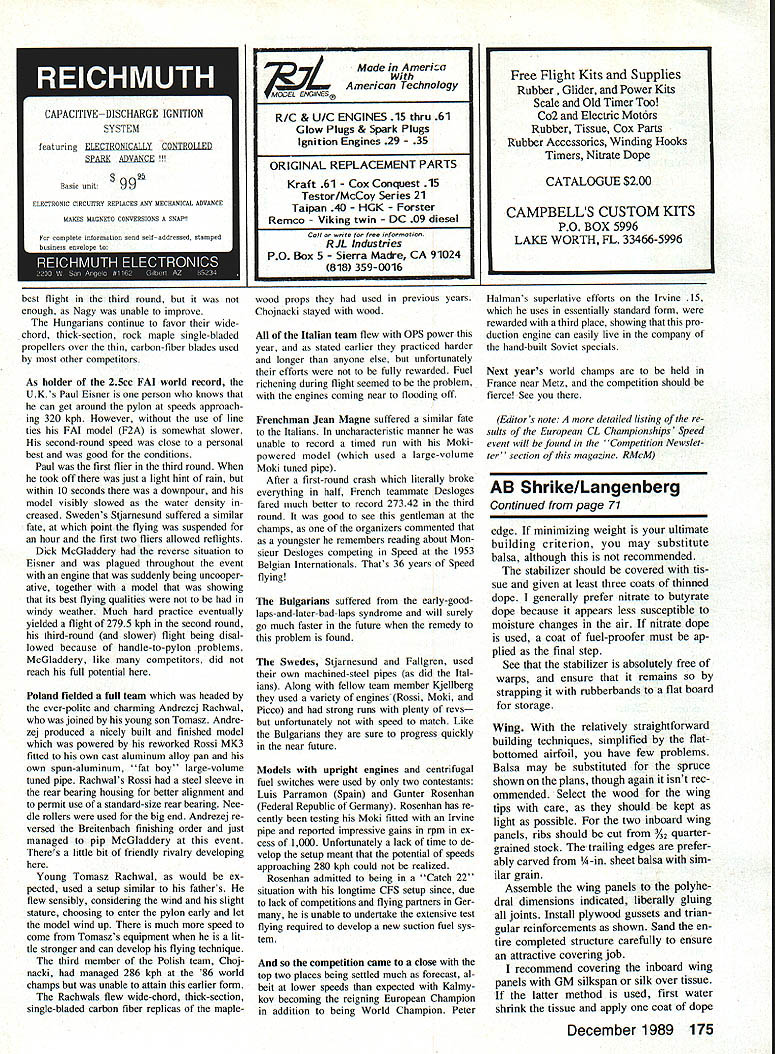
- Alexander Kalmykov (U.S.S.R.) — European Champion, 297.19 kph. Kalmykov added the European crown to his World Champion title; he processed two models at the Euro Champs. Note: engine angled up slightly; cowl drags on ground landing.
- Pitskalev (U.S.S.R.) — 296.62 kph. He used full throttle with Oscar-boosted flights during practice and qualifying.
- Peter Halman (U.K.) — 295.73 kph (posted in the third round). Halman flew his "B" model and was over 292 kph in the first round; an audible crackle in the exhaust did not affect his result.
Tactical points:
- The Russians kept a spare takeoff dolly for second attempts to avoid the difficulty of extracting the first from cage fencing.
- Many top placings were decided in early rounds; the Russian pair chose to conserve their efforts unless necessary.
Notable individual and team performances
- Chelkalin (Russia) placed fourth while developing a new engine. His engine would not stay on the pipe for full 10 laps at times, but he did enough in practice and qualifying to secure fourth.
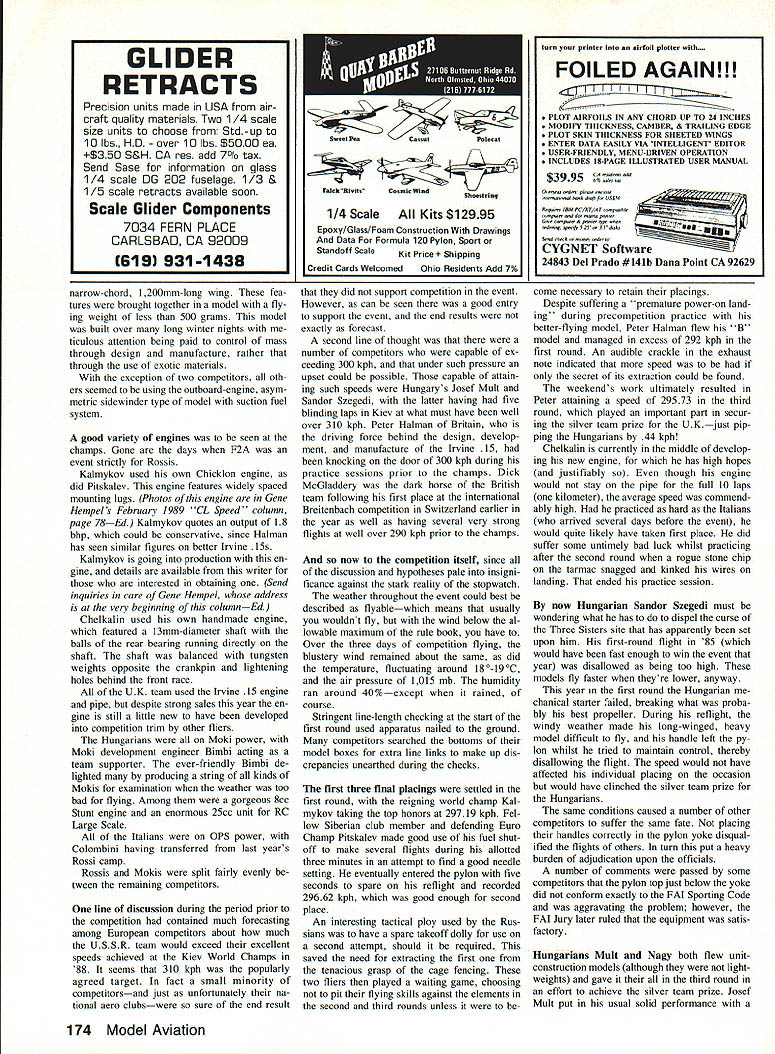
- Sandor Szegedi (Hungary) suffered mechanical starter failure in the first round, breaking a prop, and then had a reflight disallowed when his handle left the pylon while trying to control a long-winged model—costing a potential team silver for Hungary.
- Josef Mult (Hungary) put in a solid performance with his unit-construction model and tried hard in the third round.
- Paul Eisner (U.K.), holder of the 2.5 cc FAI world record, demonstrated he can approach 320 kph with the right setup, but his FAI model without line ties is somewhat slower. His second-round speed was close to a personal best given the conditions. His third-round attempt was slowed by a sudden downpour, which forced a suspension of flying for an hour and reflight of the first two finals.
- Dick McGladdrey (U.K.) suffered engine problems and a model not suited to windy conditions, logging a 279.5 kph second-round flight; a third-round flight was disallowed because of handle-to-pylon problems.
- Poland fielded a full team: Andrzej Rachwal, his son Tomasz, and Chojnacki. Andrzej produced a nicely built model powered by a reworked Rossi MK3 fitted to his own cast aluminum alloy pan and a large-volume tuned pipe. Tomasz flew sensibly and is expected to improve as he gains strength and flying technique.
- The Italians practiced hard but suffered fuel-pickup problems leading to near-flooding of engines.
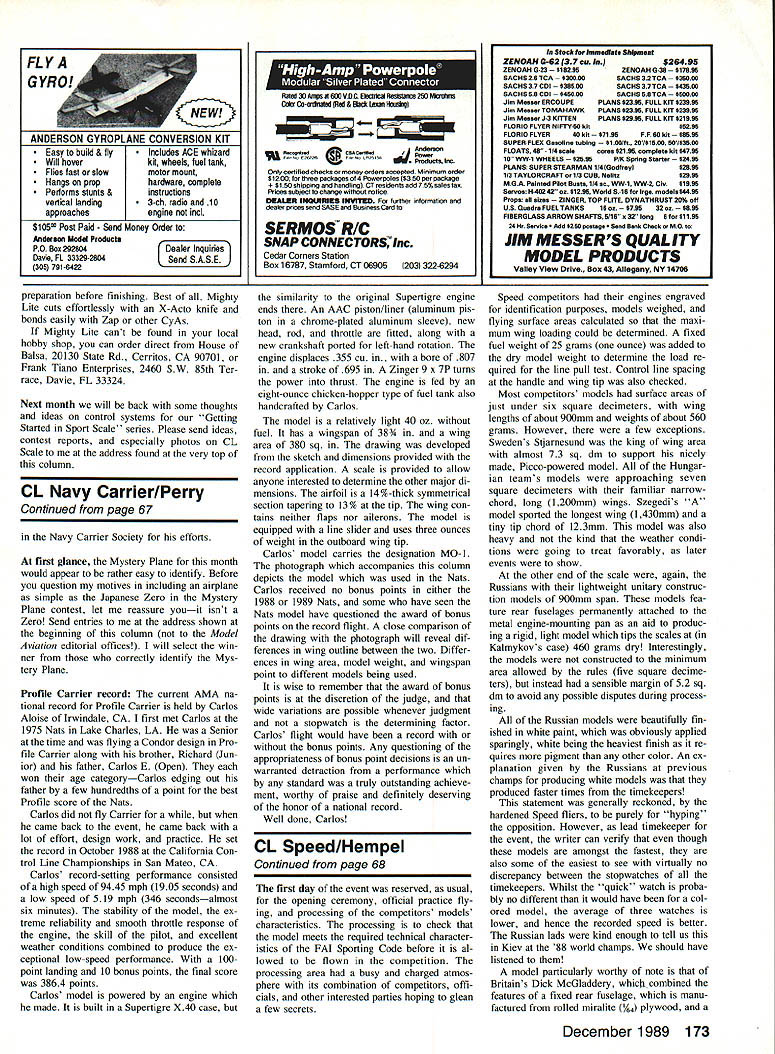
- Frenchman Jean Magne was unable to record a timed run with his Moki-powered model; teammate Desloges crashed one model in the first round but later recorded 273.42 kph in the third round.
- The Bulgarians and Swedes (Stjärnesund and Fälgren) showed promise but did not reach top speeds; the Swedes used machined-steel pipes and a variety of engines.
Two contestants used upright engines with centrifugal switches: Luis Parramon (Spain) and Gunter Rosenhan (FRG). Rosenhan reported impressive rpm gains when testing a Moki fitted with an Irvine big pipe but lacked time for full development.
Equipment notes and development
- Kalmykov's Chilcon engine is going into production; inquiries can be sent in care of Gene Hempel (address above).
- Chelkalin continues developing a new engine with innovative bearing and balancing features.
- Rosenhan faces a "Catch-22" in developing a new suction fuel system due to lack of local competitions and flying partners in Germany.
Results and closing
Top placings were settled largely as forecast, though at somewhat lower speeds than expected. Alexander Kalmykov became European Champion in addition to being World Champion. Peter Halman's strong performance on the relatively standard Irvine .15 demonstrated that a production engine can compete with hand-built Soviet specials.
Next year's world champs will be held in France near Mèze, and competition is expected to be fierce.
Editor's note
A more detailed listing of the results of the European CL Championships—Speed event will be found in the "Competition Newsletter" section of this magazine. RMcM
Transcribed from original scans by AI. Minor OCR errors may remain.

