
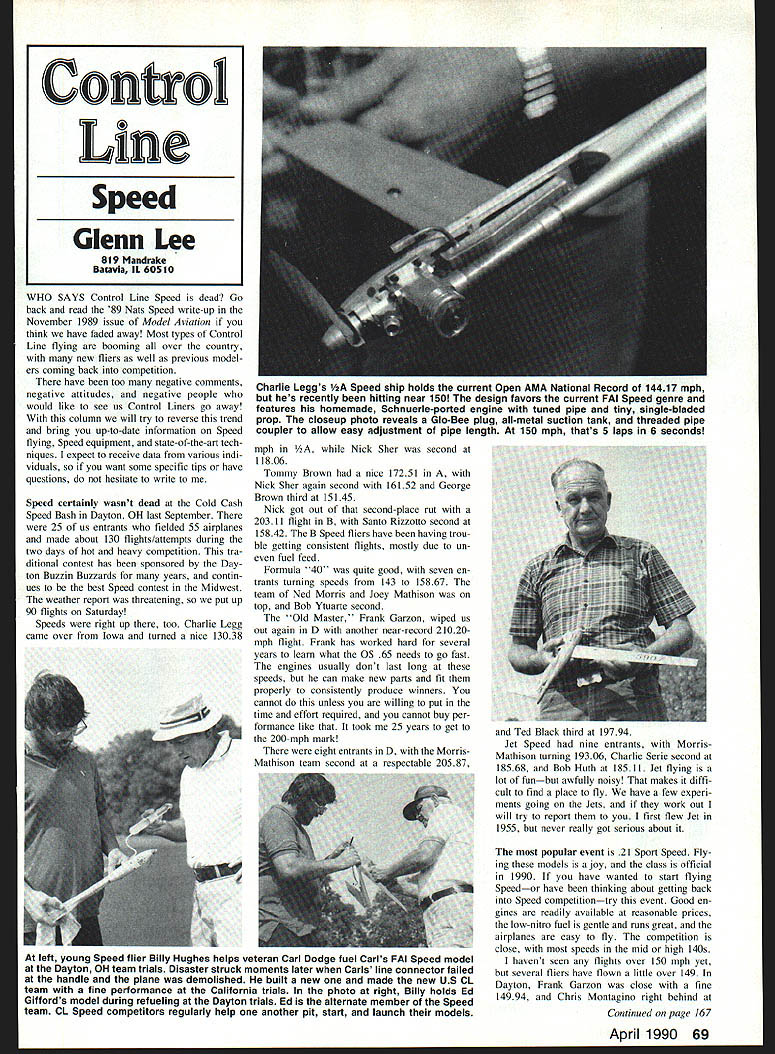
Control Line: Speed
Glenn Lee 819 Mandrake Batavia, IL 60510
Who says Control Line Speed is dead? Go back and read the '89 Nats Speed write-up in the November 1989 issue of Model Aviation if you think we have faded away! Most types of control line flying are booming all over the country, with many new fliers as well as previous modelers coming back into competition.
There have been too many negative comments, negative attitudes, and negative people who would like to see us Control Liners go away. With this column we will try to reverse that trend and bring you up-to-date information on Speed flying, Speed equipment, and state-of-the-art techniques. I expect to receive data from various individuals, so if you want some specific tips or have questions, do not hesitate to write.
Speed certainly wasn't dead at the Cold Cash Speed Bash in Dayton, OH last September. There were 25 entrants who fielded 55 airplanes and made about 130 flights/attempts during the two days of hot and heavy competition. This traditional contest has been sponsored by the Dayton Buzzin' Buzzards for many years and continues to be the best Speed contest in the Midwest. The weather report was threatening, so we put up 90 flights on Saturday!
Speeds were right up there, too. Charlie Legg came over from Iowa and turned a nice 130.38 mph in .2A, while Nick Sher was second at 118.06.
Tommy Brown had a nice 172.51 in A, with Nick Sher again second with 161.52 and George Brown third at 151.45.
Nick got out of that second-place rut with a 203.11 flight in B, with Santo Rizzotto second at 158.42. The B Speed fliers have been having trouble getting consistent flights, mostly due to unreliable fuel feed.
Formula "40" was quite good, with seven entrants turning speeds from 143 to 158.67. The team of Ned Morris and Lucy Mathison were on top and Bob Ytuarte second.
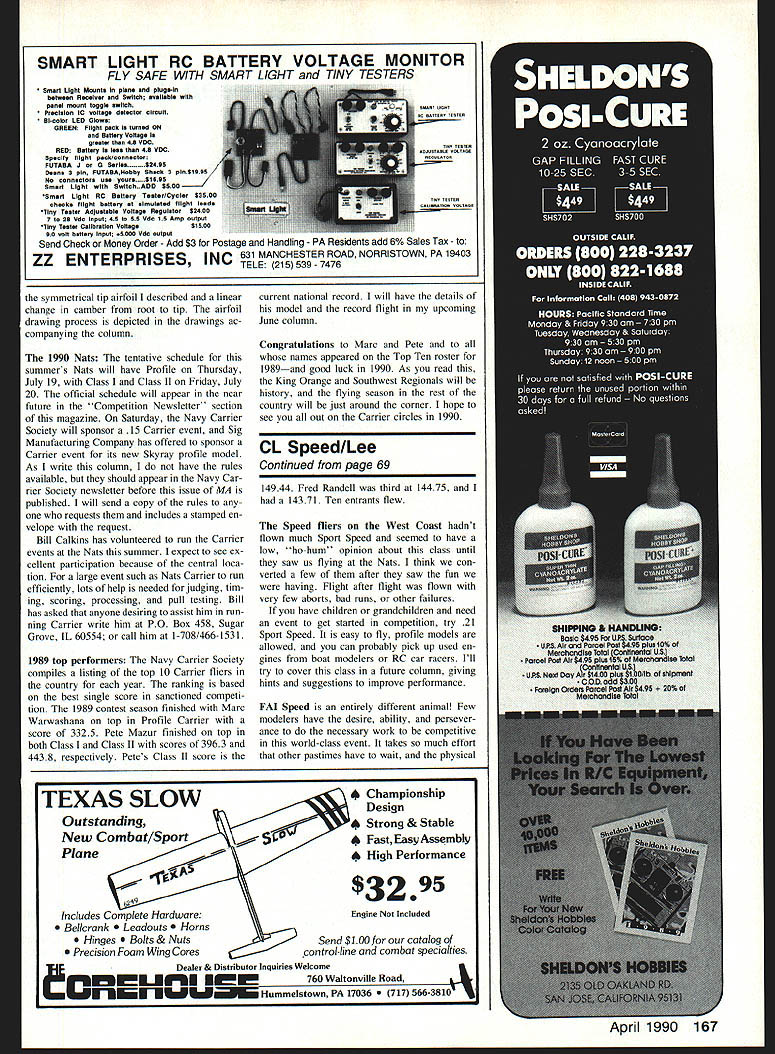
The "Old Master," Frank Garzon, wiped us out again in D with another near-record 210.20-mph flight. Frank has worked hard for several years to learn what the .05–.65 needs to go fast. The engines usually don't last long at these speeds, but he has learned to make new parts fit properly to consistently produce winners. You cannot do this unless you are willing to put in the time and effort required, and you cannot buy performance like that. It took me 25 years to get to the 200-mph mark!
There were eight entrants in D, with the Morris–Mathison team second at a respectable 205.87, and Ted Black third at 197.94.
Jet Speed had nine entrants, with Morris–Mathison turning 193.06, Charlie Serie second at 185.68, and Bob Huth at 185.11. Jet flying is a lot of fun but awfully noisy; that makes it difficult to find a place to fly. We have a few experiments going on with the jets, and if they work out I will try to report them to you. I first flew jet models in 1955, but never really got serious about it until the event became popular.
The most popular event is .21 Sport Speed. Flying these models is a joy, and the class is official in 1990. If you have wanted to start flying Speed—or have been thinking about getting back into Speed competition—try this event. Good engines are readily available at reasonable prices, the low-nitro fuel is gentle and runs great, and the airplanes are easy to fly. The competition is close, most speeds in the high 140s. I haven't seen any flights over 150 mph yet, but several fliers have flown a little over 149. At Dayton, Frank Garzon was close with a fine 149.94, and Chris Montagino right behind at 149.44. Fred Randall was third at 144.75, and I had a 143.71. Ten entrants flew.
The Speed fliers on the West Coast hadn't flown much Sport Speed and seemed to have a "ho-hum" opinion about this class until they saw us flying at the Nats. I think we converted a few of them after they saw the fun we were having. Flight after flight was flown with very few aborts, bad runs, or other failures.
If you have children or grandchildren and need an event to get started in competition, try .21 Sport Speed. It is easy to fly, profile models are allowed, and you can probably pick up used engines from boat modelers or RC car racers. If this proves to be a class in your area, the local clubs should consider sponsoring a contest to encourage participation.
FAI Speed is an entirely different animal. Few modelers have the desire, ability, and perseverance to do the necessary work to be competitive in this world-class event. It takes so much effort that other pastimes have to wait, and the physical demands require top fitness. I would still be flying FAI if I could only keep up around the pylon!
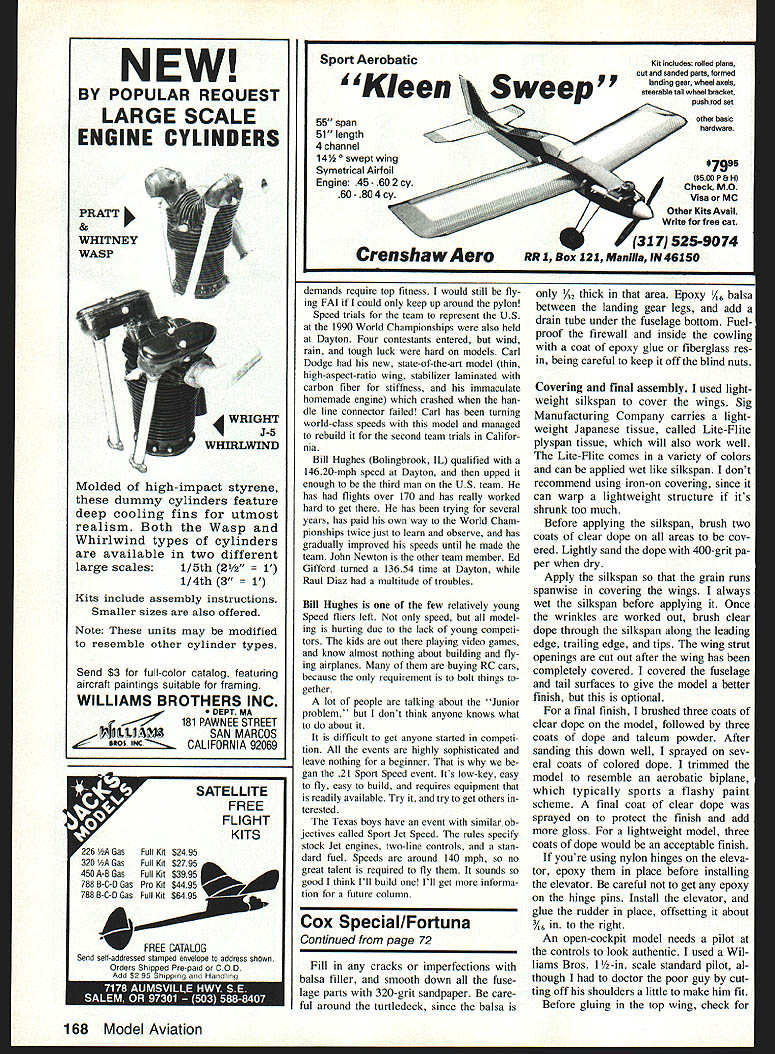
Speed trials for the team to represent the U.S. at the 1990 World Championships were also held at Dayton. Four contestants entered, but wind, rain, and tough luck were hard on models. Carl Dodge had his new, state-of-the-art model (thin, high-aspect-ratio wing, stabilizer laminated with carbon fiber for stiffness, and his immaculate homemade engine) which crashed when the handle line connector failed. Carl has been turning world-class speeds with this model and managed to rebuild it for the second team trials in California.
Bill Hughes (Bolingbrook, IL) qualified with a 146.20-mph speed at Dayton, and then upped it enough to be the third man on the U.S. team. He has had flights over 170 and has really worked hard to get there. He has been trying for several years, has paid his own way to the World Championships twice just to learn and observe, and has gradually improved his speeds until he made the team. John Newton is the other team member. Ed Gifford turned a 136.54 time at Dayton, while Raul Diaz had a multitude of troubles.
Bill Hughes is one of the few relatively young Speed fliers left. Not only speed, but model engineering is hurting due to the lack of young competitors. The kids are out there playing video games and know almost nothing about building and flying airplanes. Many of them are buying R/C cars, because the only requirement is to bolt things together.
A lot of people are talking about the "junior problem," but I don't think anyone knows what to do about it.
It is difficult to get anyone started in competition. All the events are highly sophisticated and leave nothing for a beginner. That is why we began the .21 Sport Speed event. It's low-key, easy to fly, easy to build, and requires equipment that is readily available. Try it, and try to get others interested.
The Texas boys have an event with similar objectives called Sport Jet Speed. The rules specify stock .21 speed engines, two-line controls, and a standard fuel. Speeds are around 140 mph, so talent is required to fly them. It sounds so good I think I'll build one! I'll get more information for a future column.
Covering and final assembly
I used lightweight silkspan to cover the wings. Sig Manufacturing Company carries a lightweight Japanese tissue called Lite-Flite polyspan tissue, which will also work well. The Lite-Flite comes in a variety of colors and can be applied wet like silkspan. I don't recommend using iron-on covering, since it can warp a lightweight structure if it's shrunk too much.
Before applying the silkspan, brush two coats of clear dope on all areas to be covered. Lightly sand the dope with 400-grit paper where necessary.
Apply the silkspan so that the grain runs spanwise when covering the wings. I always wet the silkspan before applying it. Once the wrinkles are worked out, brush clear dope through the silkspan along the leading edge, trailing edge, and tips. The wing strut openings are built out at the center of the wing and completely covered. I covered the fuselage and tail surfaces to give the model a better finish, but this is optional.
For a final finish, I brushed three coats of clear dope on the model, followed by three coats of dope mixed with talcum powder. After sanding this down well, I sprayed on several coats of colored dope. I trimmed the model to resemble an aerobatic biplane, which typically sports a flashy paint scheme. A final coat of clear dope was sprayed on to protect the finish and add more gloss. For a lightweight model, three coats of dope would be an acceptable finish.
If you're using nylon hinges on the elevator, epoxy them in place before installing the elevator. Be careful not to get any epoxy on the hinge pins. Install the elevator and glue the rudder in place, offsetting it about 1/8 in. to the right.
An open-cockpit model needs a pilot at the controls to look authentic. I used a Williams Bros. 1-1/2-in.-scale standard pilot, although I had to doctor the poor guy by trimming his shoulders a little to make him fit. Before gluing in the top wing, check for proper alignment and clearances.
Transcribed from original scans by AI. Minor OCR errors may remain.

