
Control Line: Speed
Glenn Lee 819 Mandrake Batavia, IL 60510
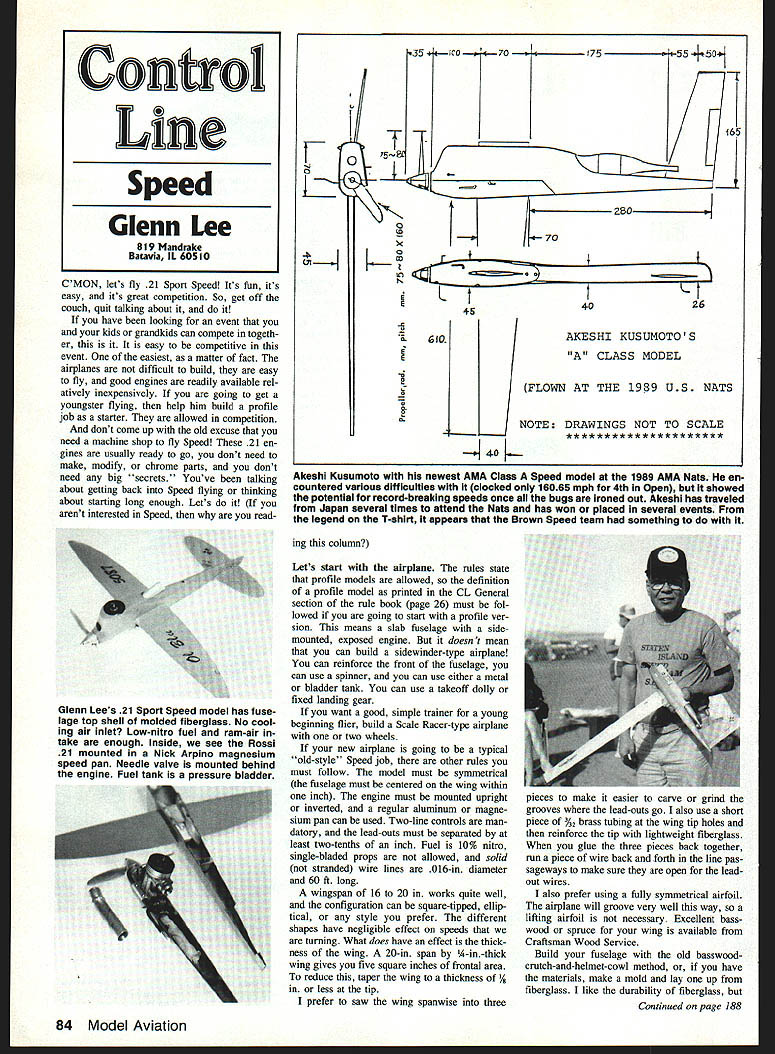
C'mon — let's fly .21 Sport Speed! It's fun, it's easy, and it's great competition. So get off the couch, quit talking about it, and do it.
If you have been looking for an event that you and your kids or grandkids can compete in together, this is it. It is easy to be competitive in this event — one of the easiest, as a matter of fact. The airplanes are not difficult to build, they are easy to fly, and good engines are readily available relatively inexpensively. If you are going to get a youngster flying, help him build a profile job as a starter — profile models are allowed in competition.
And don't use the old excuse that you need a machine shop to fly Speed! These .21 engines are usually ready to go; you don't need to make, modify, or chrome parts, and you don't need any big "secrets." If you've been talking about getting back into Speed flying or thinking about starting long enough, stop hesitating. If you aren't interested in Speed, then why are you reading this column?
Airplane
The rules state that profile models are allowed, so the definition of a profile model as printed in the CL General section of the rule book must be followed if you start with a profile version. This means a slab fuselage with a side-mounted, exposed engine. That does not mean you can build a sidewinder-type airplane. You may:
- Reinforce the front of the fuselage.
- Use a spinner.
- Use either a metal or bladder tank.
- Use a takeoff dolly or fixed landing gear.
If you want a good, simple trainer for a young beginning flier, build a Scale Racer–type airplane with one or two wheels.
If your new airplane is going to be a typical "old-style" Speed job, there are other rules you must follow:
- The model must be symmetrical: the fuselage must be centered on the wing within 1 in.
- The engine must be mounted upright or inverted; a regular aluminum or magnesium pan can be used.
- Two-line controls are mandatory, and the lead-outs must be separated by at least 0.2 in.
- Fuel is 10% nitro.
- Single-bladed props are allowed.
- Lines must be solid (not stranded) wire, 0.016 in. diameter and 60 ft long.
A wingspan of 16 to 20 in. works quite well; configuration can be square-tipped, elliptical, or any style you prefer. Different planforms have negligible effect on the speeds we are turning. What does affect frontal area is wing thickness: a 20-in. span by 1/4-in.-thick wing gives you five square inches of frontal area. To reduce this, taper the wing to a thickness of 1/8 in. or less at the tip.
I prefer to saw the wing spanwise into three pieces to make it easier to carve or grind the grooves where the lead-outs go. Use a short piece of 3/32-in. brass tubing at the wing tip holes and then reinforce the tip with lightweight fiberglass. When you glue the three pieces back together, run a piece of wire back and forth in the line passageways to make sure they are open for the lead-out wires.
I also prefer using a fully symmetrical airfoil. The airplane will groove very well this way, so a lifting airfoil is not necessary. Excellent basswood or spruce for your wing is available from Craftsman Wood Service.
Build your fuselage with the old basswood crutch-and-helmet-cowl method, or, if you have the materials, make a mold and lay up one from fiberglass. I like the durability of fiberglass, but it's a lot of work to make the mold — maybe a good topic for a future column.
CL Speed — Continued
Engine
If you have any modelers in your area running gas-powered RC cars or RC boats, go see what they are using for engines. There are several excellent .21s on the market, and I have seen comparable speeds from several different brands. If you can find a good-looking, "goody-feeling" used engine, try it — usually the only repairs needed are new bearings and maybe a new piston to get it back in condition.
If you buy a new engine, don't overload it by running it on a big prop. These modern ABC (aluminum piston running in a chromed brass liner) engines are built to rev at high rpm. They do not need a break-in, and they will not be damaged by 10% nitro fuel. If you insist on running a large prop, use a 7x4 or 6x6. We are still experimenting with props, but it seems a 6-1/2-in. diameter by 6-in. pitch works best. It takes a good prop to pull those two big wires around, so I like a fairly wide blade. My best speeds have been with a 6x6 cut down from a fiberglass copy of a 7x6 Tornado.
We have flown several brands of 10% nitro RC fuel, and they all seem to run OK. Since we are running this low-nitro fuel, you might think you must raise the engine's compression ratio. Wrong — the stock heads are fine. In fact, you might go faster if you decrease the compression by using head gaskets of various thicknesses. Get a few spare head gaskets and experiment; you should find out what head clearance to use for different weather conditions.
Do not bother your engine with attempts at porting, polishing, grinding, or other "secret" hop-up methods. Fly it several times in stock condition first. If it doesn't go fast, then analyze why.
Sleeve-and-piston fit (the real secret)
The biggest—and almost the only—"secret" is a proper sleeve-and-piston fit. The sleeve bore should be round and tapered so the piston fits loose at the bottom of the stroke and squeaky tight at the top. All my best ABC engines have squeaked at the top of the stroke!
Recommended clearances:
- About 0.005 in. clearance at the bottom of the sleeve.
- About 0.002 in. clearance in the area of the exhaust and bypass ports (i.e., approximately 0.002 in. difference between the piston diameter and the inside diameter of the sleeve).
Try not to lap the sleeve with the piston, as you will only ruin the piston. Brake hones can be used; I'll explain in a future column how to make a proper lap.
Fuel system, props, and takeoff dolly
The venturi intake restrictor is unnecessary. You will gain speed by removing it and using a remote needle valve mounted behind the engine. It's easy to make: a saw, file, and drills are all you need to construct one from a scrap block of aluminum, brass, or steel. Use surgical tubing for a pressure fuel bladder. You will need a little over one ounce of fuel (about 30 cc) for a flight. I'll show you how to build a takeoff dolly in the next column.
Suppliers
- Nick Arpino — magnesium speed pans
301 Wood Acres Rd., East Patchogue, NY 11772
- Craftsman Wood Service — hardwoods
1735 W. Cortland Ct., Addison, IL 60101
When responding to advertisers, mention that you read about them in Model Aviation.
Transcribed from original scans by AI. Minor OCR errors may remain.

