
Control Line: Speed
Glenn Lee
819 Mandrake Batavia, IL 60510
Getting Started
Last column I told you how to build a simple, lightweight dolly for .21 Sport Speed because some would-be Speed fliers are intimidated by the thought of such a "tricky" item. Another frightening thing for beginners is flying a pylon. It's not that difficult! I'll give you a few hints and suggestions to allow you to quickly overcome your fears and become an accomplished Speed flier in no time flat. I've shown several modelers how to obtain a good pylon technique. Few of them have any problems.
Takeoff and Flying Technique
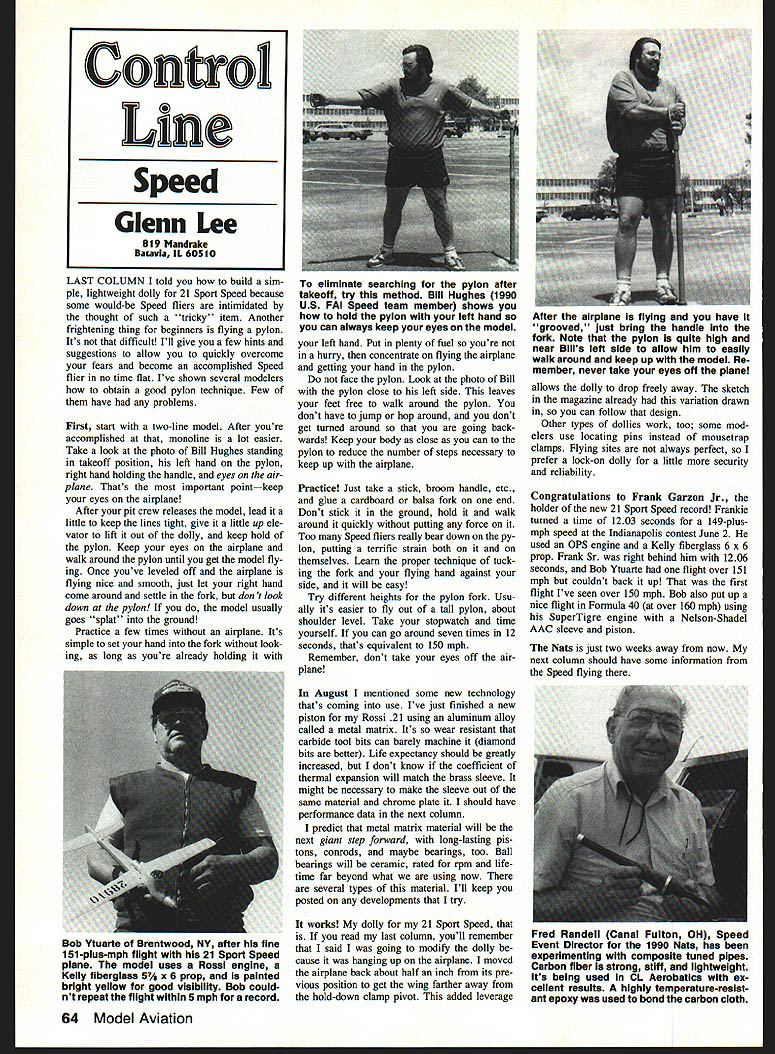
First, start with a two-line model. After you're accomplished at that, monoline is a lot easier. Take a look at the photo of Bill Hughes standing in takeoff position, his left hand on the pylon, right hand holding the handle, and eyes on the airplane. That's the most important point—keep your eyes on the airplane!
Follow these steps on takeoff:
- After your pit crew releases the model, lead the airplane a little to keep the lines tight.
- Give it a small up-elevator to lift it out of the dolly.
- Keep your left hand on the pylon and keep your eyes on the airplane.
- Walk around the pylon until the model flies smooth and level.
- Once leveled, let your right hand come around and settle into the fork—do not look down at the pylon.
If you look down at the pylon, the model often tends to "splat" into the ground.
Practice Drills
Practice a few times without an airplane. It's simple to set your hand into the fork without looking, as long as you're already holding it with your left hand. Put in plenty of fuel so you're not in a hurry, then concentrate on flying the airplane and getting your hand in the pylon.
Try this drill:
- Take a stick or broom handle and glue a cardboard or balsa fork on one end.
- Hold it and walk around quickly without putting force on it.
- Practice tucking the fork and your flying hand against your side so you don't have to bear down on the pylon.
Too many Speed fliers really bear down on the pylon, putting a terrific strain both on it and on themselves. Learn the proper technique of tucking the fork and your flying hand against your side, and it will be easy!
Pylon Positioning and Height
Do not face the pylon. Keep it close to your left side so your feet are free to walk around it naturally. You don't have to jump or hop around, and you won't get turned around so that you are going backwards. Keep your body as close as you can to the pylon to reduce the number of steps necessary to keep up with the airplane.
Try different heights for the pylon fork. Usually it's easier to fly out of a tall pylon, about shoulder level. Take your stopwatch and time yourself. If you can go around seven times in 12 seconds, that's equivalent to 150 mph. Remember—don't take your eyes off the airplane.
Materials and Technology
In August I mentioned some new technology that's coming into use. I've just finished a new piston for my Rossi .21 made from an aluminum alloy metal-matrix composite. It's so wear resistant that carbide tool bits can barely machine it (diamond bits are better). Life expectancy should greatly increase, but I don't know yet if the coefficient of thermal expansion will match the brass sleeve. It might be necessary to make the sleeve out of the same material and chrome-plate it. I should have performance data in the next column.
I predict metal-matrix material will be the next giant step forward, with long-lasting pistons, conrods, and maybe bearings, too. Ball bearings will be ceramic, rated for rpm and lifetime far beyond what we are using now. There are several types of this material; I'll keep you posted on any developments I try.
Dolly Update
It works—my dolly for my .21 Sport Speed, that is. If you read my last column, you'll remember I said I was going to modify the dolly because it was hanging up on the airplane.
What I changed:
- Moved the airplane back about a half inch to get the wing farther away from the hold-down clamp.
- Added a pivot to the hold-down clamp. This added leverage allows the dolly to drop freely away.
The sketch already in the magazine can be modified to show that variation. Other types of dollies work too; some modelers use locating pins instead of mousetrap clamps. Flying sites aren't always perfect. I prefer a lock-on dolly for a little more security and reliability.
Contest Results
Congratulations to Frank Garzon, Jr., the new holder of the .21 Sport Speed record!
- Frank Garzon, Jr.: 12.03 seconds — 149+ mph (Indianapolis contest, June 2). He used an OPS engine and a Kelly fiberglass 6x6 prop.
- Frank Garzon, Sr.: 12.06 seconds, right behind his son.
- Bob Ytuarte: Flew over 151 mph but couldn't back it up on subsequent attempts. That was the first flight I've seen over 150 mph. Bob also flew Formula 40 at over 160 mph using a SuperTigre engine with a Nelson-Shadel AAC sleeve piston.
Looking Ahead
The Nats are just two weeks away. My next column should have some information from the Speed flying there.
Transcribed from original scans by AI. Minor OCR errors may remain.

