
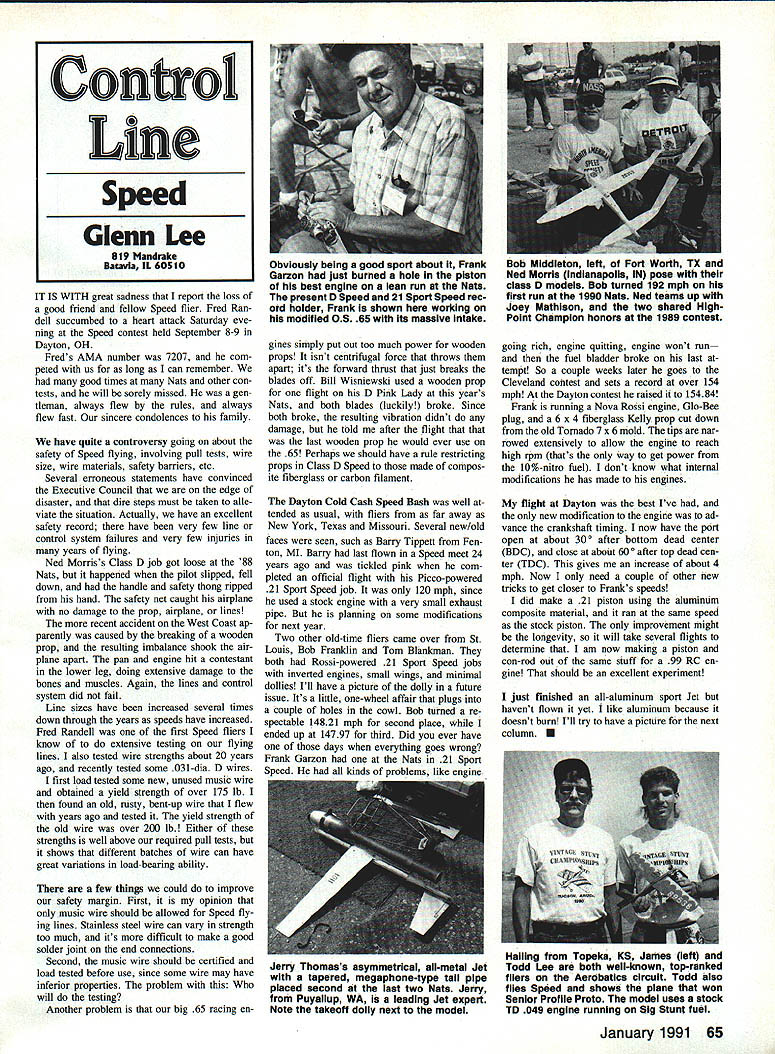
Control Line: Speed
Glenn Lee
819 Mandrake Batavia, IL 60510
It is with great sadness that I report the loss of a good friend and fellow Speed flier. Fred Randell succumbed to a heart attack Saturday evening at the Speed contest held September 8–9 in Dayton, OH.
Fred's AMA number was 7207, and he competed with us for as long as I can remember. We had many good times at many Nats and other contests, and he will be sorely missed. He was a gentleman, always flew by the rules, and always flew fast. Our sincere condolences to his family.
Safety concerns and testing
We have quite a controversy going on about the safety of Speed flying — involving pull tests, wire size, wire materials, safety barriers, etc. Several erroneous statements have convinced the Executive Council that we are on the edge of disaster and that dire steps must be taken. Actually, we have an excellent safety record: there have been very few line or control system failures and very few injuries in many years of flying.
Ned Morris's Class D job got loose at the '88 Nats, but it happened when the pilot slipped and fell; the handle and safety thong were ripped from his hand. The safety net caught his airplane with no damage to prop, airplane, or lines.
A more recent accident on the West Coast apparently was caused by a wooden prop breaking; the resulting imbalance shook the airplane apart. The pan and engine hit a contestant in the lower leg, doing extensive damage to bones and muscles. Again, the lines and control system did not fail.
Line sizes have been increased several times over the years as speeds have increased. Fred Randell was one of the first Speed fliers I know of to do extensive testing on our flying lines. I also tested wire strengths about 20 years ago, and recently tested some .031‑dia. D wires.
I first load-tested some new, unused music wire and obtained a yield strength of over 175 lb. I then found an old, rusty, bent-up wire that I flew years ago and tested it; the yield strength of the old wire was over 200 lb. Either of these strengths is well above our required pull tests, but it shows that different batches of wire can have great variations in load-bearing ability.
Proposed safety improvements
There are a few things we could do to improve our safety margin:
- Only music wire should be allowed for Speed flying lines. Stainless steel wire can vary in strength too much, and it is more difficult to make a good solder joint on the end connections.
- Music wire should be certified and load-tested before use, since some wire may have inferior properties. The problem is: who will do the testing?
- Consider a rule restricting props in Class D Speed to those made of composite fiberglass or carbon filament, because our big .65 racing engines often put out too much power for wooden props. It's not centrifugal force that throws them apart; it's the forward thrust that breaks the blades off.
Bill Wisniewski used a wooden prop for one flight on his D Pink Lady at this year's Nats, and both blades luckily broke. Since both blades broke, the resulting vibration didn't damage the plane. He told me after the flight that was the last wooden prop he would ever use on the .65.
Dayton Cold Cash Speed Bash
The Dayton Cold Cash Speed Bash was well attended as usual, with fliers from as far away as New York, Texas, and Missouri. Several new/old faces were seen, such as Barry Tippett from Fenton, MI. Barry had last flown in a Speed meet 24 years ago and was tickled pink to complete an official flight. His Picco‑powered .21 Sport Speed model reached 120 mph; since he used a stock engine with a very small exhaust pipe, he is planning some modifications next year.
Two other old-time fliers came over from St. Louis: Bob Franklin and Tom Blankman, both Rossi‑powered .21 Sport Speed jobs with inverted engines, small wings, and minimal dollies. I'll have a picture of the dolly in a future issue — it's a little one-wheel affair that plugs a couple of holes in the cowl. Bob turned a respectable 148.21 mph for second place; another competitor finished at 147.97 mph for third.
Frank Garzon and engine developments
Did I ever have days when everything goes wrong! Frank Garzon, in .21 Sport Speed, had all kinds of problems at Dayton — engine running rich, engine quitting, engine wouldn't run, and the fuel bladder broke on the last attempt. A couple weeks later he went to the Cleveland contest and set a record over 154 mph. The Dayton contest raised it to 154.84 mph.
Frank is running a Nova Rossi engine, Glo‑Bee plug, and a 6x4 fiberglass Kelly prop cut down from an old Tornado 7x6; the mold tips were narrowed extensively to allow the engine to reach high rpm. That's the way to get power on 10% nitro fuel. I don't know what internal modifications he has made to the engines. The best new modification I've seen is to advance the crankshaft timing so the port opens about 30° after bottom dead center (BDC) and closes about 60° after top dead center (TDC). This gives an increase of about 4 mph.
Frank's speeds prompted making a .21 piston using aluminum composite material; it ran the same speed as the stock piston. The improvement might be longevity. It will take several flights to determine that. I am now making a piston and conrod out of the same material for a .49 and will report the results.
I just finished an all‑aluminum sport jet but haven't flown it yet. I like aluminum because it doesn't burn! I'll try to have a picture for the next column.
Transcribed from original scans by AI. Minor OCR errors may remain.

