
Control Line: Speed
Sam Snyder
HAVING DISCUSSED the method of developing flying skill for Speed in our last article, it is now essential to select a plane that will fly consistently smooth. The following listed guidelines are probably open to debate from an engineering and aerodynamic standpoint; however, these guidelines stem totally from having been successful with Jr./Sr. competitors winning.
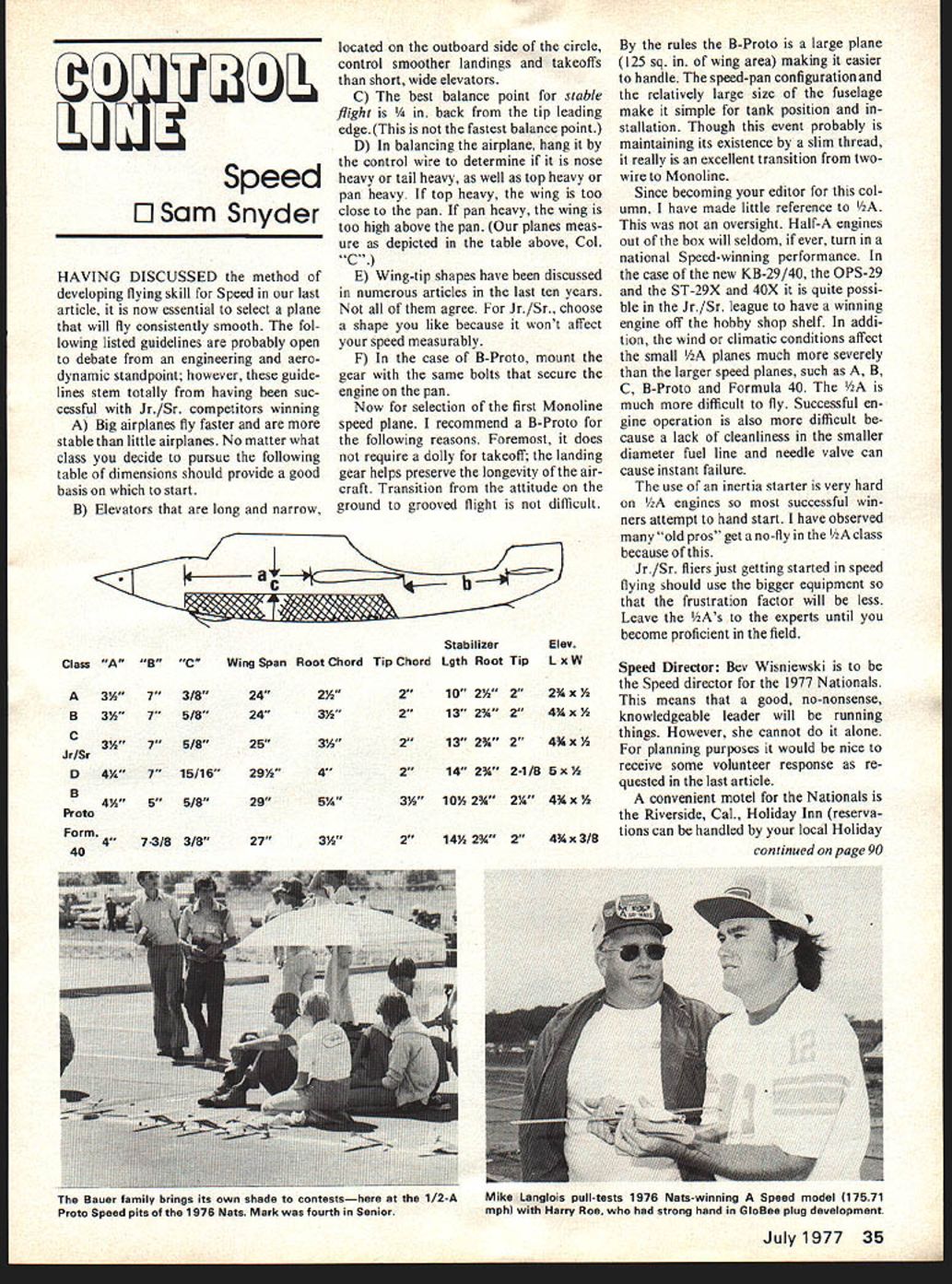
A) Big airplanes fly faster and are more stable than little airplanes. No matter what class you decide to pursue the following table of dimensions should provide a good basis on which to start.
B) Elevators that are long and narrow, located on the outboard side of the circle, control smoother landings and takeoffs than short, wide elevators.
C) The best balance point for stable flight is 1/4 in. back from the tip leading edge. (This is not the fastest balance point.)
D) In balancing the airplane, hang it by the control wire to determine if it is nose heavy or tail heavy, as well as top heavy or pan heavy. If top heavy, the wing is too close to the pan. If pan heavy, the wing is too high above the pan. (Our planes measure as depicted in the table above, Col. "C".)
E) Wing-tip shapes have been discussed in numerous articles in the last ten years. Not all of them agree. For Jr./Sr., choose a shape you like because it won't affect your speed measurably.
F) In the case of B-Proto, mount the gear with the same bolts that secure the engine on the pan.
Now for selection of the first Monoline speed plane. I recommend a B-Proto for the following reasons. Foremost, it does not require a dolly for takeoff; the landing gear helps preserve the longevity of the aircraft. Transition from the attitude on the ground to grooved flight is not difficult.
By the rules the B-Proto is a large plane (125 sq. in. of wing area) making it easier to handle. The speed-pan configuration and the relatively large size of the fuselage make it simple for tank position and installation. Though this event probably is maintaining its existence by a slim thread, it really is an excellent transition from two-wire to Monoline.
Since becoming your editor for this column, I have made little reference to 1/2A. This was not an oversight. Half-A engines out of the box will seldom, if ever, turn in a national Speed-winning performance. In the case of the new KB-29/40, the OPS-29 and the ST-29X and 40X it is quite possible in the Jr./Sr. league to have a winning engine off the hobby shop shelf. In addition, the wind or climatic conditions affect the small 1/2A planes much more severely than the larger speed planes, such as A, B, C, B-Proto and Formula 40. The 1/2A is much more difficult to fly. Successful engine operation is also more difficult because a lack of cleanliness in the smaller diameter fuel line and needle valve can cause instant failure.
The use of an inertia starter is very hard on 1/2A engines so most successful winners attempt to hand start. I have observed many "old pros" get a no-fly in the 1/2A class because of this.
Jr./Sr. fliers just getting started in speed flying should use the bigger equipment so that the frustration factor will be less. Leave the 1/2A's to the experts until you become proficient in the field.
Speed Director: Bev Wisniewski is to be the Speed director for the 1977 Nationals. This means that a good, no-nonsense, knowledgeable leader will be running things. However, she cannot do it alone. For planning purposes it would be nice to receive some volunteer response as requested in the last article.
A convenient motel for the Nationals is the Riverside, Cal., Holiday Inn (reservations can be handled by your local Holiday
Class "A" "B" "C" Wing Span Root Chord Tip Chord Stabilizer Lgth Root Tip Elev. L x W
A 3¾" 7" 3/8" 24" 2½" 2" 10" 2½" 2" 2¼ x ½ B 3¾" 7" 5/8" 24" 3½" 2" 13" 2¾" 2" 4¼ x ½ C 3½" 7" 5/8" 25" 3½" 2" 13" 2¾" 2" 4¼ x ½ Jr/Sr D 4¼" 7" 15/16" 29¼" 4" 2" 14" 2¾" 2⅛" 5 x ½ B 4¼" 5" 5/8" 29" 5½" 3½" 10½" 2¾" 2¼" 4¼ x ½ Proto Form. 40 4" 7-3/8" 3/8" 27" 3½" 2" 14½" 2¾" 2" 4¾ x 3/8"
CL Speed/Snyder
The new ST-29X has arrived on the scene. It is identical to the 40X with the same outer dimensions, bolt pattern, etc. The engine is strictly a full-tuned pipe version with a whopping 180-degree exhaust and 138-degree intake sleeve timing. I received three of them and they all measured the same, plus or minus .0003. After a careful break-in, the engine performed superbly with the full pipe. However, it will not run on a mini-pipe because of the 180-degree exhaust timing. Do not be discouraged because Mr. Maloney at World Engines assured me that the piston and sleeve combinations for a mini-pipe version were on their way. This, of course, means that the engine will be adaptable to Jr. B-Speed and B-Proto with a mini-pipe as well as a tuned pipe with the Sr./Open B-Speed and free-flight application.
The new series of engines by K&B and Super Tigre are truly superb. There is really nothing to be embarrassed about in so far as engines with powerplants like these. Stock, out of the box, these engines are capable of 155 in Formula 40; high 170's in Jr./Sr. C-Speed as well as B-Speed. Do you realize that an engine that tachs 24,000 rpm is making 400 revolutions per second? I think the fact that these manufacturers can produce a 10-oz. engine that is around two horsepower-plus, turning 400 revs per second, is a real feat. At this horsepower there are internal stresses that cannot be imagined. It amazes me that these engines last. Considering these facts, we should be much more charitable with the manufacturer when referring to the rod that broke, or the shaft that parted, etc.
Last, but not least, there is one super Speed contest every year in Eugene, Oregon, known as the Northwest Regionals. They have all classes of speed including FAI. Traditionally it is Memorial Day weekend. Try to be there.
Sam Snyder, 1041 E. Pico, Fresno, CA 93704.
Transcribed from original scans by AI. Minor OCR errors may remain.

