
Control Line: Speed
Glenn Lee 819 Mandrake Batavia, IL 60510
This morning I started wondering just who it was who began this Speed madness. Who was the first Control Line flier to use a stopwatch, measure his lines and calculate his speed? Where was the first Speed contest and who or what club organized it? What engines were used? What were the speeds? Who won? Does anyone out there know?
The engines had to be ignition, of course, but did anyone experiment with alcohol or nitro added to their fuel? I doubt those early engines could stand the hot fuel; I imagine quite a few blew up. It wasn't long until beefed-up engines appeared, but who were the pioneers — before Hornet, Ball and McCoy? Did Speed flying start before aerobatics? Before racing? It had to be soon after U-control was invented; right now it's close to the 50th anniversary of Speed flying. I've seen write-ups about the first Free Flight engine-powered flights, but very little about early Speed flying. If any of you readers have such information, please write and let me know. Send photos, too.
I didn't start flying Speed until 1949, so I missed all the ignition fun. My first engine was a McCoy .19, just before the ball-bearing Readheads, and my first airplane used a plywood crutch, a 2 x 12-in. balsa wing, a Tornado 7-9 prop and Francisco Laboratories' Power Mist fuel. I'll never forget the nitrobenzene Shinola shoe-shine smell. We had some Ohlsson and Rice 30 Plus but didn't dare run anything that hot straight. My first contest speed was 68 mph, good enough for second place.
I've heard a little about Nostalgia Speed but have no rules or other information on it. If anyone has such information, please send it to me. I still have my old McCoys, Doolings and the old airplanes. It might be fun to run the varnish out of them again. We eventually got tired of beating our heads trying to keep up with new technology and better performance and dream of reverting to times that were easier and more fun. I think that's the main recollection — more fun. We forget the bad runs, burned-out glow plugs, broken rods, holes in pistons, ruined rings, splattered airplanes and we only remember the good times, the good flights, the good friends.
We have several of these "more fun" classes such as:
- .21 Sport
- Sport Jet speed
- Foxberg racing
- Old Timer Free Flight
- special Quickie 500 RC Pylon
It's difficult to settle on rules to keep things simple yet competitive in such events. You have to specify and restrict almost everything — airplane, engine, fuel and prop. The nostalgia events are fun, though. They allow us to go back and build our favorite airplanes again or build ones we had heard of but never had time to fly the first time around.
Sport Jet and noise issues
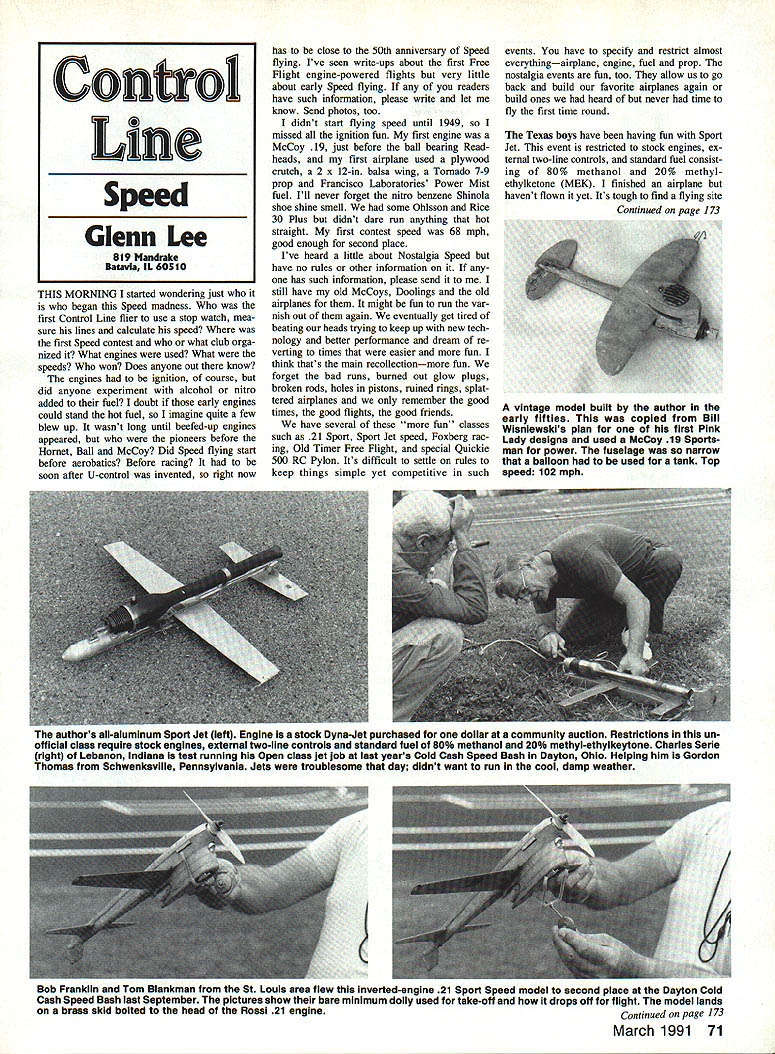
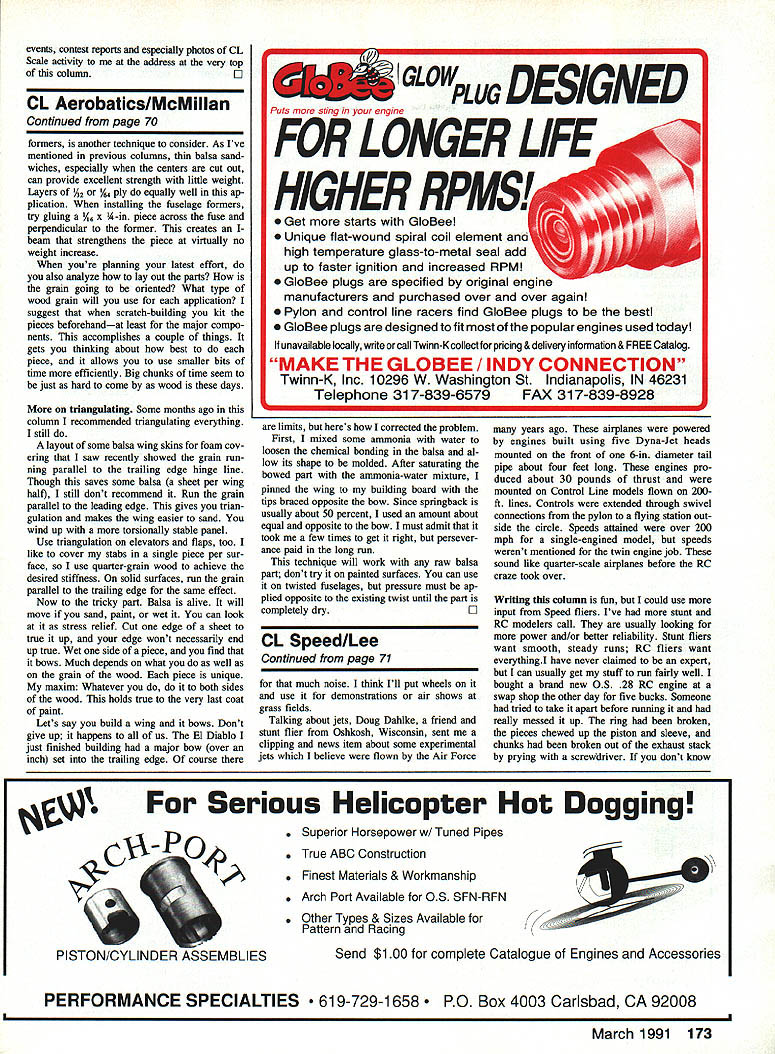
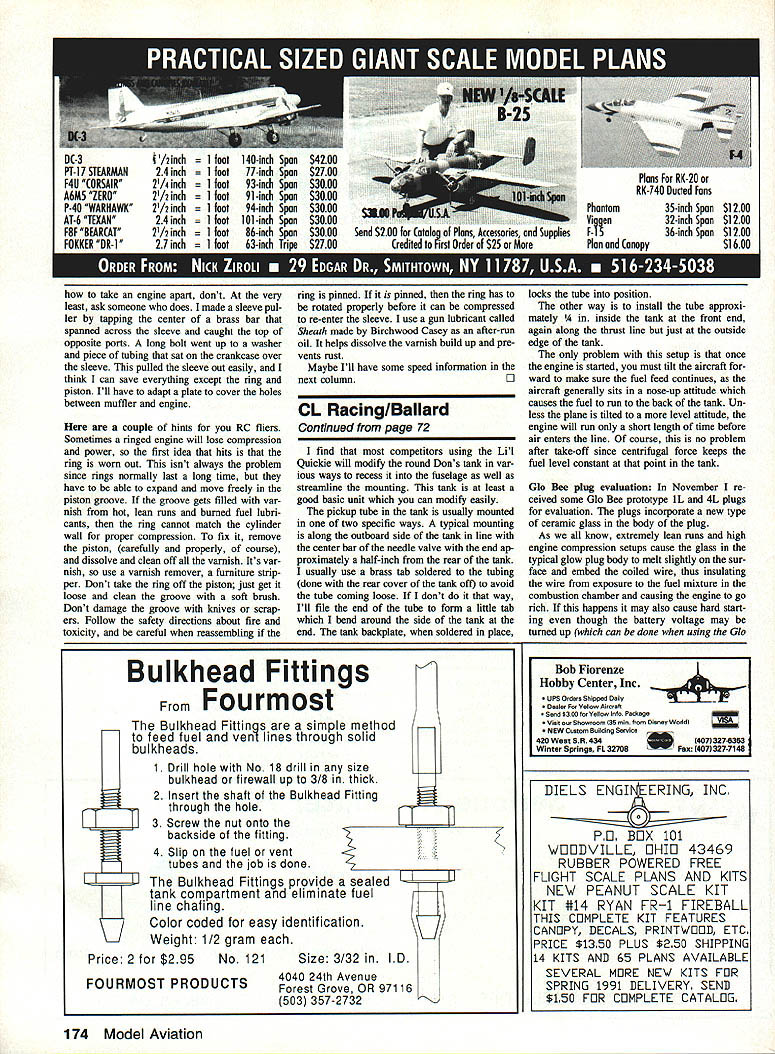
The Texas boys have been having fun with Sport Jet. This event is restricted to stock engines, external two-line controls, and standard fuel consisting of 80% methanol and 20% methyl ethyl ketone (MEK). I finished an airplane but haven't flown it yet. It's tough to find a flying site for that much noise. I think I'll put wheels on it and use it for demonstrations or air shows or grass fields.
Experimental jets and high speeds
Talking about jets, Doug Dahlke, a friend and test flier from Oshkosh, Wisconsin, sent me a clipping and news item about some experimental jets which I believe were flown by the Air Force many years ago. These airplanes were powered by engines built using five Dyna-Jet heads mounted on the front of one 6-in. diameter tailpipe about four feet long. The engines produced about 30 pounds of thrust and were mounted on Control Line models flown on 200-ft lines. Controls were extended through swivel joints from the pilot to a flying station outside the circle. Speeds attained were over 200 mph for a single-engined model, but speeds weren't mentioned for the twin-engine job. These sounded like quarter-scale airplanes before the RC craze took over.
Writing this column is fun, but I could use more input from Speed fliers. I've had more stunt and RC modelers call. They are usually looking for more power and/or better reliability. Sport fliers want smooth, steady runs; RC fliers want speed. I have never claimed to be an expert, but I can usually get my stuff to run fairly well.
I bought a brand-new O.S. .28 RC engine at a swap shop the other day for five bucks. Someone had tried to take it apart before running it and had really messed it up. The ring had been broken, the pieces chewed up inside the sleeve and chunks had been broken out of the exhaust stack by prying with a screwdriver. If you don't know how to take an engine apart, don't. At the very least, ask someone who does.
I made a sleeve puller by tapping the center of a brass bar that spanned across the sleeve and caught the top of opposite ports. A long bolt went up to a washer and a piece of tubing that sat on the crankcase over the sleeve. This pulled the sleeve out easily, and I think I can save everything except the ring and piston. I'll have to adapt a plate to cover the holes between muffler and engine.
Hints for RC fliers
Sometimes a ringed engine will lose compression and power, but the first idea that hits is that the ring is worn or out. This isn't always the problem since rings normally last a long time, but they have to be able to expand and move freely in the piston groove. If the groove gets filled with varnish from hot, lean runs and burned fuel lubricants, then the ring cannot match the cylinder wall for proper compression.
To fix it:
- Remove the piston (carefully and properly, of course).
- Dissolve and clean off all the varnish — it's varnish, so use a varnish remover or a furniture stripper.
- Don't take the ring off the piston; just get it loose and clean the groove with a soft brush.
- Don't damage the groove with knives or scrapers.
- Follow safety directions about fire and toxicity, and be careful when reassembling.
If the ring is pinned, then the ring has to be rotated properly before it can be compressed to reenter the sleeve. I use a gun lubricant called Sheath, made by Birchwood Casey, as an after-run oil. It helps dissolve the varnish buildup and prevents rust.
Maybe I'll have some speed information in the next column.
Transcribed from original scans by AI. Minor OCR errors may remain.

