
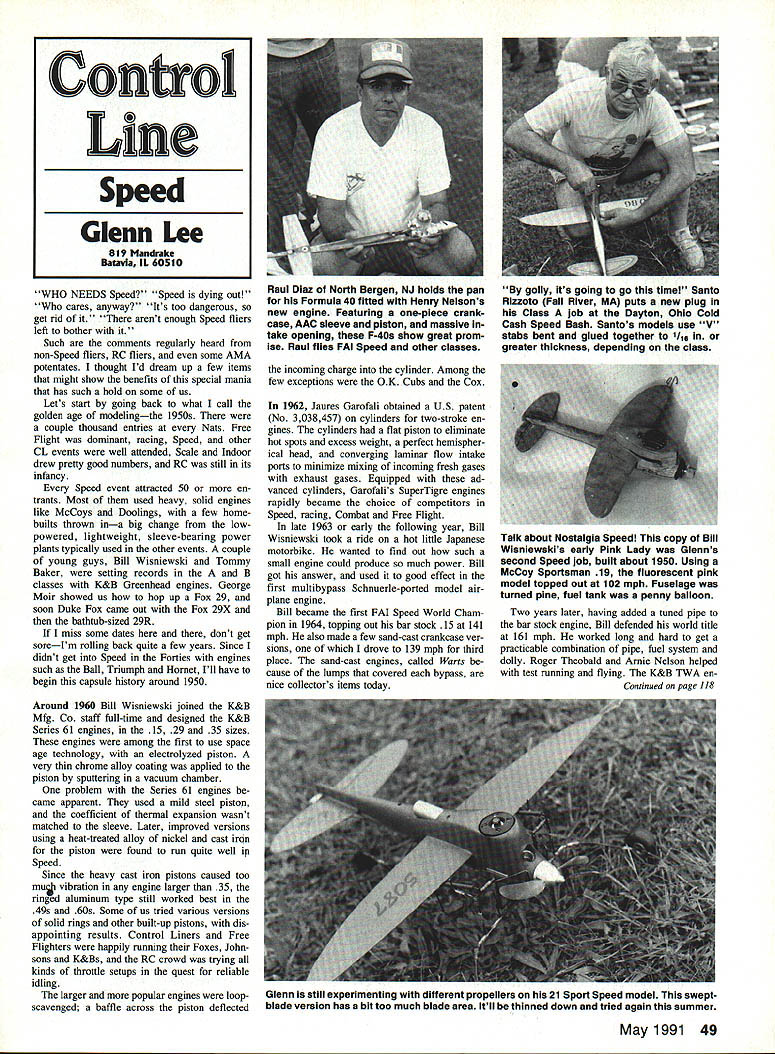
Control Line: Speed
By Glenn Lee
819 Mandrake Batavia, IL 60510
- "WHO NEEDS Speed?"
- "Speed is dying out!"
- "Who cares, anyway?"
- "It's too dangerous, get rid of it."
- "There aren't enough Speed fliers left to bother with it..."
Such are the comments regularly heard from non-Speed fliers, RC fliers, and even some AMA potentates. I thought I'd dream up a few items that might show the benefits of this special mania that has such a hold on some of us.
Let's start by going back to what I call the golden age of modeling—the 1950s. There were a couple thousand entries at every Nats. Free Flight was dominant; racing, Speed, and other CL events were well attended. Scale and Indoor drew pretty good numbers, and RC was still in its infancy.
Every Speed event attracted 50 or more entrants. Most of them used heavy, solid engines like McCoys and Doolings, with a few homebuilts thrown in—a big change from the low-powered, lightweight, sleeve-bearing power plants typically used in the other events. A couple of young guys, Bill Wisniewski and Tommy Baker, were setting records in the A and B classes with K&B Greenhead engines. George Moir showed us how to hop up a Fox 29, and soon Duke Fox came out with the Fox 29X and then the bathtub-sized 29R.
I'm rolling back quite a few years. Since I didn't get into Speed in the Forties engines such as the Ball, Triumph and Hornet, I'll have to begin this capsule history around 1950.
Around 1960 Bill Wisniewski joined the K&B Mfg. Co. staff full-time and designed the K&B Series 61 engines, in the .15, .29 and .35 sizes. These engines were among the first to use space-age technology, with an electrolyzed piston. A very thin chrome-alloy coating was applied to the piston by sputtering in a vacuum chamber.
One problem with the Series 61 engines became apparent. They used a mild steel piston, and the coefficient of thermal expansion wasn't matched to the sleeve. Later, improved versions using a heat-treated alloy of nickel and cast iron for the piston were found to run quite well in Speed.
Since the heavy cast-iron pistons caused too much vibration in any engine larger than .35, the ringed aluminum type still worked best in the .49s and .60s. Some of us tried various versions of solid rings and other built-up pistons, with disappointing results. Control liners and Free Flighters happily ran their Foxes, Johnsons and K&Bs, and the RC crowd was trying all kinds of throttle setups in the quest for reliable idling. The larger and more popular engines were loop-scavenged; a baffle across the piston deflected the incoming charge into the cylinder. Among the few exceptions were the O.K. Cubs and the Coxs.
In 1962, Jaures Garofali obtained a U.S. patent (No. 3,038,457) on cylinders for two-stroke engines. The cylinders had a flat piston to eliminate hot spots and excess weight, a perfect hemispherical head, and converging laminar-flow intake ports to minimize mixing of incoming fresh gases with exhaust gases. Equipped with the advanced cylinders, Garofali's SuperTigre engines rapidly became the choice of competitors in Speed, Racing, Combat and Free Flight.
In late 1963 or early the following year, Bill Wisniewski took a ride on a hot little Japanese motorbike. He wanted to find out how such a small engine could produce so much power. Bill got his answer and used it to good effect in the first multi-bypass Schnuerle-ported model airplane engine. Bill became the first FAI Speed World Champion in 1964, topping out his bar-stock .15 at 141 mph. He also made a few sand-cast crankcase versions, one of which I drove to 139 mph for third place. The sand-cast engines, called "Warts" because of the lumps that covered each bypass, are nice collector's items today.
Two years later, having added a tuned pipe to the bar-stock engine, Bill defended his world title at 161 mph. He worked long and hard to get a practicable combination of pipe, fuel system and dolly. Roger Theobald and Arnie Nelson helped test running and flying. The K&B TWA engines that resulted were to dominate FAI Speed for the next several years.
Many of us Speed fliers were constantly trying to improve our engines, not only to make them go faster but to extend limited life and maximize reliability. We tried a pack of ideas—odd head shapes, odd porting arrangements, even chrome-, gold- and silver-plated pistons and sleeves. A chrome-plated piston runs very well in a silver-plated sleeve. Most of our experiments, however, were less successful.
About this time, Garofali received a letter from his good friend Dick Hall, a rocket engineer and fellow Speed flier from Athens, Alabama. Hall urged Garofali to try a new aluminum alloy called Vanasil for his pistons. Vanasil contains approximately 22 percent silicon and has nearly the same coefficient of thermal expansion as cast iron. The sleeve, of course, had to be chrome-plated to prevent galling. (I believe it was Harry Roe, from Centerville, Ohio, who said: "If you're going to chrome plate it, you might as well make it out of brass!")
In my opinion this combination of Vanasil pistons and chrome-plated sleeves was one of the most important developments ever in small-engine design. The matched thermal expansion between sleeve and piston resulted in greater engine life, greater performance and reduced break-in time. With the use of lapped-piston .65 engines, speeds in Class D jumped about 30 mph. Tuned pipes brought a lot more power, too, but the parts of the bigger engines just couldn't take the stresses—we blew up an awful lot of them!
What am I getting at with all this reminiscence? Well, just take a look at any of the top RC engines available today. Many of the features that RC fliers take for granted are the result of thinking and experimenting on the part of a few Control Line Speed fliers:
- High-speed, long-life ball bearings
- Schnuerle porting
- Squish-band combustion chambers
- ABC or AAC sleeves and pistons (some pistons with Dykes rings)
- Strong, rigid crankcases
- Advanced metallurgy that gives hundreds of hours of top performance
Ten years after Bill Wisniewski pioneered it in a Speed engine, Schnuerle porting was tried in the RC world. And it took the RC world about 20 years to discover how well tuned pipes work. Few modelers today are aware of the debt they owe to Speed flying.
We're not finished yet! Though most of us are growing gray around the temples and our ranks are thinning out, we Speed guys still have a few more things to try—ceramic bearings and metal matrix materials, to name a few.
Transcribed from original scans by AI. Minor OCR errors may remain.

