
Control Line: Speed
Glenn Lee
819 Mandrake Batavia, IL 60510
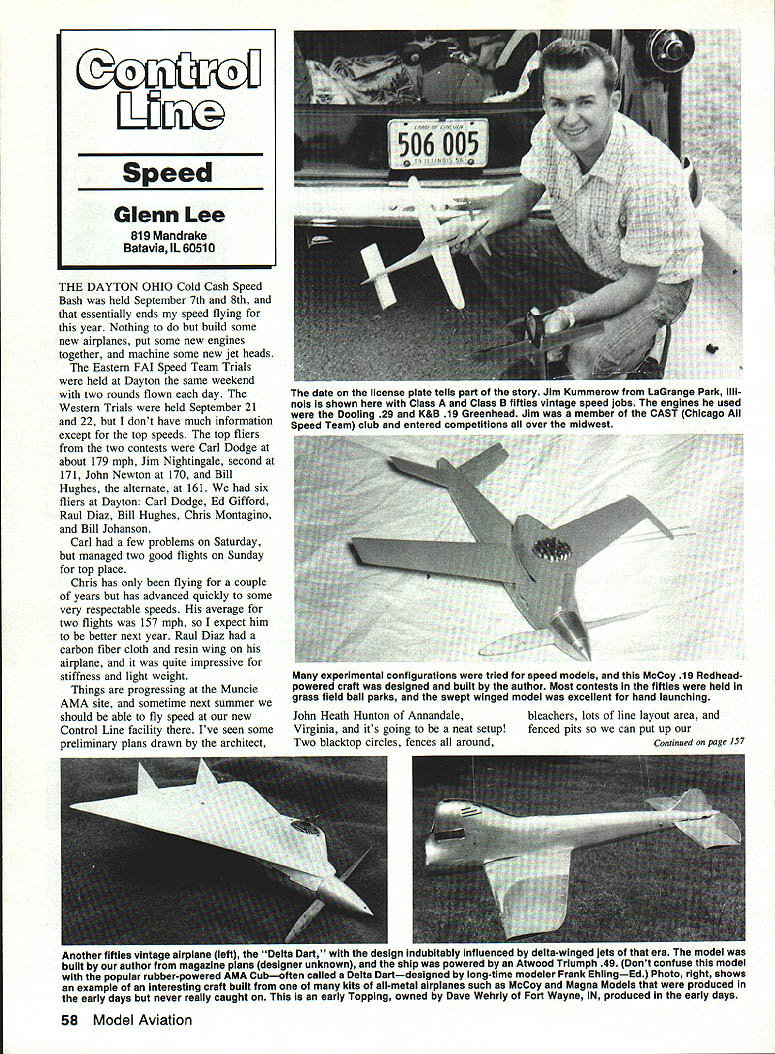
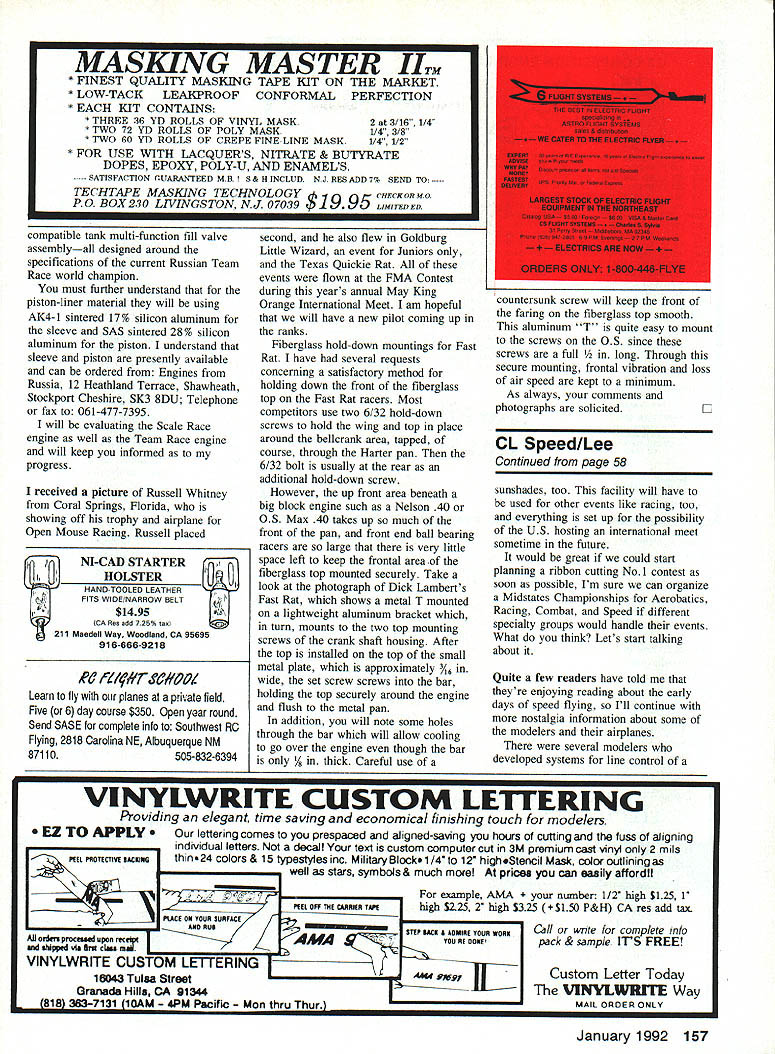
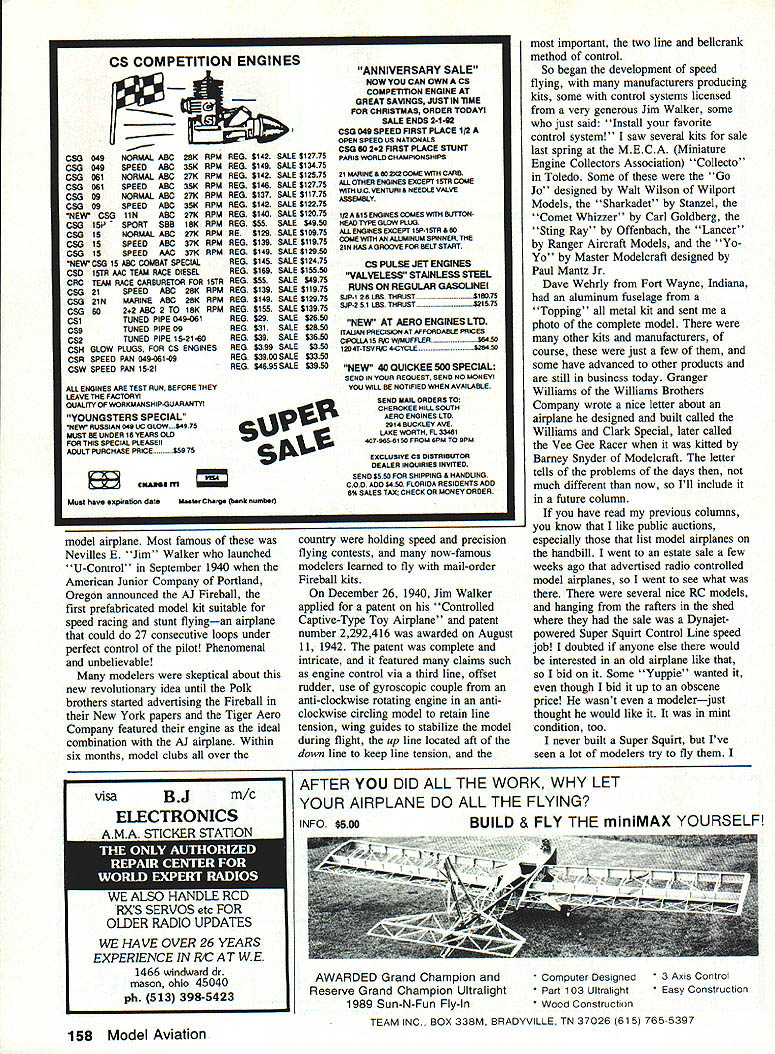
The Dayton, Ohio Cold Cash Speed Bash was held September 7–8, and that essentially ends my speed flying for this year. Nothing to do but build some new airplanes, put some new engines together, and machine some new jet heads.
The Eastern FAI Speed Team Trials were held at Dayton the same weekend, with two rounds flown each day. The Western Trials were held September 21–22; I don't have many details from that meet, only the top speeds:
- Carl Dodge — about 179 mph (Western top)
- Jim Nightingale — 171 mph
- John Newton — 170 mph
- Bill Hughes (alternate) — 161 mph
We had six fliers at Dayton: Carl Dodge, Ed Gifford, Raul Diaz, Bill Hughes, Chris Montagino, and Bill Johanson. Carl had a few problems on Saturday but managed two good flights on Sunday for top place.
Chris has only been flying for a couple of years but has advanced quickly to some very respectable speeds. His average for two flights was 157 mph, so I expect him to be better next year. Raul Diaz had a carbon-fiber cloth-and-resin wing on his airplane, and it was quite impressive for stiffness and light weight.
Things are progressing at the Muncie AMA site, and sometime next summer we should be able to fly speed at our new control-line facility there. I've seen some preliminary plans drawn by the architect John Heath Hunton of Annandale, Virginia, and it's going to be a neat setup: two blacktop circles, fences all around, bleachers, lots of line-layout area, and fenced pits so we can put up our sunshades. This facility will have to be used for other events like racing, too, and everything is set up for the possibility of the U.S. hosting an international meet sometime in the future.
It would be great if we could start planning a ribbon-cutting No. 1 contest as soon as possible. I'm sure we can organize a Midwest Championships for Aerobatics, Racing, Combat, and Speed if different specialty groups would handle their events. What do you think? Let's start talking about it.
Quite a few readers have told me that they're enjoying reading about the early days of speed flying, so I'll continue with some nostalgia about some of the modelers and their airplanes.
Early days and the birth of U-Control
There were several modelers who developed systems for line control of a model airplane. Most famous of these was Neville E. "Jim" Walker, who launched "U-Control" in September 1940 when the American Junior Company of Portland, Oregon announced the AJ Fireball — the first prefabricated model kit suitable for speed racing and stunt flying. The Fireball was reputed to do 27 consecutive loops under perfect control of the pilot.
Many modelers were skeptical about this new revolutionary idea until the Polk brothers started advertising the Fireball in their New York papers and the Tiger Aero Company featured their engine as the ideal combination with the AJ airplane. Within six months, model clubs all over the country were holding speed and precision flying contests, and many now-famous modelers learned to fly with mail-order Fireball kits.
On December 26, 1940, Jim Walker applied for a patent on his "Controlled Captive-Type Toy Airplane"; patent number 2,292,416 was awarded on August 11, 1942. The patent was intricate and featured many claims, including:
- Engine control via a third line
- Offset rudder
- Use of gyroscopic couple from an anti-clockwise rotating engine in an anti-clockwise circling model to retain line tension
- Wing guides to stabilize the model during flight
- The up line located aft of the down line to keep line tension
- The two-line and bellcrank method of control
So began the development of speed flying, with many manufacturers producing kits — some with control systems licensed from Jim Walker, some that instructed builders to "install your favorite control system!"
Kits and manufacturers
I saw several kits for sale last spring at the M.E.C.A. (Miniature Engine Collectors Association) "Collecto" in Toledo. Some of the kits and designs I noted were:
- "Go Jo" — designed by Walt Wilson of Willport Models
- "Sharkdarter" — by Stanetz
- "Comet Whizzer" — by Carl Goldberg
- "Sting Ray" — by Offenbach
- "Lancer" — by Ranger Aircraft Models
- "Yo-Yo" — by Master Modelcraft, designed by Paul Mantz Jr.
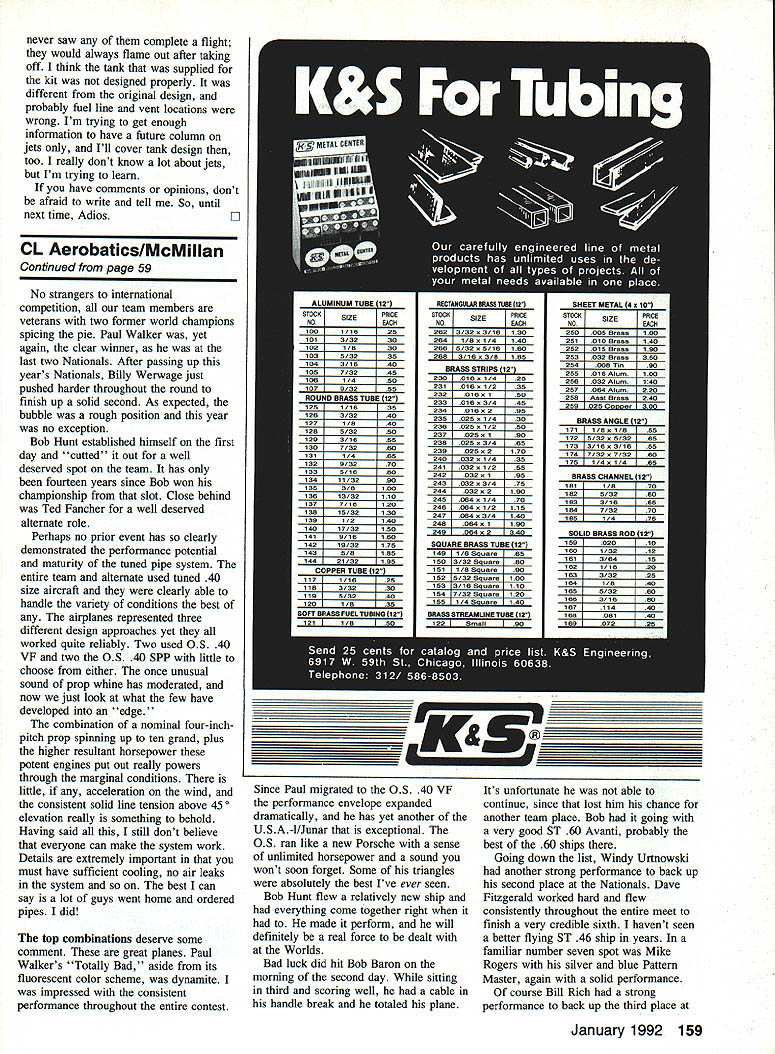
Dave Wehrly of Fort Wayne, Indiana, had an aluminum fuselage from a "Topping" all-metal kit and sent me a photo of the complete model. There were many other kits and manufacturers, of course; these were just a few, and some have advanced to other products and are still in business today. Grainger Williams of the Williams Brothers Company wrote a nice letter about an airplane he designed and built called the Williams and Clark Special, later called the Vee Gee Racer when it was kitted by Barney Snyder of Modelcraft. The letter tells of the problems of the day — not much different than now — so I'll include it in a future column.
Auction anecdote and jets
If you have read my previous columns, you know that I like public auctions, especially those that list model airplanes on the handbill. I went to an estate sale a few weeks ago that advertised radio-controlled model airplanes, so I went to see what was there. There were several nice RC models, and hanging from the rafters in the shed where they had the sale was a Dynajet-powered Super Squirt control-line model. I doubted if anyone else there would be interested in an old airplane like that, so I bid on it. Some "yuppie" wanted it too, even though I bid it up to an obscene price. He wasn't even a modeler — just thought he would like it. It was in mint condition.
I never built a Super Squirt, but I've seen a lot of modelers try to fly them. I never saw any of them complete a flight; they would always flame out after taking off. I think the tank that was supplied for the kit was not designed properly. It differed from the original design and probably had incorrect fuel-line and vent locations. I'm trying to get enough information to have a future column on jets only, and I'll cover tank design then. I really don't know a lot about jets yet, but I'm trying to learn.
If you have comments or opinions, don't be afraid to write and tell me. So, until next time, adios.
Transcribed from original scans by AI. Minor OCR errors may remain.

