
Control Line: Speed
Glenn Lee
819 Mandrake Batavia, IL 60510
One nice thing about writing this column is meeting and hearing from new people. Many of them are previous speed fliers who want to get back to flying, and most of them want to know where to buy equipment. I refer all of them to the North American Speed Society. The NASS newsletter, Speed Times, is put out by Chris Sackett and features ads and a list of parts suppliers. His address is Box 82294, North Burnaby, B.C., Canada V5C 5P7. Dues are only $20 a year ($22 if paid by check), and it's well worth it. Other features in the newsletter are photos, contest lists, contest results, articles, and other relevant information.
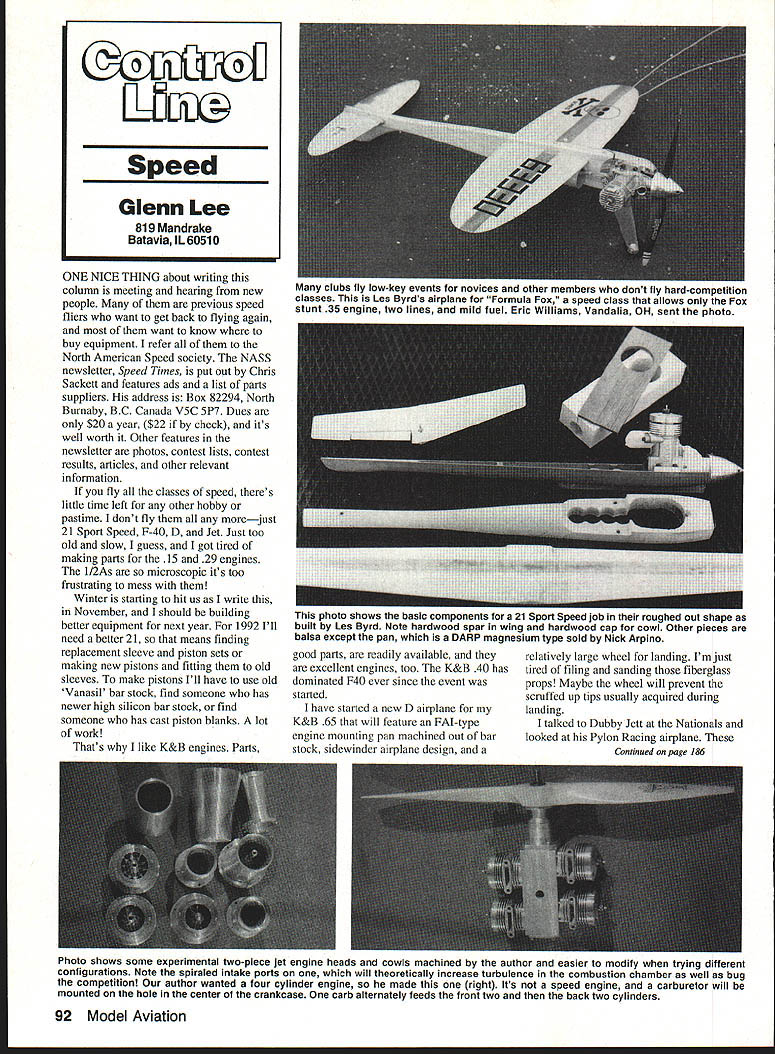
If you fly all the classes of speed, there's little time left for any other hobby or pastime. I don't fly them all any more — just 21 Sport Speed, F-40, D, and Jet. I'm just too old and slow, I guess, and I got tired of making parts for the .15 and .29 engines. The 1/2As are so microscopic it's too frustrating to mess with them!
Equipment and Engines
Winter is starting to hit us as I write this in November, and I should be building better equipment for next year. For 1992 I'll need a better .21, which means finding replacement sleeve and piston sets or making new pistons and fitting them to old sleeves. To make pistons I'll have to use old "Vanasil" bar stock, find someone who has newer high-silicon bar stock, or find someone who has cast piston blanks. A lot of work!
That's why I like K&B engines. Parts — good parts — are readily available, and they are excellent engines, too. The K&B .40 has dominated F-40 ever since the event was started.
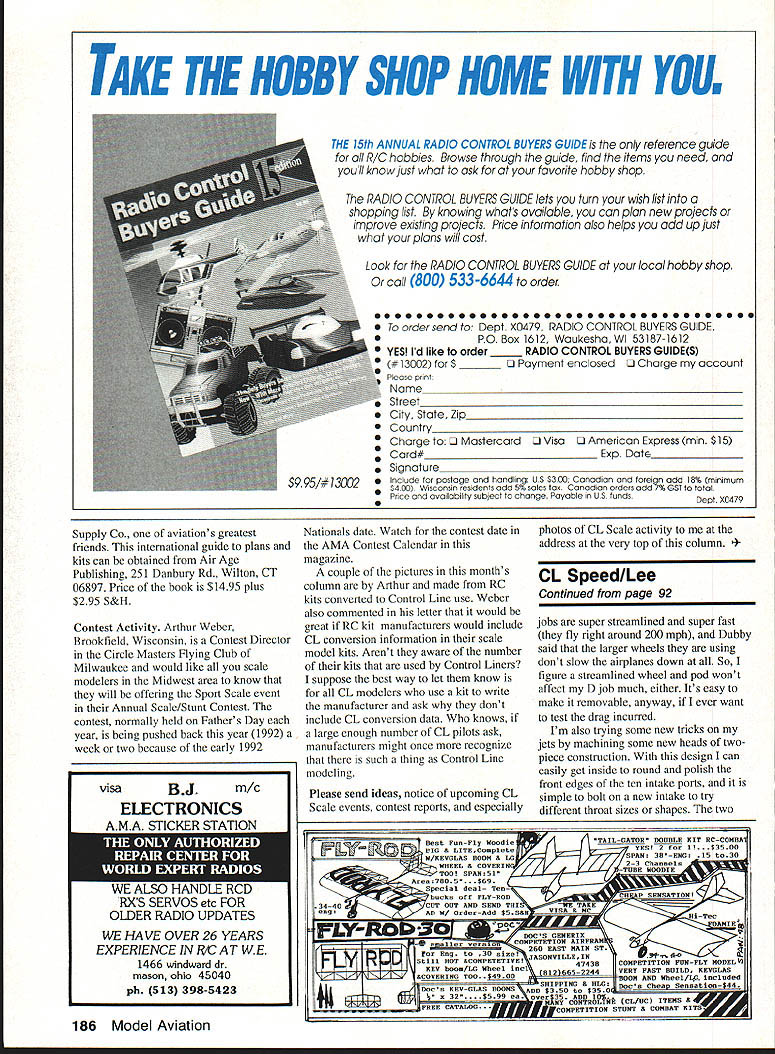
I have started a new D airplane for my K&B .65 that will feature an FAI-type engine mounting pan machined out of bar stock, a sidewinder airplane design, and a relatively large wheel for landing. I'm just tired of filing and sanding those fiberglass props! Maybe the wheel will prevent the scruffed-up tips usually acquired during landing.
I talked to Dubby Jett at the Nationals and looked at his pylon-racing airplane. These jobs are super streamlined — super fast — flying right around 200 mph, Dubby said. Larger wheels, he said, don't slow airplanes down. So a streamlined wheel pod won't affect a D job much either. It's easy to make removable anyway if you want to test the drag incurred.
Jet Work and Ideas
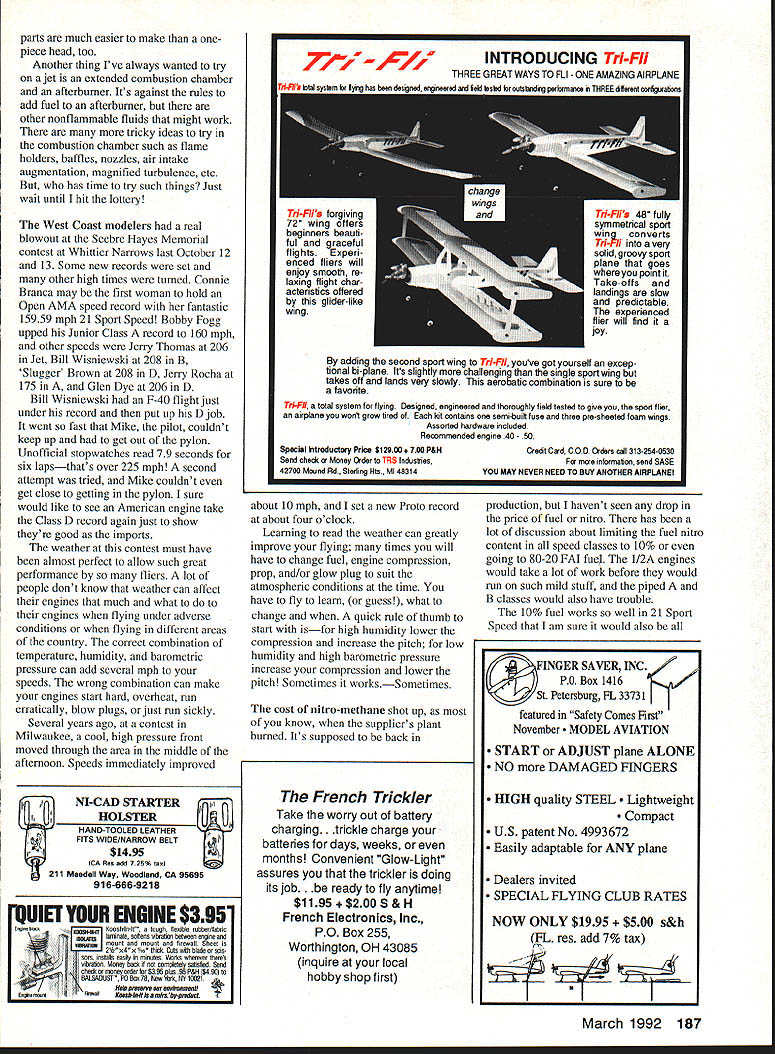
I'm also trying some new tricks on my jets by machining new two-piece heads. With this design I can easily get inside to round and polish the front edges of the ten intake ports, and it is simple to bolt on a new intake to try different throat sizes or shapes. The two-piece heads are much easier to make than a one-piece head, too.
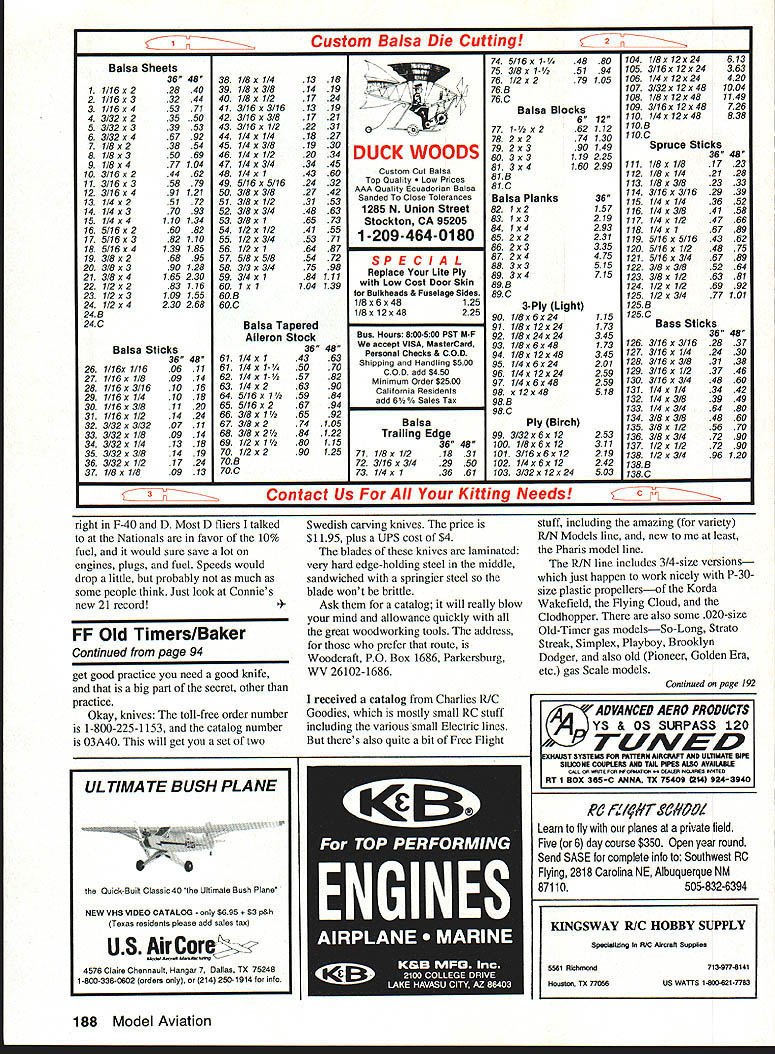
Another thing I've always wanted to try on a jet is an extended combustion chamber and an afterburner. It's against the rules to add fuel to an afterburner, but there are other nonflammable fluids that might work. There are many more tricky ideas to try in the combustion chamber such as flame holders, baffles, nozzles, air-intake augmentation, magnified turbulence, etc. But who has time to try such things? Just wait until I hit the lottery!
Sechre Hayes Memorial Contest (Whittier Narrows)
The West Coast modelers had a real blowout at the Sechre Hayes Memorial contest at Whittier Narrows last October 12–13. Some new records were set and many other high times were turned. Notable performances included:
- Connie Branca — possibly the first woman to hold an Open AMA speed record with a fantastic 159.59 mph in 21 Sport Speed.
- Bobby Fogg — upped his Junior Class A record to 160 mph.
- Jerry Thomas — 206 mph in Jet.
- Bill Wisniewski — 208 mph in B.
- "Slugger" Brown — 208 mph in D.
- Jerry Rocha — 175 mph in A.
- Glen Dye — 206 mph in D.
Bill Wisniewski had an F-40 flight just under his record and then put up his D job. It went so fast that Mike, the pilot, couldn't keep up and had to get out of the pylon. Unofficial stopwatches read 7.9 seconds for six laps — that's over 225 mph! A second attempt was tried, and Mike couldn't even get close to getting in the pylon. I sure would like to see an American engine take the Class D record again just to show they're as good as the imports.
The weather at this contest must have been almost perfect to allow such great performance by so many fliers.
Weather and Performance
A lot of people don't know that weather can affect their engines that much and what to do to their engines when flying under adverse conditions or when flying in different areas of the country. The correct combination of temperature, humidity, and barometric pressure can add several mph to your speeds. The wrong combination can make your engines start hard, overheat, run erratically, blow plugs, or just run sickly.
Several years ago at a contest in Milwaukee, a cool, high-pressure front moved through the area in the middle of the afternoon. Speeds immediately improved about 10 mph, and I set a new Proto record at about four o'clock.
Learning to read the weather can greatly improve your flying; many times you will have to change fuel, engine compression, prop, and/or glow plug to suit the atmospheric conditions at the time. You have to fly to learn (or guess!) what to change and when. A quick rule of thumb to start with:
- For high humidity: lower the compression and increase the pitch.
- For low humidity and high barometric pressure: increase your compression and lower the pitch.
Sometimes it works... sometimes.
Fuel and Nitro Discussion
The cost of nitromethane shot up, as most of you know, when the supplier's plant burned. It's supposed to be back in production, but I haven't seen any drop in the price of fuel or nitro. There has been a lot of discussion about limiting the fuel nitro content in all speed classes to 10% or even going to 80–20 FAI fuel. The 1/2A engines would take a lot of work before they would run on such mild stuff, and the piped A and B classes would have trouble. It would be right in F-40 and D. Most D fliers I talked to at the Nationals are in favor of the 10% fuel, and it would sure save a lot on engines, plugs, and fuel. Speeds would drop a little, but probably not as much as some people think. Just look at Connie's new .21 record!
Transcribed from original scans by AI. Minor OCR errors may remain.

