
Control Line: Speed
Glenn Lee 819 Mandrake Batavia, IL 60510
Introduction
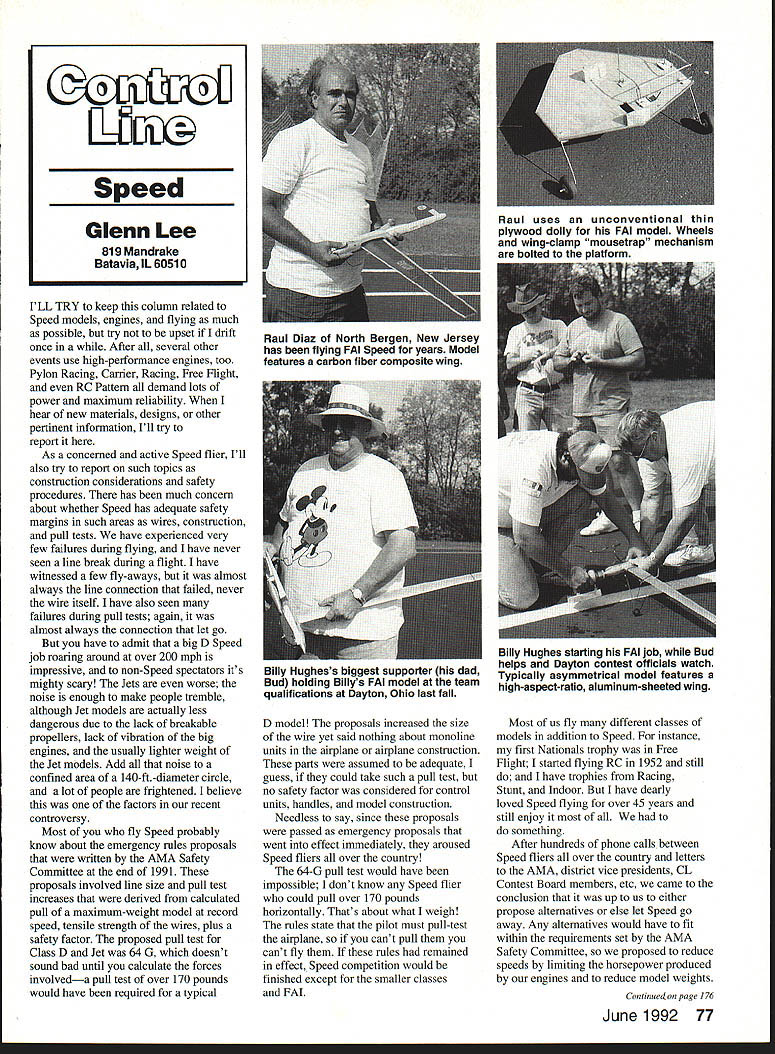
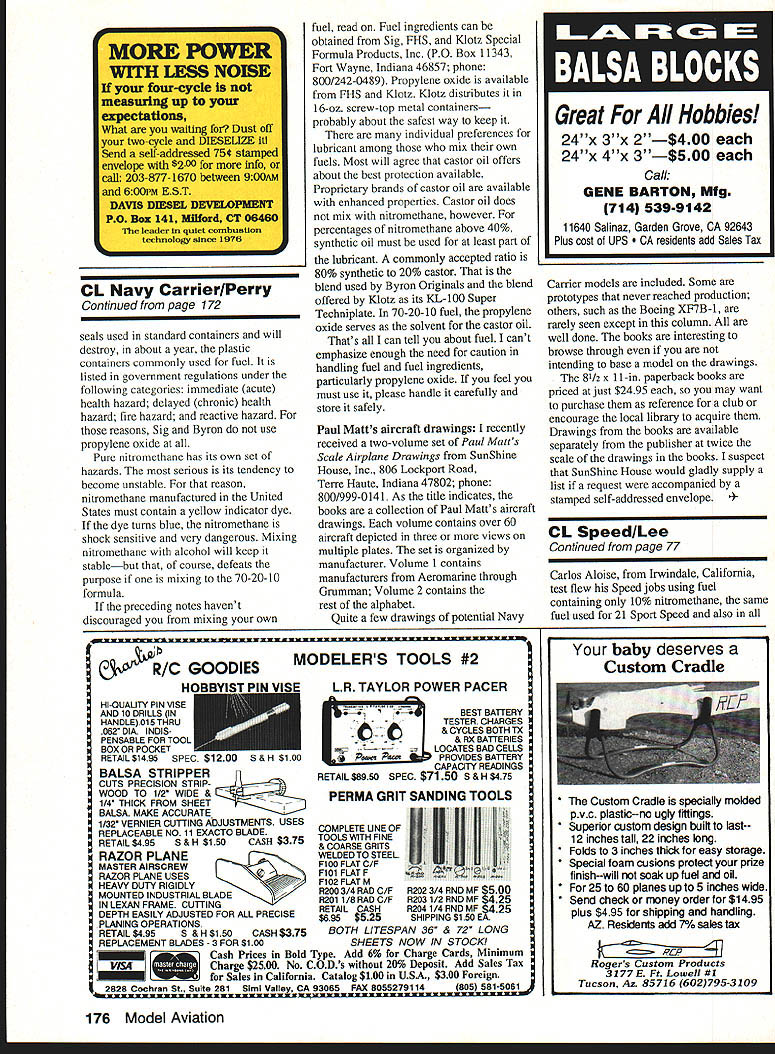
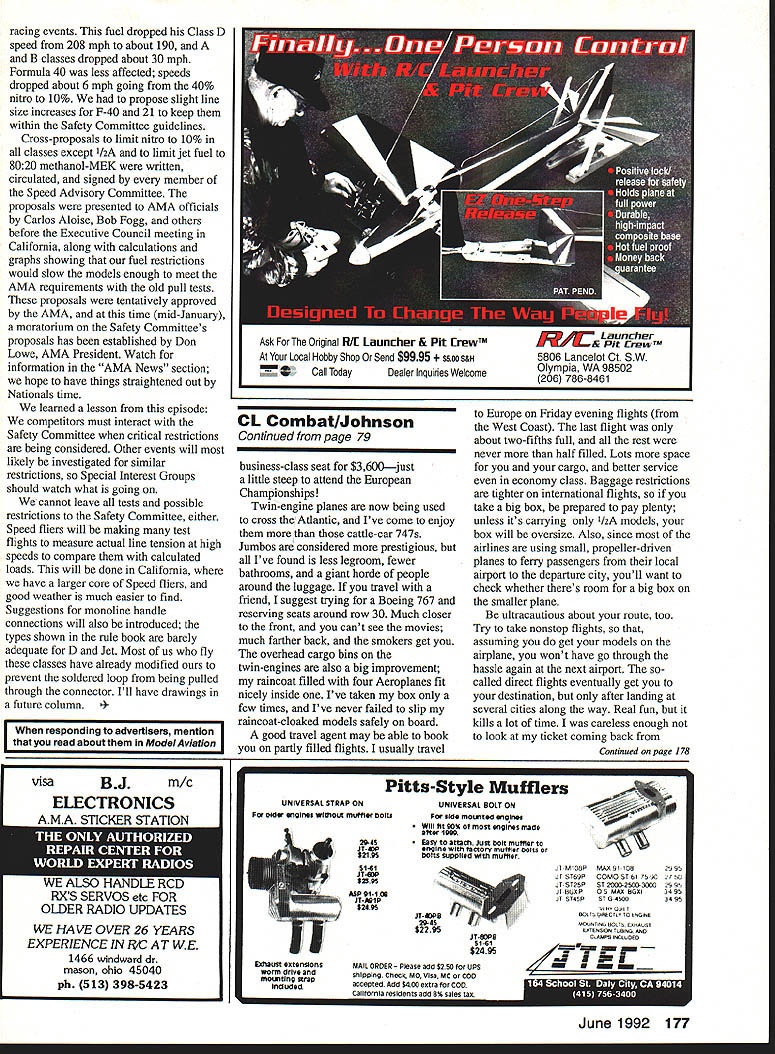
I'll try to keep this column related to Speed models, engines, and flying as much as possible, but try not to be upset if I drift once in a while. After all, several other events use high-performance engines, too. Pylon racing, carrier racing, free flight, and even RC pattern all demand lots of power and maximum reliability. When I hear of new materials, designs, or other pertinent information, I'll try to report it here.
As a concerned and active Speed flier, I'll also try to report on such topics as construction considerations and safety procedures.
Safety concerns and failures
There has been much concern about whether Speed has adequate safety margins in areas such as wires, construction, and pull tests. We have experienced very few failures during flying, and I have never seen a line break during a flight. I have witnessed a few fly-aways, but it was almost always the line connection that failed, never the wire itself. I have also seen many failures during pull tests; again, it was almost always the connection that let go.
You have to admit that a big D Speed job roaring at over 200 mph is impressive, and to non-Speed spectators it's mighty scary. The jets are even worse—the noise is enough to make people tremble—although jet models are actually less dangerous due to the lack of breakable propellers, reduced vibration from the big engines, and the usually lighter weight of jet models. Add that noise to a confined area of a 140-ft.-diameter circle, and a lot of people are frightened. I believe this was one of the factors in our recent controversy.
AMA emergency proposals
Most of you who fly Speed probably know about the emergency rules proposals that were written by the AMA Safety Committee at the end of 1991. These proposals involved line size and pull-test increases that were derived from calculated pull of a maximum-weight model at record speed, tensile strength of wires, plus a safety factor.
- The proposed pull test for Class D Jet was 64 G, which doesn't sound bad until you calculate the forces involved — a pull test of over 170 pounds would have been required for a typical D model.
- The proposals increased the size of the wire yet said nothing about monoline units in the airplane or airplane construction. These parts were assumed to be adequate — apparently the committee assumed they could take such a pull test. But no safety factor was considered for control units, handles, and model construction.
Needless to say, since these proposals were passed as emergency proposals that went into effect immediately, they aroused Speed fliers all over the country.
The 64-G pull test would have been impossible; I don't know any Speed flier who could pull over 170 pounds horizontally. That's about what I weigh! The rules state that the pilot must pull-test the airplane, so if you can't pull, you can't fly. If these rules had remained in effect, Speed competition would have been finished except for the smaller classes and FAI.
Our response and proposed alternatives
Most of us fly many different classes of models in addition to Speed. For instance, my first Nationals trophy was in free flight; I started flying RC in 1952 and still do; and I have trophies from racing, stunt, and indoor. But I have dearly loved Speed flying for over 45 years and still enjoy it most of all. We had to do something.
After hundreds of phone calls between Speed fliers all over the country and letters to the AMA, district vice presidents, CL Contest Board members, etc., we concluded it was up to us to either propose alternatives or let Speed go away. Any alternatives would have to fit within the requirements set by the AMA Safety Committee, so we proposed to reduce speeds by:
- Limiting the horsepower produced by our engines.
- Reducing model weights.
Carlos Aloise, from Irwindale, California, test-flew his Speed jobs using fuel containing only 10% nitromethane, the same fuel used for 21 Sport Speed and also in all racing events. This fuel dropped his Class D speed from 208 mph to about 190, and A and B classes dropped about 30 mph. Formula 40 was less affected; speeds dropped about 6 mph going from 40% nitro to 10%. We had to propose slight line size increases for F-40 and 21 to keep them within the Safety Committee guidelines.
Cross-proposals to limit nitro to 10% in all classes except 1/2A and to limit jet fuel to 80:20 methanol-MEK were written, circulated, and signed by every member of the Speed Advisory Committee. The proposals were presented to AMA officials by Carlos Aloise, Bob Fogg, and others before the Executive Council meeting in California, along with calculations and graphs showing that our fuel restrictions would slow the models enough to meet the AMA requirements with the old pull tests.
Outcome and lessons learned
These proposals were tentatively approved by the AMA, and at this time (mid-January) a moratorium on the Safety Committee's proposals has been established by Don Lowe, AMA President. Watch for information in the "AMA News" section; we hope to have things straightened out by Nationals time.
We learned a lesson from this episode: competitors must interact with the Safety Committee when critical restrictions are being considered. Other events will most likely be investigated for similar restrictions, so Special Interest Groups should watch what is going on.
We cannot leave all tests and possible restrictions to the Safety Committee, either. Speed fliers will be making many test flights to measure actual line tension at high speeds to compare with calculated loads. This will be done in California, where we have a larger core of Speed fliers and good weather is much easier to find.
Suggestions for monoline handle connections will also be introduced; the types shown in the rule book are barely adequate for D and Jet. Most of us who fly these classes have already modified ours to prevent the soldered loop from being pulled through the connector. I'll have drawings in a future column.
Transcribed from original scans by AI. Minor OCR errors may remain.

