
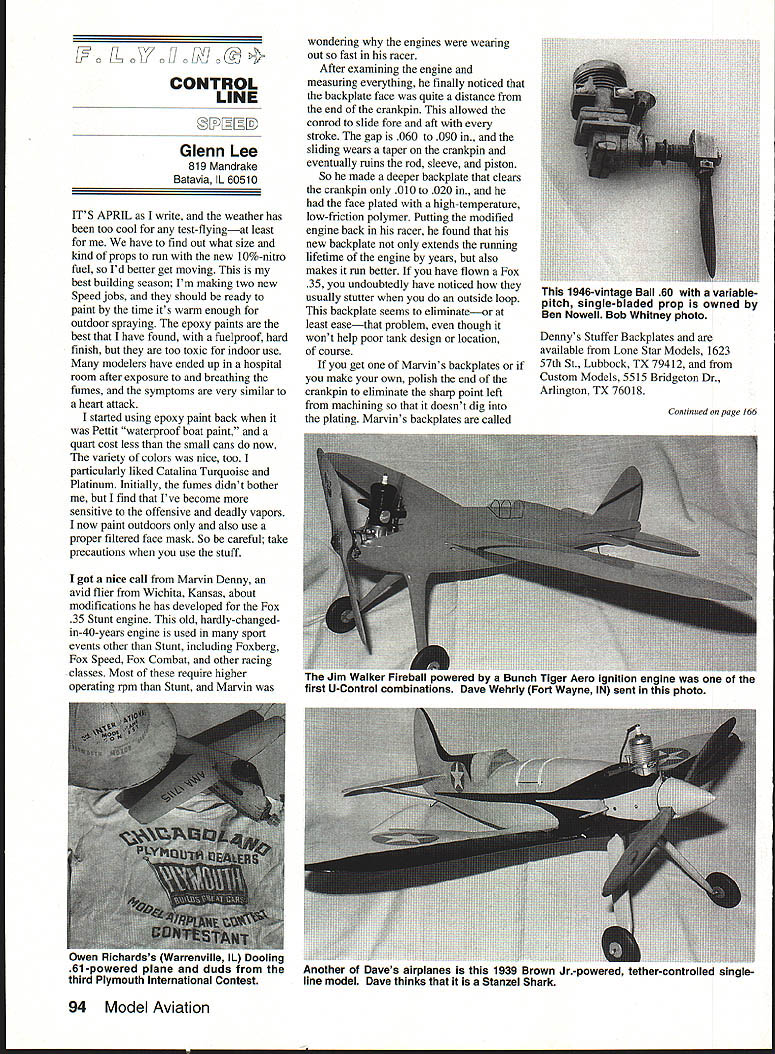
Control Line: Speed
Glenn Lee 819 Mandrake Batavia, IL 60510
Epoxy paint and safety
It's April as I write, and the weather has been too cool for any test-flying—at least for me. We have to find out what size and kind of props to run with the new 10%-nitro fuel, so I'd better get moving. This is my best building season; I'm making two new Speed jobs, and they should be ready to paint by the time it's warm enough for outdoor spraying.
The epoxy paints are the best that I have found, with a fuelproof, hard finish, but they are too toxic for indoor use. Many modelers have ended up in a hospital room after exposure to and breathing the fumes, and the symptoms are very similar to a heart attack. I started using epoxy paint back when it was Pettit "waterproof boat paint", and a quart cost less than the small cans do now. The variety of colors was nice, too. I particularly liked Catalina Turquoise and Platinum.
Initially, the fumes didn't bother me, but I find that I've become more sensitive to the offensive and deadly vapors. I now paint outdoors only and also use a proper filtered face mask. So be careful; take precautions when you use the stuff.
Fox .35 Stunt engine modification
I got a nice call from Marvin Denny, an avid flier from Wichita, Kansas, about modifications he has developed for the Fox .35 Stunt engine. This old, hardly-changed-in-40-years engine is used in many sport events other than Stunt, including Foxberg, Fox Speed, Fox Combat, and other racing classes. Most of these require higher operating rpm than Stunt, and Marvin was wondering why the engines were wearing out so fast in his racer.
After examining the engine and measuring everything, he finally noticed that the backplate face was quite a distance from the end of the crankpin. This allowed the conrod to slide fore and aft with every stroke. The gap is 0.060 to 0.090 in., and the sliding wears a taper on the crankpin and eventually ruins the rod, sleeve, and piston. So he made a deeper backplate that clears the crankpin only 0.010 to 0.020 in., and he had the face plated with a high-temperature, low-friction polymer.
Putting the modified engine back in his racer, he found that his new backplate not only extends the running lifetime of the engine by years, but also makes it run better. If you have flown a Fox .35, you undoubtedly have noticed how they usually stutter when you do an outside loop. This backplate seems to eliminate—or at least ease—that problem, even though it won't help poor tank design or location, of course.
If you get one of Marvin's backplates or if you make your own, polish the end of the crankpin to eliminate the sharp point left from machining so that it doesn't dig into the plating. Marvin's backplates are called Denny's Stuffer Backplates and are available from:
- Lone Star Models, 1623 57th St., Lubbock, TX 79412
- Custom Models, 5515 Bridgeton Dr., Arlington, TX 76018
CL Speed/Lee
Formula Fox Speed will be flown at the next Dayton Cold Cash Speed Bash, so those of you who want to try for a low-key Speed event should get to work on an airplane for it.
Two modelers wrote to me about the picture of the Topping all-aluminum Speed job that was shown in the January column. Jerry Greaves, from Newtown, Connecticut, was the first to point out that the model was shown upside down. He said that he had one but never flew it, and it gave him more electric shocks through the aluminum body than through the spark plug.
Then Norman Schell, an antique engine and airplane collector from Lexington, Ohio, wrote, pointed out the inverted photo, and sent copies of the instructions that came with the kit. They are titled "An Instruction Guide for Various Engine Installations in the Topping 100," and show methods to install:
- DeLong .30
- Hornet .60
- Forster .29
- Ohlsson .23
- OK Super .60
- Ohlsson .60
- Atwood Champion
- Vevell .35
These engines were mounted on an aluminum bracket that was bolted into the front of the body. The Atwood, Ohlsson, OK, and Hornet were held only by the top two backplate screws. No wonder few of these airplanes survive—the vibration and variable engine incidence took quite a toll.
A music-wire landing gear was bolted to the same engine bracket and extended forward. Streamlined wheels were used on the front, with a small wheel bolted into the tip of the rudder as tail support. Red plastic wing tips were furnished, and an aluminum spinner completed the fuselage. A three-bladed prop was used, but I don't know the diameter or pitch.
The spark ignition coil and a small wet cell used up a lot of space in the fuselage, so not much room was left for a fuel tank. Some of the engines had a small plastic tank mounted on the rear; the others used small metal tanks. The gasoline-oil fuel mixture gave excellent mileage, so you didn't need much fuel.
This airplane must have been a bear to fly—the elevator control horn is shown on the plan as less than 3/16 in. long! It must have been a bit sensitive.
The airplane that I always wanted but never got was a McCoy Invader all-aluminum job for the McCoy .19. By the time I had the bucks, they weren't being sold any more.
My first engine was a plain-bearing McCoy .19, and a neighbor, Mervyn Krahn, helped me start it. We flogged on that prop for several days, and finally it ran for a few seconds. That was enough to start the kids, and it started quite easily after that. Mervyn and his brother had the big engines, McCoy .29s and .60s, and we flew at the few contests that were held in South Dakota back then. We used the "hot" fuel, "francisco-s"—the stuff with nitrobenzene that smelled like shoe polish—and mixed the "super" fuel, Ohlsson 30 Plus, with it. We didn't dare use the 30 Plus straight!
Mervyn sent a postcard the other day after reading my column; he's in California now and flying sport RC. I haven't seen him since the 1950s, but I never forgot all the help he gave me and the fun we had.
My next column will be coverage of the Nationals. It's going to be interesting to see results of all the new rules and fuel changes and how they affect speeds and participation.
— Lee
Transcribed from original scans by AI. Minor OCR errors may remain.

