
CONTROL LINE: Speed
By Glenn Lee
819 Mandrake, Batavia, IL 60510
Nationals and preparations
As I write, the Nationals are two weeks away, and I'm busy filing new props and getting airplanes and engines ready. The new rules requiring 10% nitro fuel will necessitate radical changes in propeller size and possibly engine tolerances. I haven't had a chance to test-fly yet; I'll test-fly at the Nationals.
Recent contest speeds
Recent contests on the West Coast and at Cleveland have shown what speeds we can expect:
- Class D ships are turning near 180 mph.
- 21 Sport Speed has already seen flights near 150 mph; the larger lines haven't slowed those ships as much as the restricted fuel in D.
- Early Class A speeds have also been around 150 mph, and I expect speeds to rise this summer as more fliers compete.
Propellers and engine RPM
Since the larger engines haven't been run extensively on the new 10% fuel, I'm still guessing about optimum prop sizes. For my K&B .65 I have:
- 9‑in. diameter by 10‑in. pitch props ready, and
- some 8‑1/2‑ and 8‑3/4‑in. diameter props with 11‑ and 12‑in. pitch to try.
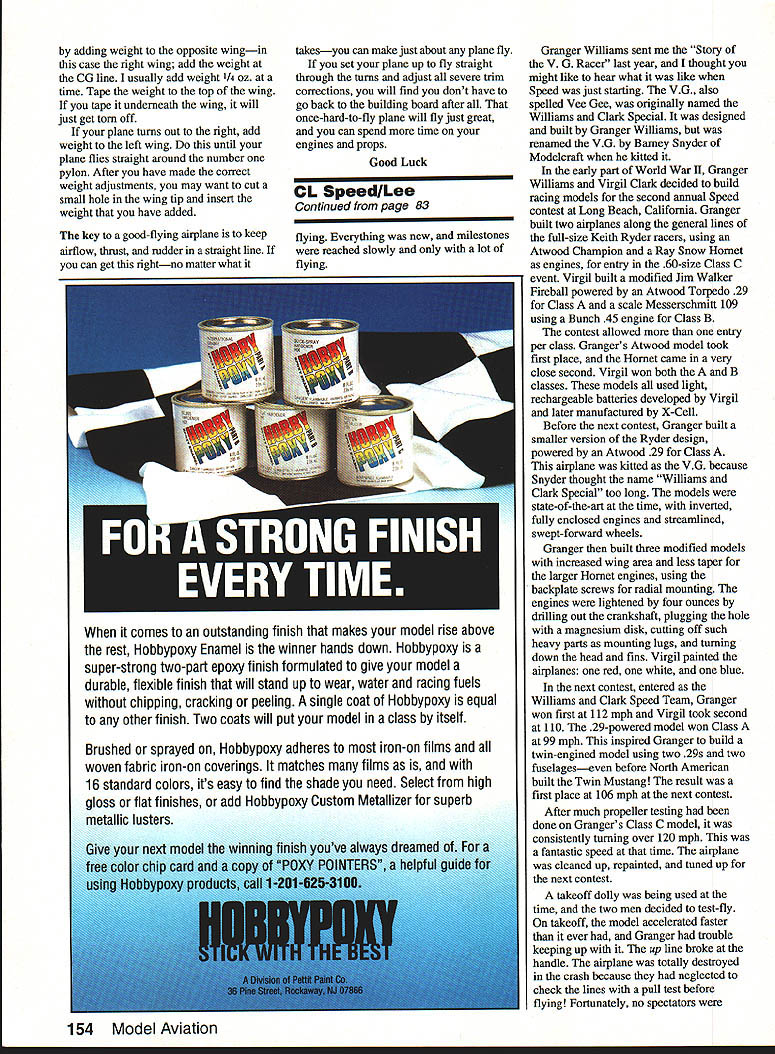
An engine that previously turned a full 9 x 13 prop at more than 19,000 rpm now only turns a 9 x 10 at about 17,000 rpm on 10% fuel. It may be necessary to reduce prop size substantially until rpm is up to the point where usable horsepower is available.
We'll be comparing notes and watching what other fliers use at the Nationals. The lower power from the restricted fuel should allow us to use wooden props safely again; expensive fiberglass and carbon-fiber types shouldn't be necessary.
F.A.I. speeds rose only after small single‑bladed props were developed. Similar single‑blade designs will likely work on our larger airplanes; however, making molds takes time, so that's a development for next year.
Jet Speed — fuel reports
First reports on Jet Speed are not very encouraging. The 80% methanol / 20% MEK fuel doesn't want to start and doesn't want to run in some places. The Texas guys have used this mixture in Sport Jet for several years with many successful flights, so questions remain:
- Does the fuel work better in hot, low‑humidity Texas weather?
- Do we need an ignitor such as propylene oxide to get the mixture to run reliably?
There is no place near me to test‑fly or even test‑run these noisy beasts, so I will have to wait until the Nationals to see more results. I don't know any Jet flier who wanted to go back to white gasoline; the 80/20 alky mix still seems the best alternative to get reasonable — if somewhat slower — speeds within the Safety Committee guidelines.
Trimming tips
Basic trim and balance adjustments can make a huge difference. A few practical steps:
- If your ship pulls to the left, add weight to the right wing (and vice versa). Add the weight at the CG line.
- Add weight in small increments — I usually add 1/4 oz. at a time.
- Tape the weight to the top of the wing for initial testing; tape underneath tends to get torn off.
- Fly until the plane goes straight around pylon number one. Once correct, consider cutting a small hole in the wingtip and permanently inserting the weight.
The key to a good‑flying airplane is to keep airflow, thrust, and rudder aligned in a straight line. If you can get this right — no matter what it takes — you can make almost any plane fly well. Set your plane up to fly straight through the turns and correct severe trim problems; you may not have to return to the building board. That once‑hard‑to‑fly plane will fly great, letting you spend more time on engines and props.
Good luck.
Continued: Early Days of Speed — The V.G. Racer
(Continued from page 83)
Everything was new in the early days of Speed, and milestones were reached slowly and only after a lot of flying. Granger Williams sent me "The Story of the V.G. Racer," and it illustrates what it was like when Speed was just starting.
The V.G. (also spelled Vee Gee) was originally named the Williams and Clark Special. It was designed and built by Granger Williams and later renamed the V.G. by Barney Snyder of Modelcraft when he kitted it.
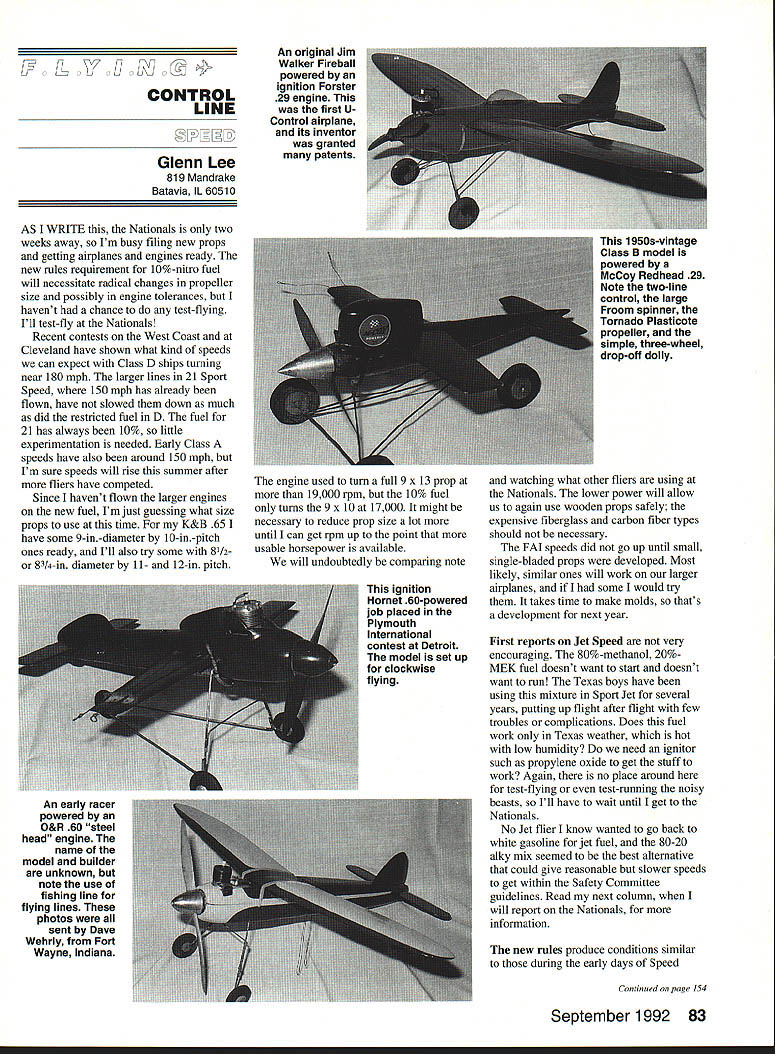
In the early part of World War II, Granger Williams and Virgil Clark decided to build racing models for the second annual Speed contest at Long Beach, California. Granger built two airplanes along the general lines of the full‑size Keith Ryder racers, using an Atwood Champion and a Ray Snow Hornet as engines for the .60-size Class C event. Virgil built a modified Jim Walker Fireball powered by an Atwood Torpedo .29 for Class A and a scale Messerschmitt 109 using a Bunch .45 for Class B.
The contest allowed more than one entry per class. Granger's Atwood model took first place and the Hornet came in a very close second. Virgil won both the A and B classes. These models all used light, rechargeable batteries developed by Virgil and later manufactured by X‑Cell.
Before the next contest, Granger built a smaller version of the Ryder design powered by an Atwood .29 for Class A. Snyder thought "Williams and Clark Special" too long, so the kit was named the V.G. The models were state‑of‑the‑art at the time, with inverted, fully enclosed engines and streamlined, swept‑forward wheels.
Granger later built three modified models with increased wing area and less taper to suit the larger Hornet engines, using the backplate screws for radial mounting. The engines were lightened by about four ounces by drilling out the crankshaft, plugging the hole with a magnesium disk, cutting off heavy parts for mounting lugs, and turning down the head and fins. Virgil painted the airplanes one red, one white, and one blue.
In the next contest, entered as the Williams and Clark Speed Team, Granger won first at 112 mph and Virgil took second at 110. The .29‑powered model won Class A at 99 mph. Encouraged, Granger built a new model using two .29s and two fuselages — even before North American built the Twin Mustang — and won first place at 106 mph at the next contest.
After extensive propeller testing, Granger's Class C model consistently exceeded 120 mph — a fantastic speed for the time. The airplane was cleaned up, repainted, and tuned for the next meet. At the time, takeoff duty (handle assistance) was being used, and the two men decided to test‑fly. On takeoff the model accelerated faster than ever, the up line broke at the handle, and the airplane was totally destroyed in the crash because they had neglected to pull‑test the lines before flying. Fortunately, no spectators were injured.
Transcribed from original scans by AI. Minor OCR errors may remain.

