
Control Line: Speed
Sam Snyder
IT WAS an exceptionally pleasant surprise to receive all the well wishes and mail so soon after my taking over this column. I was totally surprised that so many people read my first two. The following is a synopsis of the more pertinent info received.
Nick Arpino (301 Wood Acres Rd., East Patchogue, NY 11772) has speed pans for sale in most classes. It is his recommendation that no (AMA) speed flier may propose a rule in any class unless he or she has participated in that class in three AMA-sanctioned meets within the year. To paraphrase, "If you don't play the game you don't make rules."
Glen R. Dye (1015 S. 6th St., Minneapolis, MN 55415) has his new (TWA) engines about ready for production. The medium 29/36/40 cu. in. jobs should be ready in May and the 65's by June 1.
It is Glenn's thought that most lean runs on piped engines are a direct result of being overpropped; consequently, the big unload when airborne and then the ultimate burn-down. Glenn also feels that abolishing Class A and having only FAI will mean that few people will cross over; subsequently, we will be left with the same existing FAI participants and no "15" fliers or class. With the excellent Rossi and ST engines on the market this would be an injustice to these manufacturers.
Mike Tallman (3014 Exchange, Wichita, KS 67217). Appreciating his letter, I will be really kind, even though I disagree with one of his three suggestions.
"The present Junior, Senior, Open age system is outdated. A system of Novice, Advanced and Expert should be incorporated. This would encourage new fliers. A simple record system would be recorded on the back of the AMA card." Sorry, Mike, I can't buy this one. The bookkeeping system alone would exceed the capacity and budget of AMA. Speed is a specialized art. It will never attract large numbers because it is too exacting and frustrating for the average modeler to enjoy. Sometimes I wonder if I enjoy it!
Most of the current rules, and cross-rules proposals currently being considered are nothing more than attempts to legislate fairness by limiting Yankee ingenuity through rules. This includes some submitted under the guise of safety—that is, limiting speed by engine or aircraft restriction. Safety is controlled by line size, length, and pilot skill. I agree with that.
"The proposals which would change engine design criteria, such as porting, bearings, etc., must not be implemented in order to insure the development of future engines by protecting the manufacturers' current engine investments." I agree emphatically.
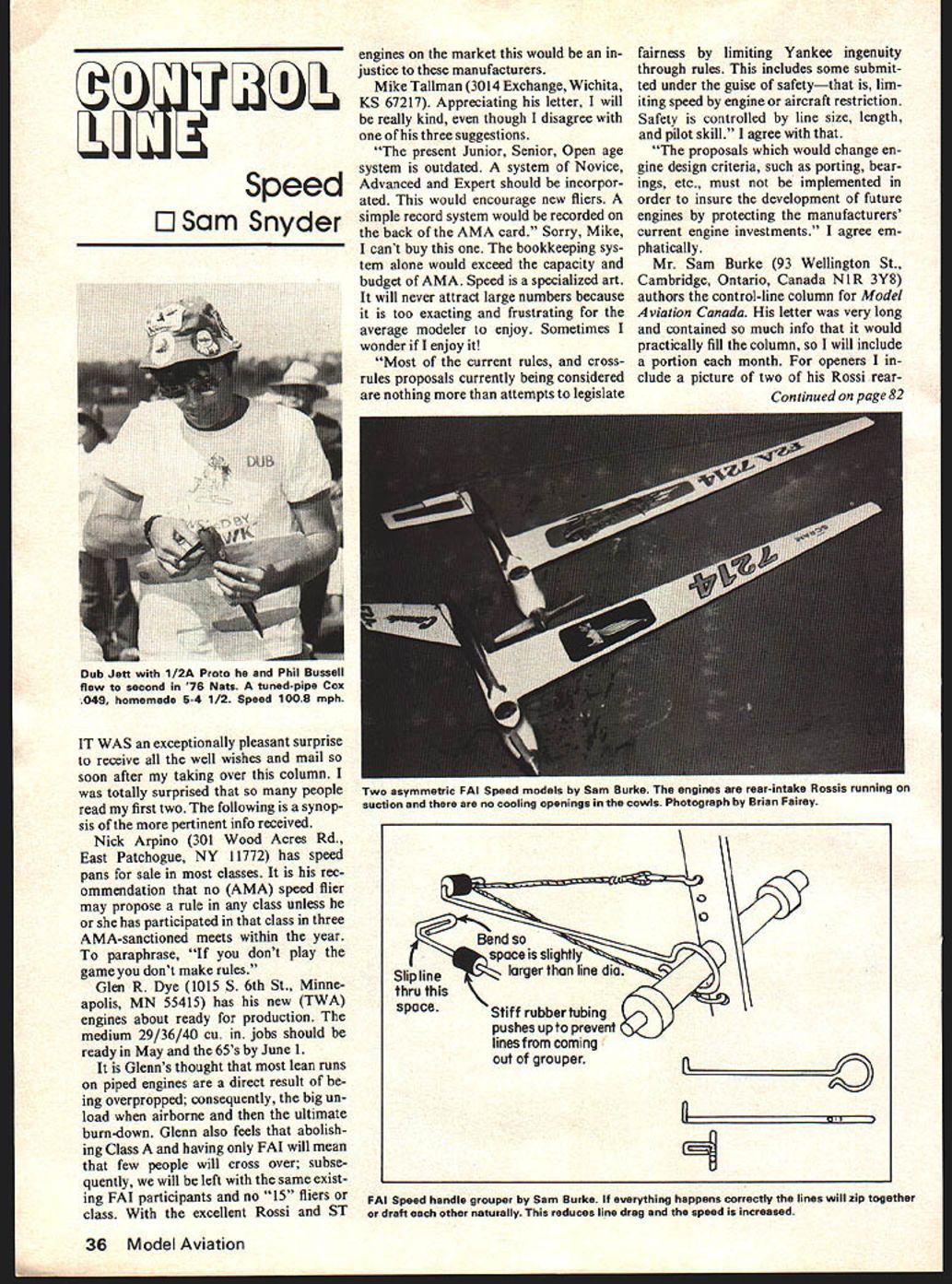
Mr. Sam Burke (93 Wellington St., Cambridge, Ontario, Canada N1R 3Y8) authors the control-line column for Model Aviation Canada. His letter was very long and contained so much info that it would practically fill the column, so I will include a portion each month. For openers I include a picture of two of his Rossi rear- intake FAI speed jobs. (Note: there are no cooling openings in the cowl.)
Burke provides the following names, addresses and equipment available: Emil Rumpel, Vormholzer Ring 32, 5810 Witten 3, West Germany; Rossi engines and parts, many special parts, fuel switches, pans, pitch gauge (almost all parts for FAI speed). George Hubschmidt, RD 1 Box 318, Ewan-Aura Rd., Glassboro, NJ 08028; Rossi and ST engines and parts, control units, lines, pans, kits, specialty items.
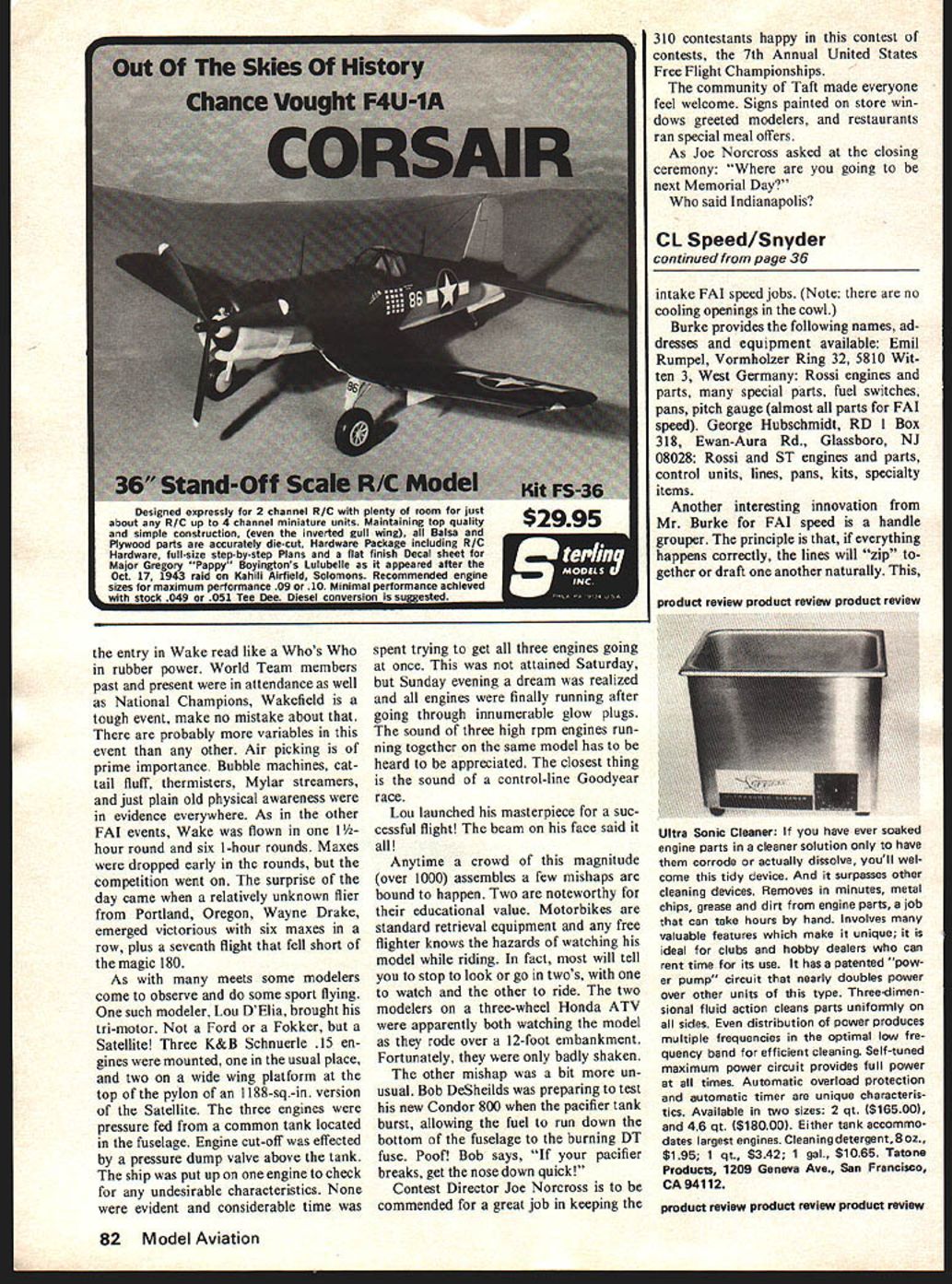
Another interesting innovation from Mr. Burke for FAI speed is a handle grouper. The principle is that, if everything happens correctly, the lines will "zip" together or draft one another naturally. This, of course, reduces line drag and speed goes up.
The educational phase of this article concerns engines. For you Juniors and inexperienced Seniors, it is my suggestion that you follow these simple rules:
1) Do not disassemble the engine. You will do it more harm than good.
2) Do not polish the parts because this does not alter the performance.
3) Do not loosen the press-fit on the bearings.
4) Do not open the venturi with a bigger hole because you won't be able to get a needle setting.
5) Do not use more than 65% nitro because it is expensive.
6) Do not lap the crankcase because you'll make it crooked and it will leak.
7) Do not polish the rod because it does not lubricate as well.
8) Do not grind portions off the crankshaft counter-balance because this will add to vibration.
9) Do not deburr the engine with the improper tool and without a bright light and magnifying glass. If you do, you will convert a minuscule burr into a bad groove.
If you insist on working on the engine to increase its power, there are some things that can be done, but not with a crowbar, file or axe. Rework requires precise tools and the knowledge of how to use them.
The best bet is to locate an experienced speed flier that is a machinist. There are, perhaps, 20 true experts in the U.S.A. There are many self-appointed experts not necessarily of proven ability. Beware of them, because they love to gain experience by working on your engines as the following true story relates.
One of these self-appointed experts was out flying when a young man arrived with his new ST29 G-21 series. It was tight and the youngster wanted advice. The "expert" proceeded to mix toothpaste, cutting oil, and fuel to break it in. In a very short time the engine had really loosened up! In fact, you could hold the engine in the breeze and it would turn like a pinwheel. Needless to say, the engine was worn out. So beware of your expert!
With the right guidance, the most important item is piston/sleeve fit. This can be accomplished by skillful use of a hone or by a meticulous break-in procedure. The second most important item is head clearance. This can be accomplished with shims from George Aldrich.
Last, but not least, the lower end must turn freely. If you don't have help, get some; don't try this on your own. The new KB 6.5's and Tigre 40x's don't need anything, if you're choosy in selection.
Sam Snyder, 1041 East Pico, Fresno, CA 93704
Transcribed from original scans by AI. Minor OCR errors may remain.

