
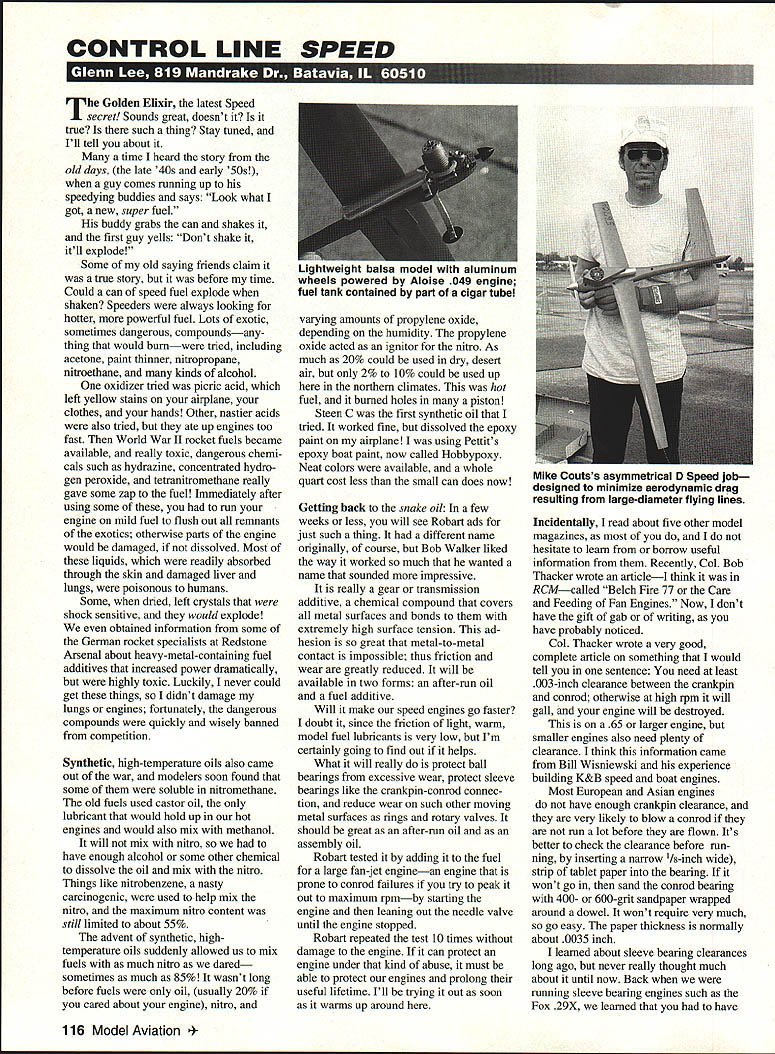
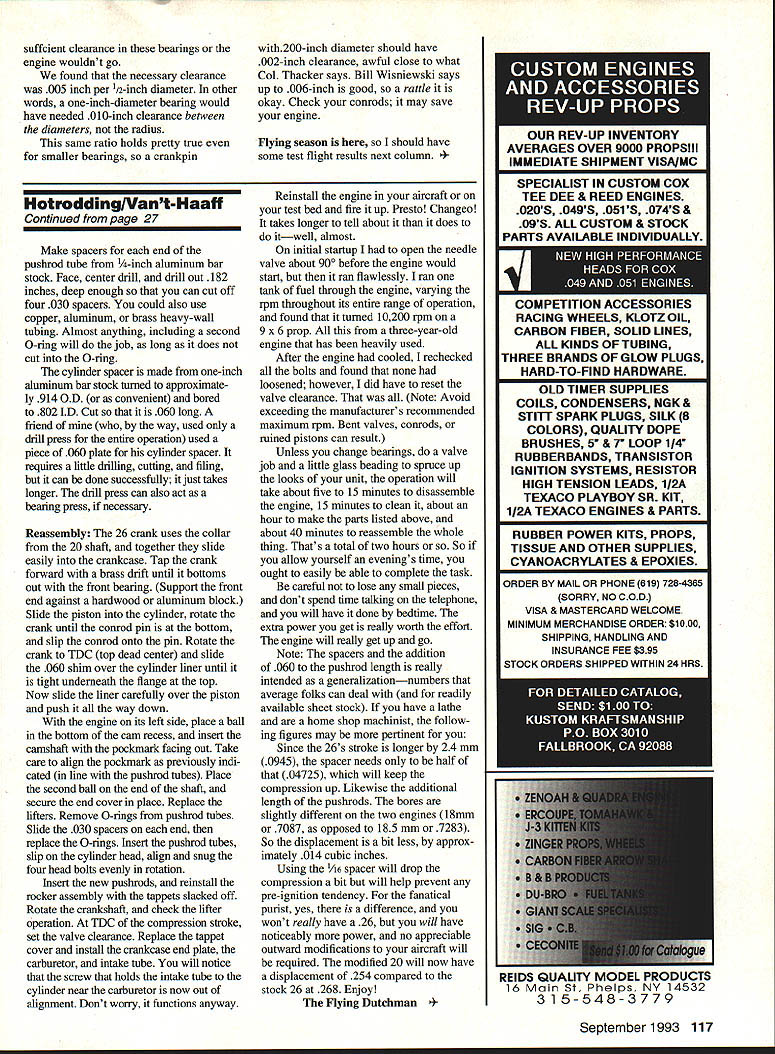
CONTROL LINE: SPEED
Glenn Lee — 819 Mandrake Dr., Batavia, IL 60510
The Golden Elixir — the latest speed secret! Sounds great, doesn't it? Is it true? Is there such a thing? Stay tuned, and I'll tell you about it.
Many a time I heard the story from the old days (the late '40s and early '50s): a guy comes running up to his speeding buddies and says, "Look what I got, a new, super fuel." His buddy grabs the can and shakes it, and the first guy yells, "Don't shake it — it'll explode!" Some old-timers claim it was true. Could a can of speed fuel explode when shaken? Speeders were always looking for hotter, more powerful fuel.
A lot of exotic, sometimes dangerous, compounds were tried — anything that would burn, including:
- acetone
- paint thinner
- nitropropane
- nitroethane
- many kinds of alcohol
One oxidizer tried was picric acid, which left yellow stains on airplanes, clothes, and hands. Other, nastier acids were also tried but they ate up engines too fast. After World War II, rocket fuels became available and introduced really toxic chemicals such as hydrazine, concentrated hydrogen peroxide, and tetranitromethane. These gave a lot of power, but required that you immediately run the engine on mild fuel to flush out remnants; otherwise parts of the engine would be damaged or dissolved. Many of these liquids are readily absorbed through the skin, damage the liver and lungs, and are poisonous to humans. Some, when dried, left crystals that were shock sensitive and would explode. We even obtained information from some German rocket specialists at Redstone Arsenal about heavy-metal fuel additives that increased power dramatically but were highly toxic. Fortunately, most of these dangerous compounds were quickly and wisely banned from competition.
Synthetic, high-temperature oils also came out of the war, and modelers soon found some were soluble in nitromethane. Old fuels used castor oil, the only lubricant that would hold up in our hot engines and that would mix with methanol. Castor oil will not mix with nitro, so you needed enough alcohol or some other solvent to dissolve the oil and mix with the nitro. Things like nitrobenzene, a nasty carcinogen, were used to help mix nitro; the maximum nitro content was still limited to about 55%.
With synthetic high-temp oils we were suddenly able to mix fuels with much more nitro — sometimes as much as 85%. Fuels became mostly oil (usually ~20% if you cared about your engine), nitro, and varying amounts of propylene oxide depending on humidity. Propylene oxide acted as an ignitor for nitro: as much as 20% could be used in dry, desert air, but only 2%–10% in northern climates. This was hot fuel and it burned holes in many pistons.
Steen C was the first synthetic oil I tried. It worked fine but dissolved the epoxy paint on my airplane. I was using Pettit's epoxy boat paint (now called Hobbypoxy). Neat colors were available, and a whole quart cost less than the small can does now.
The "Snake Oil" — a transmission additive
Getting back to the snake oil: Robart is introducing a product that sounds like that story's miracle. It originally had a different name, but Bob Walker liked the way it worked and wanted a name that sounded impressive. It's really a gear/transmission additive — a chemical compound that covers metal surfaces and bonds to them with extremely high surface tension. The adhesion is so strong that direct metal-to-metal contact is greatly reduced or prevented, thereby cutting friction and wear.
It will be available in two forms:
- an after-run oil
- a fuel additive
Will it make our speed engines go faster? I doubt it, since friction in light, warm, model-fuel-lubricated engines is already very low. What it will likely do is:
- protect ball bearings from excessive wear
- protect sleeve bearings like the crankpin–conrod connection
- reduce wear on other moving metal surfaces such as rings and rotary valves
It should be excellent as an after-run oil and as an assembly oil.
Robart tested it by adding it to the fuel for a large fan-jet engine (an engine prone to conrod failures if you try to peak it out to maximum rpm). They started the engine and leaned out the needle valve until the engine stopped, repeating the test 10 times without damage. If it can protect an engine under that abuse, it should help protect our engines and prolong their useful life. I'll be trying it out as soon as it warms up here.
Notes on engine clearance
I read a number of model magazines and don't hesitate to learn from them. Col. Bob Thacker recently wrote a very good article called "Belch Fire? Care and Feeding of Fan Engines." The essential point I took from it (and from Bill Wisniewski's experience building K&B speed and boat engines) is this: you need at least .003-inch clearance between the crankpin and conrod; otherwise, at high rpm it will gall and your engine will be destroyed. This is especially noted for .65 and larger engines, but smaller engines also need plenty of clearance.
Transcribed from original scans by AI. Minor OCR errors may remain.

