
CONTROL LINE SPEED
Glenn Lee, 819 Mandrake Drive, Batavia, IL 60510
Event summary
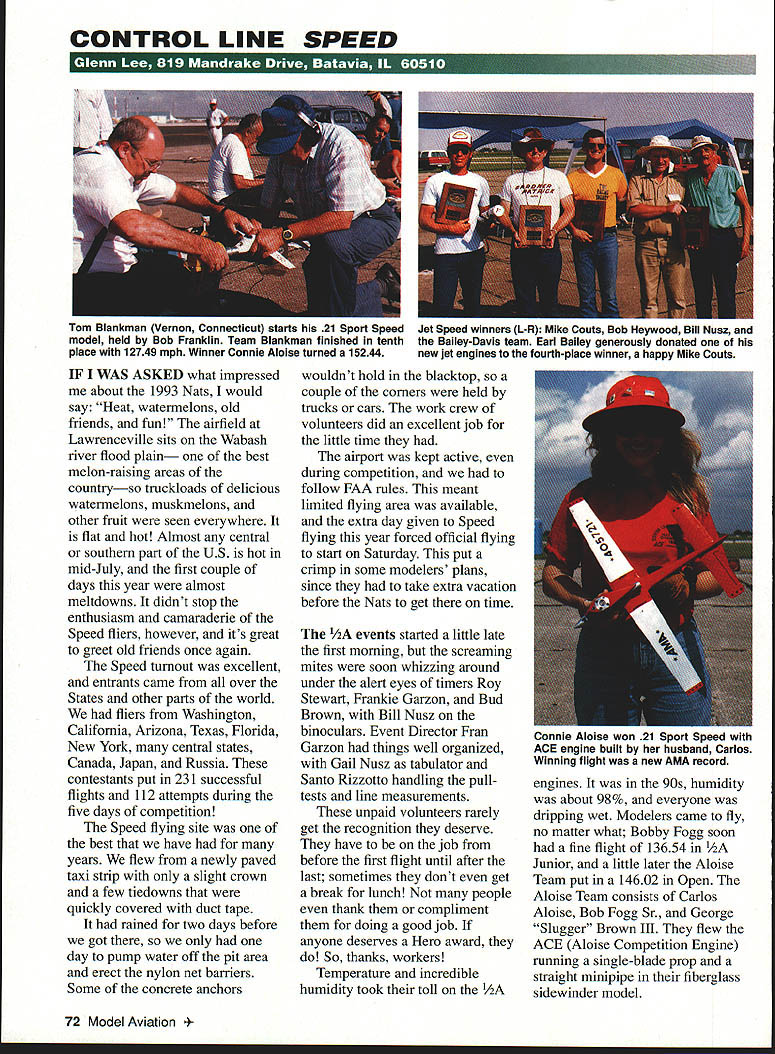
The 1993 Nats Speed event drew an excellent turnout from across the United States and abroad, including contestants from Canada, Japan, and Russia. Over the five days of competition contestants logged 231 successful flights and 112 attempts.
Venue and conditions
- Site: Lawrenceville airfield on the Wabash River flood plain — hot, flat, and ideal for melons (truckloads of watermelons and muskmelons were everywhere).
- Surface: Newly paved taxi strip with only a slight crown; a few tiedowns had to be covered with duct tape.
- Preparations: Two days of prior rain required pumping water from the pit area and erecting nylon net barriers. Some concrete anchors wouldn’t hold in the blacktop and a couple of corners were held by trucks or cars.
- Airport operations: The airport remained active during competition and FAA rules limited the flying area. An extra day added to Speed forced official flying to start on Saturday, which affected travel plans for some competitors.
- Weather: Very hot and humid — temperatures in the 90s, humidity near 98% most days — which took a toll on engines and crews.
Volunteers
The Speed events depended on unpaid volunteers who worked long hours:
- Timers: Roy Stewart, Frankie Garzon, Bud Brown
- Binoculars: Bill Nusz
- Event Director: Fran Garzon
- Tabulator: Gail Nusz
- Pull-tests and line measurements: Santo Rizzotto
These workers often went without a lunch break and deserve recognition for keeping the events running smoothly.
1/2A events
- Conditions: Heat and humidity affected small engines; turnout was good but many had engine trouble.
- Notable flights:
- Bobby Fogg: 136.54 (1/2A Junior)
- Aloise Team (Carlos Aloise, Bob Fogg Sr., George "Slugger" Brown III): 146.02 (1/2A Open) using an ACE engine, single-blade prop, straight minipipe on a fiberglass sidewinder.
- Scoring: Only four Open and six Junior official flights were recorded in the classic 1/2A Speed category on the main day; Profile/proto entries fared better overall with 22 official flights in related 1/2A events.
- Engines used: A wide variety — homemade, Shuriken, CS, ACE, Cox, and Russian units. Top profile/proto results included Bobby Fogg (top Junior at 98.9) and Warren Kurth (top Open at 102.73).
Class A and FAI
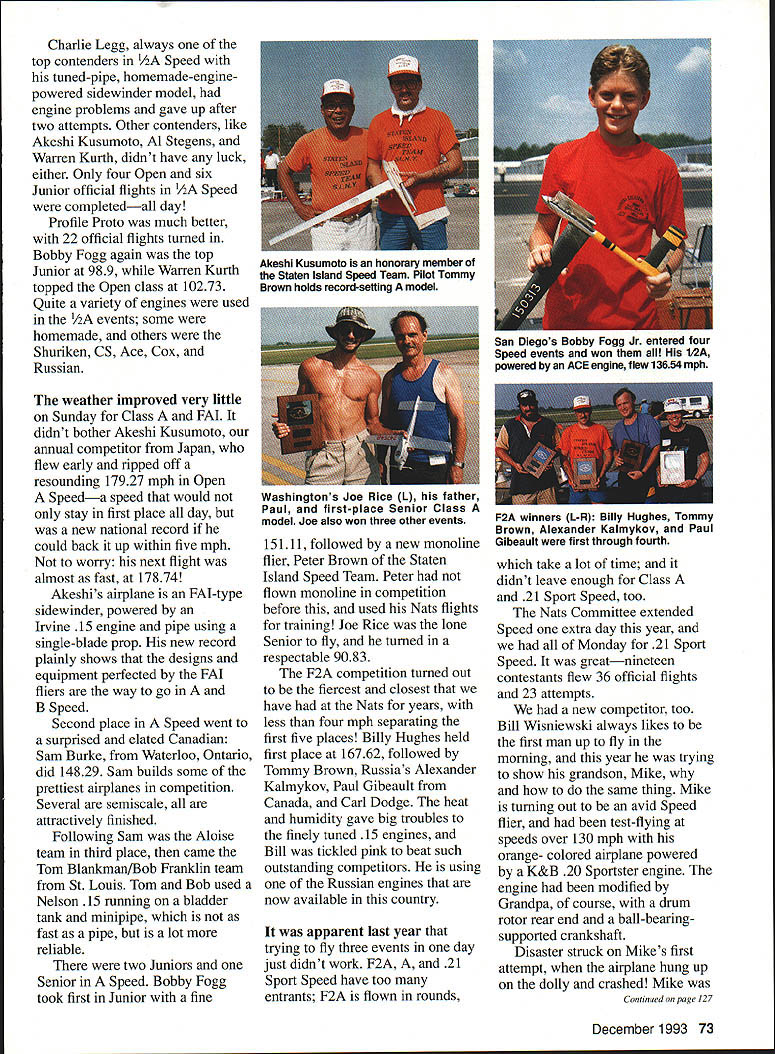
- FAI/Open standout: Akeshi Kusumoto (Japan) flew early to record 179.27 mph in Open A Speed — a new national record — and backed it up with 178.74 on the next flight. His airplane was an FAI-type sidewinder powered by an Irvine .15 with a pipe and single-blade prop.
- A Speed placings (Open):
- Akeshi Kusumoto — 179.27 (new national record)
- Sam Burke (Waterloo, Ontario) — 148.29
- Aloise Team
- Tom Blankman / Bob Franklin (St. Louis) also finished high using a Nelson .15 with bladder tank and minipipe/fast pipe.
- A Speed Juniors and Seniors:
- Junior 1st: Bobby Fogg — 151.11
- Junior 2nd: Peter Brown (Staten Island Speed Team)
- Senior: Joe Rice — 90.83
F2A (Team Speed)
- Extremely close competition: less than 4 mph separated the top five.
- Top placings:
- Billy Hughes — 167.62
- Tommy Brown
- Alexander Kalmykov (Russia)
- Paul Gibeault (Canada)
- Carl Dodge
- Note: Heat and humidity made finely tuned .15 engines temperamental. Billy Hughes used one of the now-available Russian engines.
Scheduling change
Last year showed that trying to fly F2A, A, and .21 Sport Speed in one day didn’t work. The Nats Committee extended Speed by one extra day this year to provide sufficient time for all classes.
.21 Sport Speed (extra day — Monday)
- Turnout: 19 contestants, 36 official flights, 23 attempts.
- Junior storyline: New competitor Mike Wisniewski (grandson of Bill Wisniewski) crashed on his first attempt (dolly hang-up). After repairs Mike recorded three official flights; best was 133.78 — Junior 1st, narrowly beating Peter Brown (133.18).
- Seniors: Three tried to fly; David Van Allen (Chandler, AZ) was the only Senior to record an official time.
- Opens: Variety of engines in use — ACE (Aloise Team), Rossis, O.S., Nelsons, etc. Aloise Team continued to use the ACE engine with single-blade prop on a fiberglass sidewinder.
Formula .40 and B Speed (Tuesday)
- Flights: F-40 — 37 flights, 10 attempts. B Speed — 28 flights, 15 attempts.
- B Speed (Junior): Bobby Fogg won his fourth first place of the Nats with 122.59, just ahead of Peter Brown (122.54).
- B Speed (Senior): David Van Allen had the only Senior B official time — 112.01 (K&B .29).
- F-40:
- 1st: Joe Rice — 130.81
- 2nd: David Van Allen — 130.38 (after switching to a K&B .40)
- Howell Pugh also placed (three B Senior attempts; recorded 117.27 for third in F-40).
- Open B Speed: Akeshi Kusumoto — 167.90; Bill Wisniewski — 162.59; Glen Van Sant and Billy Hughes also placed.
- Open F-40: Bill Nusz (Nelson .40) — 153.33; Frank Garzon — 152.07. Several other fliers posted speeds over 148 mph.
Class D and Jet (final day)
- Class D: 19 entrants, 48 flights, 9 attempts. Speeds approaching 190 mph, with 12 contestants over 170 mph.
- 1st: Bill Nusz — K&B .65 — 187.13
- 2nd: Tommy Brown — 184.60
- 3rd: Akeshi Kusumoto — O.S. .65 — 184.23
- Carlos Aloise’s new ACE .65 showed potential but was limited to about 181.50 due to some issues. The Aloise D models used sidewinder FAI construction with fiberglass and carbon-fiber thin shells (Fogg-Sheehan methods).
- Jet:
- Development: Dr. Charles "Doc" Davis and Earl Bailey developed an improved pulse-jet after hundreds of tests. Earl manufactured a batch for sale; one engine was donated as a fourth-place prize.
- Competition: 12 Jet entries, 17 flights, 11 attempts.
- Winner/record: Dr. Charles "Doc" Davis — 190.80, backed up by 190.60 (record-setting flight).
- Other top jets: Bill Nusz — 187.62; Bob Heywood — 186.45; Mike Couts — 183.98 (4th).
- Notes: Jerry Thomas used an augmenter tube (louder); Gordon Thomas recorded his first official Nats Jet flight after four years of trying.
Slow, Super Slow, engines, and equipment observations
- Speeds: Slow models ran about 105 mph without a streamer; David Owens’ Fast model was timed around 119 mph towing a streamer.
- Wiley engine:
- Features: Chrome-plated aluminum sleeve, 15mm shaft with extra-loose-fit riveted-cage bearings, bore .800, stroke .715, timing similar to standard Fox numbers.
- Performance: Runs well on a standard glow plug; excels with tight fit control and squareness.
- Price: About $175 — considered good value.
- Nelson engine:
- Features: High-tech elements, ~8.25-ounce weight, shorter stroke, 17mm shaft with thin-race main bearing, AAC piston and sleeve, Henry Nelson’s custom glow plug/head insert (sealed without exposed threads).
- Performance: Plug/head detail yields substantial rpm gains; some Nelsons use chrome-plated titanium shafts, weighing ~7 ounces.
- Price: Around $275.
- VA .049 (used by Larry Driskill; imported by Dan Rutherford):
- AAC construction with aluminum piston running in a nickel-plated case; weighs ~1.2 ounces (lighter than a Tee Dee). Suited to high-rpm bladder operation.
- Arrowshaft models:
- Growing in use because they’re strong and easy to build. The common shaft diameters are .505 and .524 inches.
- Some debate: purists prefer wooden booms, but current profile rules only mention fuselage thickness and resemblance to full-size aircraft — pod-and-boom arrowshaft models meet that criterion.
- Super Slow and match behavior:
- Rules worked well; the "any plane goes" format encouraged creative entries (choked-down Fast models, FAI models, Stunt .35s, detuned Slow models).
- Stunt .35 models often suffered rich, four-cycle runs and lost 5–10 mph, hurting competitiveness.
- FAI models turned tight but sometimes had inconsistent air time or runs; bladders and pacifiers require careful setup.
- Wind was generally not a factor. The speed-limit rule (approximate) generally succeeded; occasional spectator/pit-crew sightings of "too fast" were usually due to viewing angles.
- Matches often decided by getting the knot on the streamer; many matches ended in midairs when both fliers went for the knot.
Awards and banquet
Wednesday afternoon concluded Speed flying. Almost all Speed fliers attended the traditional banquet where perpetual trophies were awarded:
- High Time Award (record ratio speed): Akeshi Kusumoto (for his record A flight)
- Junior High Point Award: Bobby Fogg (four first places)
- Open High Point Award: Tommy Brown — edged Carlos Aloise by less than one point
Congratulations to Akeshi, Bobby, and Tommy — see you next year.
Transcribed from original scans by AI. Minor OCR errors may remain.

