
Control Line: Speed
Glenn Lee 819 Mandrake Drive, Batavia, IL 60510
NEW INFORMATION, ideas, or products for this column are sometimes hard to come by, but I keep trying. If you have any suggestions or requests, please write and let me know.
Robart’s Snake Oil and Related Lubricants
More on Robart's Snake Oil: I mentioned this product in my last pre-Nats column, and now have additional info and some test results. Robart has several compounds that contain the low-friction additive in addition to the fuel additive that you may want to try.
- #50-02 — R/C fuel treatment. Comes in a plastic bottle that automatically measures the proper amount to add to your fuel. Squeeze the bottle and it forces a “shot” into a smaller section that can be poured into the fuel jug. About one shot per quart of fuel.
- #50-06 — Full-strength oil with the additive for mixing with commercial gasoline (for 1/4-scale gas ignition engines). Proper mixing ratios are printed on the label.
- #50-01 — One-ounce squirt bottle of after-run oil. Lubricates the engine, protects from moisture, and fits neatly in your toolbox.
- #50-05a — RC spray lubricant. A pressurized can that repels and replaces moisture as well as lubricating. The pressure forces the spray into engines, bearings, or wherever needed; a very small squirt is usually sufficient.
- Additional items — Larger containers for transmissions, gearboxes, and crankcases; a small tube of grease useful in bicycle wheel bearings and RC car gearboxes.
These lubricants are not restricted to RC engines; they work well for bicycles, fishing reels, electric motors, lawn mowers, and many household chores.
Field Test Results
Does the fuel additive really increase power, rpm, and performance? To find out, I set up two fuel tanks connected to a tee on my engine test stand so I could pinch off either line at will. I could start the engine, set the needle and measure rpm on standard fuel, then open the line to the modified fuel without stopping the engine and check for any increase.
I tested only a few ringed RC engines (not speed or racing engines where competing fuels are restricted). I first mounted an O.S. .40, fired it up, and set the needle to peak rpm (but not lean). When I opened the line to the modified fuel there was some increase, but nothing like the 1,000 rpm boost that some have claimed.
Across several engines I saw similar results: increases of roughly 100 to 200 rpm — not enormous, but noticeable given these were sport engines turning normal sport-type props. It’s difficult to improve lubrication in our engines anyway; a thin layer of hot oil is already very slippery.
The main benefits of Snake Oil are:
- It bonds to bearing surfaces and protects them during high-rpm or lean runs.
- It reduces wear and increases engine reliability.
- It makes starting easier and extends engine life.
For a quick demonstration, find an ABC engine that squeaks when you turn it over. Give it a shot of Snake Oil and flip it again — you’ll notice the difference.
Many RC fliers set engines so lean for takeoff that they sag partway through a flight, or during maneuvers. That puts maximum stress on the engine because it’s producing high power without sufficient lubrication and cooling. Robart’s additive can help by providing a tenacious oil layer on bearing surfaces. If I get more information and test results, I’ll keep you posted.
Flea Market Finds
I like flea markets and antique shops, and every once in a while some engine or old kit shows up. At the Sycamore, Illinois “thresher” and antique gas-engine and tractor show (they always have a flea market), I found an original kit of a Stanzel Tiger Shark g-line control model in new condition — never even out of the box. This model was produced just before Jim Walker patented U-Control, so it is about 54 years old. I’m not going to build it — it’s too nice a collectible — but it might be fun to build a replica. There are still old kits and engines out there, and we stumble onto them now and then.
Nats: Gadgets and Engines
Getting back to modern things, here are a couple of neat items I saw at the Nats.
#### Bob Fogg’s Prop Trimmer
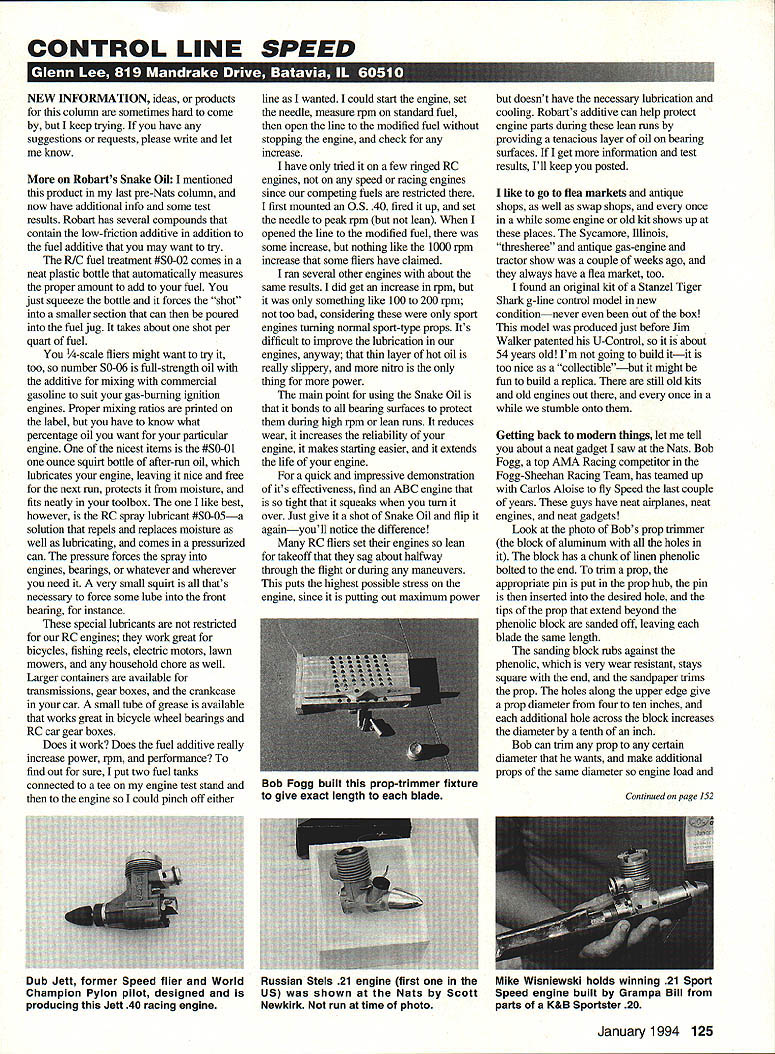
Bob Fogg, a top AMA Racing competitor, teamed up with Carlos Aloise to fly Speed the last couple of years. One neat gadget Bob uses is a prop trimmer: a block of aluminum with many holes and a chunk of linen phenolic bolted to the end.
How it works:
- Put the appropriate pin in the prop hub.
- Insert the pin into the desired hole in the block.
- Sand off the tips of the prop that extend beyond the phenolic block; the sanding leaves the blades the same length.
The phenolic is very wear resistant and stays square with the block end. The holes along the upper edge provide prop diameters from 4 to 10 inches; an additional hole across the block increases the diameter by 0.1 inch. Different pins are required for different props; they’re stored in the hole on the end of the block and kept there by a threaded brass plug. A terrific accessory to ease prop modification and increase flight repeatability.
#### Bill Wisniewski’s Modified K&B .21
Another interesting Nats display was Bill Wisniewski’s .21 K&B engine, used by his grandson Mike in 21 Sport Speed. Modifications included:
- Sleeve and piston from a Sportster .20.
- Drum rotor rear end as used in the marine version of the engine.
- Ball-bearing crankshaft and crankcase.
Bill had trouble with the conrod — the bronze bushing kept failing — so he pressed in a high-silicon aluminum bushing. That worked well, and the engine ran very well. K&B engines now have more conrod clearance; as much as .005 is being used on the lower end, and engine performance and reliability are better than ever.
See the Nats photos of a couple of new engines: the Wiley .40 and the Jett .40. I’ll try to get performance information on them for a future column.
Transcribed from original scans by AI. Minor OCR errors may remain.

