
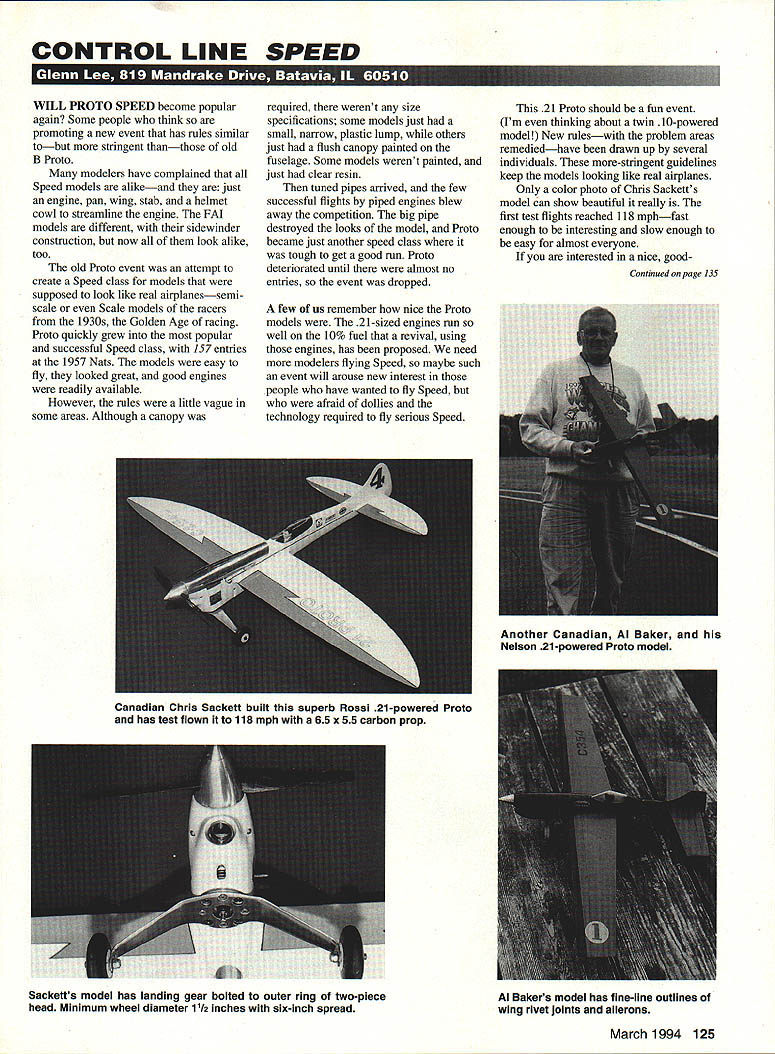
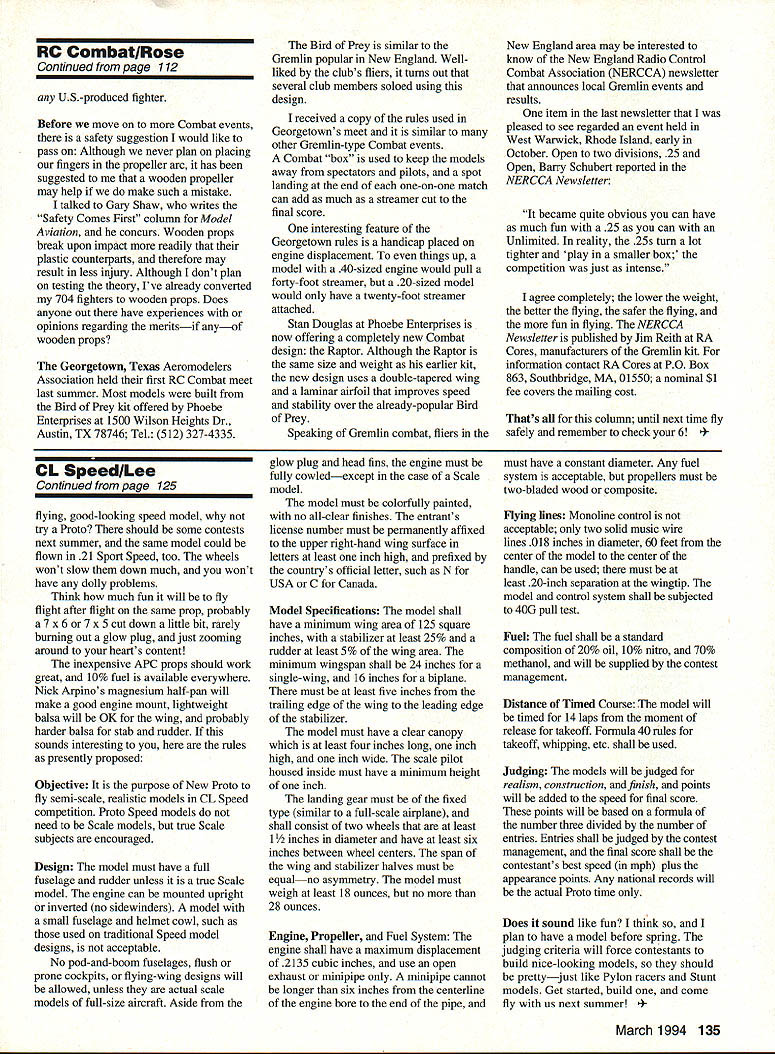
CONTROL LINE: SPEED
Glenn Lee 819 Mandrake Drive, Batavia, IL 60510
WILL PROTO SPEED become popular again? Some people who think so are promoting a new event that has rules similar to—but more stringent than—those of old B Proto.
Many modelers have complained that all Speed models are alike—and they are: just an engine, pan, wing, stab, and a helmet cowl to streamline the engine. The FAI models are different, with their sidewinder construction, but now all of them look alike, too.
The old Proto event was an attempt to create a Speed class for models that were supposed to look like real airplanes—semiscale or even scale models of the racers from the 1930s, the Golden Age of racing. Proto quickly grew into the most popular and successful Speed class, with 157 entries at the 1957 Nats. The models were easy to fly, they looked great, and good engines were readily available.
However, the rules were a little vague in some areas. Although a canopy was required, there weren't any size specifications; some models just had a small, narrow, plastic lump, while others just had a flush canopy painted on the fuselage. Some models weren't painted, and just had clear resin.
Then tuned pipes arrived, and the few successful flights by piped engines blew away the competition. The big pipe destroyed the looks of the model, and Proto became just another speed class where it was tough to get a good run. Proto deteriorated until there were almost no entries, so the event was dropped.
A few of us remember how nice the Proto models were. The .21-sized engines run so well on the 10% fuel that a revival, using those engines, has been proposed. We need more modelers flying Speed, so maybe such an event will arouse new interest in those people who have wanted to fly Speed, but who were afraid of dollies and the technology required to fly serious Speed.
This .21 Proto should be a fun event. (I'm even thinking about a twin .10-powered model!) New rules—with the problem areas remedied—have been drawn up by several individuals. These more-stringent guidelines keep the models looking like real airplanes.
Only a color photo of Chris Sackett's model can show how beautiful it really is. The first test flights reached 118 mph—fast enough to be interesting and slow enough to be easy for almost everyone. If you are interested in a nice, good-flying, good-looking speed model, why not try a Proto? There should be some contests next summer, and the same model could be flown in .21 Sport Speed, too. The wheels won't slow them down much, and you won't have any dolly problems.
Think how much fun it will be to fly right after night on the same prop, probably a 7 x 6 or 7 x 5 cut down a little bit, rarely burning out a glow plug, and just zooming around to your heart's content!
The inexpensive APC props should work great, and 10% fuel is available everywhere. Nick Arpino's magnesium half-pan will make a good engine mount, lightweight balsa will do OK for the wing, and probably harder balsa for stab and rudder. If this sounds interesting to you, here are the rules as presently proposed:
Objective
- Purpose: To fly semi-scale, realistic models in Control Line (CL) Speed competition.
- Proto Speed models do not need to be Scale models, but true Scale subjects are encouraged.
Design
- The model must have a full fuselage and rudder unless it is a true Scale model.
- The engine can be mounted upright or inverted (no sidewinder).
- A model with a small fuselage and helmet cowl, such as those used on traditional Speed model designs, is not acceptable.
- No pod-and-boom fuselages, flush or prone cockpits, or flying-wing designs will be allowed, unless they are exact models of full-size aircraft.
- Aside from the glow plug and head fins, the engine must be fully cowled—except in the case of a Scale model.
- The model must be colorfully painted; no all-clear finishes.
- The entrant's license number must be permanently affixed to the upper right-hand wing surface in letters at least one inch high and prefixed by the country's official letter (e.g., N for USA, C for Canada).
Model Specifications
- Minimum wing area: 125 square inches.
- Stabilizer area: at least 25% of wing area.
- Rudder area: at least 5% of wing area.
- Minimum wingspan: 24 inches for a monoplane; 16 inches for a biplane.
- There must be at least five inches from the wing trailing edge to the stabilizer leading edge.
- The model must have a clear canopy at least 4 inches long, 1 inch high, and 1 inch wide.
- The scale pilot housed inside must have a minimum height of 1 inch.
- Landing gear must be fixed type (similar to full-scale airplanes) and consist of two wheels at least 1½ inches in diameter with at least six inches between wheel centers.
- The span of the wing halves and stabilizer halves must be equal—no asymmetry.
- Minimum weight: 18 ounces. Maximum weight: 28 ounces.
Engine, Propeller, and Fuel System
- Engine maximum displacement: 0.2135 cubic inches.
- Exhaust: open exhaust or minipipe only.
- Minipipe restrictions: cannot be longer than 6 inches from the engine bore centerline to the end of the pipe, and must have a constant diameter.
- Any fuel system is acceptable.
- Propellers must be two-bladed wood or composite.
Flying Lines
- Monoline control is not acceptable.
- Only two solid music wire lines, 0.018 inches in diameter, 60 feet from the center of the model to the center of the handle, may be used.
- There must be at least 0.20-inch separation at the wingtip.
- The model and control system shall be subjected to a 40 G pull test.
Fuel
- Fuel composition: 20% oil, 10% nitro, and 70% methanol.
- Fuel will be supplied by contest management.
Distance of Timed Course
- Timing: The model will be timed for 14 laps from the moment of release for takeoff.
- Formula 40 rules for takeoff, whipping, etc., shall be used.
Judging
- Models will be judged for realism, construction, and finish.
- Appearance points will be added to the speed for the final score.
- Appearance points will be based on a formula: 3 ÷ number of entries.
- Entrants shall be judged by the contest management.
- Final score = contestant's best speed (in mph) + appearance points.
- Any national records will be the actual Proto time only.
Does it sound like fun? I think so, and I plan to have a model before spring. The judging criteria will force contestants to build nice-looking models, so they should be pretty—just like Pylon racers and Stunt models. Get started, build one, and come fly with us next summer!
Transcribed from original scans by AI. Minor OCR errors may remain.

