
CONTROL LINE: SPEED
Glenn Lee, 819 Mandrake Drive, Batavia, IL 60510
Have you purchased a new engine lately—maybe one of the newer ABC lapped-piston types? Did you take it out of the box, put a prop on it (as most of us do), and flip it just to test the feel? Were you amazed, perhaps, at how free and loose it was when you flipped it—except at the top of the stroke, where it popped over neatly and cleanly?
Did you read the instructions to find out the manufacturer's recommendations for break-in running, needle setting to start, prop sizes, and fuel? Does it need prolonged break-in running?
There is a lot of break-in procedure misinformation around, and I could probably write an entire column about that. Maybe I will—sometime. Until then, follow the instructions that come with the engine; manufacturers aren't going to tell you to do anything that might affect warranties or performance.
Necessary break-in procedures vary from engine to engine, according to design, size, and the materials of manufacture. The time required can range from a couple of minutes (for most ABC engines) to an hour or more for other engines.
Tapered (choke-bored) sleeves and performance
Getting back to the great-feeling new powerhouse you just bought, did you wonder why it feels that nice, and where the design, parts, and materials come from? I'll try to explain some of these speed secrets.
Such looseness and freedom of movement in these ABC high-performance engines are mostly the result of a tapered—or so-called "choke-bored"—cylinder liner, where the bore diameter is perhaps as much as .005 larger at the bottom of the stroke than it is at the top, where the piston must seal against it. The top 1/32 inch of the piston also tapers slightly to match the sleeve. This combination greatly reduces piston drag, resulting in more rpm, increased reliability, better idling for RC engines, and extended lifetime. Such engines need almost no break-in running; just bolt them in your model and go fly. By the time you start the engine, set the needle, check the throttle, and rev it up a couple of times, it is ready to go.
Just don't start with a bigger prop than recommended and don't run the engine slobbering rich. Start with a smaller prop and run it fast—not lean—just to knock the fuzz off the metal parts.
So who was the first turkey who would abuse an engine like that? Who would grind, lap, or hone a sleeve to such radical looseness? Who would have thought of letting the piston flop around in that nice chrome-plated sleeve?
A bit of history — who started it
Back in the old days, we used to go to extreme methods to get the sleeve as straight and as round as could be, then run the engines for hours on little props to break them in until they would run on high nitro fuel. I like to give credit for major engine design advancements where credit is due, so let me tell you a little story.
Quite a few years ago (probably close to 20), I was flying at a Speed contest at St. Louis, Missouri. We had quite a few entrants then, and Formula 40 was one of the most popular events. I was running K&B 6.5 ABC engines that ran pretty well, and regularly beat the SuperTigres and other engines. I was talking to my friend Tom Blankman, a Speed flier from St. Louis, and he told me:
"If you want those .40s to go, you have to loosen them up. Just taper the bore from squeaky tight at the top to .005 clearance at the bottom, and make sure you have about .002 clearance on the diameter in the area near the bypass and exhaust ports."
Tom had been flying Pylon with Charlie Brunner; they tapered the sleeves on Charlie's SuperTigre .40s and pretty well wiped out the competition!
When I got home, I made a brass lap and followed Tom's directions using 900-grit aluminum oxide lapping compound and oil to cut the chrome plating. I carefully checked measurements with a telescoping gauge and micrometer, and faithfully tried for the .002 inch near the ports and .005 inch at the bottom.
Much of my lapping usually went through the chrome, exposing the brass near the bottom of the sleeve, but that didn't seem to make any difference. When I went to the next contest, my speeds had jumped about 10 mph! I won a lot of contests and set some Formula 40 records with this setup; other contestants just couldn't figure how my engines ran so well.
Tom and Charlie were the guys who came up with such radical dimensions for our racing engines. Some manufacturers had slight tapers of a few thousandths, and some would relieve the sleeve beneath the exhaust port. Nobody thought engines would run as loose as Tom set them up!
According to some information I have read, Mel Anderson apparently used some choke-bore in free-flight engines as early as 1932, and some of the World War II P-SI engines had choke-bored cylinders. The first SuperTigre ABC engines came in with very little taper, and they were easily hopped up by Tom's treatment.
I told George Aldrich about the lapping treatment, and he told Terry Prather, and soon they were hopping up engines for all the other Pylon fliers. Speeds immediately jumped dramatically. I told Bill Wisniewski about the .005 taper at that year's Nats.
When I saw him again at the next Nats, I asked: "Does the .005 taper work?" He said: ".015 inch is better!" (That's the way Bill is; if he hears of something new, he tries it, expands on it, and improves on it.)
Now you buy new engines, and they come with all these improvements from the start.
Practical observations and warnings
Those of you who still believe ABC engines need extended break-in should stop and think. The high-silicon piston alloys have a coefficient of expansion less than the brass sleeve, so as soon as any heat gets onto the sleeve, it expands more than the piston, and the clearance is increased.
The best, fastest running engines I ever had were so tight cold that you could not turn them over slowly; you had to flip them hard to generate a little friction and heat. The tighter engines sealed better when hot and running, so you got more power.
The only time we had trouble was when the engine was set just a little lean on our 80% nitro fuel, and inadequate piston cooling at maximum power burned a hole in the piston. The pistons never burned or scored the sleeves, they just ended up with a hole near center.
The next time you flip one of your ABC engines, think of Tom and Charlie, and mentally thank them for their contribution to engine performance, lifetime, and operation.
Reader submission
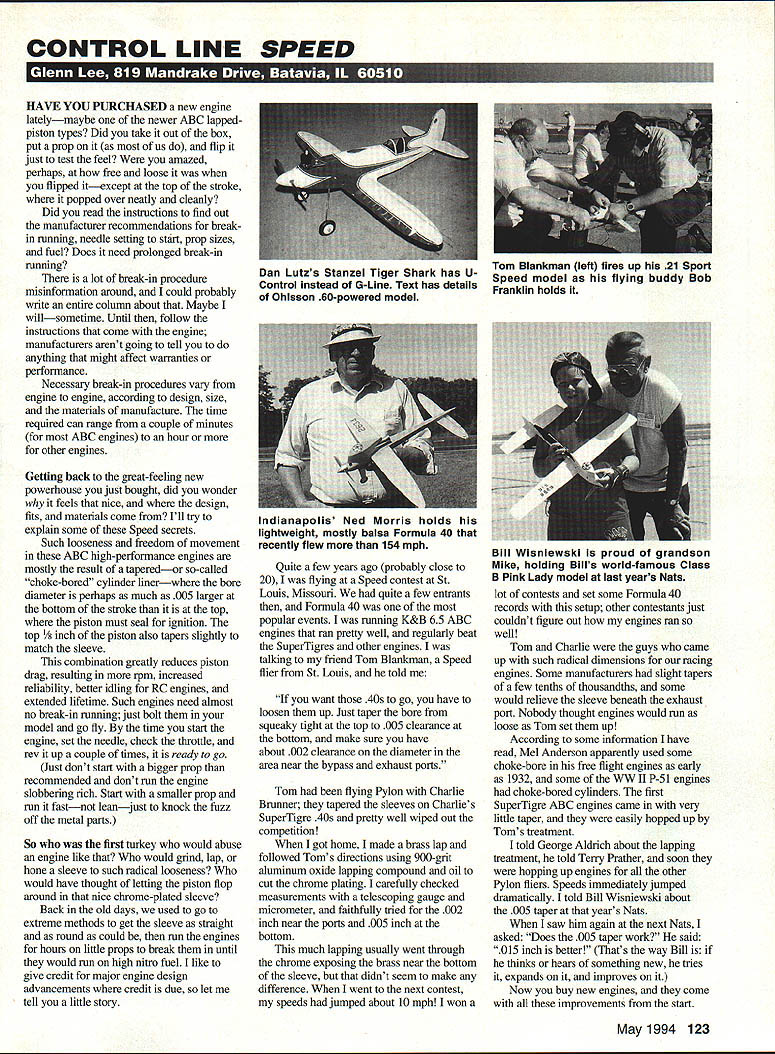
Dan Lutz of Fallbrook, California sent a photo of his Victor Stanzel Tiger Shark after reading the January column. It is powered by an Ohlsson .60 ignition engine, built with U-control rather than the original G-Line, and has the Super "V" Shark red and white paint scheme. A grandson of one of the Stanzel brothers sent Dan an original G-Line decal for the top of the fuselage, dated 1946.
Transcribed from original scans by AI. Minor OCR errors may remain.

