
CONTROL LINE SPEED
Glenn Lee
819 Mandrake Drive, Batavia, IL 60510
MODELERS KEEP writing to me asking about the availability of control line equipment, especially that for Speed models. I tell them to contact the North American Speed Society, Box 82294, North Burnaby, B.C., Canada. Chris Sackett puts out a newsletter every two months, and once a year he includes a list of equipment suppliers.
Availability and small suppliers
Many good items are produced by garage or basement dealers, and Ned Morris, an avid Speed flier from Indianapolis, Indiana, is one of them. He designed and made up a batch of really nice bellcranks that are just right for .21 Sport Speed, Formula .40, or any other two-line model that you want to build. They are constructed of .040-inch steel with rotating brass connectors, have brazed connector pins, and are suitable for any of the CL Racing classes if you want internal line connections.
Remember: the new rules require double loops on your lines if they are directly connected internally to the bellcrank. You do not need the double loops if you have rotating connector bearings on the bellcrank, so Ned used this method of construction. If you are interested, call Ned at (317) 271-1231. Ned also has a supply of straightened solid music wire for Speed lines.
Vintage Control Line Contest (VCLC)
The upcoming Vintage Control Line Contest (VCLC) is being organized by the Aeromodelers of Brevard (AMOB) in Palm Bay, Florida. The contest will be held October 1–2, 1994 at the Melbourne Mall in Melbourne, Florida.
Events include:
- Old Time Stunt
- Classic Stunt
- Vintage Combat
- Class A and B Vintage Team Racing
- Vintage Speed
- Concours
Speed will be record-ratio based on records from 1957, and Team Racing has special rules. If you are interested, write to Jon Ramsden, 730 Badger Dr. N.E., Palm Bay, FL 32905-5810 for the rule book. Speed models must have been kitted, designed, or flown before December 31, 1957 to be eligible.
I've been restoring my old McCoy .19, Dooling .29, and McCoy .60 models, so this would be a great opportunity to fly them in competition again. It is intended to be a low-key, fun-fly type of competition—like when we used to have fun, remember?
Jet Speed: history and notes
I've been trying to collect enough data to write a couple of columns on Jet Speed. I believe this is an appropriate time to write about jets, in remembrance of Bill Tenny, who passed away last year during an overseas trip. Bill was the founder of Aeromarine Corporation where the renowned Dynajet engine was developed and manufactured in 1946.
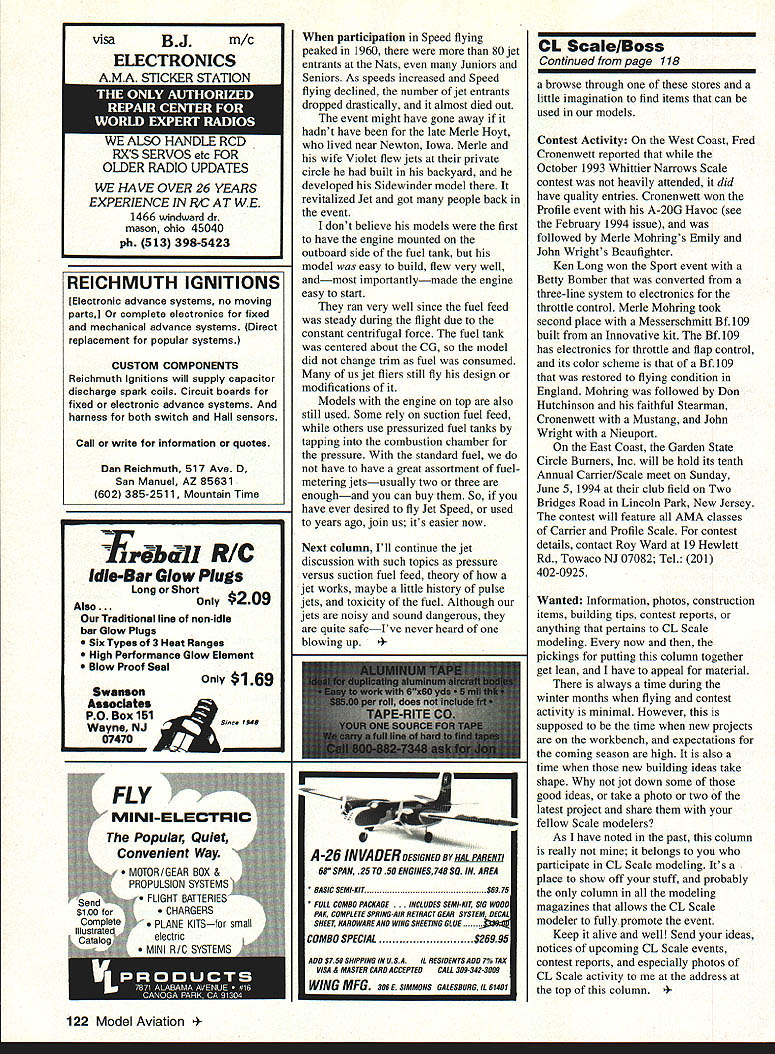
An excellent historical write-up about the Dynajet by Jerry Wiles of Bradford, Ohio was published in the May and July 1988 issues of Model Aviation. Jerry went to work for Aeromarine in 1949. His extensive collection of model jet engines is shown in the photo.
Jerry Wiles has collected pulse jet engines since he worked on Dynajets 40 years ago. Engine descriptions in text are still available today. Several similar jet engines were sold, many with interchangeable parts. Even today's new engines can use the Dynajet reeds, tailpipe, and other parts.
Bill Pardue and Mike Langlois held the AMA Jet Speed record of more than 212 mph for many years. The record was set with a Dynajet modified by gluing a 35mm film can on the front to extend the intake. This longer, tuned intake is almost standard on jets used in competition now.
Jet Speed flying is fun but frustrating. Theories go out the window. You have to test fly to get them going fast. It doesn't seem possible that I've been messing with them for forty years!
Several new engines are available, and our new AMA-standard fuel of 80% methanol and 20% propylene oxide starts easily and runs very well. The current record is about 193 mph held by Mike Couts. Jerry Thomas turned a flight of 196 mph last fall, but he couldn't back it up for a record. I won't be surprised if someone reaches 200 mph this summer.
When participation in Speed flying peaked in 1960, there were more than 80 jet entrants at the Nats, even many Juniors and Seniors. As speeds increased and Speed flying declined, the number of jet entrants dropped drastically, and it almost died out.
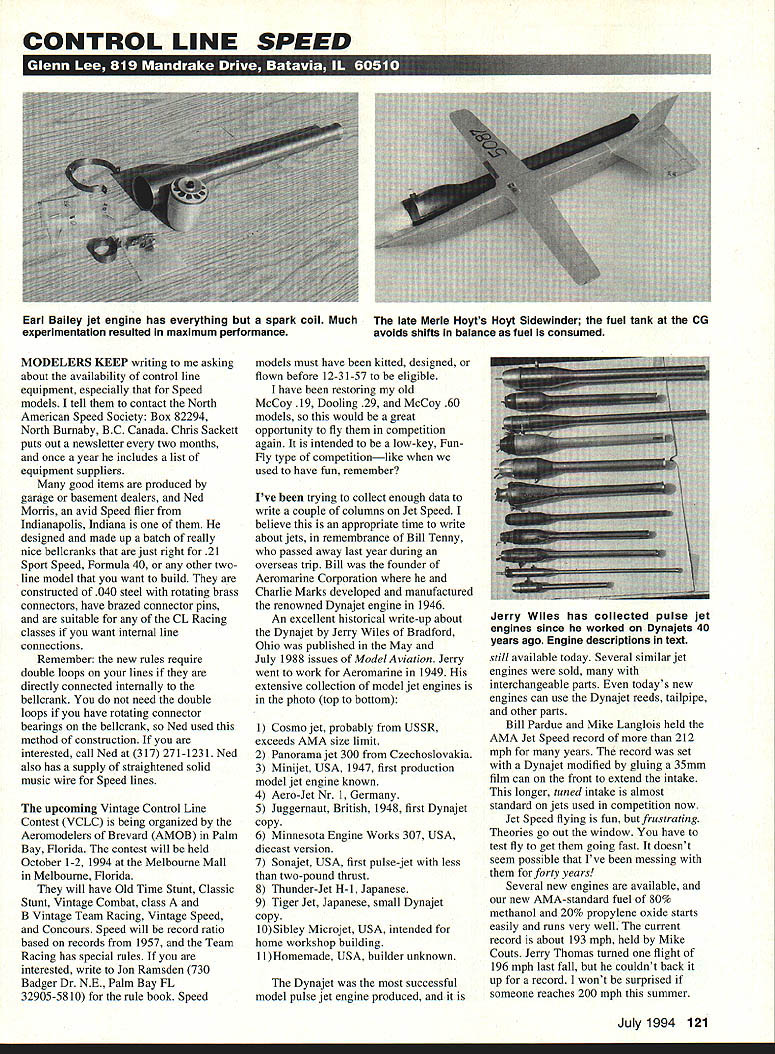
The event might have gone away if it hadn't been for the late Merle Hoyt, who lived near Newton, Iowa. Merle and his wife Violet flew jets at a private circle he had built in his backyard, and he developed his Sidewinder model there. It revitalized Jet and got many people back in the event.
I don't believe his models were the first to have the engine mounted on the outboard side of the fuel tank, but his model was easy to build, flew very well, and—most importantly—made the engine easy to start. They ran very well since the fuel feed was steady during the flight due to the constant centrifugal force. The fuel tank was centered about the CG, so the model did not change trim as fuel was consumed. Many of us jet fliers still fly his design or modifications of it.
Models with the engine on top are also still used. Some rely on suction fuel feed, while others use pressurized fuel tanks by tapping into the combustion chamber for pressure. With the standard fuel, we do not have to have a great assortment of fueling metering jets—usually two or three are enough—and you can buy them. So, if you have ever desired to fly Jet Speed, or used to years ago, join us; it's easier now.
Next column, I'll continue the jet discussion with such topics as pressure versus suction fuel feed, theory of how a jet works, a little history of pulse jets, and toxicity of the fuel. Although our jets are noisy and sound dangerous, they are quite safe—I've never heard of one blowing up.
Transcribed from original scans by AI. Minor OCR errors may remain.

