
On July 7-11, 27 nations met at Utrecht, Netherlands to have it out in Speed, Team Race and Aerobatics.
Text and Photos by Charlie Johnson
Control Line World Championships
THE Royal Netherlands Aeronautical Association was the organizer of this year's World Championships. Individuals and teams compete within the three categories of F2A Speed, F2B Aerobatics and F2C Team Race. Entrants from each country compete on an individual as well as team basis. Qualification for team selection varies from country to country as does the size of the team, but a maximum of three two‑man Team Race teams, three Aerobatic pilots and three Speed pilots are permitted per nation.
Reigning Champions do not have to qualify for a team spot and are permitted to enter on their own, but team prizes are based on the performances of the three regular team members. National sponsorship also varies with some countries paying the entire expenses of the team and in a few cases where the individual pays for everything himself. Twenty‑seven nations were represented this year with entries from as far away as South Africa, Australia, Brazil and an Aerobatics team from Egypt.
The Utrecht site is permanent with an enclosed clubhouse and has three circles, two caged circles for Team Race and Speed and a third for Aerobatics which also has a model race car track snake through it. The Team Race circle has a timing tower for equipment and jury, light boards to display the number of laps for each team, fouls, and the numbers of the contestants in the following heats. Speed was both mechanically and electronically timed with the speed posted on a light board following the run. A set of red and green lights informed the pilot and pit crew when official timing was taking place.
Nothing sophisticated — judging flight patterns, just five hard‑working jury members crowded under an umbrella.
Wednesday, July 7th, the first official day of the WC was set aside for registration. Thursday was a training/processing day — everyone had a chance to put in some practice although some preferred the privacy of an alternate training site. Things could be sorted out during processing. A 7cc tank limit was in effect for Team Race; reports varied from country to country, but the Russians were reported to have won the oversize tank contest with a record 74cc. Because of elaborate filling systems some tanks measured 2cc larger due to filler valve assemblies.
Aerobatics and Speed ran very smoothly, times ahead of schedule. Team Race had two protest tests before flying started. Both proxy‑flying incidents centered around Clarkson/Daly: the New Zealand entry Barnes/Brown allowed Enrico Flores (legally Italian, married to a Dutch girl) to proxy‑fly as a member of the Dutch team. Although allowed to fly heats, Flores did not qualify; he was allowed to participate in the semi‑rounds. The Dutch team was very unhappy that Flores did not qualify under current FAI rules.
F2B Aerobatics
After the first round Friday apparent Aerobatics...
F2B Aerobatics
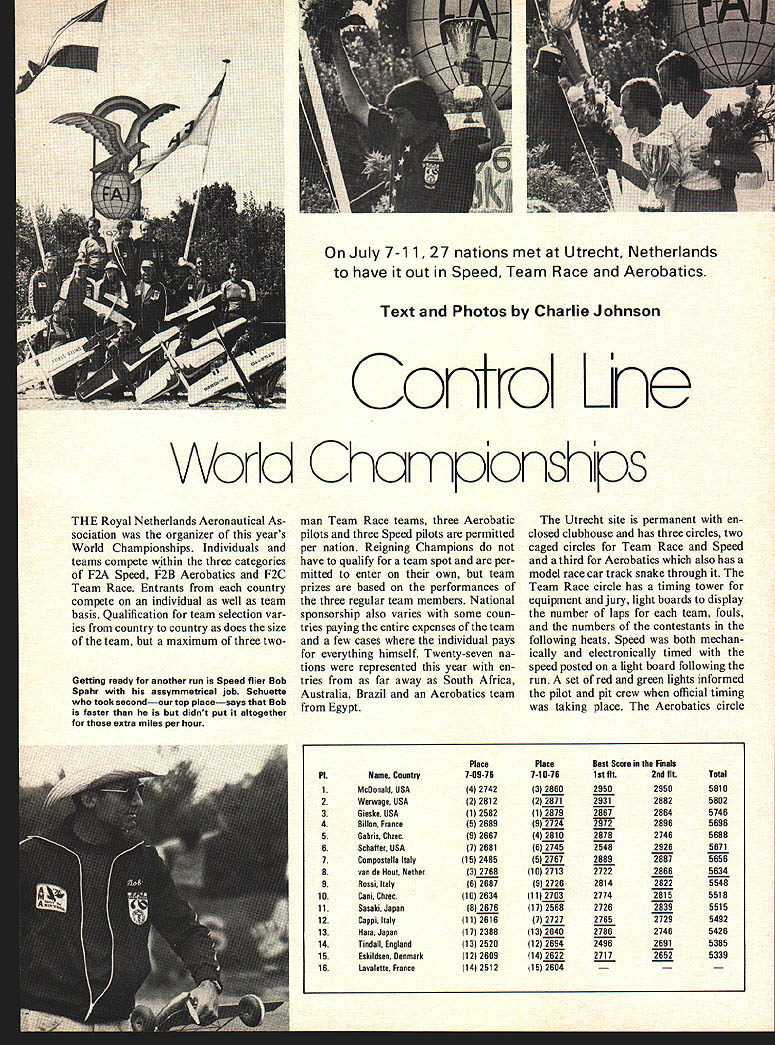
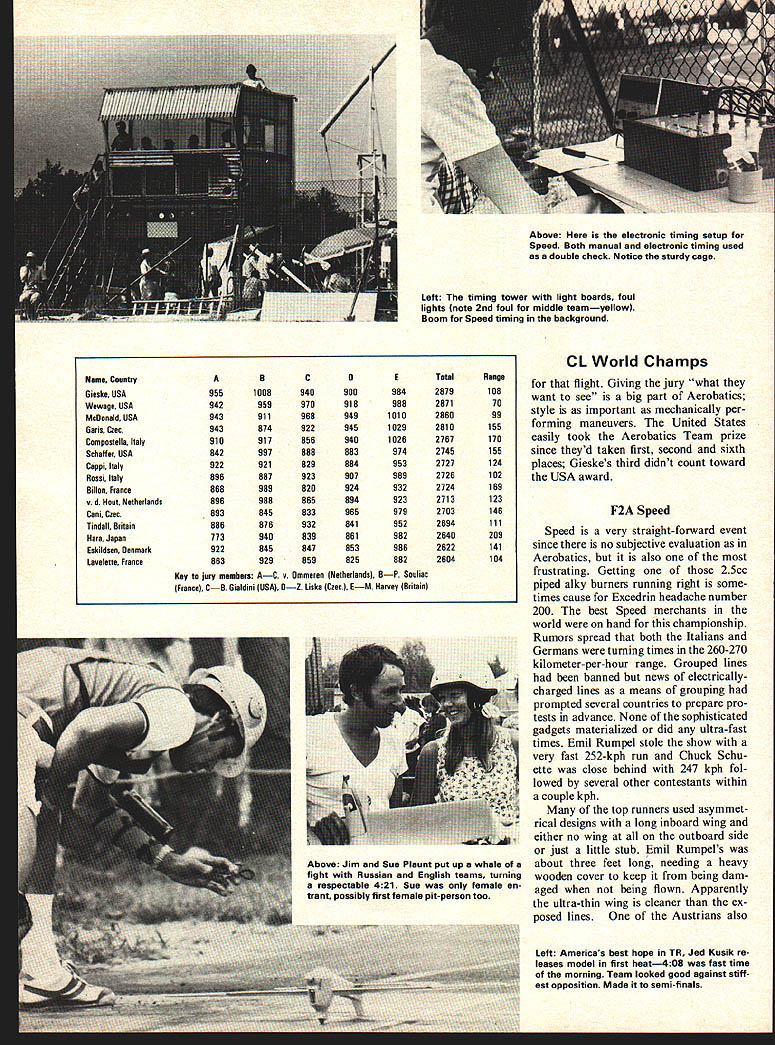
After the first round Friday it was apparent to most Aerobatic pilots that first place would go to an American; it was just a question of which one. Below is a summary of scores from the three days of competition. All contestants were given two preliminary qualifying attempts with the highest 15 getting two flights Sunday. The final score was determined by adding the highest qualifying flight from either Friday or Saturday and the best score Sunday. The majority of fliers scored highest during their second pattern on Saturday and first pattern Sunday. Also observe that only 8 points separates the first two places and the two 2950 patterns turned in by McDonald on Sunday. Below is a sample of scores by the five jury members; the number at the end is the range between the highest and lowest score since only the three middle scores are used.
No one in the top 15 had a narrower range than did Bill Werwage. The range between high and low for some contestants down the list was over 240 points. As you can see, Gieske's range was 108 points, if all five judges are taken into the total, but only 44 points when counting the middle three scores which were used as his total. for that flight. Giving the jury "what they want to see" is a big part of Aerobatics; style is as important as mechanically performing maneuvers. The United States easily took the Aerobatics Team prize since they'd taken first, second and sixth places; Gieske's third didn't count toward the USA award.
F2A Speed
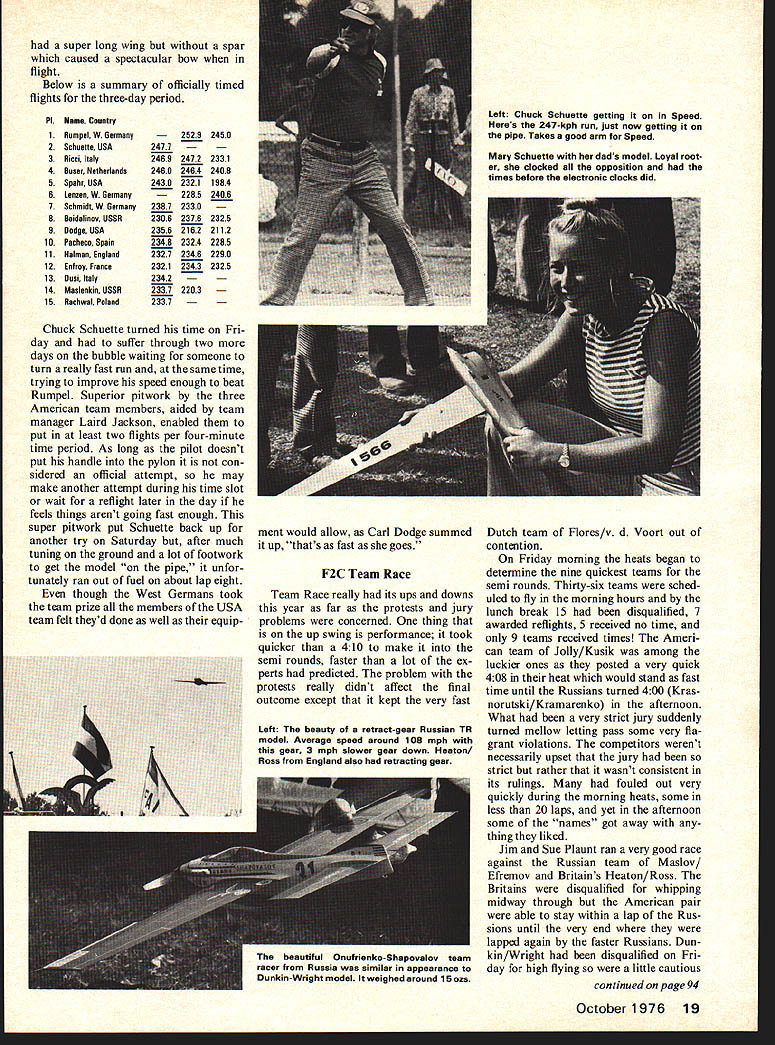
Speed is a very straight-forward event since there is no subjective evaluation as in Aerobatics, but it is also one of the most frustrating. Getting one of those 2.5cc piped alky burners running right is sometimes cause for Excedrin headache number 200. The best Speed merchants in the world were on hand for this championship. Rumors spread that both the Italians and Germans were turning times in the 260-270 kilometer-per-hour range. Grouped lines had been banned but news of electrically-charged lines as a means of grouping prompted several countries to prepare proper tests in advance. None of the sophisticated gadgets materialized or did any ultra-fast times. Emil Rumpel stole the show with a very fast 252-kph run and Chuck Schuette was close behind with 247 kph followed by several other contestants within a couple kph.
Many of the top runners used asymmetrical designs with a long inboard wing and either no wing at all on the outboard side or just a little stub. Emil Rumpel's was about three feet long, needing a heavy wooden cover to keep it from being damaged when not being flown. Apparently the ultra-thin wing is cleaner than the exposed lines. Chuck Schuette turned his time on Friday and had to suffer through two more days on the bubble waiting for someone to turn a really fast run and, at the same time, trying to improve his speed enough to beat Rumpel. Superior pitwork by the three American team members, aided by team manager Laird Jackson, enabled them to put in at least two flights per four-minute time period. As long as the pilot doesn't put his handle into the pylon it is not considered an official attempt, so he may make another attempt during his time slot or wait for a reflight later in the day if he feels things aren't going fast enough. This superior pitwork put Schuette back up for another try on Saturday, but, after much tuning on the ground and a lot of footwork to get the model "on the pipe," it unfortunately ran out of fuel on about lap eight.
Even though the West Germans took the team prize all the members of the USA team felt they'd done as well as their equipment would allow, as Carl Dodge summed it up, "that's as fast as she goes."
F2C Team Race
Team Race really had its ups and downs this year as far as the protests and jury problems were concerned. One thing that is on the upswing is performance; it took quicker than a 4:10 to make it into the semi rounds, faster than a lot of the experts had predicted. The problem with the protests really didn't affect the final outcome except that it kept the very fast Dutch team of Flores/v.d. Voort out of contention.
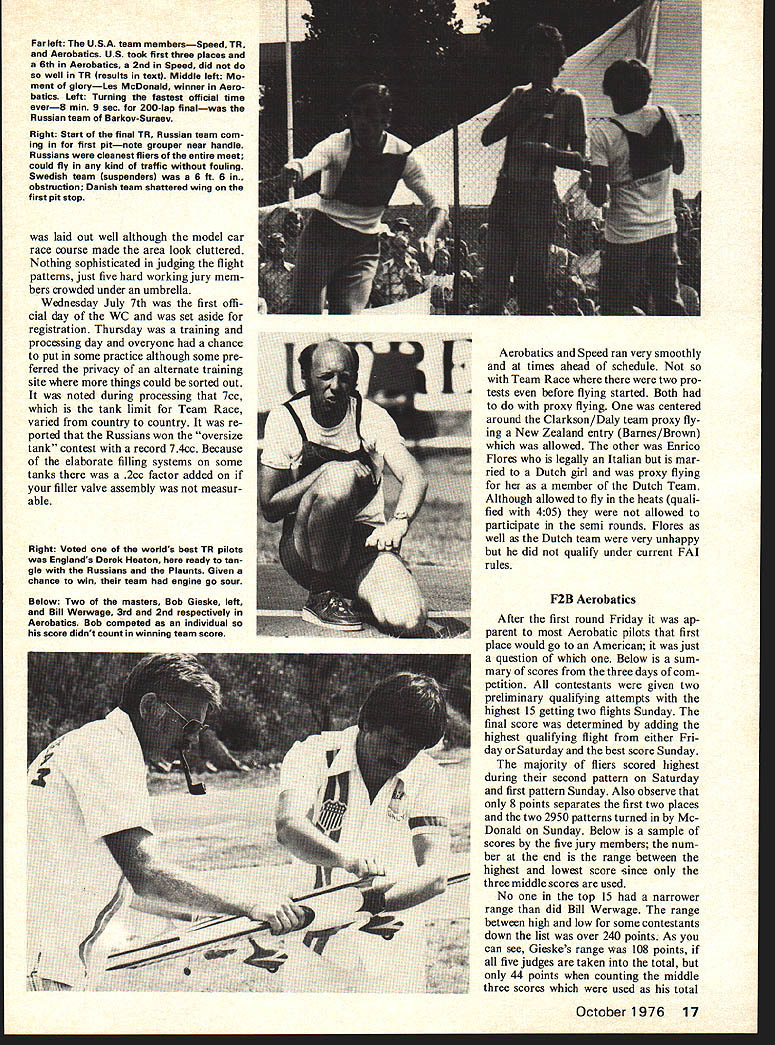
On Friday morning the heats began to determine the nine quickest teams for the semi rounds. Thirty-six teams were scheduled to fly in the morning hours and by the lunch break 15 had been disqualified, 7 awarded re-flights, 5 received no time, and only 9 teams received times! The American team of Jolly/Kusik was among the luckier ones as they posted a very quick 4:08 in their heat which would stand as fast time until the Russians turned 4:00 (Krasnorutski/Kramarenko) in the afternoon. What had been a very strict jury suddenly turned mellow letting pass some very flagrant violations. The competitors weren't necessarily upset that the jury had been so strict but rather that it wasn't consistent in its rulings. Many had fouled out very quickly during the morning heats, some in less than 20 laps, and yet in the afternoon some of the "names" got away with anything they liked.
Jim and Sue Plaunt ran a very good race against the Russian team of Maslov/Efremenov and Britain's Heaton/Ross. The British were disqualified for whipping midway through but the American pair were able to stay within a lap of the Russians until the very end where they were lapped again by the faster Russians. Dunkin/Wright had been disqualified on Friday for high flying so were a little cautious
Control Line World Championships
tics In their second round. Everything looked OK for a qualifying shot when the motor “cooked” a bit during some heavy traffic and then the motor became balky at the pit and required an extra dose of flipping. The third American team of Jolly/Kusik couldn't improve their first-round time, in fact having more trouble on one flight than in the past year. A split fuel line caused the engine to sputter and caused a run-in.
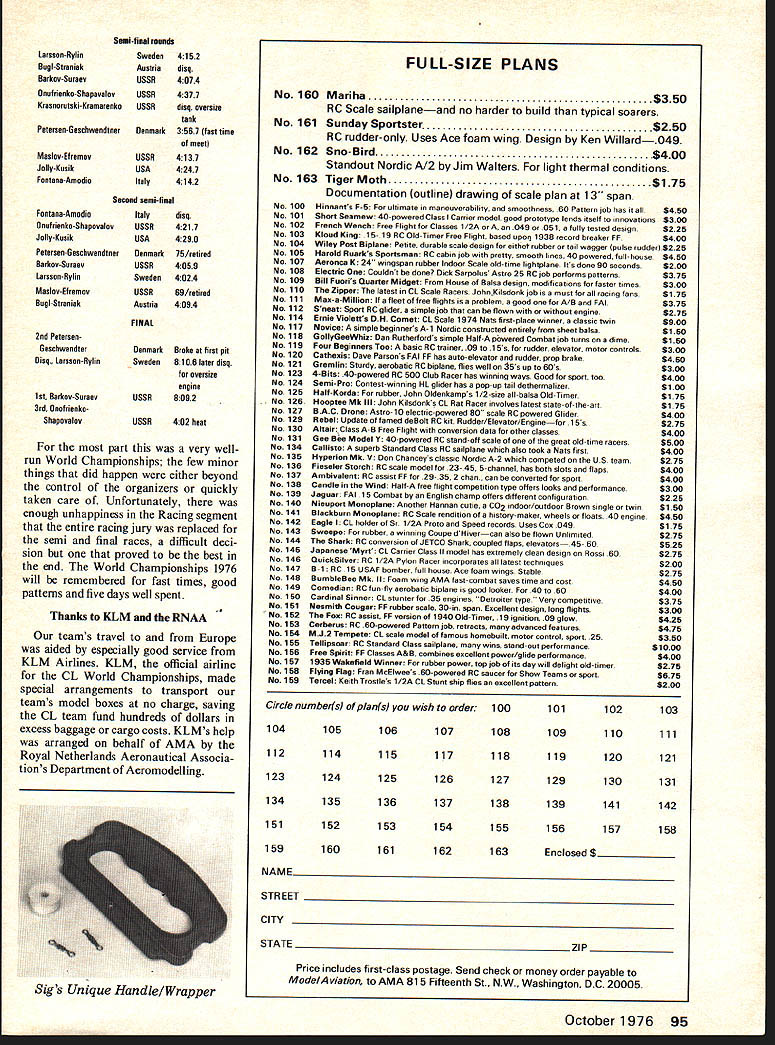
The final was very exciting even though the Danish team broke their model at the first pit. The Russian pilot used two fouls to whip over the Swedish team and this proved to be enough margin to pull out the win. The race was so close that they were late timing on another pass each other and the lap-counting lights flashed off at the same instant. Later at the banquet we found out that Larsson-Rylin's engine was oversized by a small amount. Many of the Rossi 15's come oversize from the factory and this happened to be one of them so unfortunately they were disqualified. Because of their fast heat time the third place award was given to the Russian team of Orunfenko-Shapovalov (4:02 heat time). The Austrians were awarded the prize for top team in Team Race on the basis of their fast heat times. For the most part this was a very well-run World Championships; the few minor things that did happen were either beyond the control of the organizers or quickly taken care of. Unfortunately, there was enough unhappiness in the Racing segment that the entire racing jury was replaced for the semi and final races, a difficult decision but one that proved to be the best in the end. The World Championships 1976 will be remembered for fast times, good patterns and five days well spent.
Thanks to KLM and the RNAA
Our team's travel to and from Europe was aided by especially good service from KLM Airlines. KLM, the official airline for the CL World Championships, made special arrangements to transport our team's model boxes at no charge, saving the CL team fund hundreds of dollars in excess baggage or cargo costs. KLM's help was arranged on behalf of AMA by the Royal Netherlands Aeronautical Association's Department of Aeromodelling.
Transcribed from original scans by AI. Minor OCR errors may remain.

