


Control Line World Championships
U.S.S.R. fliers continued their winning ways, taking the gold individually and as a team in all four events. It's an unprecedented accomplishment. — Walt Perkins
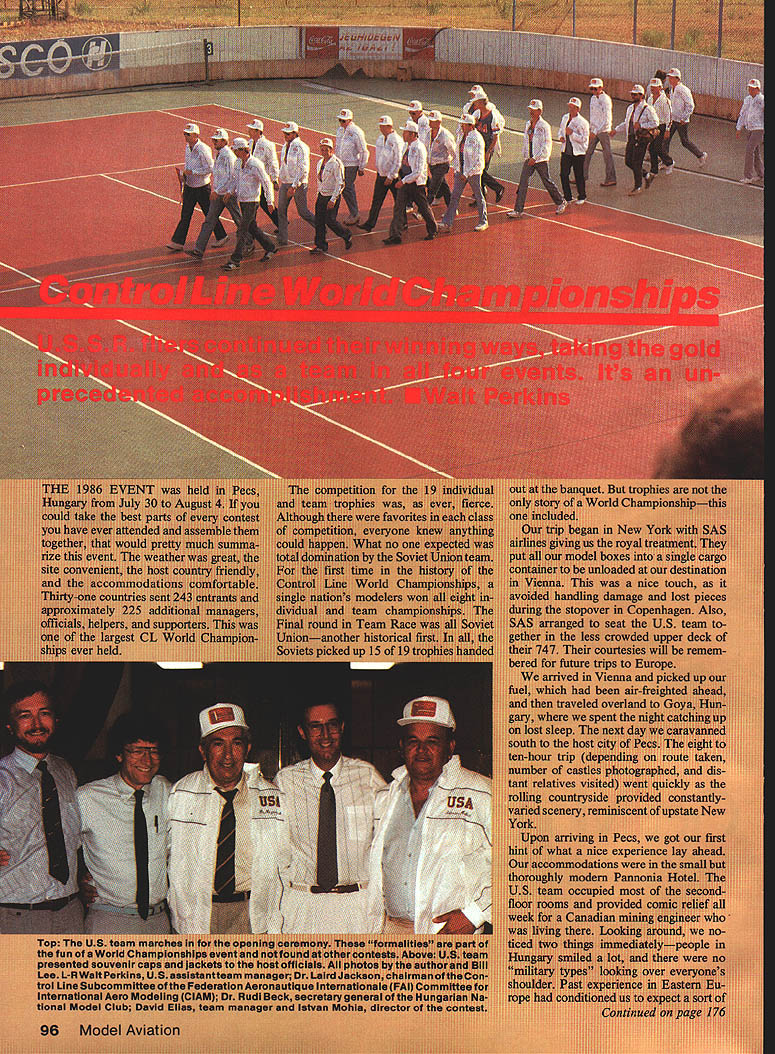
THE 1986 event was held in Pecs, Hungary, from July 30 to August 4. If you could take the best parts of every contest you have ever attended and assemble them together, that would pretty much summarize this event. The weather was great, the site convenient, the host country friendly, and the accommodations comfortable. Thirty-one countries sent 243 entrants and approximately 225 additional managers, officials, helpers, and supporters. This was one of the largest CL World Championships ever held.
The competition for the 19 individual and team trophies was, as ever, fierce. Although there were favorites in each class of competition, everyone knew anything could happen. What no one expected was total domination by the Soviet Union team. For the first time in the history of the Control Line World Championships, a single nation's modelers won all eight individual and team championships. The Final round in Team Race was all Soviet Union—another historical first. In all, the Soviets picked up 15 of 19 trophies handed out at the banquet.
Our trip began in New York with SAS airlines giving us the royal treatment. They put all our model boxes into a single cargo container to be unloaded at our destination in Vienna. This was a nice touch, as it avoided handling damage and lost pieces during the stopover in Copenhagen. Also, SAS arranged to seat the U.S. team together in the less-crowded upper deck of their 747. Their courtesies will be remembered for future trips to Europe.
We arrived in Vienna, picked up our fuel (air-freighted ahead), and then traveled overland to Goya, Hungary, where we spent the night catching up on lost sleep. The next day we caravanned south to the host city of Pecs. The eight- to ten-hour trip (depending on route taken, number of castles photographed, and distance visited between stops) went quickly as the rolling countryside provided constantly varied scenery, reminiscent of upstate New York.
Upon arriving in Pecs, we got our first hint of what a nice experience lay ahead. Our accommodations were in the small but thoroughly modern Pannonia Hotel. The U.S. team occupied most of the second-floor rooms and provided comic relief all week for a Canadian mining engineer who was living there. Looking around, we noticed two things immediately—people in Hungary smiled a lot, and there were no "military types" looking over everyone's shoulder. Past experience in Eastern Europe had conditioned us to expect a sort of stiffness that was happily absent here.
Speed (F2A)
This is a marvelously objective event: a model and engine conform to clear requirements and fly 10 laps in a pylon against the clock. Standard fuel, 4 minutes per round to get in the flight; no problems—nice and easy. Not quite! The technology needed to squeeze nearly 290 kph out of a 2.5 cc engine on 80% methanol fuel (20% lubricant) is astounding. You see tuned pipes that are at least 50% black magic, strange asymmetric models with sidewinder engines, and fuel systems that only someone with a PhD in physics could begin to understand. Rotational speeds in the 1.2- to 3-sec/revolution range put a physical strain on the pilot that is hard to imagine.
The teams expected to do well were the Hungarians (the reigning World Champions) and the Soviets. The Hungarians (Muti, Molnar, and Szegedi) have been consistently fast for several years, and some very high speeds had been coming out of the Soviet Union lately. The U.S. team was considered a dark horse: there were only individuals to watch, not a whole-team threat.
Carl Dodge was the U.S. standout. He brought a newly constructed asymmetric model and worked nonstop in the days before the contest to find the right combination of model, engine, fuel system, and prop. His practice flights were erratic, but the fast ones were very encouraging. Carl has a competitor's ability to find the correct solution at the right time, and his second-round speed of 286.39 kph put him solidly in contention. A characteristic of contemporary F2A equipment is a two-stage exhaust-pipe resonance; the Soviet and Hungarian models made a small rpm transition from primary to secondary resonance, while Carl's models made a much more dramatic jump.
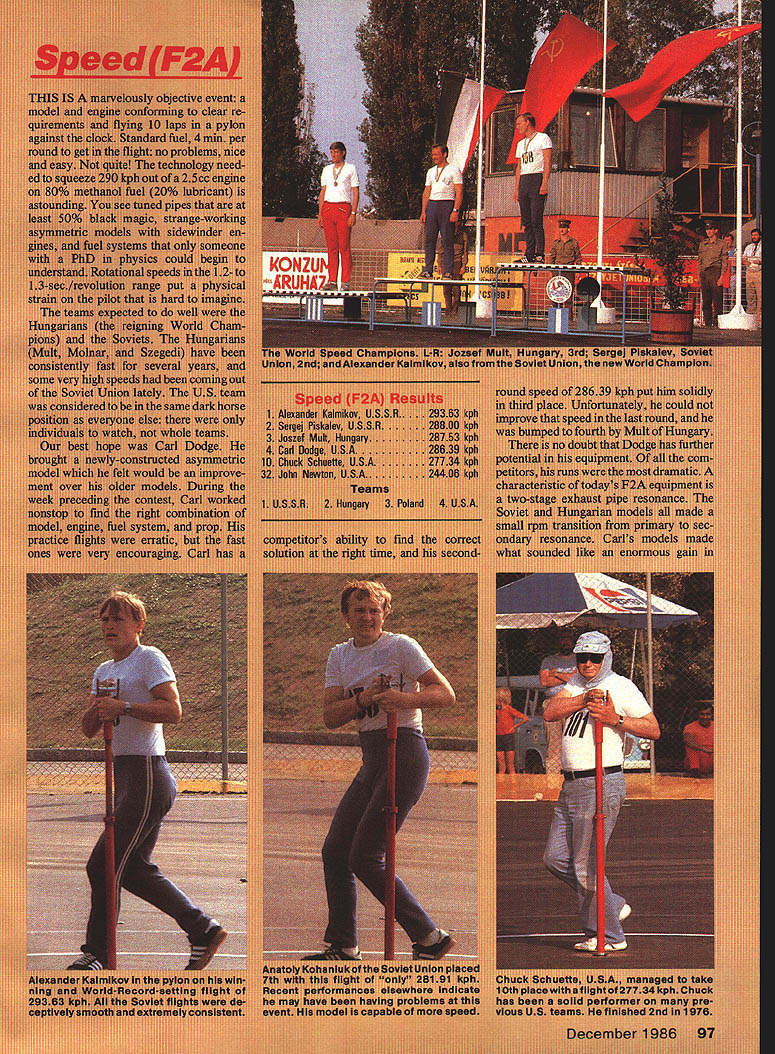
The Soviet team posted extremely fast, consistent speeds. Their flying style emphasized uniformity so much that it was hard to tell one team member's flight from another. They flew similar-looking asymmetric ships with medium-aspect-ratio wings and state-produced speed engines. Kalmikov won the Individual Championship with a flight of 293.63 kph; Piskalev was 2nd and Komanuk placed well. Naturally, they took the Team Championship.
Speed (F2A) Results
- Alexander Kalmikov, U.S.S.R. — 293.63 kph
- Sergej Piskalev, U.S.S.R. — 288.00 kph
- Jozsef Muti, Hungary — 287.53 kph
- Carl Dodge, U.S.A. — 286.39 kph
- Chuck Schuette, U.S.A. — 277.34 kph
- John Newton, U.S.A. — 244.06 kph
Teams
- U.S.S.R.
- Hungary
- Poland
- U.S.A.
For the first time in history the Jim Walker Team Championship Trophy will be engraved with the name and nation. Other U.S. team members reacted on the trip home with talk of getting the trophy back. New model designs were discussed with a keen eye toward a middle-of-the-road approach.
Aerobatics (F2B)
Aerobatics is an event of extreme subjectivity; a competitor's placing depends as much on the judges' interpretation as on technical merit. There is a written standard the fliers try to attain, but any smart competitor knows it is each judge's interpretation that really matters.
Three "styles" have emerged as effective:
- The "finesse" approach: small, tight, relatively quiet models that perform well in still air.
- The "brutal" approach: large, loud, heavy models flown on maximum-length lines to present very square corners and strict rule compliance.
- The middle-of-the-road approach: aims for a unified pattern that flows from start to finish, emphasizing overall impression over strict technical dimensions.
Fliers tend to adopt a single style that mirrors their model/engine setup and their physical coordination; changing styles during a contest is difficult. Past U.S. teams have been successful with all styles, but history tends to favor the middle-of-the-road approach for top placings.
The U.S. team came equipped with large, .60-powered models capable of running in any air. Paul Walker arrived late after an airline snafu separating him from his model boxes, but he quickly settled in. Bill Werwage and Jim Casale practiced heavily to find the right engine, model, and prop combination.
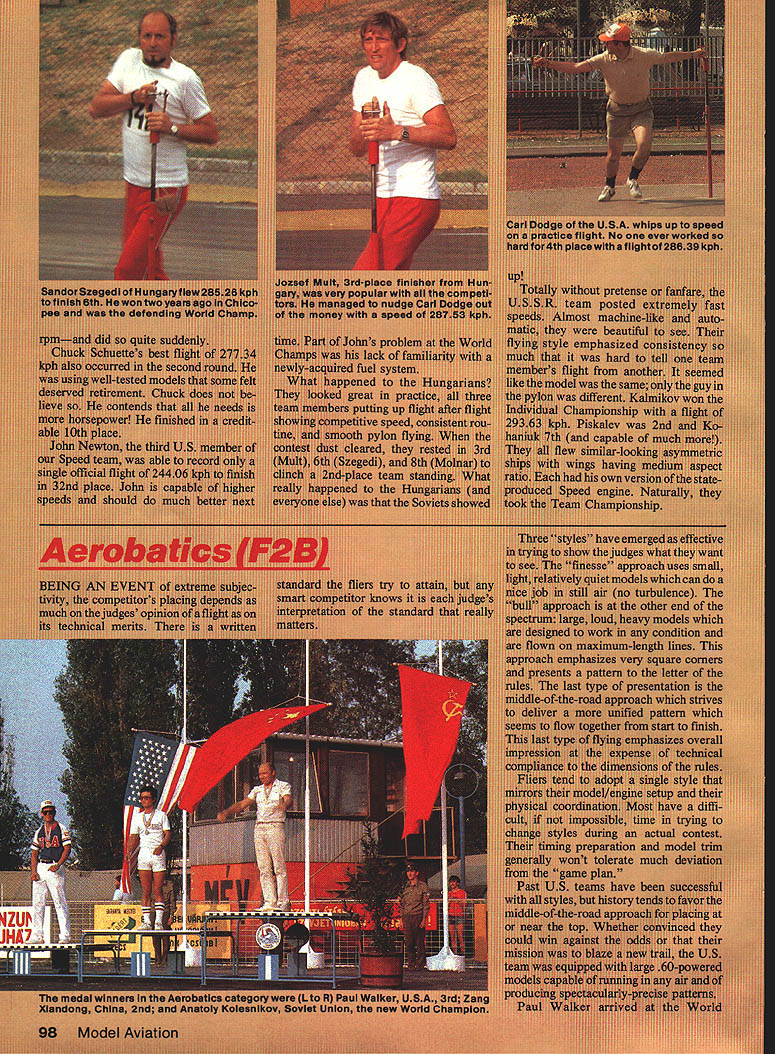
The Chinese team brought small, lightweight models and suffered in the constantly changing turbulence around the tall trees adjacent to the flight circle. The Soviet Union brought a modeler representing each style: Salonek (small), Klochkov (giant), and Kolesnikov (middle). This strategy paid off—the Soviets won both the individual and team championships. Kolesnikov took a commanding lead early and was never threatened.
Aerobatics (F2B) Results
- Anatoly Kolesnikov, U.S.S.R. — 5753 pts.
- Xian Dong Zang, P.R. China — 5648 pts.
- Paul Walker, U.S.A. — 5457 pts.
- Jim Casale, U.S.A. — 5387 pts.
- Bill Werwage, U.S.A. — 5196 pts.
Teams
- U.S.S.R.
- P.R. China
- U.S.A.
Team Racing (F2C)
Design, construction, and flying of Team Race models is an exceedingly complex combination of contradictory requirements. Models must be lightweight yet strong enough to withstand pit-stop catches. Even though a stopwatch determines the winner objectively, races are conducted under the subjective eyes of a three-man jury. Add pit stops, three-up flying, and the disorienting effect of racing inside a chain-link "cage," and it's easy to see why few teams master the sport. It takes years of dedicated teamwork to handle all the variables.
To say the Soviets are the masters of Team Racing is an understatement. Since the mid-1960s they have been legitimate contenders, with few exceptions. They hold current Heat (100 laps) and Final (200 laps) World Records, though neither was set at this contest. Their approach since about 1982 has been to make modest, well-tested refinements rather than radical changes—they are now in a "cruising" phase.
There is nothing secret or revolutionary in Soviet equipment; they will show it to anyone. What sets them apart is enormous attention to detail, simplicity, and total preparation. All three U.S.S.R. teams flew generic flying-wing configurations with molded carbon fuselage shells, minimum frontal area, smooth transitions, and small duct openings. Each team's engines shared features: small dimensions, integrally molded backplate/multifunction valve, crutch-less mounting, and jewel-like attention to detail.
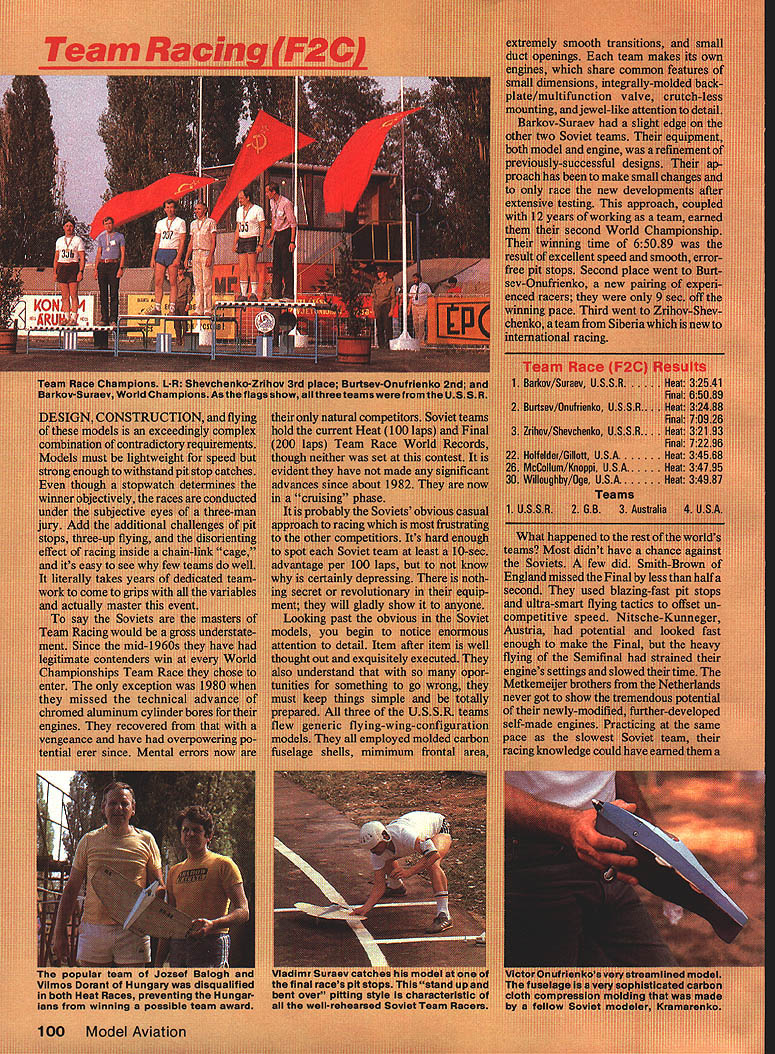
Barkov–Suraev had a slight edge on the other two Soviet teams. Their refined equipment and twelve years of teamwork earned them the World Championship. Their winning time was 6:50.89, the result of excellent speed and smooth, error-free pit stops. Second place went to Burtsev–Onufrienko, a newly paired but experienced duo, only 9 seconds behind. Third went to Zrinkov–Shevchenko, a team from Siberia new to international racing.
Most of the rest of the world's teams had little chance against the Soviets, though a few nearly made the Final. Smith–Brown of England missed the Final by less than half a second, using blazing-fast pit stops and smart tactics to offset some speed disadvantages. Nitsche–Kunniger of Austria looked quick but strained their engine settings in the semifinal. The Metkeimer brothers from the Netherlands never got to show the potential of their self-made engines. Hollfelder–Gillott finished 22nd after consuming their supply of highly modified Nelson engines in practice and suffering disqualifications in Heat Races. Host-country favorites Balogh–Dorant had potential but tried too hard in the heats and recorded no times.
The U.S. teams finished well down the results column, but at least this time there were no unanswered questions about their potential: all three U.S. teams completed both their heats without disqualification. The simple truth is that the U.S., like the rest of the West, suffers from a lack of horsepower. Commercial engine manufacturers such as Nelson and Cipolla must make a profit and build hundreds of engines annually, so they cannot spend the same man-hours per engine as Soviet makers, who produce only a handful each year. The answer may be a drastically more expensive commercial engine or teams deciding to copy the Soviet approach and make their own.
Additional Team Race notes:
- The Team Race jury (Don Jehlick, Carl Plotsin, and Pietro Fontana) was criticized by organizers for decisions favoring or disfavoring hometown teams, though many observers agreed the jury was consistent.
- McCollum–Knopp ended in 26th place but had the potential for a much higher finish; safe practice settings disappeared in the racing.
- Willoughby–Oge finished 30th after practicing well but failing to sustain pace under race conditions—an all-too-common issue for U.S. teams due to limited domestic competition.
Combat (F2D)
Combat is a contest where luck plays a role alongside skill. Everyone prepares mightily, but outcomes often depend on circumstances beyond a pilot's control.
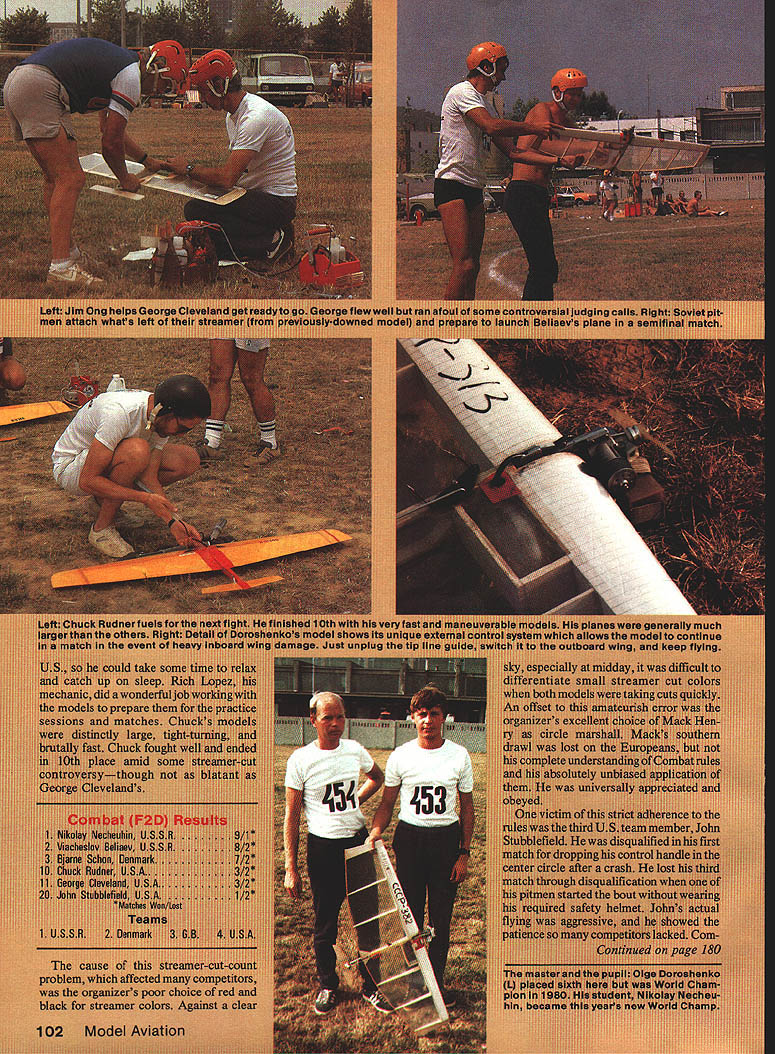
For the U.S. fliers, luck at these World Championships was mostly bad. George Cleveland probably had the worst luck: both of his losing matches ended in controversy. In one match he had what appeared to be a clear three-cuts-to-one victory over Fred Meijer of the Netherlands, but the cut judges recorded it three-cuts-to-one in Meijer's favor. Attempts to convince the FAI jury of a mistaken streamer-color count failed; the subjective decision stood. The loss took the wind out of George's sails; he finished the contest with three wins and an 11th-place showing.
Chuck Rudner's trip started badly when his wife, Muffy, had emergency surgery a week before leaving, delaying his arrival. Fortunately, Chuck had thoroughly sorted his equipment before leaving the U.S., and his mechanic Rich Lopez prepared the models well. Chuck's models were large, tight-turning, and brutally fast. He fought well and ended in 10th place amid some streamer-cut controversy—though not as blatant as Cleveland's.
Streamer-count controversies affected many competitors because the organizers chose red and black for streamer colors. Against a clear midday sky it was difficult to differentiate small cuts when both models were taking cuts quickly. An offset to this problem was the excellent choice of Mack Henry as circle marshal. His complete understanding of Combat rules and absolutely unbiased application of them were universally appreciated.
John Stubblefield, the third U.S. team member, suffered disqualifications: he was DQ'd in his first match for dropping his control handle in the center circle after a crash, and he lost another match because a pitman started a bout without wearing the required safety helmet. Despite the DQs, John's flying was aggressive and showed the patience many competitors lacked.
Combat rewards maturity: cuts in the last 10 seconds matter much more than those in the first 10 seconds. The Soviets exemplified this discipline. They fielded a remarkably consistent team and made few mistakes. The champion was young Nikolay Necheuhin (age 19), quiet, polite, and very disciplined. His one lapse—forgetting to wear his safety helmet—was caught by pitman Oleg Doroshenko. The Soviet team did not lose a match until that fifth-round incident, finishing with 14 winning flights and one loss.
Other top Combat performers included:
- Schön, Denmark — 3rd place
- Jones, England — 4th place
- Ingvar, Sweden — 5th place
Combat hardware was diverse—foam, balsa, and foam/balsa hybrids in many configurations and sizes, powered by a wide variety of engines. Novel hardware tricks abounded: the Soviets displayed a slick on-board cam-operated fuel-line pinching device and detachable metal engine mounts to allow nose-moment adjustment and more reliable engine runs (as seen on Oleg Doroshenko's model).
Overall, the 1986 Control Line World Championships in Pecs was memorable for excellent organization, friendly hosts, good weather, a large international turnout, and stunning Soviet dominance across all events.
Transcribed from original scans by AI. Minor OCR errors may remain.

