

Control Line: World Championships
Bill Lee & Rich Von Lopez
We left San Francisco on Saturday, October 15 and arrived in Shanghai late Sunday after a long, tiring 13½-hour flight on an Air China 747. At the airport we were met by Mr. Huang of the Aero Sports Federation of China, host organization for the Control Line World Championships. He had arranged with local authorities to get us quickly through customs and into buses for the trip to our hotel.
The ride to the hotel at 1 a.m. was wild: narrow streets crowded with people, bicycles, and construction crews; few street lights and virtually no traffic control. Other vehicles—many without headlights—seemed to aim for the same small piece of road as our bus. Still, we arrived safely.
Weather and practice
- The US team planned to arrive several days early for practice, but Monday and Tuesday were cool, overcast, and too windy for much flying. Wednesday was cold, windy, and wet; Thursday a cold front moved through and conditions improved enough for a few practice flights. Friday was nice and more teams began to arrive.
- Getting practice time was difficult because the Olympic Hotel and the Qienhe Hotel (where teams were housed) were about eight miles from the flying site. With Shanghai’s population and bicycle traffic, that eight miles could take ½ to 2 hours each way. On our first Monday at 1 p.m., the trip took about 1½ hours to the site, a couple of hours there, and about two hours back to the hotel.
- During the official days the organizers worked with local authorities to provide police escorts for the buses. With police clearing traffic in advance, the trip was consistently under an hour—congratulations to the organizers for handling a difficult situation well.
Flying site and facilities
- The flying site was nestled among factories and high-rise apartments. It was a nice site with limitations compared to typical U.S. sites (usually sited away from habitation because sound models are offensive).
- A new "sportsman building" adjacent to the site had six floors of small rooms off a central hall; teams were assigned rooms for work areas and model storage. The building housed large rooms for model processing and served noon meals. Two small lakes built for model boating flanked the flying site.
F2A Speed
Entry in F2A was up about 25% from the 1992 World Championships, including Junior fliers. The Speed circle was newly built and first-class: ample space inside the mandatory fencing with a very sturdy pylon. Early test flying by the American team produced good speeds; Tommy Brown clocked a 297 kph flight in testing.
Official flying began at 6:30 a.m. China has a single time zone; in Shanghai the sun rises early and daylight is short (about 10 hours), so early starts were necessary to get all official flights and possible relights completed.
Highlights
- Peter Hallman (Great Britain) posted the best flight of the competition, 302.7 kph, as the second competitor of the day at about 6:40 a.m.
- Gerard Billon (France) recorded multiple 300+ flights (302.3 and 300.7 among them).
- Tomasz Rachwat (Poland) took third with 300.3 kph.
- Tommy Brown had reliability issues (split solder joint in his fuel tank), and Carl Dodge’s best was 288.6 kph. John Newton managed a 293.8 kph but crashed while exiting the pylon after the flight.
Team results
- Great Britain
- Russia
- Spain
- United States
Observations (F2A)
- The FAI rule change eliminating the builder-of-the-model provision has accelerated the use of purchased, race-ready equipment. Examples include the Russian ZALP system (capable of 300+ kph for about $2,000–2,500) and the Ukrainian Profi equipment (good for 290+ kph at roughly $600).
- A large percentage of competitors now use purchased equipment; overall performance increased significantly. While the winning speed was slightly slower than two years prior, the average of the top 30 times was about 15 kph faster.
- This shift raises a concern: the event is trending from a hobby testing individual skill and craftsmanship toward "how big is your wallet?" Many competitors who improved markedly did so using commercially prepared equipment.
F2B Aerobatics
The F2B schedule suffered from the same early starts: flying began at 6:30 a.m. There were 73 competitors, including five Juniors. FAI rules require all competitors to fly for a single set of judges, which produced a hectic schedule—complete flights were expected every 7½ minutes, while FAI allows seven minutes per complete flight. Judges and competitors were placed under severe strain.
Site issues
- Only two circles were available for aerobatics; one was closed during the contest to place pits, leaving limited practice space (a bumpy grass soccer field).
- The flying surface was fairly new concrete covered with a fine dust. Control lines picked up the dust and became sticky; American fliers cleaned lines before entering the circle and had helpers hold handles off the ground until the pilot arrived.
- Organizers asked competitors to fuel in the pits and adopt altered procedures, which imposed heavy physical and procedural burdens on competitors and judges.
Competition summary
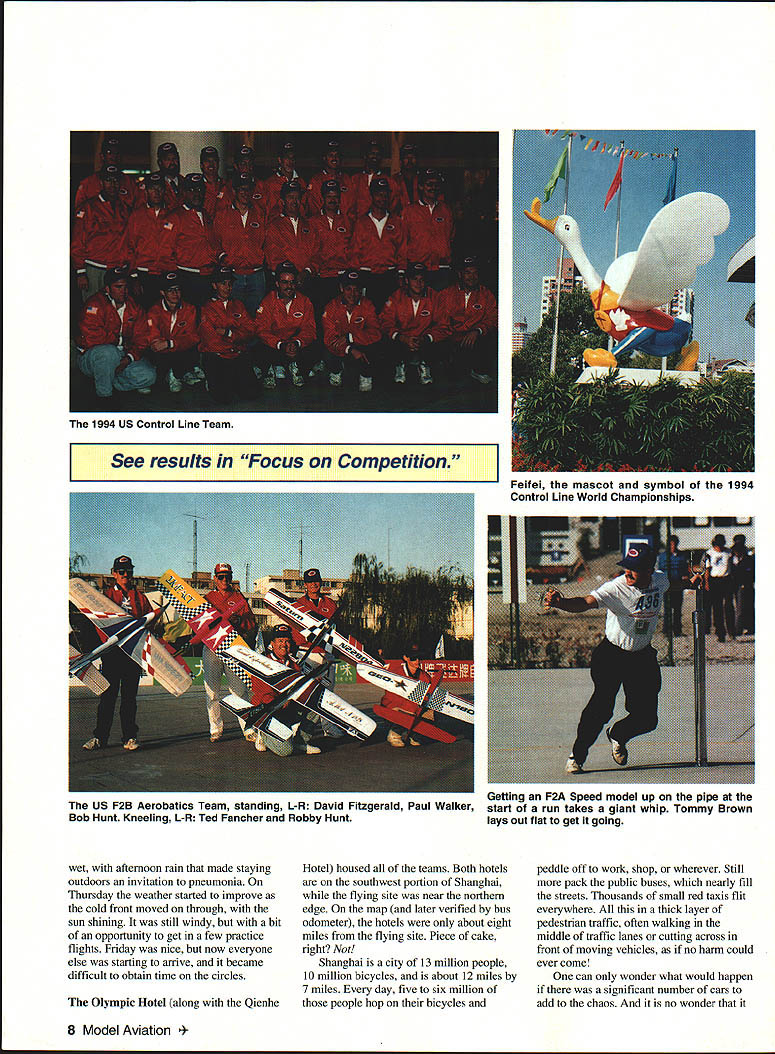
- Round One: Chinese fliers Han Xin Ping, Wang Jian Zhong, and Niu An Lin placed 1st, 2nd, and 5th in the first round; Paul Walker (reigning world champion) was the top-placing American in third (his scores did not count toward the U.S. team total). The U.S. team of Bob Hunt, Ted Fancher, and David Fitzgerald placed 4th, 7th, and 10th in the first round. Robby Hunt led the Juniors after Round One with 2,761 points.
- Round Two: Most fliers improved. Han Xin Ping increased slightly to 3,350.5; Wang Jian Zhong improved to 3,313.5; Niu An Lin to 3,254.5, moving ahead of Paul Walker. Major gains came from Japanese fliers Kazuhiro Minato and Shinichi Furukawa. American improvements were more modest; biggest gains were David Fitzgerald (+118 to 3,079.5) and Bob Hunt (+44 to 3,137.5). Ted Fancher suffered a fuel-runout and dropped about 260 points.
- Team standings after qualification (which also determined finalists): 1) China, 2) Japan, 3) United States.
- Finals: Top 15 Open fliers and top three Juniors flew three more rounds. The Chinese team dominated: Han Xin Ping (1st), Niu An Lin (2nd), Wang Jian Zhong (3rd). Fourth and fifth were Paul Walker and Ted Fancher (6,339.5 and 6,320.0). Bob Hunt and David Fitzgerald placed 8th and 9th (6,284.5 and 6,243.0).
- Junior podium: 1) Igor Cheprasov (Ukraine), 2) Cai Chuan (China), 3) Robby Hunt (USA).
Observations (F2B)
- With 73 competitors, the judging load was immense. The subjective nature of scoring combined with judge fatigue produced unusually large point spreads: the top-scored flier was nearly 200 points better than second place—an unusual margin for a World Championship where differences are typically within tens of points.
- The competition level was high and closely matched; scores should have reflected that closeness more accurately.
F2C Team Race
The F2C site was excellent: a continuous circle with a rough, weathered asphalt center ideal for pilots, a smooth freshly ground concrete flying surface, and a brand-new control tower with an electronic scoreboard showing time, laps, and fouls. Some practical flaws appeared:
- Oil accumulation in pits made footing slippery; organizers had to wash pit segments daily.
- The scoreboard used many small lights set back in cylindrical shrouds, making it difficult to read from the sides; pit men in at least two segments could not see the display.
The best American F2C team in many years placed third among 36 teams. American teams used engines and kit models from Oleg Vorobiev (Moscow).
Practice and speeds
- American teams were mostly in the low 18s with raceable settings; some teams were easily in the 17s. Defending champions Ivanov/Yugov ran steady 17.75; Nazin/Vorobiev (Russia) observed at 17.1.
- Josef Fischer and Hans Straniak (Austria), using equipment prepared by G. Sursa, set a world record of 3:14.6 for 100 laps during preliminaries. They backed this up with a 3:17.1 in their second heat.
Preliminary highlights
- Stew Willoughby and Bob Oge set a then-American best of 3:27.8. Braun and Kusik later recorded 3:24.6 to secure a semifinal spot (8th).
- Titov/Yugov, Nazin/Vorobiev, and Shabashov/Ivanov (1990 World Champions) were among the top Russian teams.
Semifinals and finals
- Semifinalists included three Russian teams plus Austria (Fischer/Straniak), France (Ougen/Constant), The Netherlands (Metkemeyer), Italy (Pennisi/Rossi), and the USA (Braun/Kusik). Willoughby/Oge finished 11th and missed the cut.
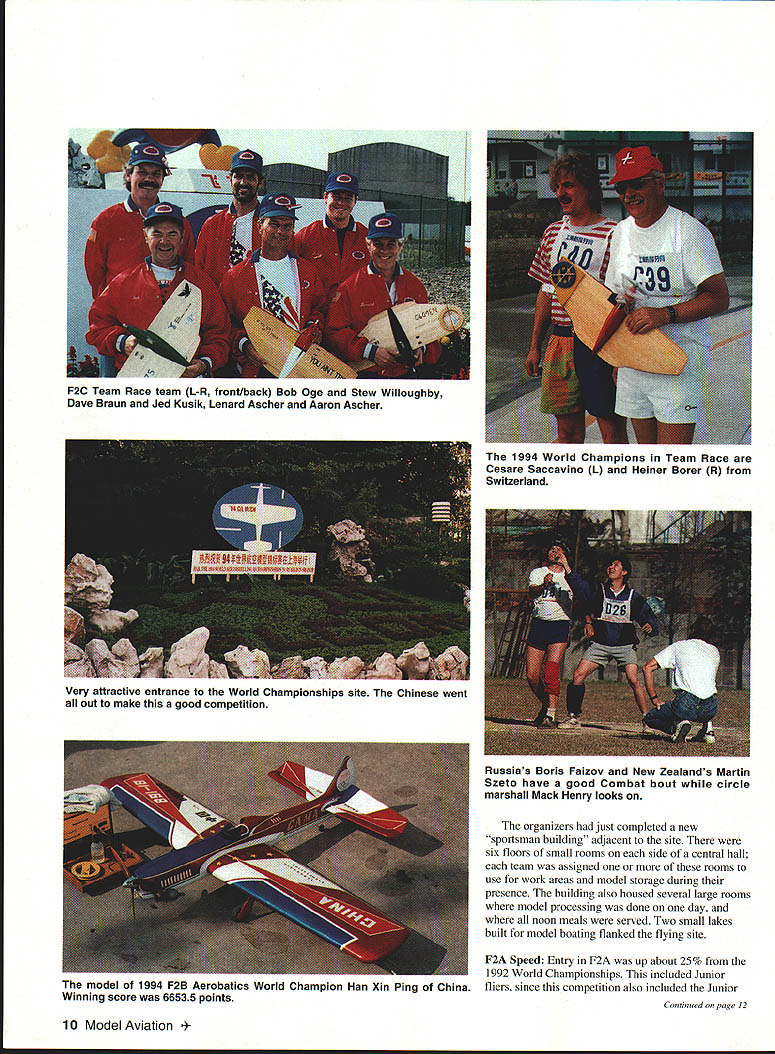
- Finals: Fischer/Straniak, Titov/Yugov, and Heiner Borer/Cesare Scaccavino (Austria). Borer/Scaccavino won the world championship, using superior airspeed to best Titov/Yugov and Fischer/Straniak.
Observations (F2C)
- "Deep pocket" racing is now a major factor: race-ready equipment can be bought at nearly any level of performance, limited only by budget. Skill and individual model-building have been pushed to the background in the quest to win.
- The American team had to comply with the builder-of-the-model rule for selection; although much of their equipment was kit-built rather than scratch-built, finishing third under these conditions is a significant achievement.
F2D Combat
The American Combat team consisted of:
- Chuck Rudner (The Old Pro)
- Mike Wilcox (The Kids)
- David Owen (The Kids)
Junior competitor: Mark Rudner (Chuck’s son)
Equipment and competitors
- Americans used Faizov 1 design models with Droschenko L5 engines. Only Chuck and the Chinese team used Nelson rear-intake/rear-exhaust motors. Chuck flew a boom-type model.
- Strong teams included Russia (Arifov, Faizov, Netchekoulin, Believ), Great Britain (including John James and Mervyn Jones), Finland (Jari Valo), Spain (Juan Garcia Vaquero), New Zealand, and others. Boris Faizov had the best equipment in the contest.
Competition highlights
- Mark Rudner caused an early surprise by beating John James (England) in Round One. Chuck also managed an opening win; Mike and David lost their first bouts.
- Round Two saw Mike and David pick up wins while Chuck suffered a loss. After two rounds Russia had only one loss total.
- Notable incidents: Chuck put a prop on backwards in one match and won the bout despite poor performance; in another match a battery failed to accept a charge and the backup had a broken clip, costing him later.
- Mark went 3–0 at one point and later drew top opponents like Boris Faizov and Mervyn Jones. Mechanical problems—prop nuts that would not tighten and engine issues—hampered advancement at critical moments.
- Mike Wilcox lost to Vladimir Arifov on a poor setting that ran over-lean.
Final results
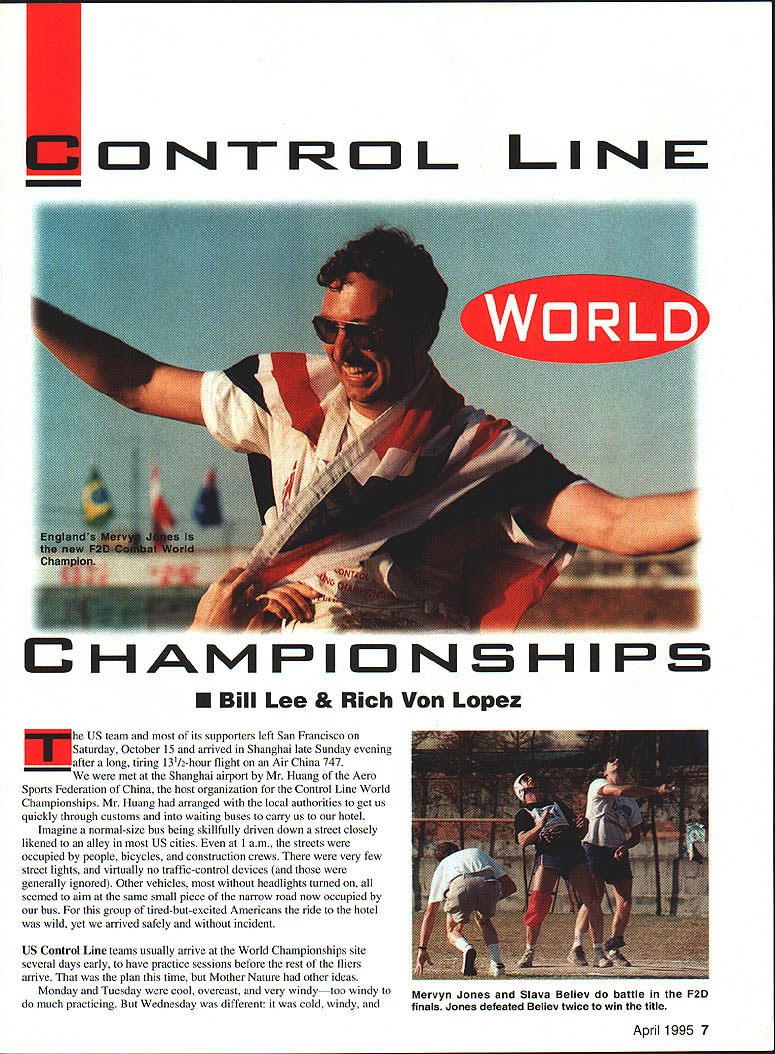
- Mervyn Jones (England) dethroned two-time World Champion Slava Believ, beating him twice in succession to take the crown.
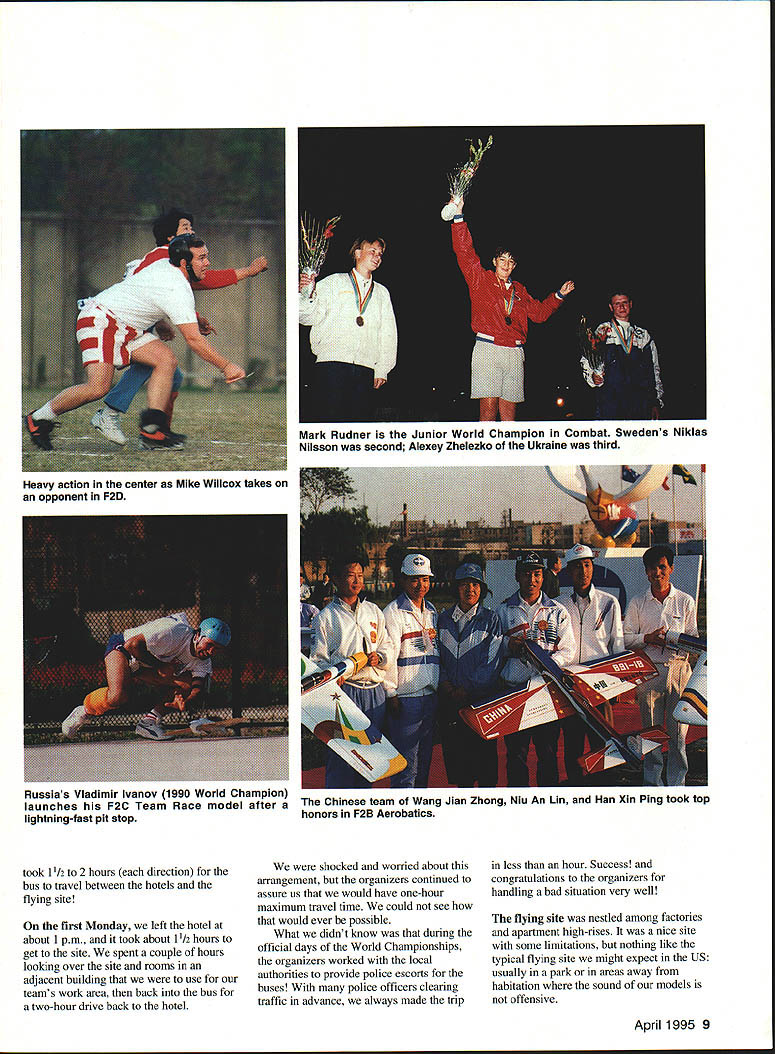
- Mark Rudner earned the title of F2D Junior World Champion; his performance ensured the U.S. heard The Star-Spangled Banner during the medal presentations.
- The U.S. team finished third—our best result in a long time.
Acknowledgments and thanks Special thanks to companies that contributed to the U.S. team funding:
- Aero Products
- Orange Blossom Hobbies
- Tru-Turn
Special thanks to Sig Manufacturing for arranging fuel shipment to China, and to Model Aviation and Flying Models for providing advertising space to support CL team fundraising.
Transcribed from original scans by AI. Minor OCR errors may remain.

