
Control Line World Championships - 2003/02
AT AGE 16, I, the daughter of avid Control Line (CL) Combat flier and journalist Rich von Lopez, set out for the 2002 Control Line World Championships in Sebnitz, Germany, July 14–22, for my first time as a member of the press.
I had been to the World Championships in Sweden in 1996, but I don't remember much except that they had really good meatballs; I was only 10 at the time. Although I went to the World Championships in France two years earlier, I conveniently blocked most of my rain-soaked memories of that trip and decided it wouldn't happen again. I was right. The 2002 World Championships illustrated how enjoyable and relatively painless an event such as this can be.
Many of the American team members and supporters arrived in Germany under the watchful, helpful gaze of Team Manager Bill Lee, and preparation for the contest began. Pilots practiced, and models were checked, flown, and rechecked to make sure everything would run smoothly during the competition. The excitement was building in anticipation of this world-class event—especially among the Combat fliers and their faithful supporters, who were ready to see an American flier take first place.
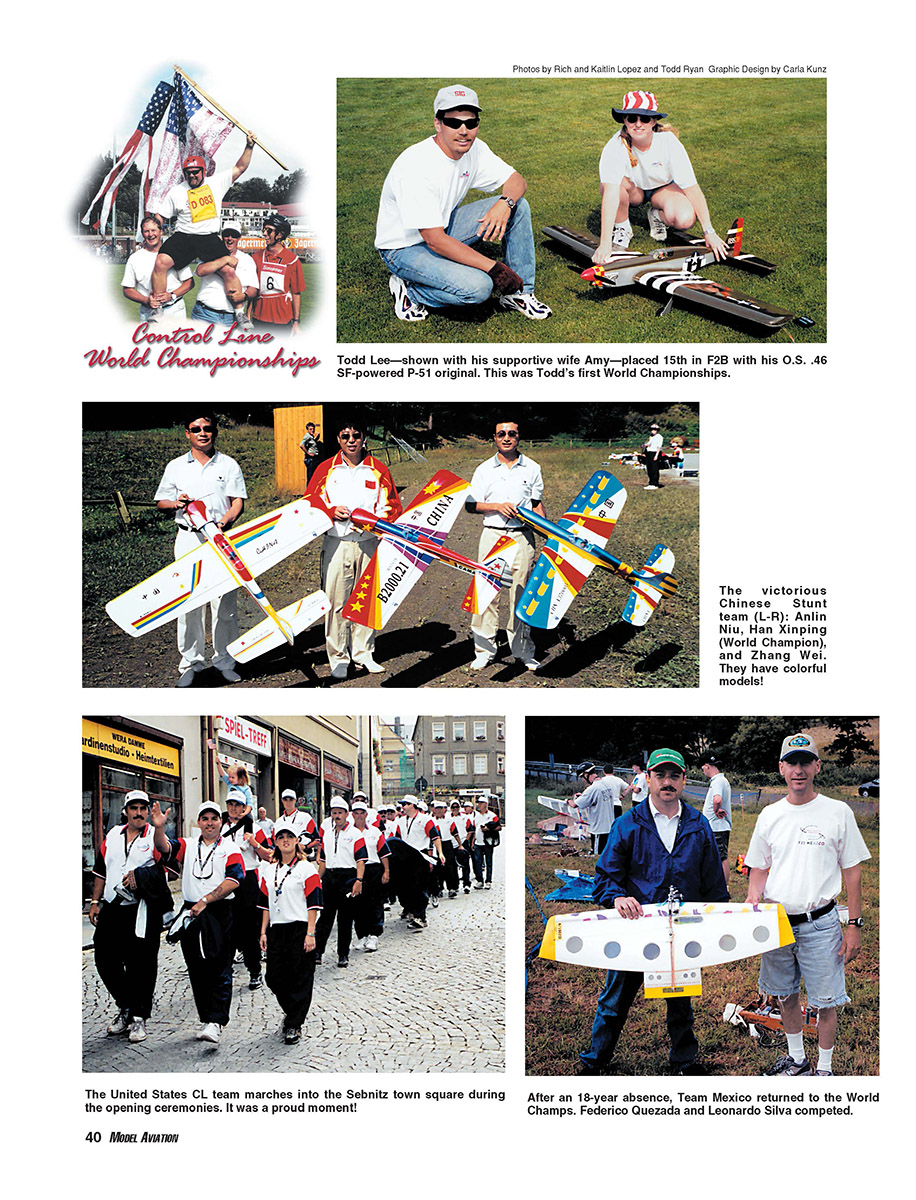
The entire town of Sebnitz was present for the opening ceremonies because an event such as this doesn't happen very often. It is stirring to see the competitors march in procession. A special stage was built for the ceremonies, and there were speeches, music, and dancing. The shops around the town square were open and bustling, and the scene was full of life. The smell of sausages was in the air. Booths filled with all sorts of goodies were set up around the perimeter, including a beer stand. Most of the competitors took advantage of that one! The people of Sebnitz brought out their official flower-girl mascot, who handed out carefully designed artificial flowers.
Competitors mingled with townspeople, and the mix of languages added to the festive atmosphere. Many attendees saw recognizable faces, renewed friendships, and made new friends. The Americans and British exchanged friendly competitive digs, including making a bet about which of the two countries would do better during the meet. The winnings would be a round of beer. These festivities were a fitting start to the competition.
During the contest we went back and forth between the main field and the Combat field so we could catch Combat (Fédération Aéronautique Internationale class F2D) and Precision Aerobatics/Stunt (class F2B).
The organizers provided the spectators with portable stands downwind of the main circle, giving them a good view of the action. To keep the spectators informed, there was a mini information kiosk with a listing of each match’s results. Many officials helped keep the competition moving along.
The Stunt models looked amazing. I instantly felt sympathy for the Stunt fliers, who often had to fly when a wind kicked up, making it more difficult to fly without twitching. The American competitors did exceptionally well considering the circumstances.
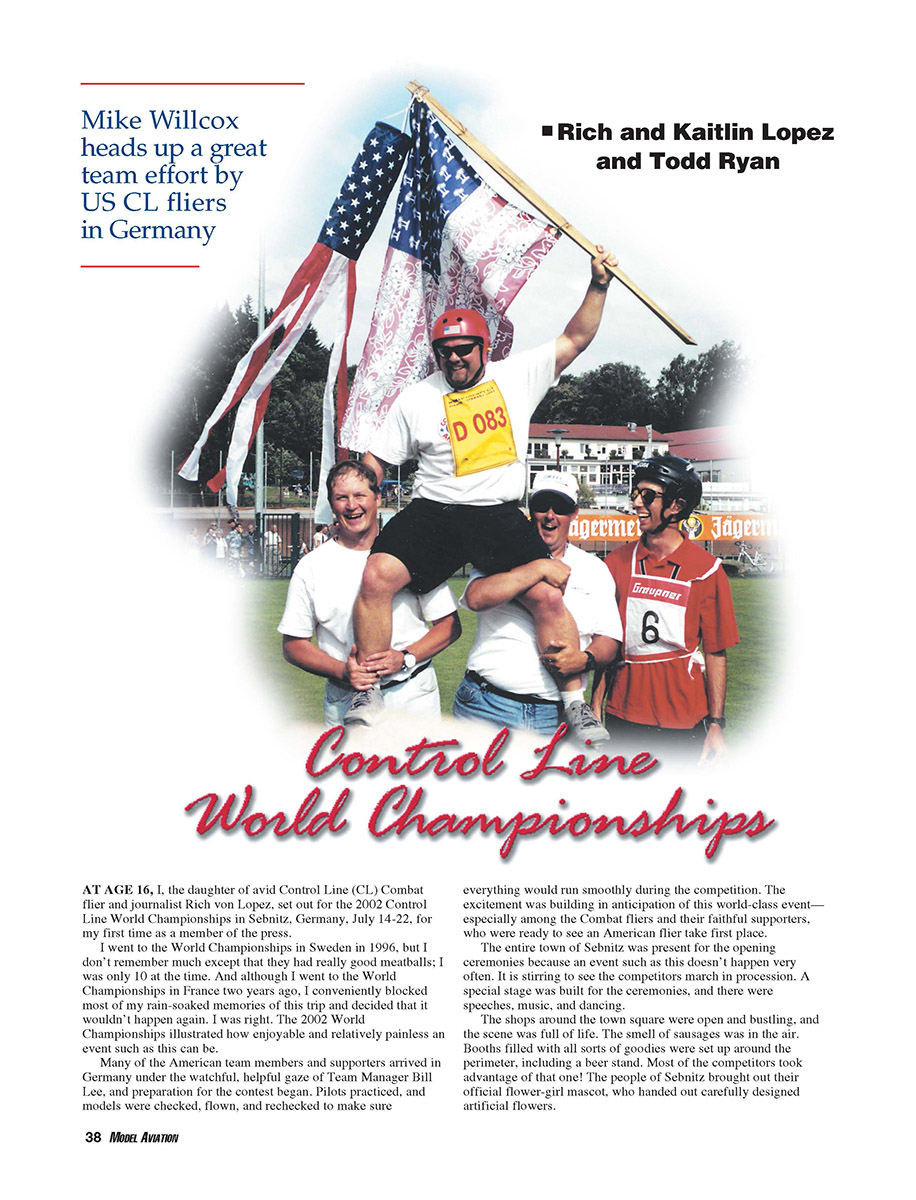
The Combat fliers were ready to go. All the practice may seem dull, but the official Combat matches tend to be exciting. The four American competitors started out enthusiastic and finished in the same manner. It came down to a finish that brought us to our feet cheering, and it meant that “The Star-Spangled Banner” was played for the first time in 20 years at a World Championships!
The banquet that closed the competition was a grand occasion. Everyone was dressed in his or her best attire and ready to party after a long, hard competition. Food and drink, mingling, and dancing made a fitting end to a well-run event. Many competitors used this occasion to trade T-shirts, hats, and stickers. This was also a fun photo opportunity. All good things must come to an end, but memories from the competition will last forever.
F2D (Combat)
With 86 entries, F2D had the largest number of entries at any World Championships. The US team—Don Cranfill, Rich Tupper, Mike Willcox, and junior Nick Meers—were well prepared with plenty of models and top-of-the-line engines. Don used Foras, Rich preferred the Redko, Mike had strong Zorros, and Nick sported AKMs.
This class included five female pilots. Monique Wakkerman of the Netherlands is a regular around the European circuits. Laura Leino of Finland had world-class mechanic Jari Valo. Making appearances for the first time at a World Championships were Svetlana Bolshakova of Russia and juniors Olga Soshkina of Ukraine and Anja Möbius of Germany. No equipment was used that we had not seen before: models with paper-wrapped leading edges, wooden ribs, and metal mounts; no new engines that would cause everyone to sell everything and buy them. One of the most popular models in the US was the Andrei Belaiev design, and they were plentiful at this contest. Andrei was part of Team Russia. There were only a few all-foam models.
Round One had 43 matches and five rematches. First-time US representative Rich Tupper was the first American to fly, and he lost to Robert Liber of Belgium. Mike Willcox gave junior Mikael Sjölund of Sweden his first loss. Nick Meers drew Rik Olijve of the Netherlands and lost in his World Championships debut. Don Cranfill, in his first World Championships appearance though previously qualified for a US team, earned a victory over Ladislav Marek of the Czech Republic.
Four Americans lent their services to foreign teams: Pat Willcox worked for New Zealand pilots Adrian Wellington and Bryce Gibson; Chuck Biederman and Rich Lopez assisted Federico Quezada and Leonardo Silva of Mexico; Marshall Busby worked for Argentine junior Patricio Nadig.
Only Monique Wakkerman and Olga Soshkina posted wins among the female pilots in Round One. The 2000 World Champion, Stanislav Chorny of Ukraine, took a loss to German Johann Schwarz.
Round Two again had 43 matches and seven rematches. Nick Meers drew French pilot Xavier Riera i Romagosa and was eliminated after another loss. Rich Tupper won when Sven de Ridder of the Netherlands was disqualified for a rules infraction. Mike Willcox had to fly Christian Pedersen of Denmark twice before posting his second win.
Don Cranfill continued posting wins, beating Czech Lubomir Slezak. Anja Möbius posted a win. Stanislav Chorny would not repeat as World Champion after taking his second loss to Lithuanian Audrius Rastenis. Marshall Busby was laid off after his pilot took a second loss.
Round Three shrank to 31 matches and eight rematches. It took Mike Willcox three tries to defeat a feisty Anja Möbius. Ching Chee Hau of Singapore eliminated Rich Tupper. Don Cranfill suffered his first loss, falling to Igor Dementiev of Moldova. Monique Wakkerman earned a win and found herself the only female left in the competition. Rich Lopez and Chuck Rudner were unemployed, but Pat Willcox kept both of his New Zealand pilots in the hunt.
By Round Four, less than half of the original field remained, with only 21 scheduled matches and three rematches. Don Cranfill beat junior Sergio Dementiev of Moldova for his third win. Mike Willcox ended Monique Wakkerman’s run by taking his fourth win. Russian Boris Faizov was still undefeated after his bout with Volodymyr Vesich of Ukraine.
Round Five had 13 matches and three rematches. Don Cranfill beat Canadian Ivan Mackenzie in a rematch. Mike Willcox beat Ole Bjerager of Sweden. By this point the junior ranks had thinned, and Spaniard Cesar Picardo looked as competent as any senior pilot. Igor Zholnerkevich of Belarus, Loet Wakkerman of the Netherlands, Andrei Belaiev, and Johann Schwarz were still flying well.
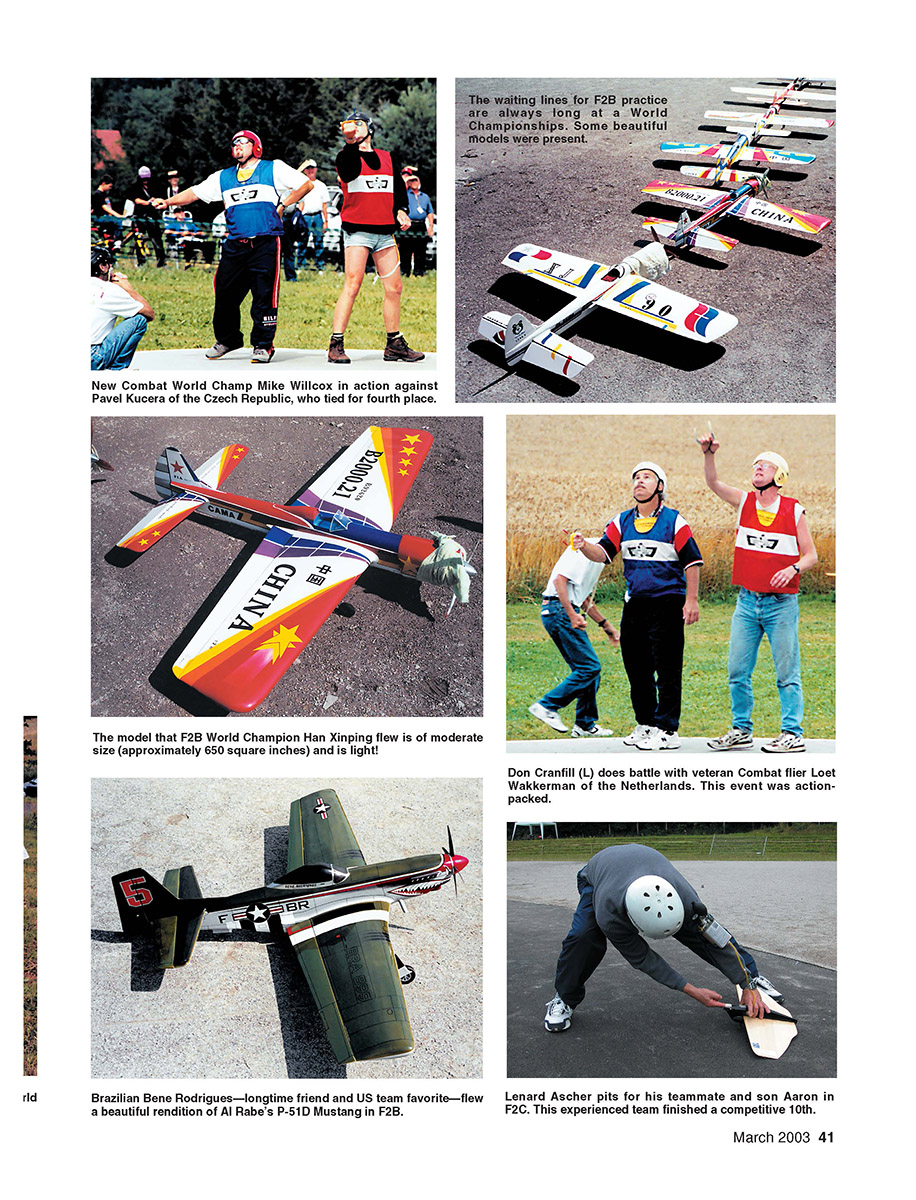
In Round Six there were 17 pilots left. Mike Willcox gave Boris Faizov his first loss. Don Cranfill flew Loet Wakkerman three times before posting a win; rematches were caused by tie scores. Pat Willcox was still pitting for Bryce Gibson, who had just eliminated Cesar Picardo.
Round Seven had six matches scheduled. Mike Willcox beat Igor Dementiev for his seventh win. Bryce Gibson ended Don Cranfill’s excellent run after two rematches; the difference was a 40-point penalty for stepping out of the circle. At the end of this round only six pilots remained: Mike Willcox, Pavel Kucera (Czech Republic), Bryce Gibson, Volodymyr Vesich, Boris Faizov, and Igor Zholnerkevich.
In Round Eight, Mike Willcox beat Pavel Kucera to obtain the only undefeated scorecard—8–0. Volodymyr Vesich beat Bryce Gibson and sent Pat Willcox to the spectators’ stands to cheer on his son Mike. Boris Faizov disposed of former fellow Russian pilot Igor Zholnerkevich. Boris and Volodymyr sat with 7–1 records.
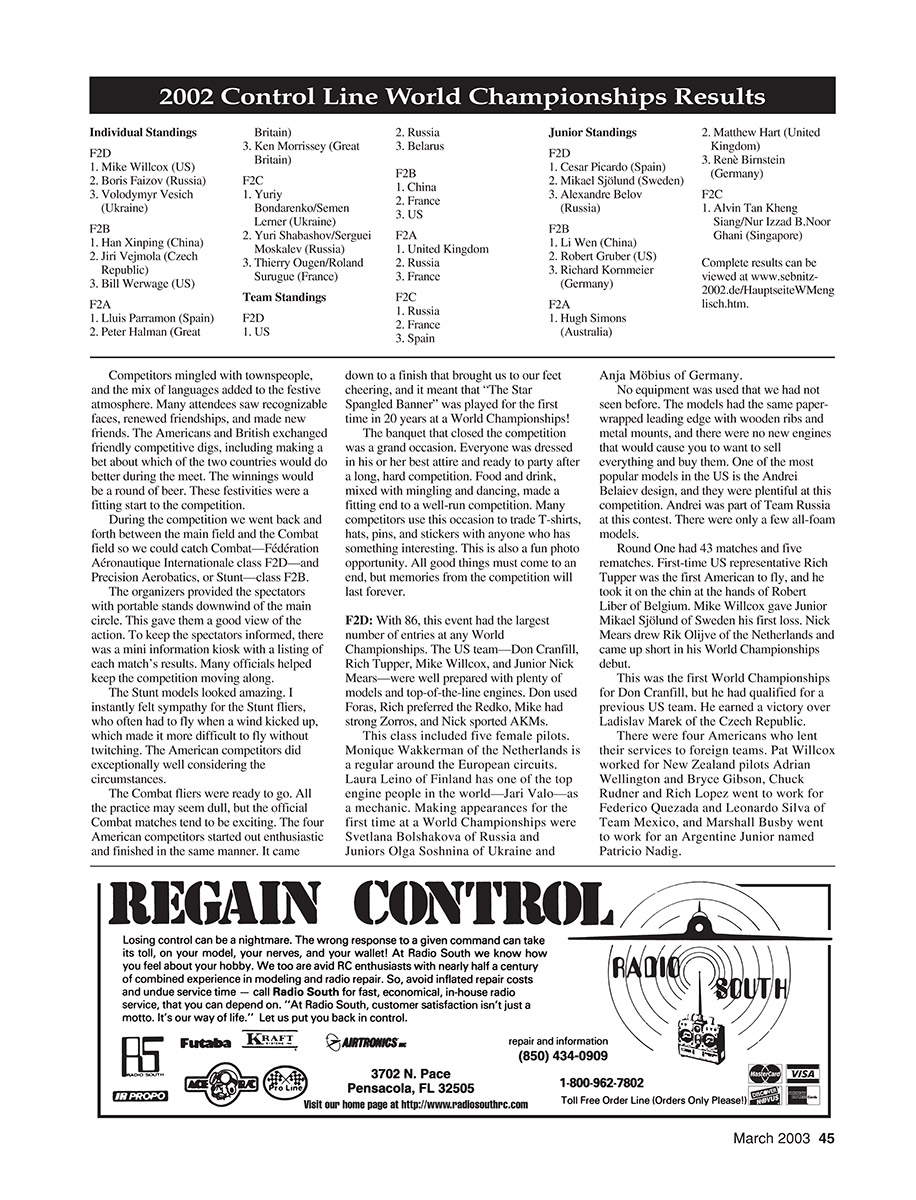
The Juniors sorted out their final standings before the Seniors took center stage. Cesar Picardo was the new Junior World Champion. Mikael Sjölund of Sweden was second, and Russian Alexander Belov was third.
In the finals, Mike Willcox drew Volodymyr Vesich first. Volodymyr, behind on points, took a desperate chance by attacking Mike’s model without a streamer. Volodymyr hit the model, which is against the rules, and was promptly disqualified. This left Mike to battle the only remaining pilot: Boris Faizov.
This was a battle of Zorros versus AKM. Boris had Mikel Zorlov, the AKM engine builder, and former World Champion Slava Belaiev as his pit crew. Mike had been well served by his pit crew of former junior teammates and supporters. In the end, Mike Willcox won the F2D World Championship for the United States.
F2B (Stunt)
F2B (Stunt) is one of the most difficult events to win at a World Championships. A competitor must fly a near-perfect pattern and hope the judges like it. There is an element of subjectivity that sets Stunt apart from Speed, Team Race, or Combat. The judges in Sebnitz worked long and hard to eliminate wide gaps in scoring and tried their best to be impartial.
Luck and weather played significant roles. The site at the main venue in Sebnitz was surrounded by tall evergreens and located in a mini-valley. The main circle was subjected to irregular and turbulent winds coming off the trees. Some pilots were lucky and flew during calm moments; others were not and had to fly when the barrier tape rattled in the wind.
This uncontrollable element affected the final standings. Pilots who could normally fly straight and level found their models buffeted and twitching in the wind.
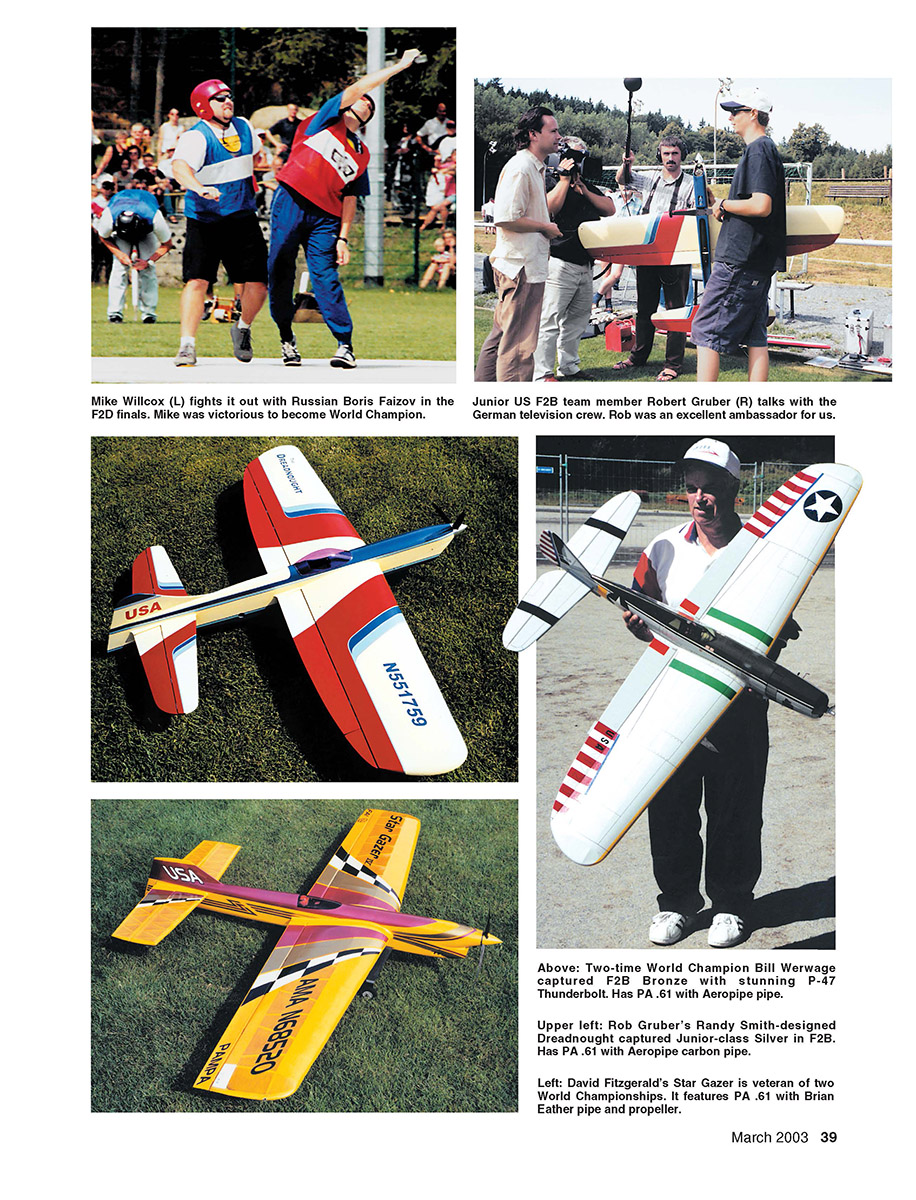
The US fielded a competent, well-practiced team that included two-time World Champion Bill Werwage, former silver medalist David Fitzgerald, and first-timers Todd Lee and junior Robert Gruber.
One obstacle in traveling to any contest is getting the models there intact; another is having proper fuel. Team Manager Bill Lee and Assistant Team Manager Keith Trostle worked tirelessly to ensure everyone's fuel was in Germany waiting for them. There were a couple of glitches that caused extra stress.
Early in the week tragedy befell David Fitzgerald when his model hit a fence on a practice flight, causing extensive damage to an outboard wingtip and panels. He spent frantic hours in the Sebnitz model clubhouse making repairs and was able to fix his model and continue in the competition.
Local television crews and reporters were present to interview competitors. Robert Gruber was asked about his model and how he got involved in flying—this will give him something to talk about with his high-school friends back home.
F2B had 86 total entries, 12 of which were Juniors. All pilots flew qualifying rounds during the first part of the week to get to the final 15 competitors, who flew three rounds; the two highest scores were combined for final placement.
David Fitzgerald, Todd Lee, and Bill Werwage made the finals, as did the Chinese team: Han Xinping, Zhang Wei, and Anlin Niu. France sent Remi Beringer, Serge Delabarde, and Gilbert Beringer to the finals. Slovakia sent Alexander Sychrek and Igor Burger. Jiri Vejmola represented the Czech Republic, and Hiromi Ohta represented Japan. Alberto Maggi represented Italy, and Yuriy Yatsenko represented Ukraine.
Han Xinping used a Super Tigre .60 to claim the World Championship for China. Czech pilot Jiri Vejmola used a piped .60 on his run to second place. Bill Werwage put the US colors on the podium in third place, flying a P-47 Thunderbolt powered by a piped PA .61.
All French pilots used Saito 56 engines. The two other Team China pilots used Retro .60s, as did the Ukrainian pilot. David Fitzgerald used a PA .61 with a pipe for a 14th-place finish. Todd Lee used an O.S. .46 SF to power his P-51 Mustang to 15th place.
Li Wen of China won the Junior World Champion title. Only three points behind was US junior Robert Gruber. Richard Kornmeier of Germany was third.
Team prizes were awarded as follows:
- 1st: China
- 2nd: France
- 3rd: United States
Contact / Contributors
Rich and Kaitlin Lopez 8334 Colegio Dr. Los Angeles, CA 90045
Report by Todd Ryan
F2A (Speed)
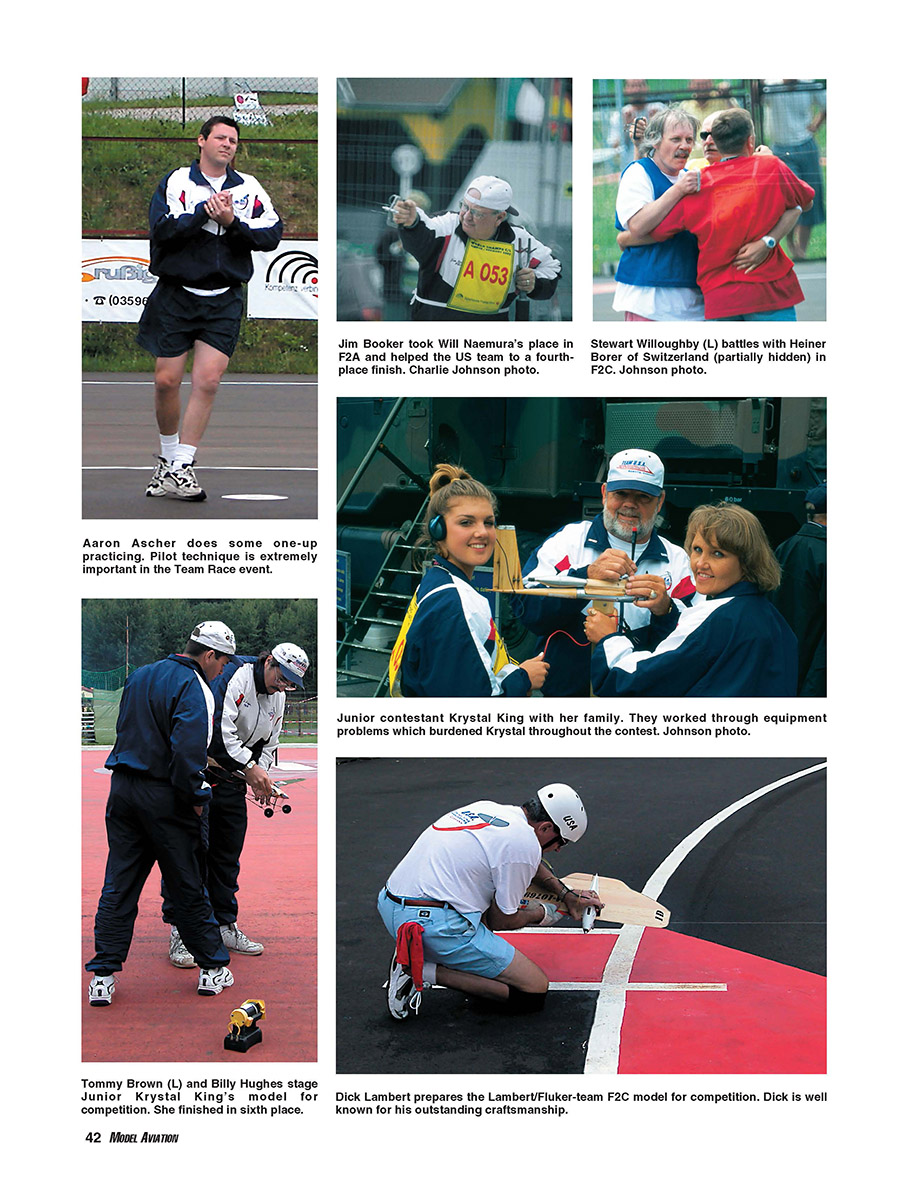
The US Speed team comprised veterans Tommy Brown, Billy Hughes, and Will Naemura. Will had to withdraw a few weeks before the event; alternate Jim Booker took the vacant position. Junior Krystal King filled out the US team.
Tommy Brown used his familiar Hallman Special with Irvine equipment. Bill Hughes used a stars-and-stripes Profi-powered airplane and a Mejzlik carbon-fiber prototype model. Jim Booker used the newest-generation Profi models he had acquired only weeks prior to the competition. Krystal King used Hallman Special–powered airplanes.
The weather in Round One was less than desirable, with calculated available horsepower as low as 90% at times. This proved troublesome for many competitors, but all US team members posted times. Tommy Brown had a 174.59 mph flight, slightly edged out by Billy Hughes at 174.77 mph. Jim Booker posted 171.36 mph in the open entries. In the Junior class, Krystal King posted her fastest flight of the contest at 161.57 mph.
These times were slightly slower than expected for world-level competition, but considering the weather they were very good and put the US team in second place overall at the end of the round.
In Round Two, Tommy Brown improved to 176.57 mph, showing great comfort and control. Billy Hughes posted a time just slightly slower than in the first round. Jim Booker had an incident during his flight that caused his model to contact the ground, vaporizing the propeller but only causing minor cosmetic damage. His backup flight later in the day was down considerably, posting 164.79 mph.
Krystal King posted 159.46 mph in Round Two. Her flying skills have improved greatly over the years, and her times became more consistent with her family's help.
The highlight of Round Two was three-time World Champion Lluis Parramon breaking the world record at 187.67 mph. The cage around the circle was at least three people deep, and the applause was incredible.
At the end of the round the US team had moved to fourth place overall. The next day was set aside for either a tour of nearby Dresden or a full day of practice; most US team members opted for practice. The break was appreciated; the day provided better communication and more relaxed flying, with many friendships strengthened.
The third and final round began with a surprising twist: heavy rain fell in traditional monsoon fashion. After the initial downpour, flying resumed and approximately 70% of competitors used their flights as attempts, hoping for better conditions later in the day during reflights. This resulted in a tremendously long day for competitors and observers.
Billy Hughes improved with his fastest flight of the competition at 175.77 mph, placing him 18th overall. Tommy Brown was consistent with 176.39 mph but didn’t improve on his second-round 176.57 mph, securing 15th place overall.
Jim Booker struggled in the third round when a failed glow plug and a subsequent starting-equipment failure gave him a no-score for the final round. His first-round time of 171.36 mph placed him 30th overall.
The combined scores gave the US team an overall placing of fourth.
Junior competitor Krystal King suffered tremendous equipment problems throughout the competition, losing at least five engines. With intense support from her family she managed a third-round flight of 143.71 mph (down from 161.57 mph) and finished sixth in the junior standings.
F2C (Team Race)
The US Team Race contingent consisted of three veteran teams with different approaches:
- Team Fluker/Lambert: pilot Tommy Fluker and longtime teammate Dick Lambert, using their own models and a newly designed bar-stock engine conceived by Dick and Wayne Trivlin.
- Team Willoughby/Oge: veteran pilot Stewart Willoughby with quick-handed pitman Bob Oge, using their own-built Mazniak-powered models.
- Team Ascher/Ascher: pilot Aaron Ascher and pitman Lenard Ascher, using newly acquired Suryav models and engines.
Round One proved consistent for the US, with all three teams posting official times. Ascher/Ascher had the fastest US time at 3:24. Tommy Fluker worked hard in the circle to achieve 3:43 with quick stops from Dick Lambert. Willoughby/Oge posted a respectable 3:46 but had restarting issues.
The teams supported one another by watching for incoming traffic and other problems while one team was flying.
In Round Two the Aschers solved many restarting problems by adjusting their priming mechanism, reducing the engine prime from a four-flip to a one-flip restart. Their race looked promising but a second pit with lines dragging on the ground during landing caused a missed catch and ended hopes of a top time. Willoughby/Oge had a slightly faster race than in Round One but continued restart issues, posting an official 3:45.
The scheduled tour of Dresden gave competitors a day off and an open practice field the next day. Teams Fluker/Lambert and Ascher/Ascher used the practice opportunity to debug and prepare; Team Willoughby/Oge went on the trip and enjoyed the break.
Round Three provided highs and lows. Fluker/Lambert were disqualified for lines measured .00025 inch undersize; their protest and request for a second measurement were denied, leaving them with a previous time of 3:27 and a 24th-place finish overall.
Ascher/Ascher tuned in at the practice circle and posted a tremendous 3:16 time, securing a place in the semifinals and breaking the US heat record.
Willoughby/Oge suffered a disastrous entanglement when their model launched while another competitor’s was landing; the lines tangled, the Willoughby/Oge airplane crashed after two laps of uncontrolled flight, and the fuselage sheared off at the leading edge. After parts were recovered, the entanglement resulted in a disqualification and a 37th-place finish.
In the semifinals Ascher/Ascher worked hard. The first semifinal was rough: Aaron received three penalties, ending that round. The second semifinal began well; the Aschers had a great start and competitive airspeed. During the flight the French team—already qualified for the finals—used aggressive tactics that impeded other pilots and resulted in a jury disqualification of the French team. The Aschers posted a 3:26 time and secured 10th overall.
The US overall placing was seventh. Thanks to all the US teams for their hard work and dedication during the 2002 World Championships.
The finals were a glorious sight and extremely close. The three qualifiers were teams from France, Russia, and Ukraine. The French team had an initial engine overheating issue that required quenching with water during the first pit stop. The Ukrainian team used a new multifunction valve that provided an extra 1.5 seconds of hands-on time during pit stops. The Ukrainian pair of Yuriy Bondarenko and Semen Lerner proved superior and won with a 6:31.80. The Russian team of Yuri Shabashov and Sergei Moskalev finished second with 6:35.50, and the French team of Thierry Oguen and Roland Surugue finished third with 6:47.60.
Transcribed from original scans by AI. Minor OCR errors may remain.

