

CONTROL LINE WORLD CHAMPIONSHIPS
Rich von Lopez
Location and facilities
The 1996 Control Line World Championships were held near Norrköping, Sweden, at the old military field that housed the Royal Bravalla Swedish Air Force F 13 wing until 1992. The Bravalla facility continued to be a center for flying activities and provided excellent space for the various events.
- The Combat site featured a huge expanse of freshly mowed grass, accommodating around a dozen circles.
- The Stunt (F2B) circle used the whole runway and counted five models in the air at a time.
- Speed (F2A) and Team Race (F2C) had the long runway available for practice flights and pylon practice.
- Camping and dormitory facilities were available; the walk between them and the flying sites was typically 1–2 kilometers.
Competitors could practice freely at most sites, and pilots were often seen walking equipment each morning.
U.S. team personnel and changes
Several U.S. teams experienced last-minute personnel changes:
- F2D Combat original team: Don Cranfil, Mark Rudner, Richard Stubblefield.
- Mark Rudner was allowed to defend his 1994 Junior World Champion title while still having his score count toward the team prize if it was greater than that of the other team members.
- First alternate Joe McKenzie had the first opportunity to represent the U.S.
- Don Cranfil later dropped off; second alternate Mitchell Cleveland replaced him.
- F2B (Stunt): Bob Hunt suffered a disaster the week before departure (July 19, 1996) when his primary and backup models were destroyed in practice. Bill Werwage stepped in and was ready within two days. Werwage had attended World Championships since 1970.
- F2A team: Bill Hughes, Tom Brown, Willie Naemura, and junior Bobby Fogg.
Events
F2A — Speed
- Entries: 47.
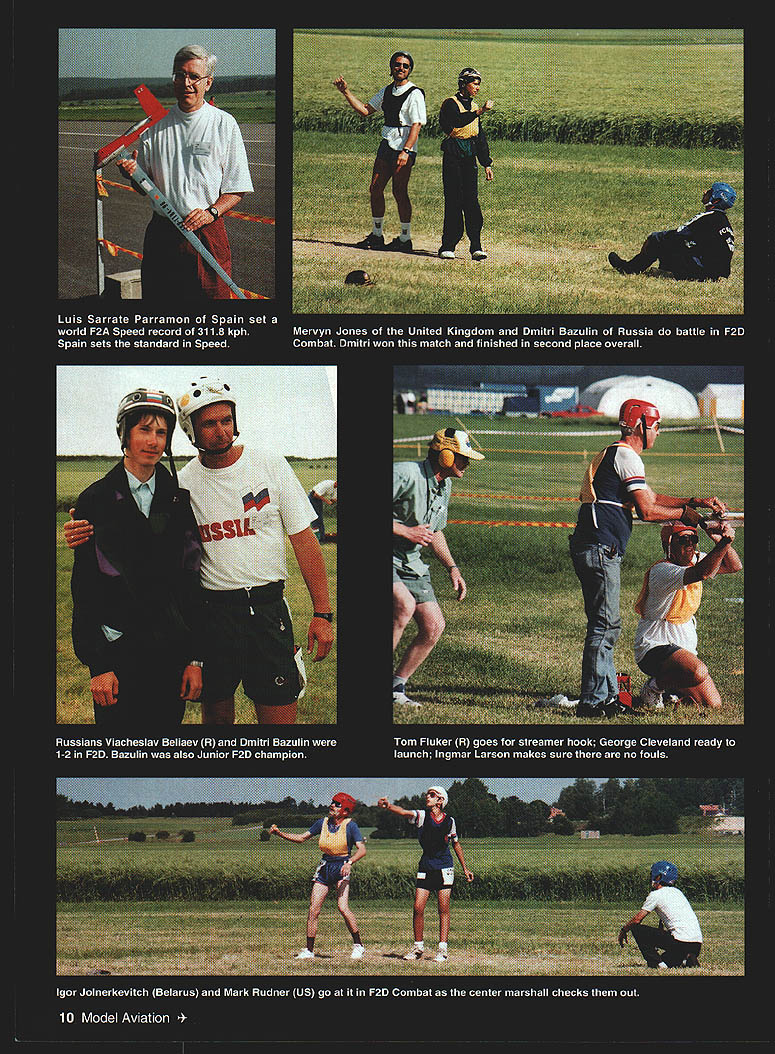
- Winner and Profi record: Luis Sarrate Parramon (Spain) — 311.2 kph.
- Other top performers: Sergei Kostin (Russia) — 305.3 kph; Konstantin Fedotov (Russia) — 303.0 kph.
- U.S. results:
- Willie Naemura — 298.3 kph (8th place)
- Bill Hughes — 290.7 kph (19th)
- Tommy Brown — 289.2 kph (22nd)
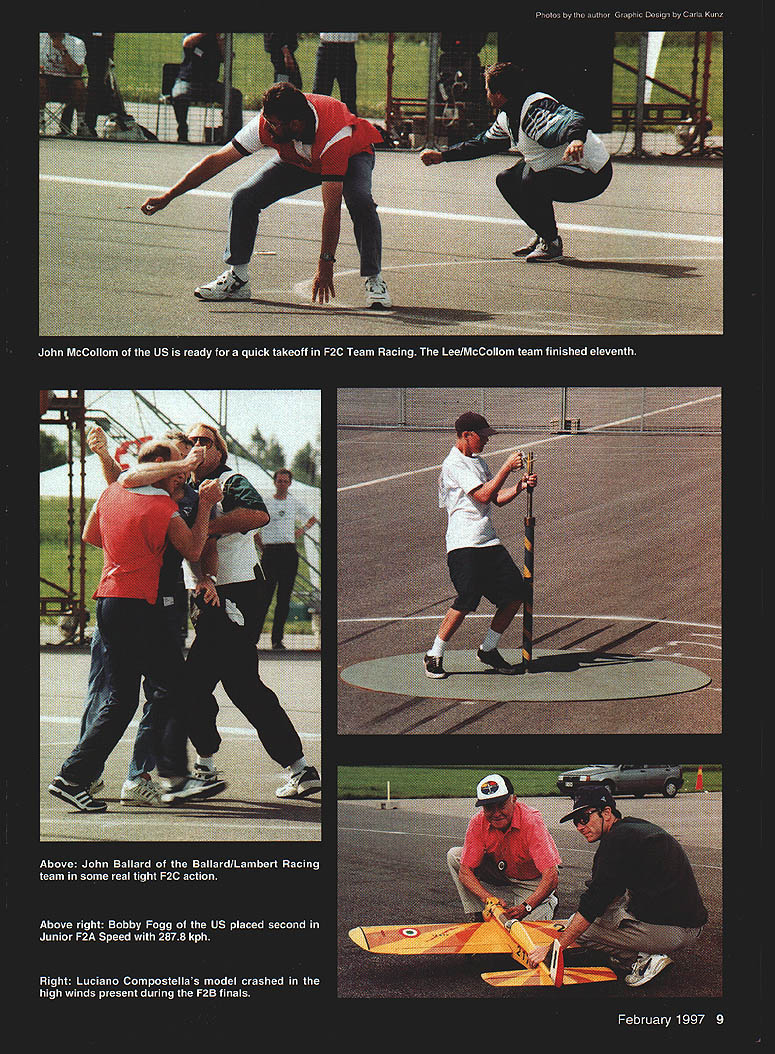
- Bobby Fogg (junior) — 287.8 kph
- Team standings (Speed): Russia 1st, Italy 2nd, United Kingdom 3rd, United States 4th (U.S. just one point out of third).
Notes:
- Early timing problems occurred when judges took extra laps at the start; an air horn was later used to signal timing completion.
- Bobby Fogg had spectacular practice runs after switching to his number-three engine when two custom-built engines failed; however, his lines were discovered to be 22 inches short.
F2B — Aerobatics (Stunt)
- Entries: 86, cutting to a final 15 for medals.
- U.S. team: Paul Walker, David Fitzgerald, Bill Werwage, junior Derek Barry — all reached the finals.
- Individual results:
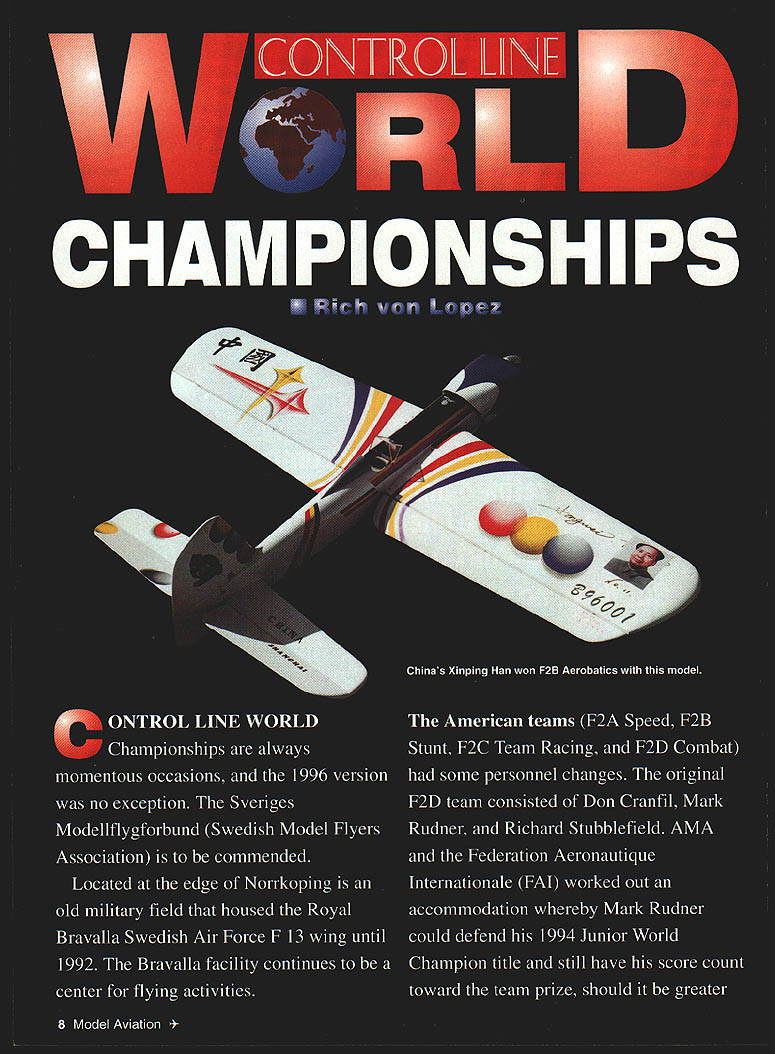
- Gold (World Champion): Xinping Han (China)
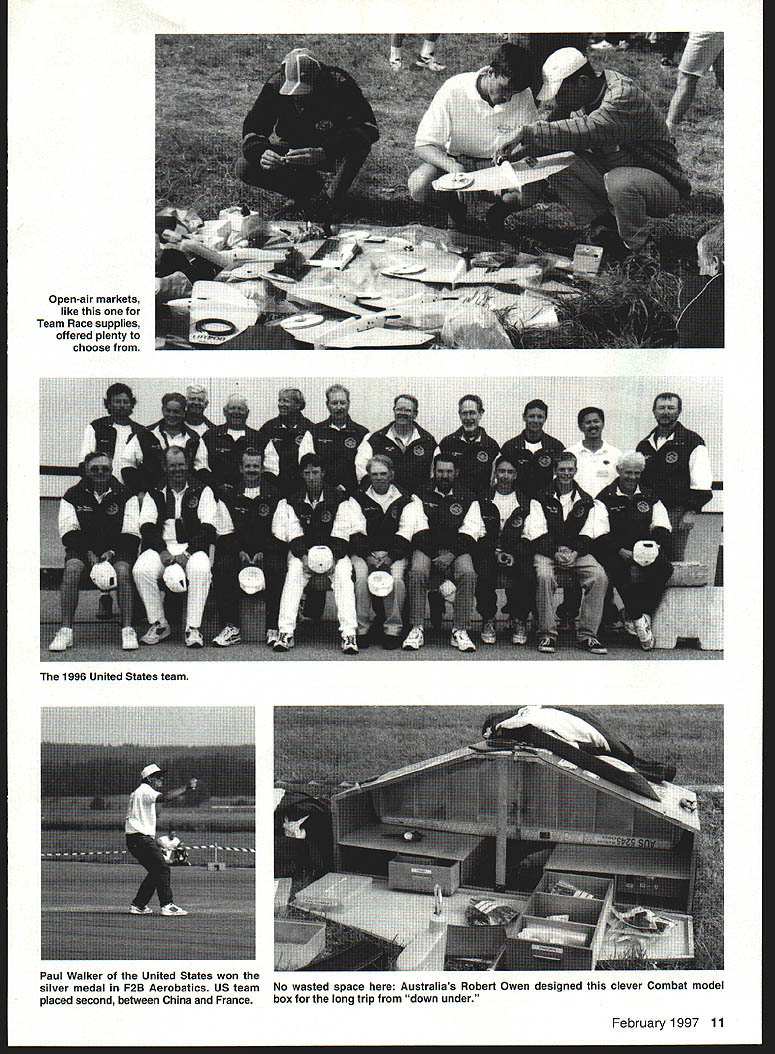
- Silver: Paul Walker (U.S.) — one of the top flights; a gust caused a bounce on landing
- Bronze: David Fitzgerald (U.S.)
- Bill Werwage — 6th place
- Derek Barry — 15th overall and Junior World Champion (gold in Junior class)
- Alexei Solenin (Russia) — 2nd in Junior
- Julie Delior (France) — 3rd overall
- Team standings (F2B): China 1st, United States 2nd, France 3rd.
Notes:
- There were judging controversies; a judge from China was perceived by some to have awarded consistently higher scores to fellow countrymen. Officials addressed complaints and adjusted later scoring, but earlier rounds (which count toward team prizes) were already affected.
F2C — Team Racing
- Format: Intense center-circle action, pit stops, electronic lap counters, and foul lights. Teams wear colored identifiers for clarity.
- U.S. teams:
- John McCollom / Bill Lee (Shabashov model)
- Aaron Ascher / Lenard Ascher (Vorobieev equipment)
- John Ballard / Dick Lambert (Mazniak equipment)
- First-day 100-lap heats times:
- Lambert/Ballard — 3:18
- McCollom/Lee — 3:23
- Ascher/Ascher — 3:25
- Fastest overall: Roberto Pennisi / Andrea Rossi (Italy) — 3:14
- All three U.S. teams reached the semifinals (Ascher/Ascher advanced as a standby when another team was disqualified).
- Junior final: Only three Junior entries; the Junior final ended in several crashes and a disqualification. The French team was declared winners, Poland second, Russians disqualified.
- Finalists included Pennisi/Rossi (Italy), Yuri Nazin/Oleg Vorobiev (Russia), and Marcello Magli/Elvis Pirozzini (Italy).
- Team standings (Team Race): Russia 1st, Italy 2nd, United Kingdom 3rd, United States 4th.
Notes:
- Ready-to-race equipment has become more widely available; top-quality Suriey gear can cost $5,000–$7,000.
F2D — Combat
- Entries: 63, including 8 Juniors.
- Notable competitors and equipment: Two women competed — Laura Leino (Finland, first Worlds, tutored by Jari Valo) and Monique Wakkerman (Netherlands, veteran).
- Early rounds:
- Mitchell Cleveland drew Gunter Staffel (Austria) and suffered a pitting foul when a pit crew stepped on a streamer.
- Jock Stubbelhof beat Peteris Brokans (Latvia) despite a nasty line twist.
- Mark Rudner beat Igor Jonkevich (Belarus).
- Russian team (Viacheslav Beliaev, Nikolay Necheukhin, Boris Fazilov, junior Dmitri Bazulin) posted strong wins early.
- Equipment notes: Spain’s team used top Russian-built equipment (Cyclons, VVs, Futuras) and engines nicknamed "Zorro."
- Progression:
- After four rounds, five pilots remained undefeated: Viacheslav Beliaev (Russia), Jiri Karger (Germany), Gunnar Kowark (Germany), Mervyn Jones (U.K.), and John James (U.K.).
- By Round Six: eight pilots remained, including junior Dmitri Bazulin and 1984 World Champion Loet Wakkerman.
- Round Seven/Seven through Eight narrowed the field to three: Beliaev, Wakkerman, and Bazulin.
- Wakkerman lost to Bazulin, leading to an all-Russian final.
- Final results:
- Gold (World Champion): Viacheslav Beliaev (Russia) — his second Combat World Championship
- Silver: Dmitri Bazulin (Russia) — also the top Junior performer
- Bronze: Mark Rudner (after a fly-off with Enrico Sagner of Germany)
- Team standings (F2D): Russia 1st, Germany 2nd, Netherlands 3rd. The United States tied with Italy for 10th place.
Notes:
- Beliaev was notable for meticulous trimming and frequent test flights and adjustments.
- The availability of ready-to-fly Combat models increases participation but makes identical-looking models prone to mistaken identity during pitting.
Judging and controversies
- Concerns were raised in F2B about possible favoritism by a judge from China, who appeared to score compatriots higher. Officials intervened and later scores were more realistic, but early-round damage to team scores remained.
- Speed event had timing inconsistencies early on, which led to the implementation of an air horn to signal the end of timing.
- In F2D, an inaccurate gauge used to measure a muffler outlet caused a protest in a match involving Germany's Gunnar Kowark; officials later found the gauge to be inaccurate.
Social events and seminars
- The awards banquet featured a traditional meal (reindeer as the main entrée) and lively trading of caps, shirts, pins, and patches.
- The day after the banquet included a boat trip through the Swedish archipelago and locks — a relaxing opportunity to socialize.
- That evening, the organizers held model airplane seminars covering technical issues, championship organization, rules, stunt judging standards, and jury proposals for F2C and F2D.
Conclusion
The 1996 Control Line World Championships at Bravalla provided excellent flying facilities and strong international competition across all classes. If you ever have the opportunity to attend a World Championship, take advantage of it.
Transcribed from original scans by AI. Minor OCR errors may remain.

