
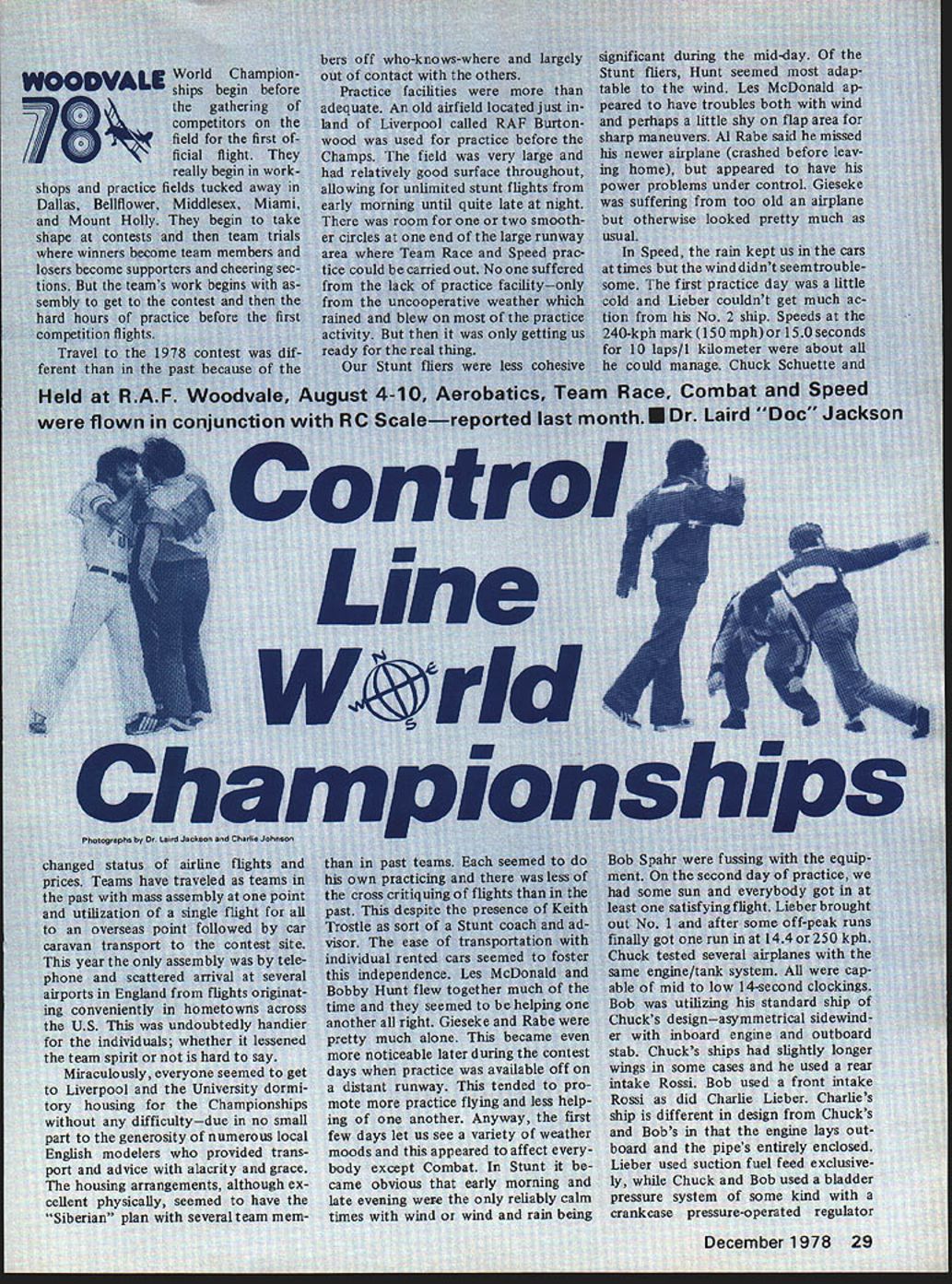
Control Line World Championships: Woodvale 78
Held at R.A.F. Woodvale, August 4–10.
Overview
The World Championships begin long before the first official flight — in workshops, practice fields, contests and team trials across the home countries. Travel to the 1978 contest was different from past years: airline schedules and prices led team members to travel independently to several English airports rather than assemble in one spot and fly as a group. Despite this, competitors reached Liverpool and the university dormitory housing without major difficulty, aided greatly by the generosity of local English modelers who provided transport and advice.
Practice facilities were more than adequate. RAF Burtonwood, an old airfield inland from Liverpool, provided a large field and good surface for extensive practice, including one or two smoother circles suitable for Team Race and Speed. The principal limiting factor was weather — rain and wind affected most practice sessions.
Organization and Processing
The organizers ran multiple simultaneous attractions — Control Line events (Aerobatics, Team Race, Combat, Speed), RC Scale, Standoff Scale, Rubber Scale, RC demonstrations, vintage and custom cars, steam demonstrations, and commercial exhibitions — to attract crowds and offset costs. This broad program helped attendance but sometimes left Control Line-specific needs unattended: public address for CL was poor, crowd control near the flying pits was inconsistent, and some amenities were lacking until CL officials improvised solutions.
Processing (signing up, weighing, measuring and certifying models) was generally orderly despite heavy drizzle that turned the hangar surroundings into muddy paths and required improvisation to enter and exit. During processing, it became clear that several countries had withdrawn or restricted participation in protest over South Africa's involvement; many Eastern Bloc countries did not attend.
A managers’ meeting addressed rules interpretations, notably the Speed-line separation rules. A compromise was reached for the contest: freedom of line placement at the wingtip but no “grouper” or line tie at the handle.
Weather
Weather dominated much of the event: gray skies, rain and blustery conditions affected practice and competition, especially mid-day. Calm early mornings and late evenings provided the most reliable flying windows. Several events, notably Aerobatics (F2B) and Speed (F2A), saw delays or difficult flying conditions because of cool air, rain and wind.
Practice Observations by Event
Aerobatics (F2B / Stunt)
- The U.S. stunt team was less cohesive than in previous years; individual practice and travel arrangements reduced cross-critiquing and team coaching. Keith Trostle provided some coaching.
- Early and late flights were usually the calmest; mid-day sessions were often windy or rainy.
- Aircraft condition varied: some fliers used older ships or were missing newer planes due to crashes before departure. Engine and flap-area choices affected performance in gusty conditions.
Speed (F2A)
- Rain and wind impeded some practice; cooler air reduced engine performance early on.
- Several pilots experimented with different tanks, induction systems and fuel feed methods:
- Charlie Lieber used an outboard engine sidewinder with enclosed pipe and suction fuel feed; he managed a best recorded run at 14.35 s (250.8 kph).
- Chuck Schuette and Bob Spahr tested various airplanes and setups; Spahr used an inboard-engine sidewinder with front induction and a pressure tank.
- Many top fliers used one-bladed props and centrifugal fuel switches (Rumpel-style Kingfisher systems were common).
- Practice speeds suggested 240–260 kph were achievable under good conditions.
Team Race (F2C)
- Practice was hampered by weather and some teams lacked complete practice runs due to late arrivals (e.g., Jed Kusik’s pilot arrived late).
- U.S. teams experimented with older, proven designs and newer retracting-gear models. Examples:
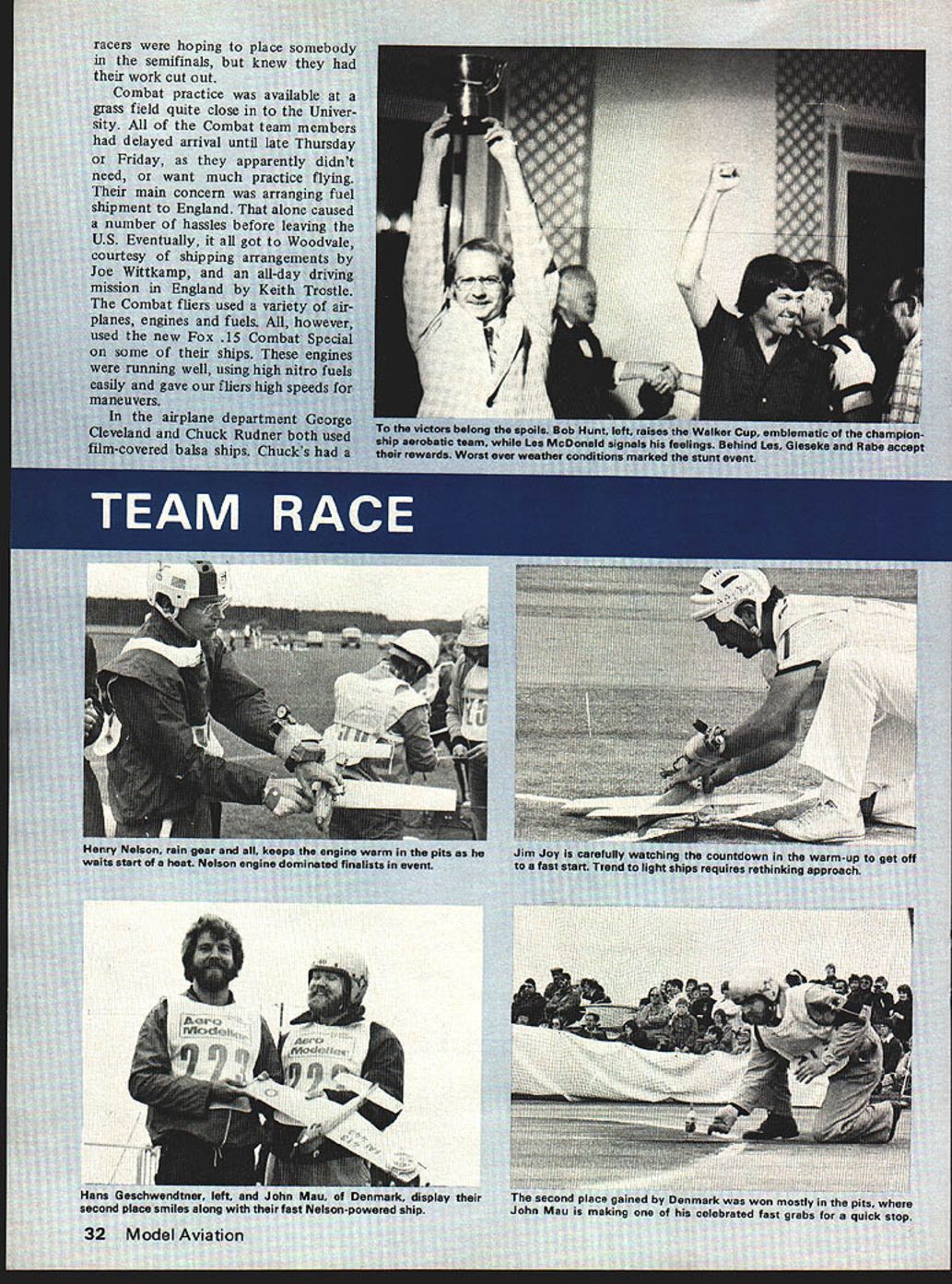
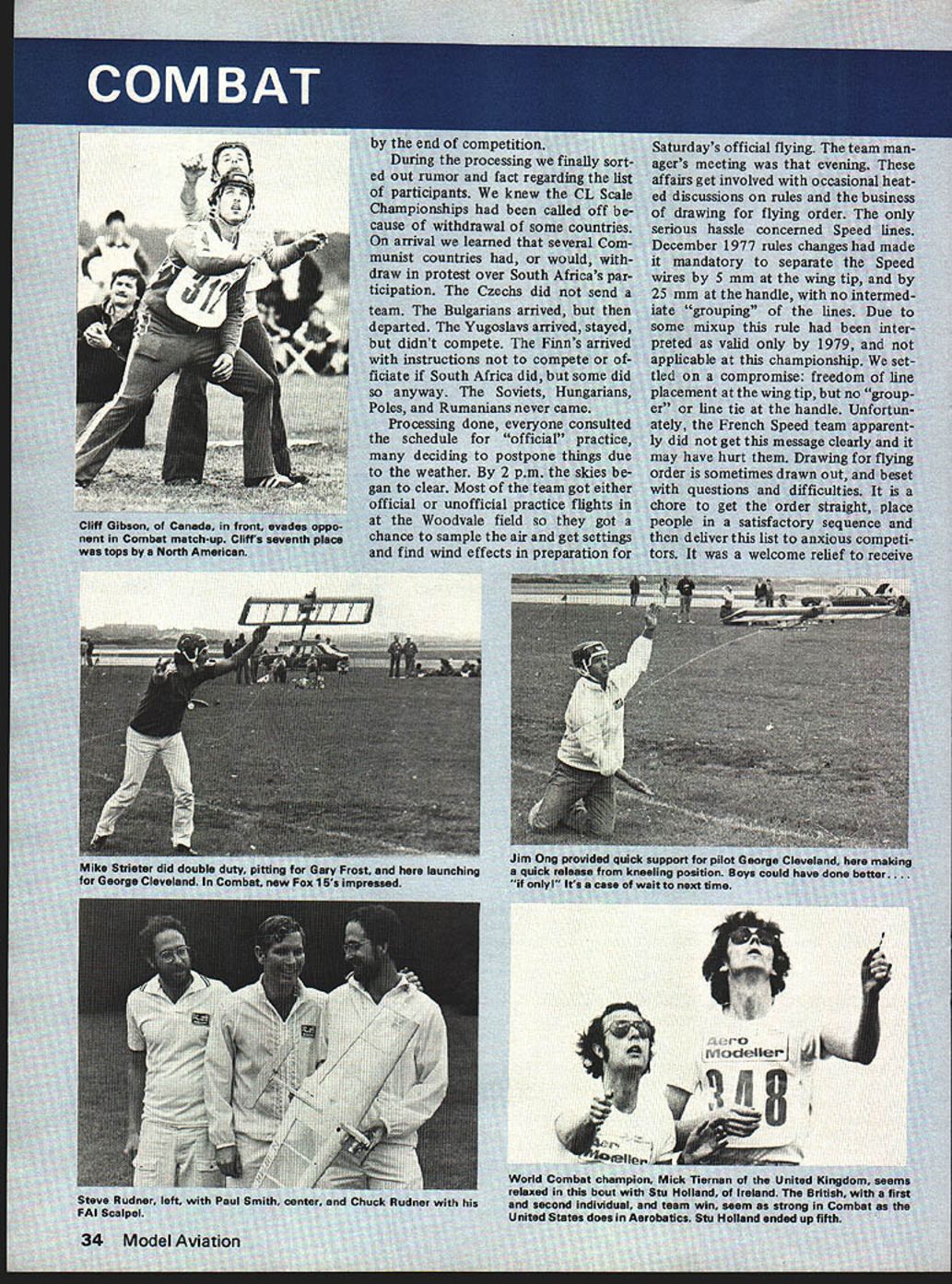
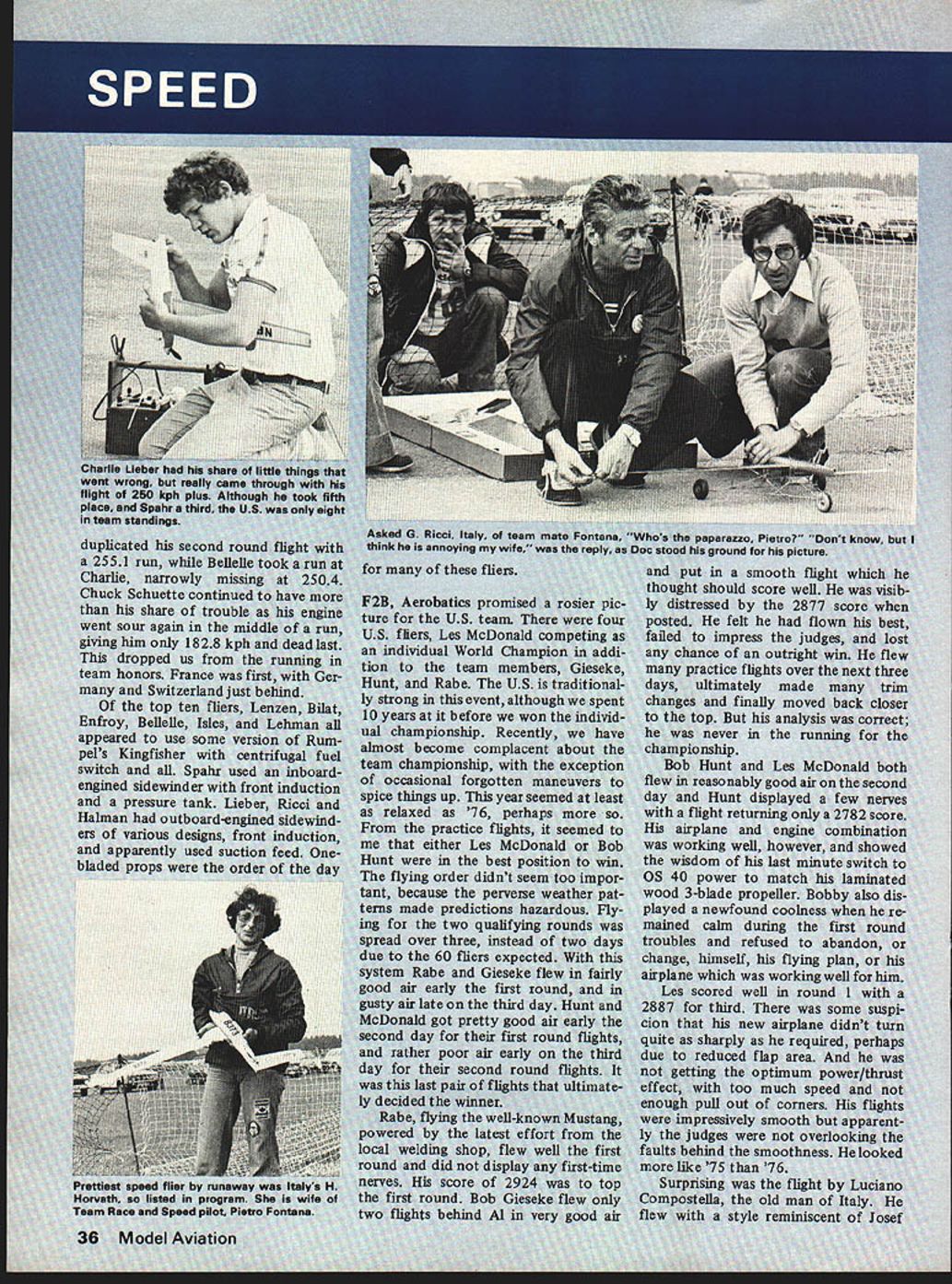
- Dodge/Nelson ran “Pelican” (deep-bellied enclosed-wheel) and “Stork” (retractor). They achieved good range (37–42 laps) but lacked the outright speed of top European teams.
- Albritton/Joy used lighter ships with Barr/Theobald style spring gear and magnesium “spats”; settings proved more critical and less consistent.
- Many top teams used Nelson-powered engines; engine performance and pit technique were decisive.
Combat
- Combat team members arrived late and focused on fuel shipment logistics; eventually all equipment arrived.
- Competitors used a variety of airframes and fuels; many adopted the new Fox .15 Combat Special engine, which ran well on high-nitro fuels.
- Aircraft construction varied from film-covered balsa to foam mono-boom designs; practice went well and the team felt prepared.
Competition Reports and Results
Speed (F2A)
- Official flying was delayed because cooler air and poor conditions reduced attainable speeds.
- Notable performances and incidents:
- Charlie Lieber recorded consistent flights with a best around 14.35 s (250.8 kph), finishing in the top group.
- Luis Bilat (Switzerland) and Jurgen Lenzen (Germany) posted very fast times; Lenzen produced an exceptional 14.08 s (255.5 kph) to lead at one point and later nearly duplicated it.
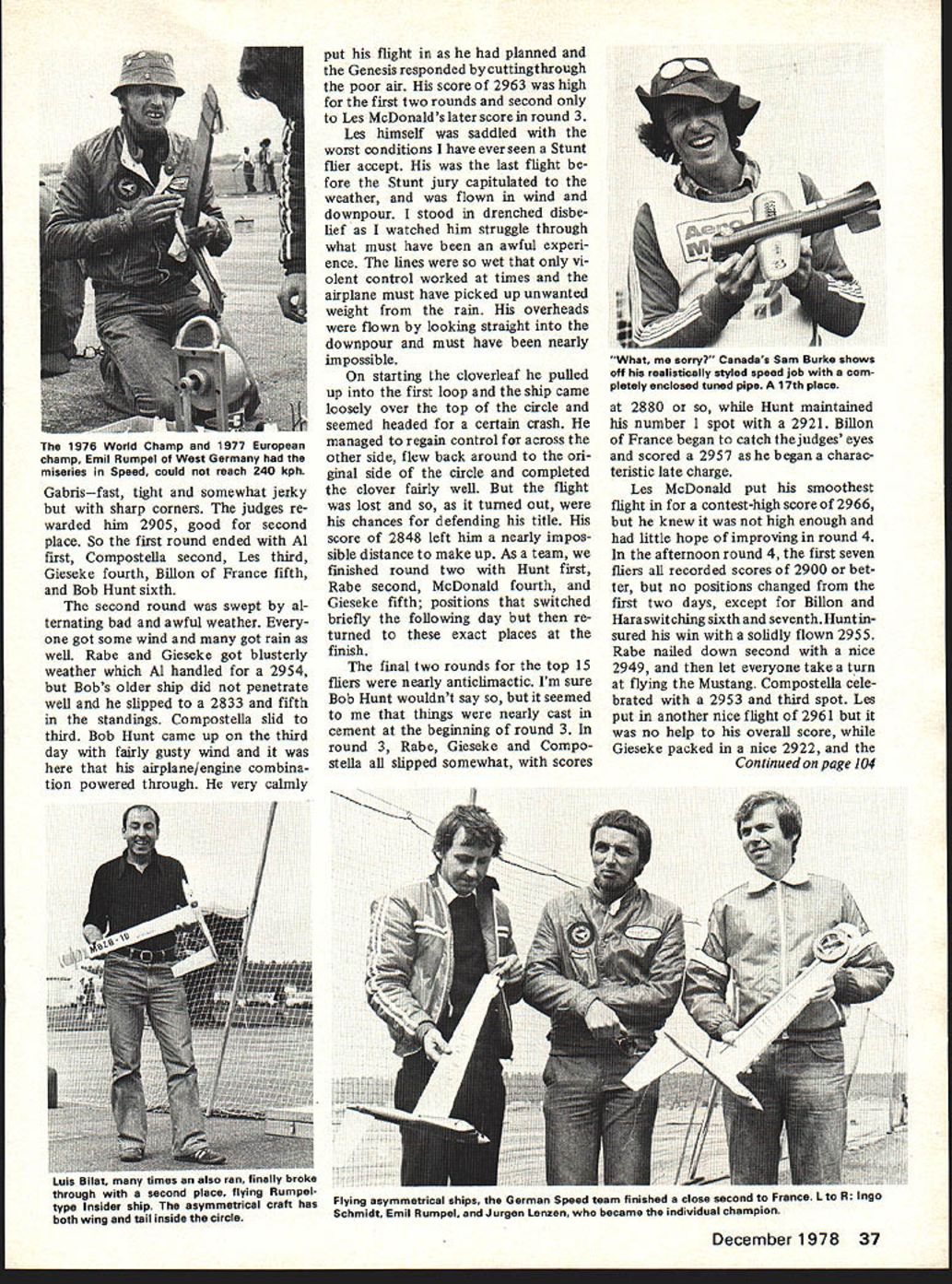
- Emil Rumpel’s Kingfisher-equipped entries featured prominently; several top pilots used variants of centrifugal fuel switches.
- Fuel-system reliability affected results: Chuck Schuette suffered repeated engine failures and recorded no competitive times, removing the U.S. from contention for team honors in Speed.
- Final team standings in Speed were led by France, with Germany and Switzerland close behind.
Aerobatics (F2B / Stunt)
- The U.S. team performed strongly despite weather interruptions.
- After early rounds and changeable weather, standings among top fliers stabilized:
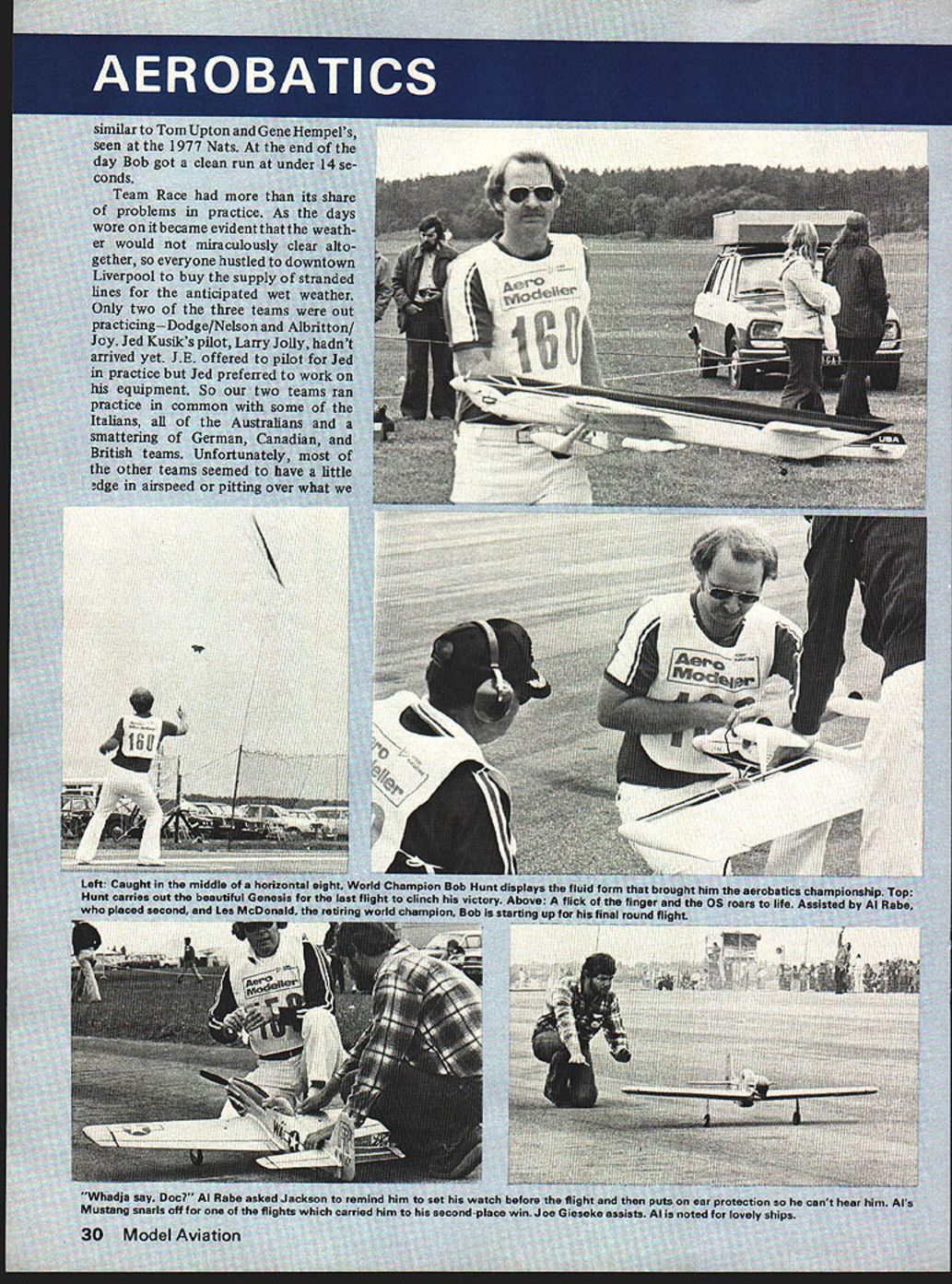
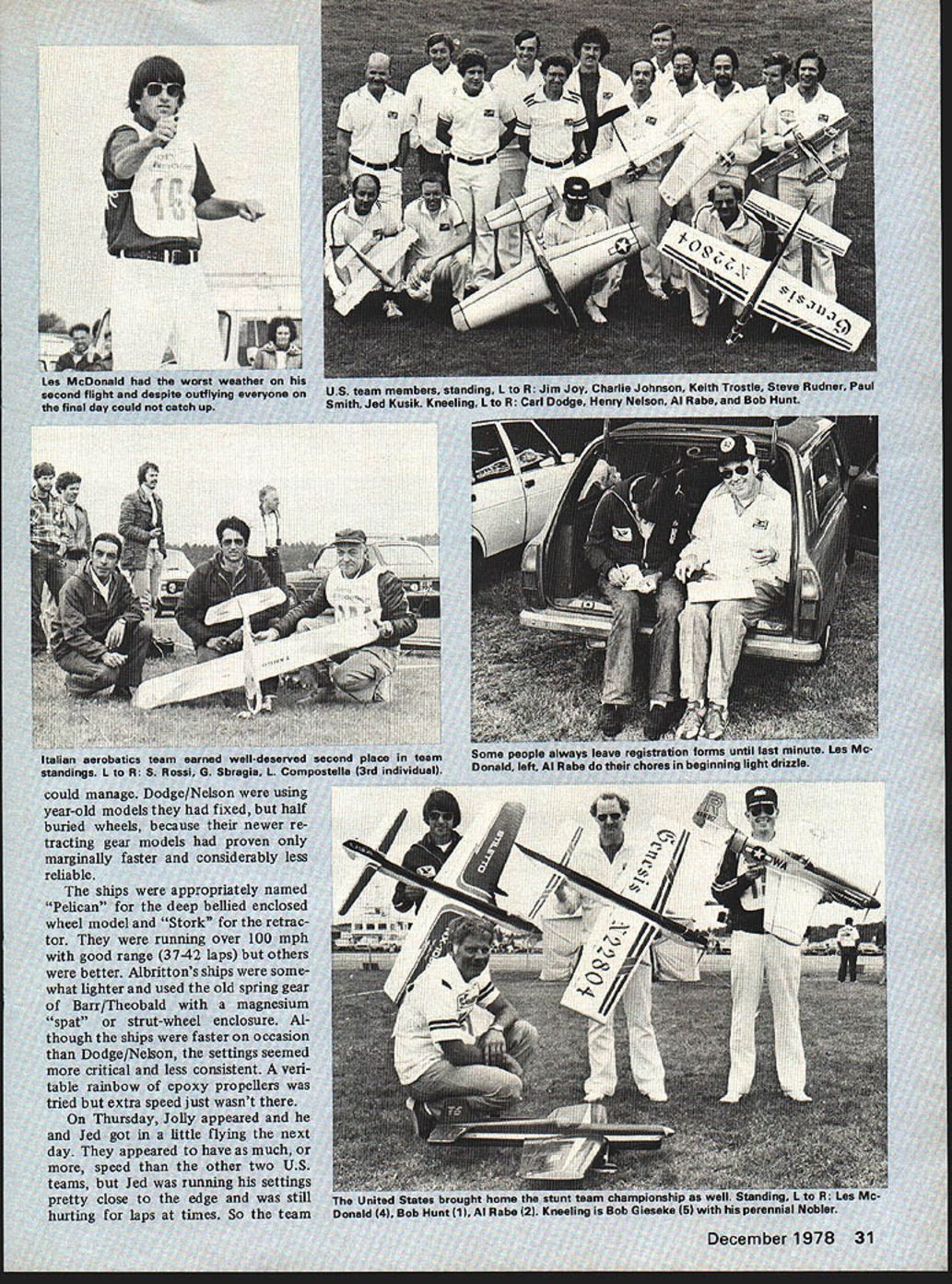
- Bob Hunt maintained the lead and secured the individual championship with consistent flights and top scores, including a 2921 and a 2955 that sealed the win.
- Al Rabe finished second overall with strong, steady flying (notable scores around 2954 and 2949).
- Luciano Compostella (Italy) took third with tightly flown sequences (2953).
- Les McDonald flew exceptionally in later rounds (e.g., a contest-high 2966 in round 3 and 2961 in round 4) but an earlier rain-drenched round with a 2848 left him too far behind for the title.
- Team positions after round two: Hunt first, Rabe second, McDonald fourth, Gieseke fifth; these positions ultimately returned and solidified through to the end.
- Judges’ scores tended to reward tight, sharp corners and precision; inconsistent or wet flights lost substantial points.
Team Race (F2C)
- Team race was extremely fast and competitive; semifinal and final cutoff times were unexpectedly tough.
- Highlights:
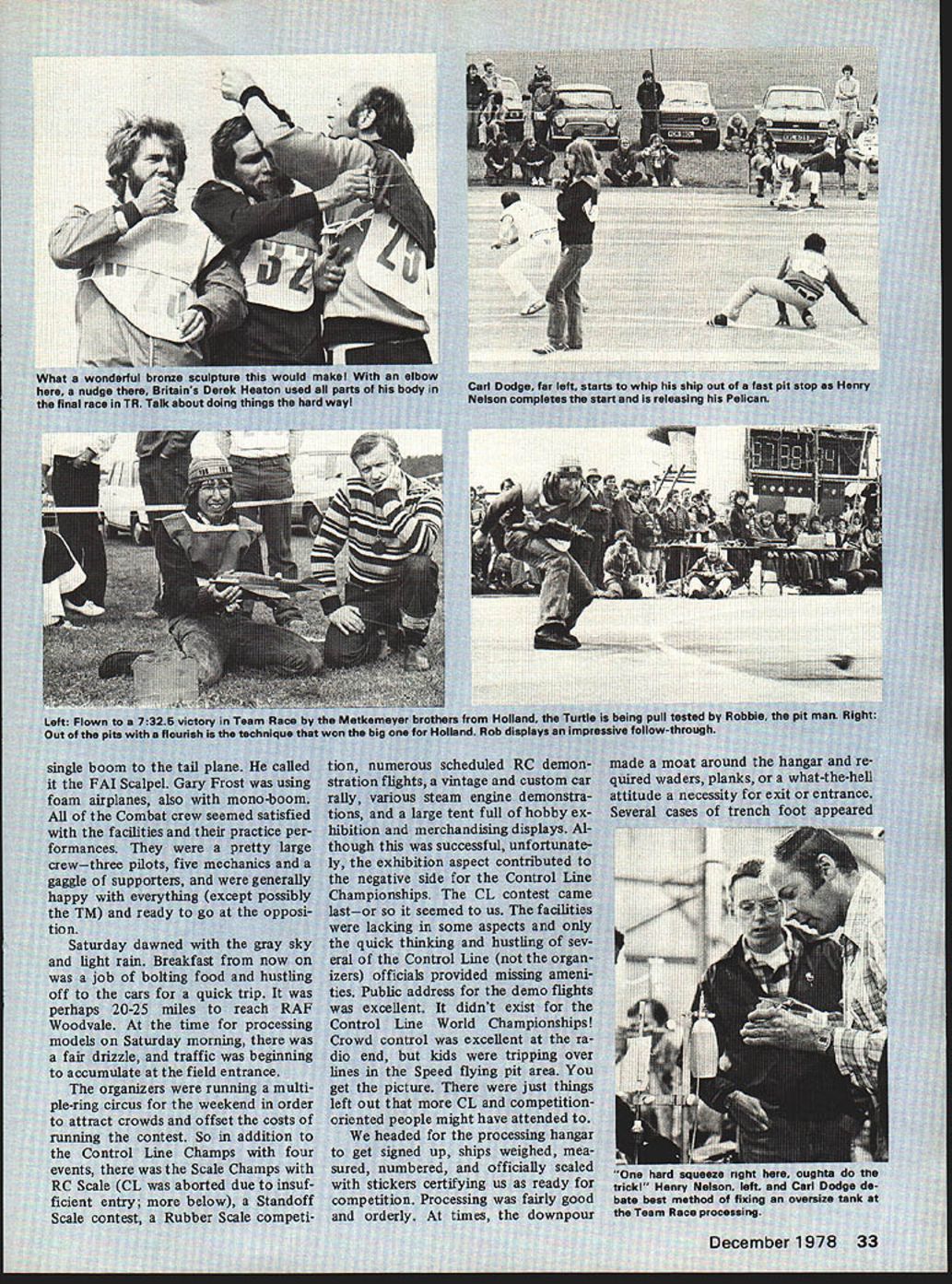
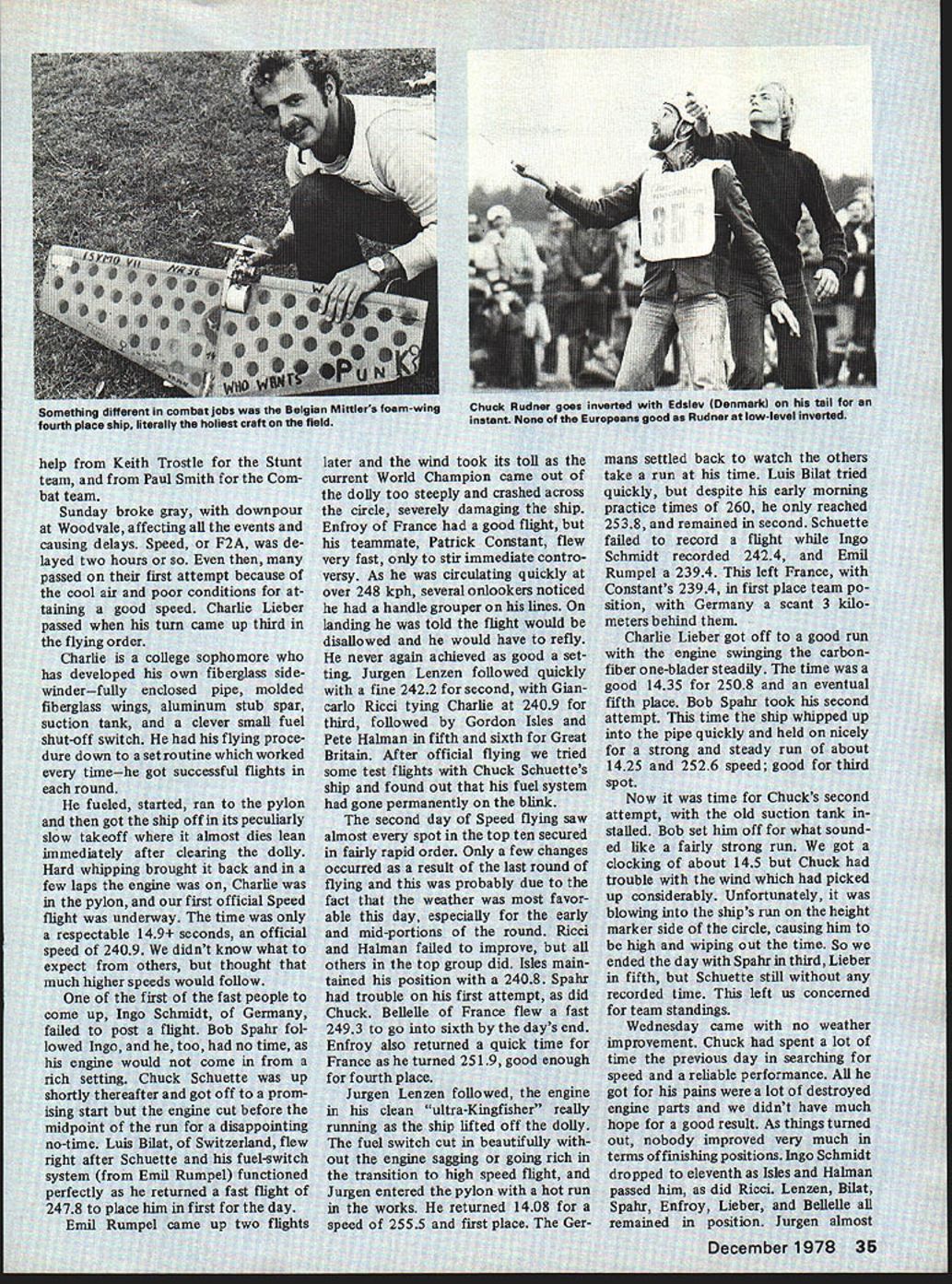
- Many top teams used Nelson engines. The Metkemeyer brothers (Holland) and several British and Australian teams posted sub-4-minute times.
- Early surprise: Metkemeyer brothers recorded a very fast 3:49.5 in initial heats.
- Semifinals tightened the field. Several teams recorded sub-3:50 times in the semis and finals contention required times near or under 4:00.
- U.S. teams struggled to make semifinals. Dodge/Nelson posted a promising 4:03.1 but later ran into issues; Albritton/Joy and Jolly/Kusik also failed to reach the semifinal cutoff consistently.
- In the semis and finals, teams from Australia, Great Britain, the Netherlands and others produced the leading times; engine tune, pit technique and consistent pitting were decisive.
Combat
- Combat competitors reached the contest with varied equipment and fuel constraints noted earlier, but the Fox .15 Combat Special performed well for many entrants.
- Practice indicated strong readiness; final combat results reflected individual pilot skill and aircraft robustness in head-to-head rounds.
Noteworthy Incidents and Notes
- A number of countries withdrew or limited participation in protest over South Africa’s involvement. The Czechs did not send a team; the Bulgarians arrived then departed; Yugoslavs attended but did not compete; several Eastern Bloc nations did not attend.
- Speed flying controversies arose over line handling and “grouper” lines on the handle. Some fast flights were protested or disallowed due to perceived illegal line ties or unsafe landings.
- Weather forced several schedule changes and jury decisions (including allowing late flights under marginal conditions), which affected outcomes — most dramatically for Les McDonald in Aerobatics.
- Equipment reliability — fuel switches, tanks, and engine tune — played a major role in many events. Several promising competitors were undone by recurring engine or fuel-system failures.
Top Individual Placings (selected)
- Aerobatics (F2B) top finishers:
- 1. Bob Hunt (USA)
- 2. Al Rabe (USA)
- 3. Luciano Compostella (Italy)
- Les McDonald, Billon (France), Bob Gieseke and others rounded out the top group.
- Speed (F2A) top finishers (selected):
- Jurgen Lenzen (Germany) — top recorded run ~255.5 kph
- Luis Bilat (Switzerland) — strong early runs
- Charlie Lieber (USA) — consistent 240–251 kph range
- France, Germany and Switzerland were prominent in the team standings.
- Team Race (F2C):
- Top heats and semifinal times were dominated by teams from the Netherlands, Great Britain, Australia and other European competitors using extensively tuned Nelson engines and exceptional pitting.
Closing
The 1978 Control Line World Championships at Woodvale were marked by excellent practice facilities, erratic weather, stringent competition — particularly in Team Race and Speed — and several controversies around rules interpretation and equipment. Despite travel changes, withdrawals, and weather, competitors displayed high skill, ingenuity and sportsmanship. The event concluded with strong performances across Aerobatics, Speed, Team Race and Combat, and left many looking forward to future refinements in rules, equipment and organization for the next championships.
Transcribed from original scans by AI. Minor OCR errors may remain.

