
Control Line World Champs
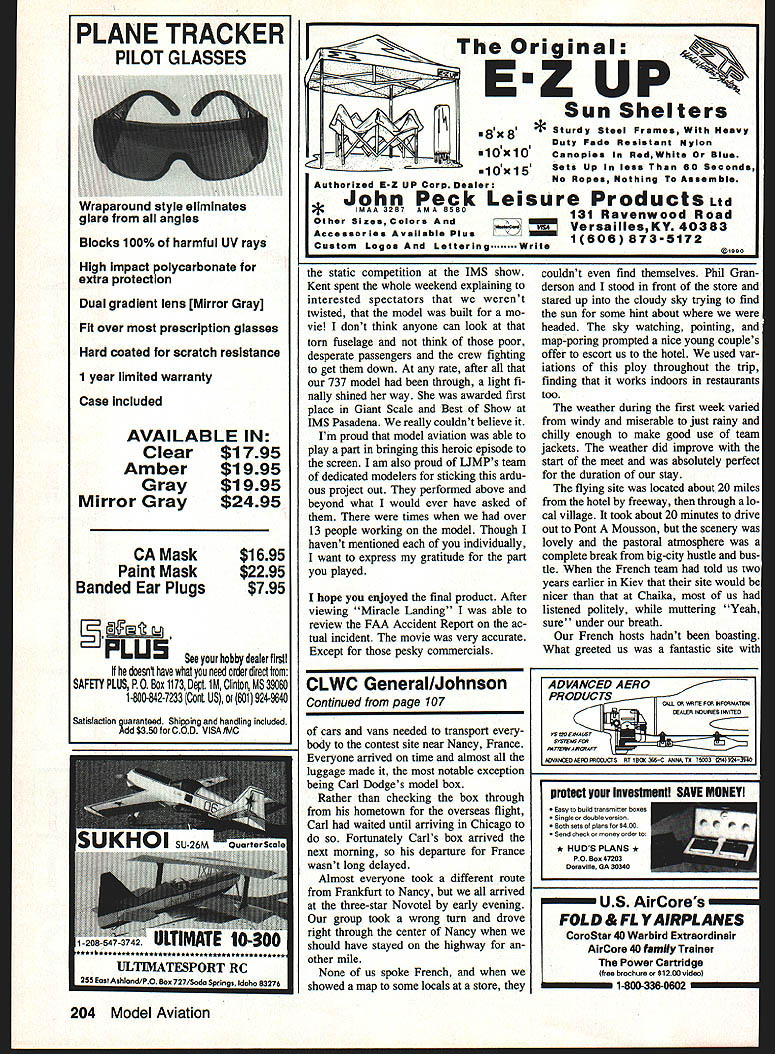
The fireworks overhead matched those on the field as the U.S.A.'s Carl Dodge walked away with the F2A Speed World Championship for 1990. Just as the French had promised, Blénod-lès-Pont-à-Mousson, near Nancy, proved a spectacular site.
Arrival and travel
The 1990 expedition to the Control Line World Championships departed from many locations around the U.S.A. on July 3, 1990. Everyone flew on Lufthansa with plans to meet in Frankfurt and stay overnight at the nearby Dorint Hotel. By taking direct flights from selected U.S. cities, the team and its supporters saved the New York stopover that had added time and expense on the 1988 trip to Kiev. Team Manager Bill Lee and John McCollum left a day early to arrange for the fleet.
Cars and vans transported everybody to the contest site near Nancy. Most of the group arrived on time and almost all luggage made it; the notable exception was Carl Dodge's model box. Rather than checking the box through from his hometown for the overseas flight, Carl waited until arriving in Chicago to do so. Fortunately, the box arrived the next morning and the delay in his departure for France was short.
Almost everyone took a different route from Frankfurt to Nancy, but we all reached the three-star Novotel by early evening. Our group took a wrong turn and drove right through the center of Nancy when we should have stayed on the highway another mile. None of us spoke French; when we showed a map to some locals at a store, they couldn't even find themselves on it. Phil Granderson and I stood in front of the store, staring at the cloudy sky trying to spot the sun for a hint about where we were headed. A nice young couple offered to escort us to the hotel — a ploy we used, with variations, throughout the trip.
The site and facilities
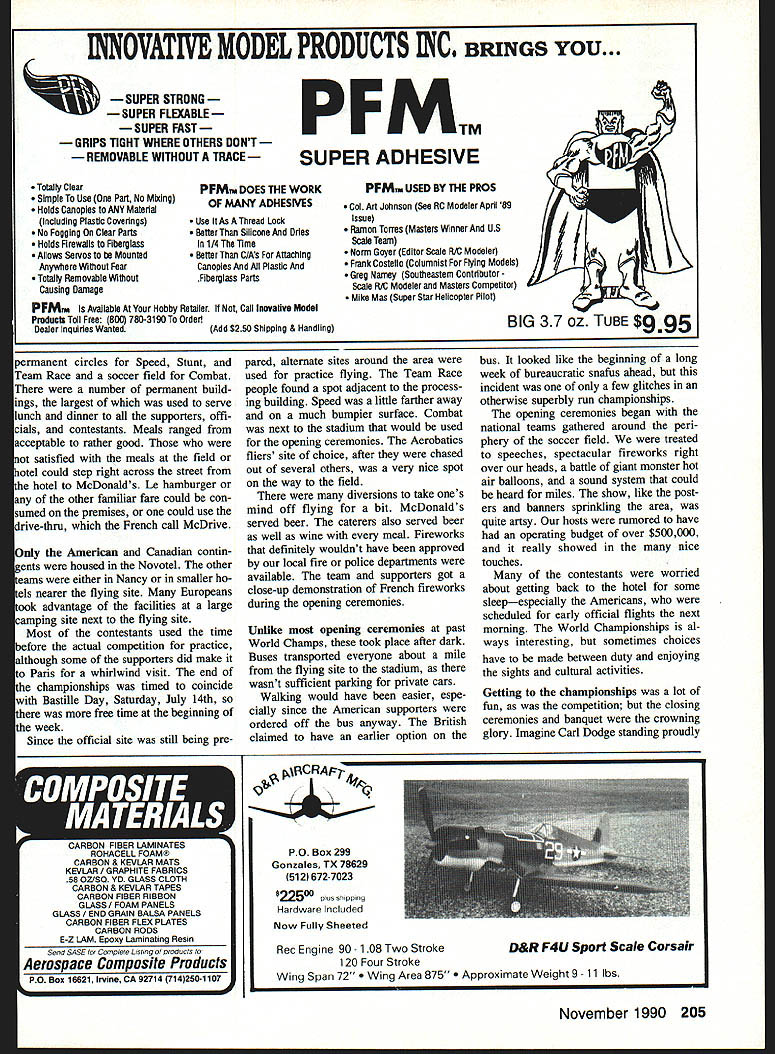
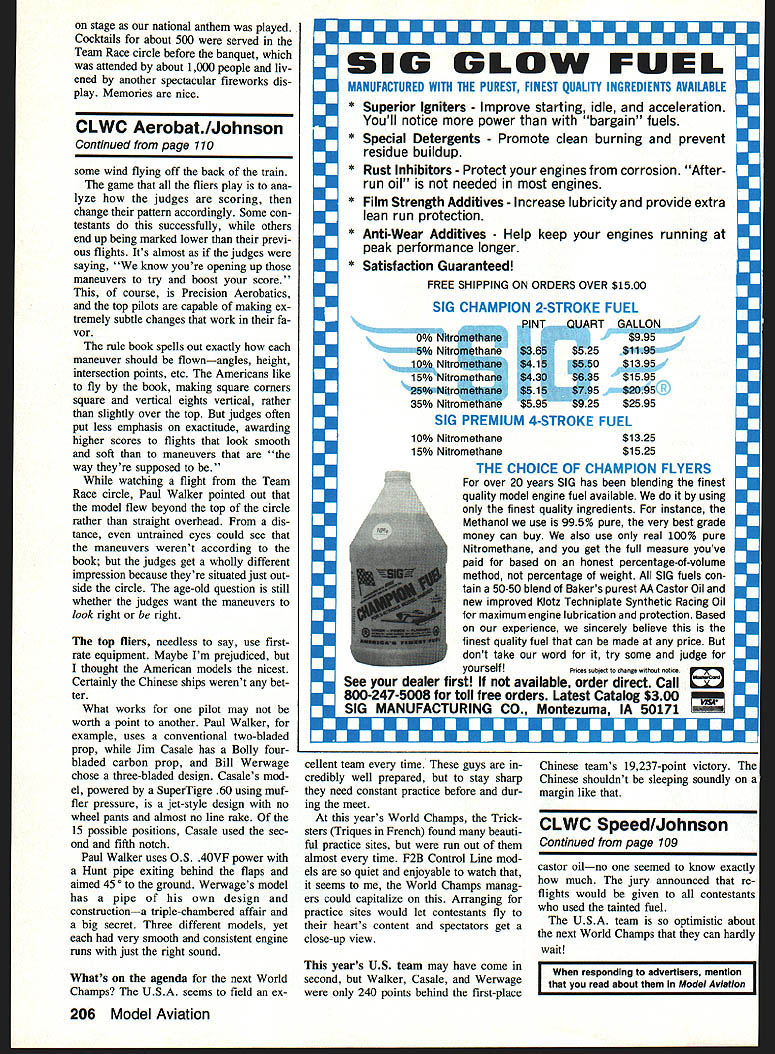
The flying site was located about 20 miles from the hotel by freeway, then through a village. It took about 20 minutes to drive out to Pont-à-Mousson, but the scenery was lovely and the pastoral atmosphere was a complete break from big-city hustle and bustle. Our French hosts hadn't been boasting — what greeted us was a fantastic site with permanent circles for Speed, Stunt (F2B), and Team Race and a soccer field for Combat. There were a number of permanent buildings, the largest of which served lunch and dinner to supporters, officials, and contestants. Meals ranged from acceptable to rather good.
Those not satisfied with the hotel or field meals could step across the street from the hotel to McDonald's. Le hamburger and other familiar fare could be consumed on the premises, or via the drive-thru, which the French call McDrive. Only the American and Canadian contingents were housed in the Novotel; other teams stayed in Nancy or in smaller hotels nearer the flying site. Many Europeans camped at a large site next to the field.
Weather and practice
The weather during the first week varied from windy and miserable to rainy and overcast. Conditions improved with the start of the meet and were absolutely perfect for the duration of the official competition. Most contestants used the time before the actual competition for practice, while some supporters made whirlwind visits to Paris. The end of the championships was timed to coincide with Bastille Day (Saturday, July 14), so there was more free time at the beginning of the week.
Since the official site was still being prepared, alternate sites around the area were used for practice flying:
- Team Race found a spot adjacent to the processing building.
- Speed practiced a little farther away on a bumpier surface.
- Combat practiced next to the stadium used for the opening ceremonies.
- Aerobatics fliers, after being moved from several locations, settled on a very nice spot on the way to the field.
Opening and closing ceremonies
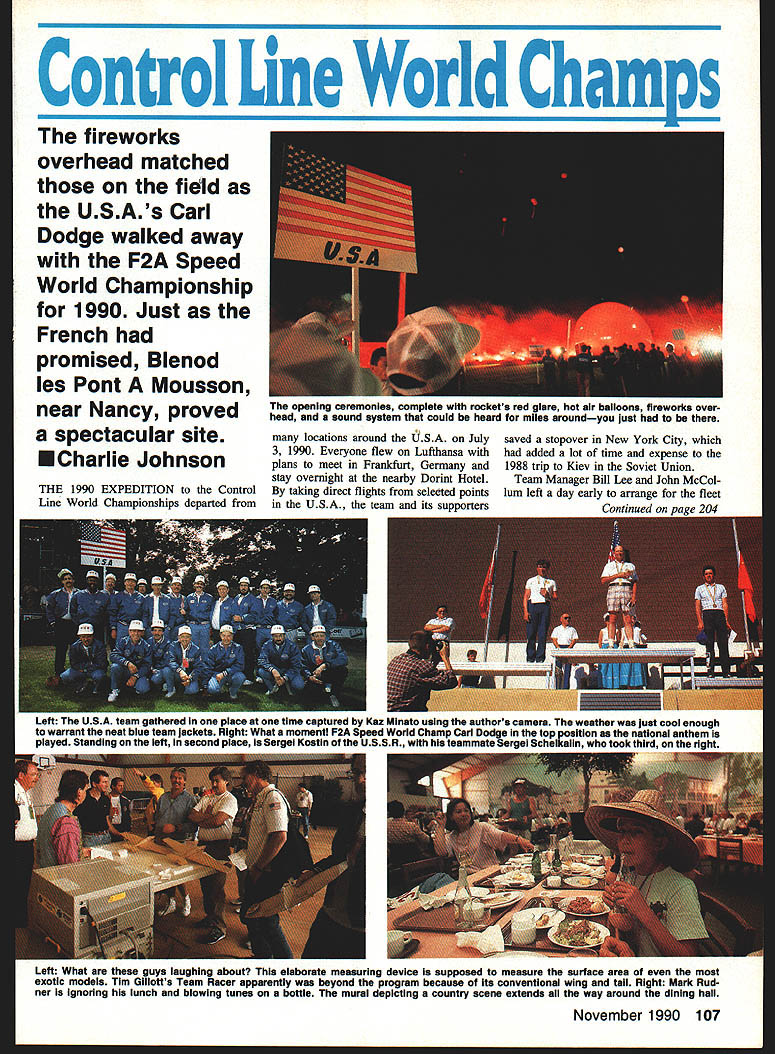
Unlike most opening ceremonies at past World Champs, these took place after dark. Buses transported everyone about a mile from the flying site to the stadium, as there wasn't sufficient parking for private cars. The opening ceremonies began with the national teams gathered around the periphery of the soccer field. We were treated to speeches, spectacular fireworks right over our heads, a battle of giant monster hot air balloons, and a sound system that could be heard for miles. The show — like the posters and banners sprinkling the area — was quite artsy. Our hosts were rumored to have had an operating budget of over $500,000, and it really showed.
Cocktails for about 500 were served in the Team Race circle before the banquet, which was attended by about 1,000 people and livened by another spectacular fireworks display. Many contestants were worried about getting back to the hotel for sleep, especially the Americans who were scheduled for very early flights the next morning. The closing ceremonies and banquet were the crowning glory of the event.
Aerobatics and judging
The game that all the fliers play is to analyze how the judges are scoring, then change their pattern accordingly. Some contestants do this successfully; others end up being marked lower than on previous flights. Precision Aerobatics (F2B) requires exact execution: the rule book spells out how each maneuver should be flown — angles, height, intersection points, etc.
Americans tend to "fly by the book," making square corners and vertical eights truly vertical. Judges, however, often put less emphasis on exactitude, awarding higher scores to flights that look smooth and soft rather than strictly textbook. From the judges' vantage point — just outside the circle — maneuvers can appear quite different than they do from a distance. The age-old question remains: do judges want maneuvers to look right, or to be right?
There was also an issue with tainted fuel (castor oil contamination); the jury announced that re-fueling flights would be given to all contestants who used the affected fuel.
Equipment
The top fliers use first-rate equipment, and different approaches can all work. Examples from the U.S. team:
- Paul Walker: uses an O.S. .40VF engine with a Hunt pipe exiting behind the flaps and aimed 45° to the ground; conventional two-bladed prop.
- Jim Casale: flies a jet-style design powered by a SuperTigre .60 using muffler pressure, with a Boully four-bladed carbon prop and almost no line rake. Casale used the second and fifth notch of the 15 possible positions.
- Bill Werwage: uses a three-bladed prop and a pipe of his own triple-chambered design.
Different engines, pipe designs, and prop choices all produced very smooth and consistent runs with pleasing sound.
Results and aftermath
Carl Dodge won the F2A Speed World Championship for 1990. The U.S. team finished a close second in F2B: Walker, Casale, and Werwage were only 240 points behind the first-place Chinese team's 19,237-point total. The Chinese margin was respectable but not overwhelming; the U.S. team is optimistic and already looking forward to the next World Champs.
Overall, the meet was superbly run, with a few bureaucratic glitches overshadowed by excellent facilities, great flying, memorable ceremonies, and a friendly international atmosphere.
Transcribed from original scans by AI. Minor OCR errors may remain.

