
Control Surface Flutter
An effective solution to a serious problem
H. Carlin Hulick
If you have flown RC for any length of time, chances are good you have experienced control-surface flutter. Besides scaring you with that humming sound, flutter will severely stress the control surfaces and can cause breakage of support structure, hinges, linkages, servo gear trains, and control surfaces.
We know it exists and realize it is a dangerous problem, but why does it happen, and what can we do to eliminate it or prevent it from happening?
Flutter starts when airflow across a surface causes a force on the surface that tries to move it. Slop in linkages or bending structure allows some movement. When the surfaces spring back, the force is applied again, and flutter begins.
The rate of flutter can become quite high, and you hear the hum of the fluttering surface. When this happens, immediately cut throttle and, if possible, climb to reduce speed and relieve the force before the flutter causes damage to the model and/or a complete loss of control.
The degree of movement during flutter is amazing. I have watched surfaces through field glasses, and high-rate surface travel of 1/2 to 1 inch is not unusual. Try bending the surfaces that much against the linkages and servo and you will see the high forces being applied.
Cures
All of the following items are worth considering, but the best answer is usually static balancing of the control surfaces.
- Lessen or seal the opening between surfaces on the hingeline. MonoKote across the gap (or better building practices) can help with this, and will cure many cases of flutter.
- Lower speed lessens forces and will stop the problem, but that's no fun.
- Eliminate slop in linkages. Complex linkages such as wing-mounted bellcranks increase the problem, and wear through use gives a gradual loosening that will occur in time on any linkage. Coat soldered wire ends with five-minute epoxy.
- Ailerons that extend to the wingtip will flutter more easily due to tip-vortex effects. Most newer designs have a tip that tapers back to the trailing edge.
- Static-balance the control surfaces. This lessens inertial effects of the moving surface and usually provides a cure.
Most full-scale high-performance aircraft have balanced control surfaces. Look at the full-scale P-38 and notice the balance weights on the elevator. Prototypes of the P-38 flew faster than engineers had experienced in earlier designs; flutter occurred but was eliminated by balanced surfaces.
On our models, it's usually the ailerons that flutter because of their large areas and complex linkages. Flutter is sometimes found on elevators, especially with two-piece surfaces or flimsy pushrods.
Example: The .40 size Ugly Stick
The .40-size Ugly Stick is a model that's famous for aileron flutter problems. I have seen a lot of this problem, as .40 Sticks are my favorite models and I have flown a lot of them.
A recent Stick of mine had some aileron flutter problems that were greatly aggravated by the installation of a more powerful engine. I tried all the usual fixes—checking linkages, tightening servo mounts, then MonoKote full span over the hinge gaps—but nothing helped until static balance was done. After balancing, there was no flutter.
How to static-balance control surfaces
The application is simple:
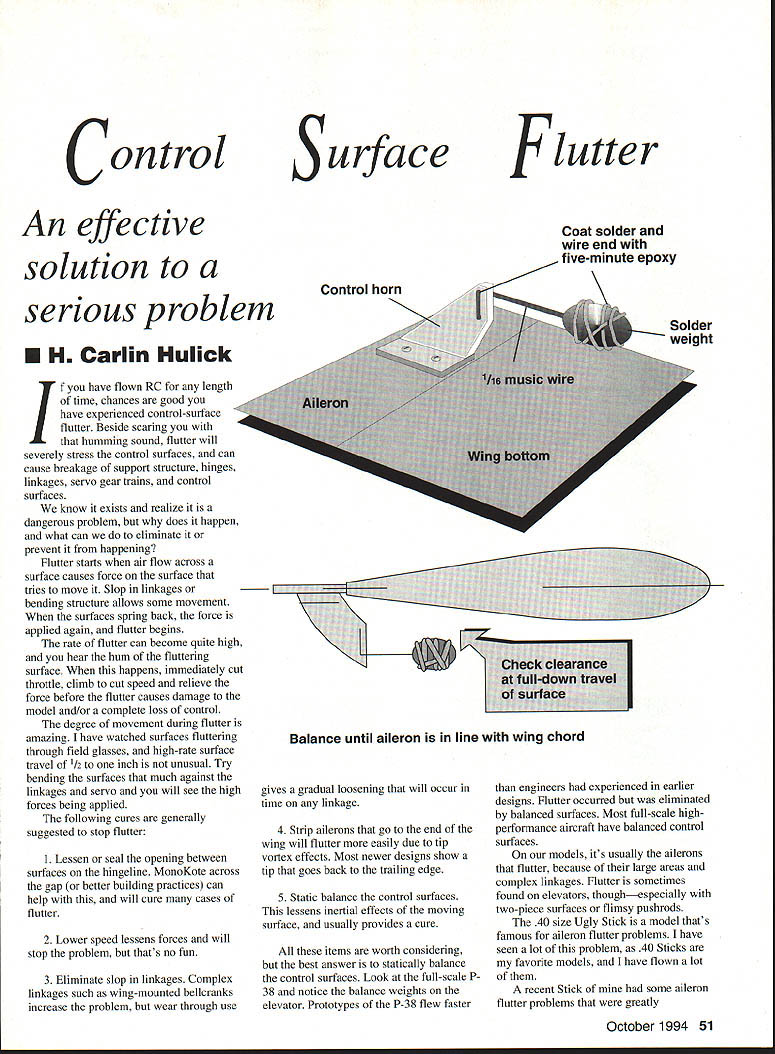
- Balance weights are installed under the wing, one on each aileron.
- Mount a control horn in the center of the aileron near the hinged edge.
- Use 1/16" music wire with weight attached to counterbalance the aileron weight. Make a bend on the end of the wire and wrap solder around it until the aileron is balanced (sits level).
- Position the wing level at flight angle with the bottom up. Disconnect the pushrods and add solder until the aileron returns to level after being moved.
- Apply some five-minute epoxy over the solder and the wire connection to the horn so it all stays together during flight.
- Position the weight so it does not hit the wing when the down aileron is applied.
Elevator balance can be done in a similar way if needed.
This simple fix made my Stick fly fine, even in steep dives. I have used this method on other models with flutter tendencies and it has always solved the problem. Give it a try!
Transcribed from original scans by AI. Minor OCR errors may remain.

