
Coppa Schneider
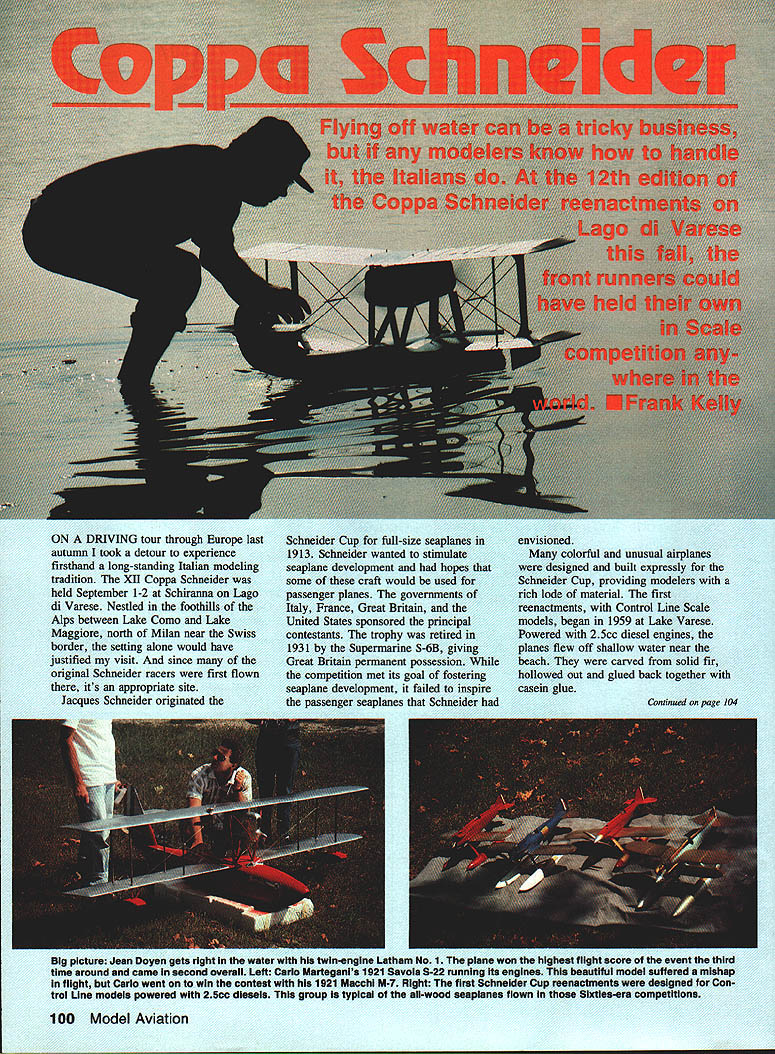
Flying off water can be a tricky business, but if any modelers know how to handle it, the Italians do. At the 12th edition of the Coppa Schneider reenactments on Lago di Varese that fall, the front runners could have held their own in scale competition anywhere in the world. — Frank Kelly
Background
Jacques Schneider originated the Schneider Cup for full-size seaplanes in 1913. Schneider wanted to stimulate seaplane development and hoped some of these craft would be used for passenger planes. The governments of Italy, France, Great Britain, and the United States sponsored the principal contestants. The trophy was retired in 1931 by the Supermarine S-6B, giving Great Britain permanent possession. While the competition met its goal of fostering seaplane development, it failed to inspire the passenger seaplanes Schneider had envisioned.
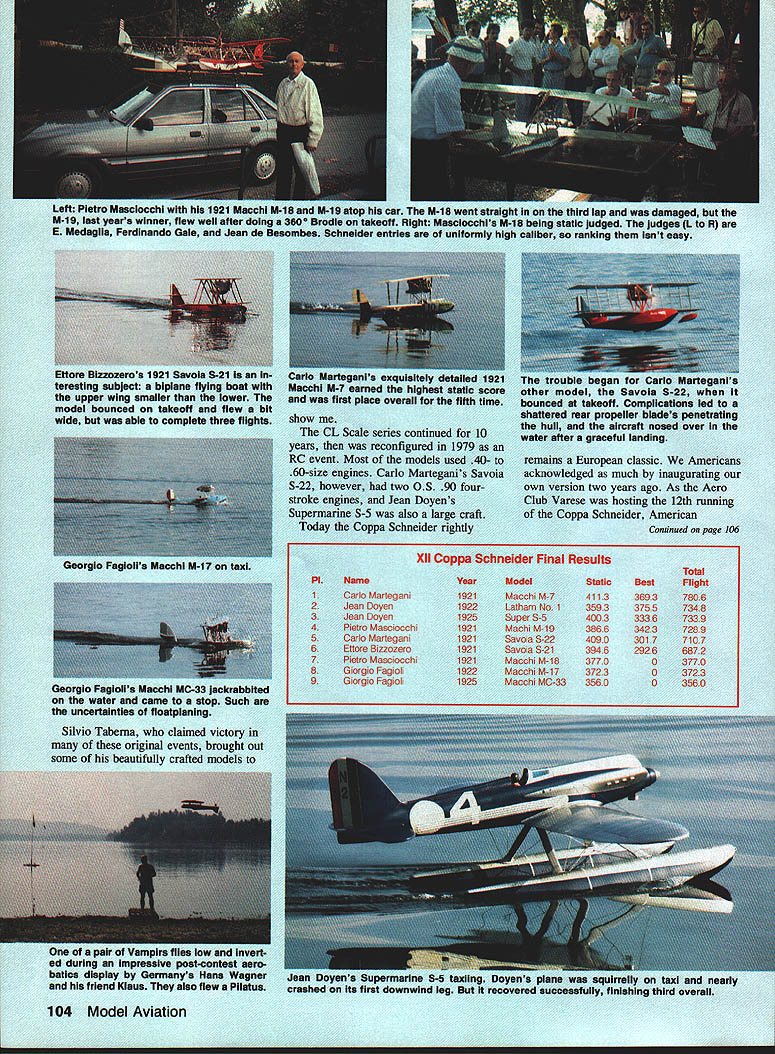
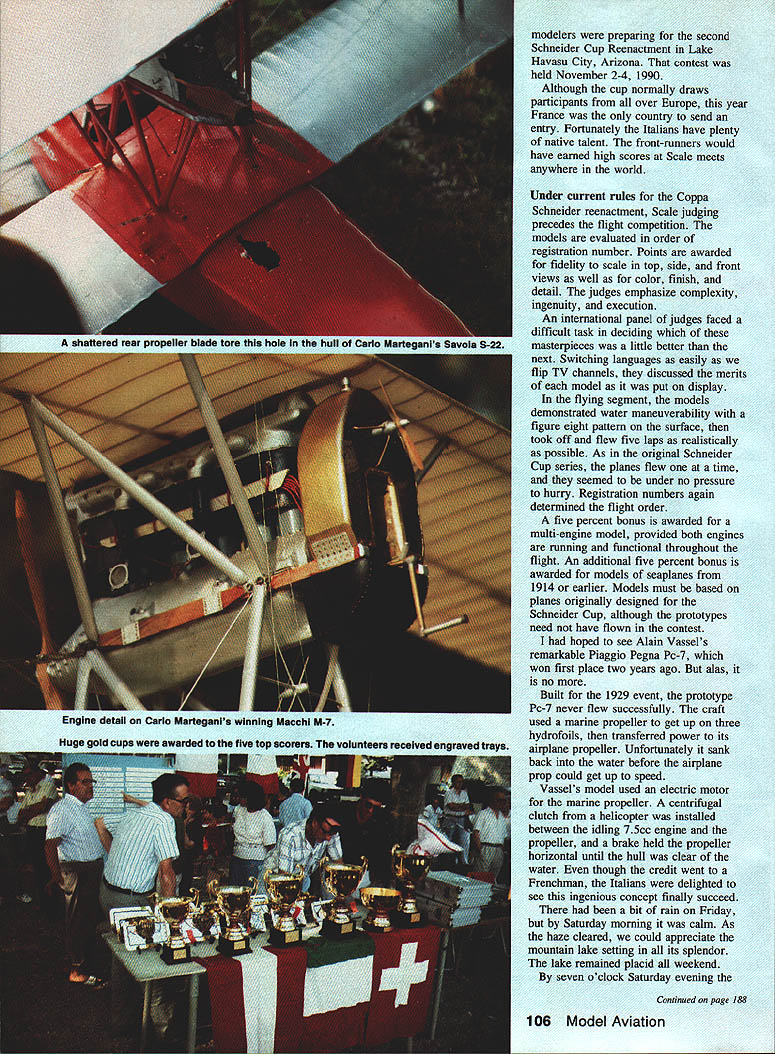
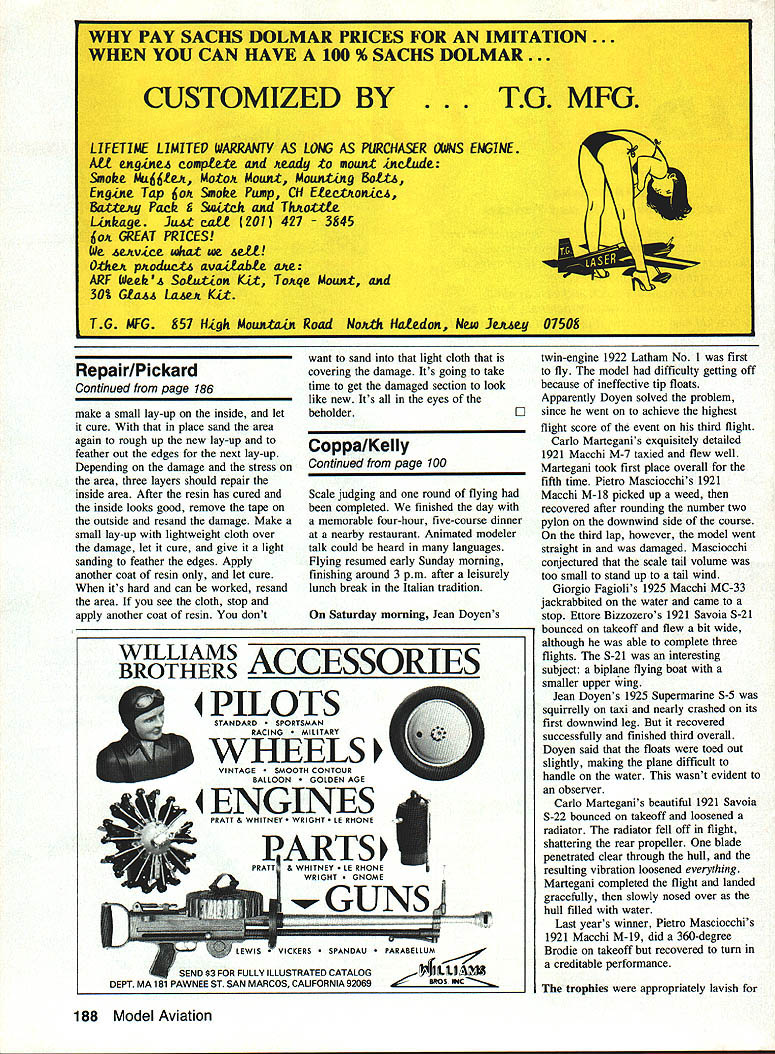
Many colorful and unusual airplanes were designed and built expressly for the Schneider Cup, providing modelers with a rich lode of material. The first reenactments, with control-line scale models, began in 1959 at Lake Varese. Powered with 2.5 cc diesel engines, the planes flew off shallow water near the beach. They were carved from solid fir, hollowed out and glued back together with casein glue.
The control-line scale series continued for 10 years, then was reconfigured in 1979 as a radio-control (RC) event. Most of the models used .40- to .60-size engines. Carlo Martegani’s Savoia S-22, however, had two O.S. .90 four-stroke engines, and Jean Doyen’s Supermarine S-5 was also a large craft.
We Americans acknowledged the event’s importance by inaugurating our own version two years earlier. As the Aero Club Varese hosted the 12th running of the Coppa Schneider, Silvio Taberna, who claimed victory in many of the original events, brought out some of his beautifully crafted models to show me.
The XII Coppa Schneider — Schiranna, Lago di Varese
The XII Coppa Schneider was held September 1–2 at Schiranna on Lago di Varese, nestled in the foothills of the Alps between Lake Como and Lake Maggiore, north of Milan near the Swiss border. Many of the original Schneider racers were first flown there, making it an appropriate site.
Although the cup normally draws participants from all over Europe, this year France was the only foreign country to send an entry. Fortunately, the Italians have plenty of native talent. The front-runners would have earned high scores at scale meets anywhere in the world.
Modelers were also preparing for the second Schneider Cup reenactment in Lake Havasu City, Arizona; that contest was held November 2–4, 1990.
Rules and Judging
Under current rules for the Coppa Schneider reenactment, scale judging precedes the flight competition. Models are evaluated in order of registration number. Points are awarded for fidelity to scale in top, side, and front views, as well as for color, finish, and detail. Judges emphasize complexity, ingenuity, and execution.
An international panel of judges faced a difficult task in deciding which of these masterpieces was a little better than the next. Switching languages as easily as we flip TV channels, they discussed the merits of each model as it was put on display.
In the flying segment, models demonstrate water maneuverability with a figure-eight pattern on the surface, then take off and fly five laps as realistically as possible. As in the original Schneider Cup series, the planes fly one at a time and seem under no pressure to hurry; registration numbers determine the flight order.
A five-percent bonus is awarded for a multi-engine model, provided both engines are running and functional throughout the flight. An additional five-percent bonus is awarded for models of seaplanes from 1914 or earlier. Models must be based on planes originally designed for the Schneider Cup, although the prototypes need not have flown in the contest.
Event Conditions and Schedule
There was a bit of rain on Friday, but by Saturday morning it was calm. As the haze cleared, the mountain-lake setting could be appreciated in all its splendor. The lake remained placid all weekend.
By 7:00 p.m. Saturday the scale judging and one round of flying had been completed. The day ended with a memorable four-hour, five-course dinner at a nearby restaurant, with animated modeler talk in many languages. Flying resumed early Sunday morning and finished around 3:00 p.m. after a leisurely lunch break in the Italian tradition.
Highlights from the Flying
- Jean Doyen’s twin-engine 1922 Latham No. 1 was first to fly on Saturday morning. The model had difficulty getting off because of ineffective tip floats; Doyen later solved the problem and achieved the highest flight score on his third flight.
- Carlo Martegani’s exquisitely detailed 1921 Macchi M-7 taxied and flew well. Martegani took first place overall for the fifth time.
- Pietro Masciocchi’s 1921 Macchi M-18 picked up a weed, recovered after rounding the number two pylon, but on the third lap went straight in and was damaged. Masciocchi conjectured that the scale tail volume was too small to stand up to a tailwind.
- Giorgio Fagioli’s 1925 Macchi MC-33 jack-rabbitted on the water and came to a stop.
- Ettore Bizzozero’s 1921 Savoia S-21 bounced on takeoff and flew a bit wide, although he completed three flights. The S-21 is an interesting subject: a biplane flying boat with a smaller upper wing.
- Jean Doyen’s 1925 Supermarine S-5 was squirrely on taxi and nearly crashed on its first downwind leg but recovered and finished third overall. Doyen said the floats were too wet, making the plane difficult to handle on the water.
- Carlo Martegani’s 1921 Savoia S-22 bounced on takeoff and loosened a radiator. The radiator fell off in flight, shattering the rear propeller. One blade penetrated the hull and the resulting vibration loosened everything. Martegani completed the flight and landed gracefully, then slowly nosed over as the hull filled with water.
- Last year’s winner, Pietro Masciocchi’s 1921 Macchi M-19, did a 360-degree Brodie on takeoff but recovered to turn in a creditable performance.
There was hope to see Alain Vassel’s remarkable Piaggio‑Pegna Pc‑7 (winner two years earlier), but the model was no more. The prototype Pc‑7, built for the 1929 event, never flew successfully: it used a marine propeller to get up on hydrofoils then transferred power to an airplane propeller, but it sank before the airplane prop reached speed. Vassel’s model used an electric motor for the marine prop and a centrifugal clutch between the idling 7.5 cc engine and the propeller, with a brake to hold the propeller horizontal until the hull was clear of the water.
Hans Wagner of Germany attended despite not completing his 1913 Morane‑Saulnier model in time. He brought an enormous Pilatus and a pair of float-equipped Vampires. Hans and his friend Klaus put on an impressive aerobatics display after the contest, including a crisp four-point hesitation roll going straight down. They were scheduled to compete the following weekend in a floatplane aerobatics meet at nearby Lake Lugano, Switzerland. Their internal mufflers were remarkably effective; the Germans place a lot of emphasis on noise reduction. Wagner reported that the Pilatus, designed to launch four-meter sailplanes, normally has a muffler on the intake that reduces noise by another 7 dB.
The trophies were appropriately lavish for such a prestigious event. Winners through fifth place were awarded huge gold cups. Volunteer assistants received engraved trays for their efforts. Their years of experience in running the contest were apparent: the PA system worked well, everything came off as scheduled, and the crowd was properly controlled by the police so people were free to watch the whole show.
I left Lago di Varese with pleasant memories of a great weekend with new modeling friends in Italy.
XII Coppa Schneider — Final Results
- Carlo Martegani — 1921 — Macchi M-7 — Static: 411.3 — Best Flight: 369.3 — Total: 780.6
- Jean Doyen — 1922 — Latham No. 1 — Static: 359.3 — Best Flight: 375.5 — Total: 734.8
- Jean Doyen — 1925 — Supermarine S-5 — Static: 400.3 — Best Flight: 333.6 — Total: 733.9
- Pietro Masciocchi — 1921 — Macchi M-19 — Static: 386.6 — Best Flight: 342.3 — Total: 728.9
- Carlo Martegani — 1921 — Savoia S-22 — Static: 409.0 — Best Flight: 301.7 — Total: 710.7
- Ettore Bizzozero — 1921 — Savoia S-21 — Static: 394.6 — Best Flight: 292.6 — Total: 687.2
- Pietro Masciocchi — 1921 — Macchi M-18 — Static: 377.0 — Best Flight: 0.0 — Total: 377.0
- Giorgio Fagioli — 1922 — Macchi M-17 — Static: 372.3 — Best Flight: 0.0 — Total: 372.3
- Giorgio Fagioli — 1925 — Macchi MC-33 — Static: 356.0 — Best Flight: 0.0 — Total: 356.0
Transcribed from original scans by AI. Minor OCR errors may remain.

