
Corporate Flying Sites
Lost your flying site? Unsure what to do next? Consider the benefits of corporate involvement to secure a flying field for your group.
Part of finding and keeping your flying field is paying attention to details. How often have we looked for a field and not been able to find the owner or make contact for that perfect place? Most U.S. municipalities have plot maps or area maps that show parcels of land and their ownership. A further check will often produce an address of the landowner (taxpayer). A simple phone call—or perhaps many calls—to city, municipal, or local government offices can produce a name or other information about unused open land.
Many large and mid-size companies, colleges and universities, and private developers have unused land that may be leased short- or long-term and used for flying. A large corporation recently had an unused golf course that was idle for several years while waiting for a new tenant. This area was discovered just a few weeks before it was sold; it could easily have been leased during the idle/for-sale period.
Please keep in mind that using company-owned property means you must adhere to the company's rules and regulations. You may have to jump through a few hoops to prove how good you really are and to keep everyone comfortable. The AMA insurance policy really helps when pitching these groups, as they're always concerned about liability. It also helps to have a couple of employees as fliers/members.
The 3M Club example
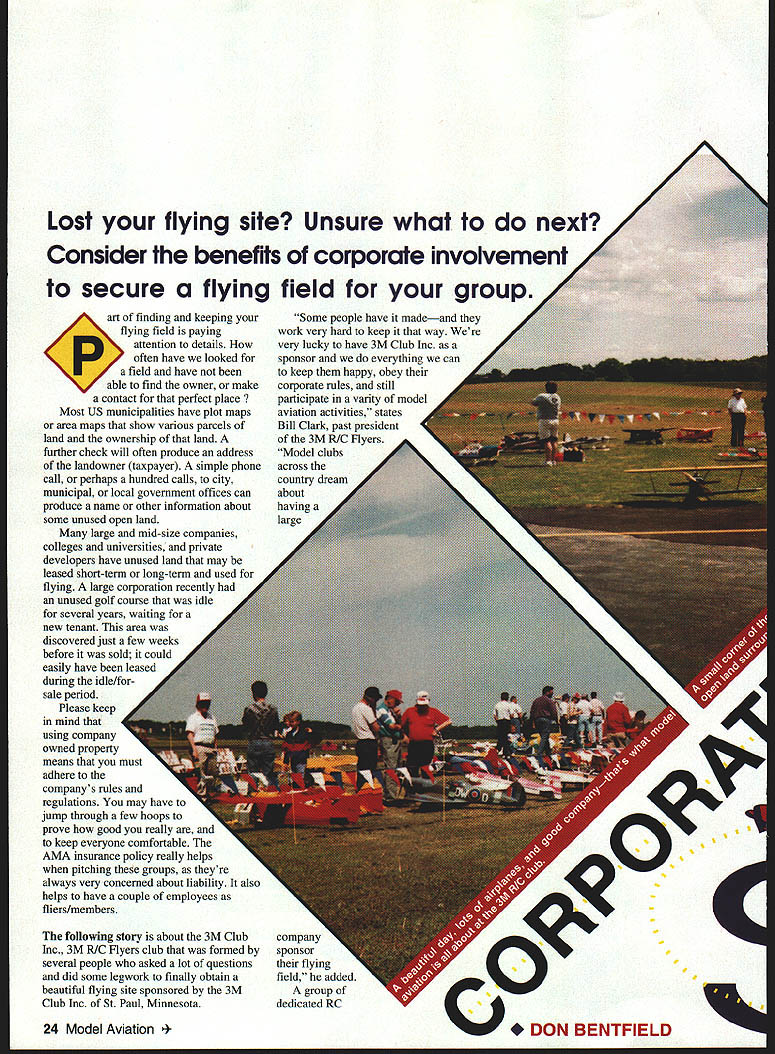
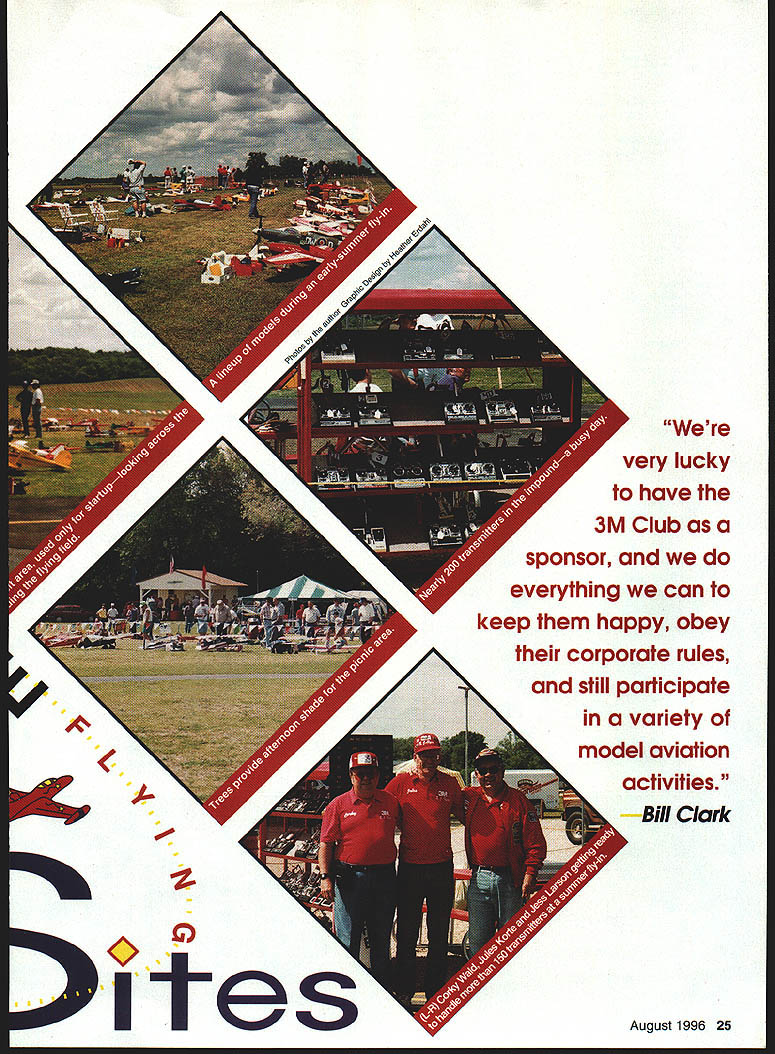
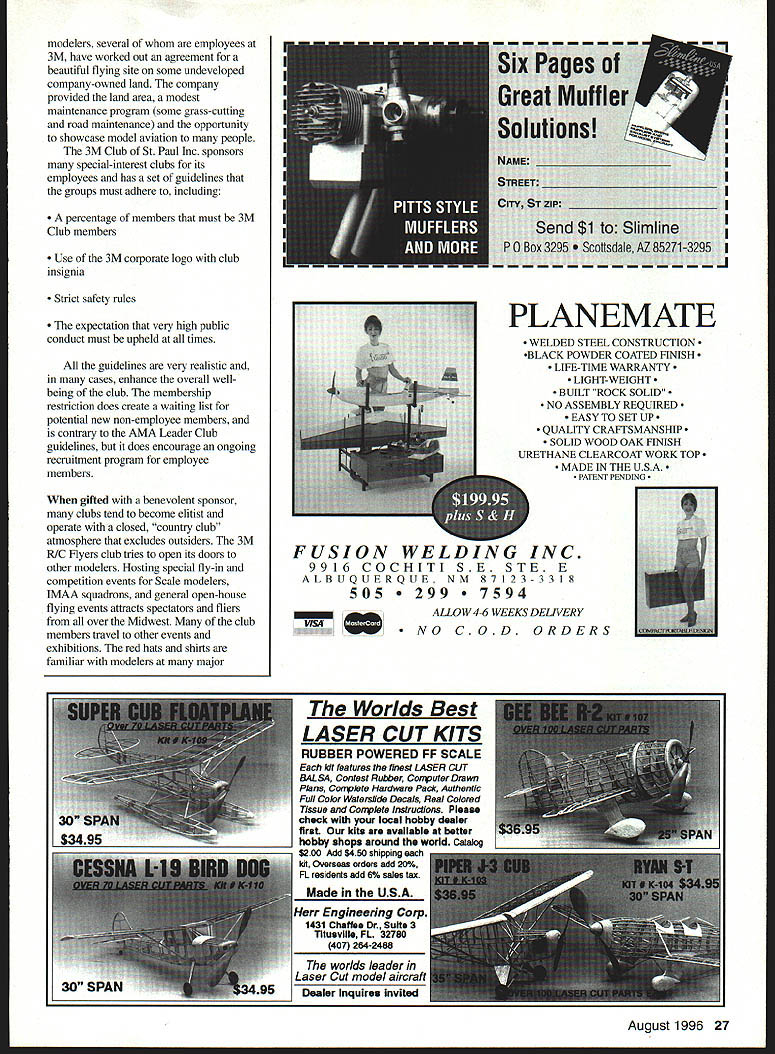
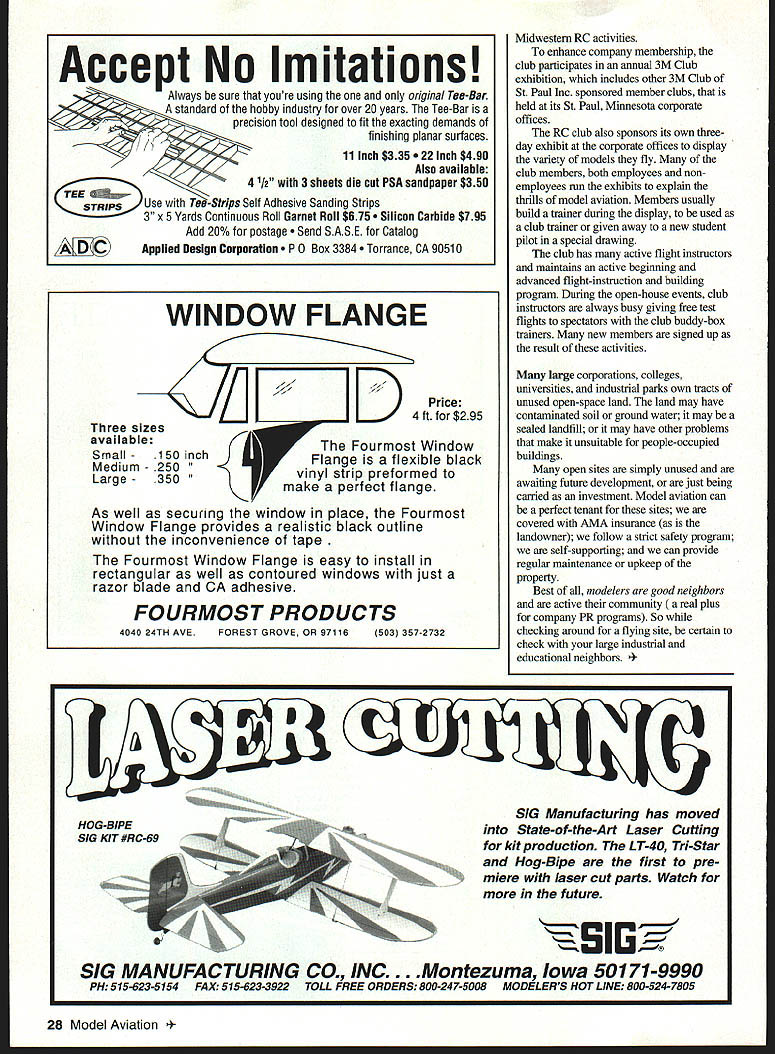
The following story is about the 3M R/C Flyers club that was formed by several people who asked a lot of questions and did some legwork to finally obtain a beautiful flying site sponsored by the 3M Club Inc. of St. Paul, Minnesota.
"Some people have it made—and they work very hard to keep it that way. We're very lucky to have 3M Club Inc. as a sponsor and we do everything we can to keep them happy, obey their corporate rules, and still participate in a variety of model aviation activities," states Bill Clark, past president of the 3M R/C Flyers.
"Model clubs across the country dream about having a large company sponsor their flying field," he added.
A group of dedicated RC modelers, including several 3M employees, worked out an agreement to use a beautiful flying site on some undeveloped company-owned land. The company provided the land and a modest maintenance program—some grass cutting and road maintenance—and the opportunity to showcase model aviation to company employees.
The 3M Club St. Paul Inc. sponsors special-interest clubs for its employees and has set guidelines that groups must adhere to, including that a percentage of members must be 3M Club members. Use of the 3M corporate logo and club insignia is controlled. Strict safety rules and a very high expectation of public conduct must be upheld at all times. These guidelines are realistic and, in many cases, enhance the overall well-being of the club.
The membership restriction does create a waiting list for potential new non-employee members; contrary to AMA Leader Club guidelines, it does encourage an ongoing recruitment program. With employee members and a generous sponsor, clubs tend not to become elitist or operate as a closed, country-club atmosphere that excludes outsiders.
The 3M R/C Flyers try to open their doors to other modelers by hosting special fly-ins, competitions, scale-model and IMAA events, and general open-house flying events that attract spectators and fliers from across the Midwest. Club members also travel to other events and exhibitions; the red hats and shirts are familiar to modelers at major events.
Midwestern RC activities enhance company membership. The club participates in an annual 3M Club exhibition that includes other 3M Club St. Paul Inc.–sponsored member clubs. The RC club also sponsors its own three-day exhibit at the corporate offices to display the variety of models they fly. Many club members, both employees and non-employees, run the exhibits to explain the thrills of model aviation. Members usually build a trainer during the display to be used as a club trainer or given away to a new student pilot in a special drawing.
The club has many active flight instructors and maintains an active beginning and advanced flight-instruction and building program. During open-house events, club instructors are always busy giving free test flights to spectators with the club buddy-box trainers. Many new members are signed up as a result of these activities.
Many large corporations, colleges, universities, and industrial parks own tracts of unused open-space land. The land may be:
- contaminated soil or groundwater,
- a sealed landfill, or
- affected by other problems that make it unsuitable for people-occupied buildings.
Many open sites are simply unused and are awaiting future development, or are being carried as an investment. Model aviation can be a perfect tenant for these sites because:
- AMA insurance covers the activity (and the landowner),
- clubs follow a strict safety program,
- clubs are self-supporting,
- clubs can provide regular maintenance or upkeep of the property, and
- modelers are good neighbors and are active in their community—a real plus for company PR programs.
So while checking around for a flying site, be certain to check with your large industrial and educational neighbors.
Transcribed from original scans by AI. Minor OCR errors may remain.

