
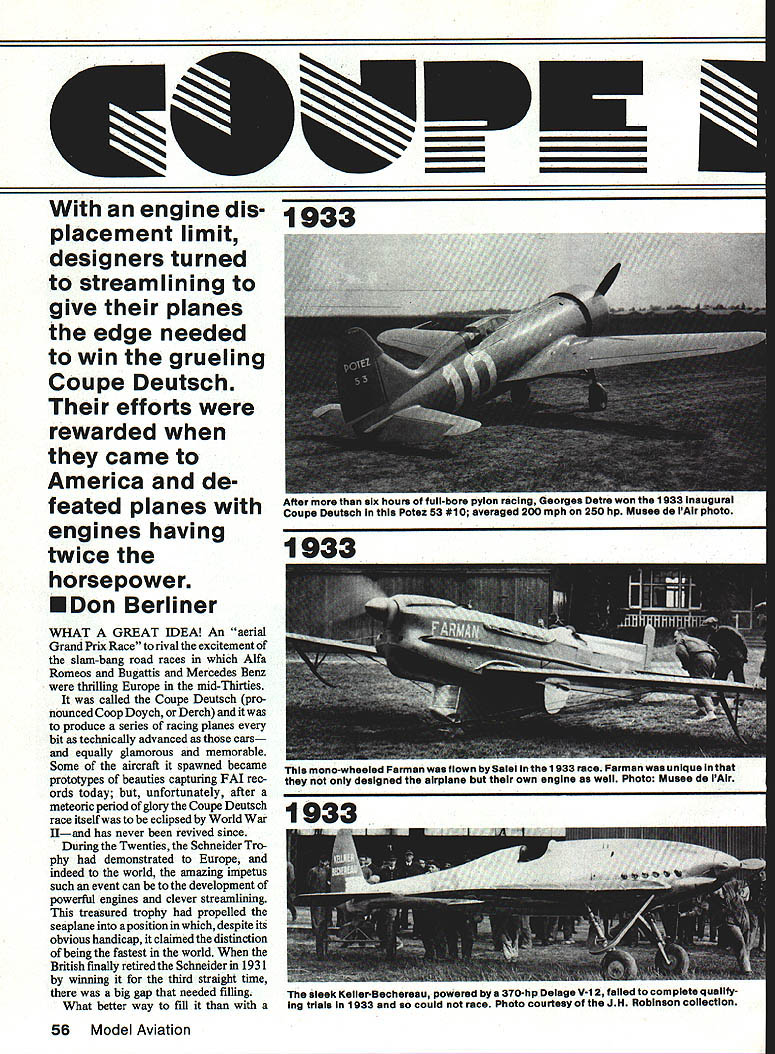
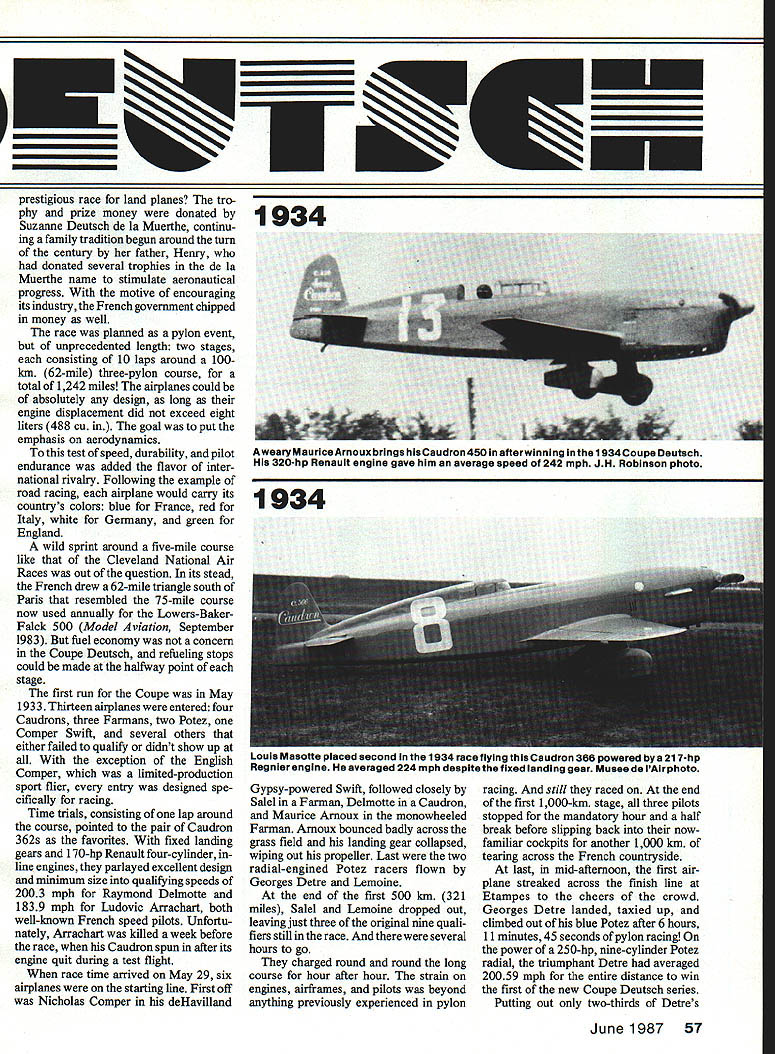
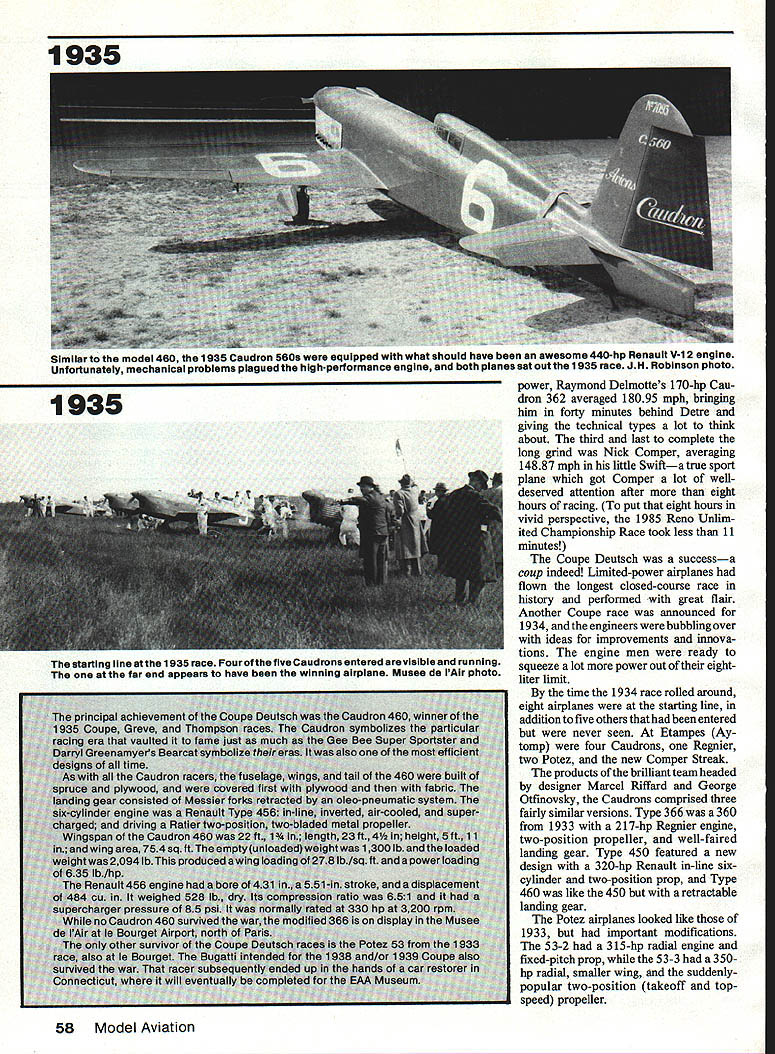
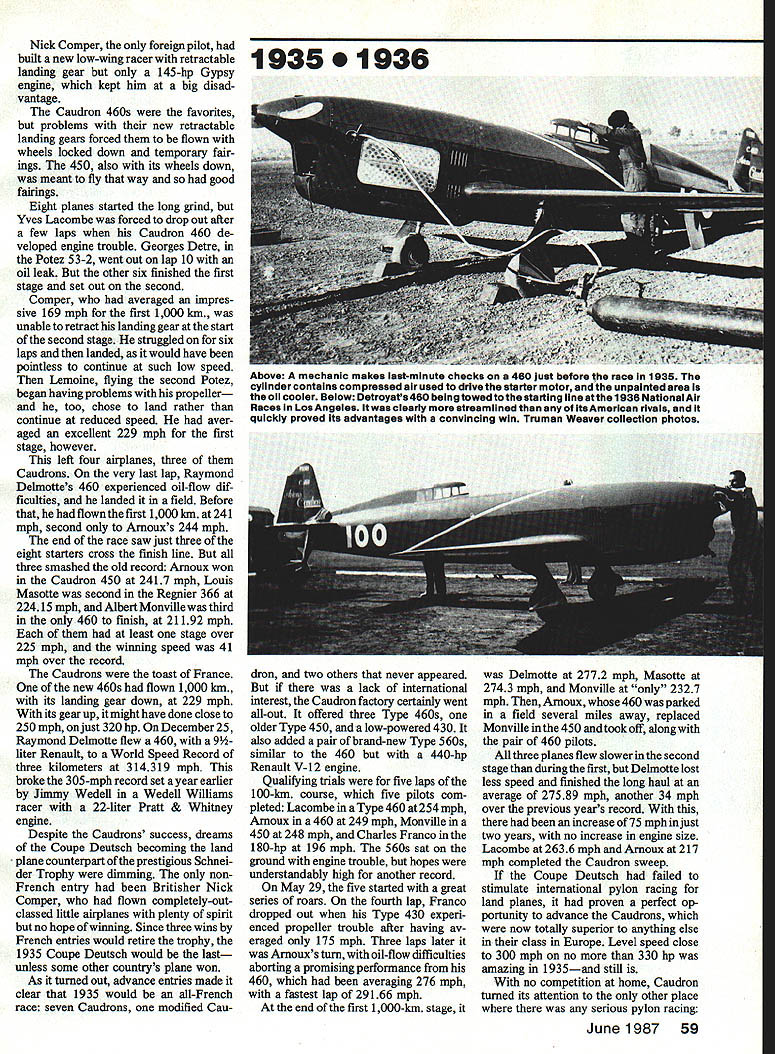
Coupe Deutsch
By Don Berliner
WHAT A GREAT IDEA! An "aerial Grand Prix Race" to rival the excitement of the slam‑bang road races in which Alfa Romeos, Bugattis, and Mercedes‑Benz were thrilling Europe in the mid‑Thirties.
Pronounced "Coop Doych" (or "Derch"), the Coupe Deutsch was intended to produce a series of racing planes every bit as technically advanced, glamorous, and memorable as the era's grand prix cars. Some of the aircraft it spawned became prototypes of beauties that still capture FAI records today. Unfortunately, after a meteoric period of glory the Coupe Deutsch itself was eclipsed by World War II and has never been revived.
Origins
During the 1920s the Schneider Trophy had demonstrated how a single prestigious competition could drive development of powerful engines and clever streamlining. When the British finally retired the Schneider in 1931 by winning it for the third straight time, there was a vacuum to fill. Suzanne Deutsch de la Meurthe donated a trophy and prize money to stimulate aeronautical progress in the same family tradition as her father Henry, and the French government added funds as well.
The Coupe Deutsch was planned as a pylon event of unprecedented length: two stages consisting of 10 laps around a 100‑km (62‑mile), three‑pylon course — a total of 2,000 km (1,242 miles). Airplanes could be designed freely so long as engine displacement did not exceed eight liters (488 cu in). The formula emphasized aerodynamics and endurance, testing speed, durability, pilot stamina, and international rivalry. Following road‑racing tradition, an airplane would carry its country's colors — blue for France, red for Italy, white for Germany, green for England. Fuel concerns allowed refueling stops at the halfway point of each stage.
1933: The First Coupe
The first Coupe ran in May 1933. Thirteen airplanes entered: four Caudrons, three Farmans, two Potez, a Comper Swift, and others that either failed to qualify or didn't show. Time trials pointed to a pair of Caudron 362s as favorites: Raymond Delmotte (200.3 mph) and Ludovic Arrachart (183.9 mph), both flying Renault‑powered Caudrons. Tragically, Arrachart was killed the week before the race when his Caudron spun after its engine quit during a test flight.
When the race began on May 29, six airplanes were on the line. Nicholas Comper started in the de Havilland Gypsy‑powered Swift, followed by Salel in a Farman and Delmotte in a Caudron. Maurice Arnoux in a mono‑wheeled Farman bounced badly on takeoff; his landing gear collapsed and the propeller was destroyed. The two radial‑engined Potez racers, flown by Georges Detré and Lemoine, survived the first 500 km (321 miles); Salel and Lemoine then dropped out, leaving just three of the original nine qualifiers.
Several hours later the survivors continued the grueling long course, straining engines, airframes, and pilots beyond anything previously seen in pylon racing. At the end of the first 1,000‑km stage three pilots stopped for the mandatory hour‑and‑a‑half break before resuming for another 1,000 km. Late in the afternoon the first airplane streaked across the finish.
At Étampes, to the cheers of the crowd, Georges Detré landed, taxied up, and climbed out of his blue Potez after 6:11:45 of pylon racing. Powered by a 250‑hp, nine‑cylinder Potez radial, Detré averaged 200.59 mph for the entire distance to win the inaugural Coupe Deutsch.
Raymond Delmotte, with only two‑thirds of Detré's power (a 170‑hp Caudron 362), averaged 180.95 mph and finished forty minutes behind—an impressive demonstration of aerodynamic efficiency. Nicholas Comper finished third, averaging 148.87 mph in his little Swift, having spent more than eight hours racing (for perspective: the 1985 Reno Unlimited Championship Race took less than 11 minutes).
The first Coupe Deutsch was a success. Limited‑power airplanes flew the longest closed‑course race in history and performed with great flair. Another Coupe was announced for 1934, and engineers were already planning improvements to squeeze more power from the eight‑liter limit.
The Caudron racers and early innovations
By 1934 Caudron, under designer Marcel Riffard and engineer George Ostinovsky, had produced a family of racers that included the Type 366, 450, and 460:
- Type 366: a 1933 360 with a 217‑hp Regnier engine, two‑position propeller, and faired fixed gear.
- Type 450: new wing with a 320‑hp Renault in‑line six and two‑position prop.
- Type 460: like the 450 but with retractable landing gear.
Potez updated its racers too: the 53‑2 had a 315‑hp radial with fixed‑pitch prop, while the 53‑3 had a 350‑hp radial, smaller wing, and the now‑popular two‑position propeller.
Caudron 460 — Design and specifications
The Caudron 460 became the principal achievement of the Coupe Deutsch era, winning the 1935 Coupe, the Greve, and the Thompson races. It was a supremely efficient design and one of the era's speed icons.
Construction and features:
- Fuselage, wings, and tail built of spruce and plywood, covered with plywood and then fabric.
- Landing gear: Messier forks retracted by an oleo‑pneumatic system.
- Engine: Renault Type 456 — in‑line, inverted, air‑cooled, supercharged six‑cylinder driving a Ratier two‑position, two‑bladed metal propeller.
Dimensions and weights:
- Wingspan: 22 ft. 1 in.
- Length: 23 ft. 4½ in.
- Height: 5 ft. 11 in.
- Wing area: 75.4 sq. ft.
- Empty weight: 1,300 lb.
- Loaded weight: 2,094 lb.
- Wing loading: 27.8 lb./sq. ft.
- Power loading: 6.35 lb./hp.
Renault 456 engine (nominal):
- Bore: 4.31 in.; Stroke: 5.51 in.; Displacement: 484 cu. in.
- Dry weight: 528 lb.
- Compression ratio: 6.5:1
- Supercharger pressure: 8.5 psi
- Rated power: 330 hp at 3,200 rpm.
No Caudron 460 survived World War II, but a modified Type 366 is on display at the Musée de l'Air at Le Bourget. The Potez 53 from the 1933 race also survives at Le Bourget. The Bugatti racer intended for 1938/39 survived the war and later was in the hands of a restorer in Connecticut for eventual completion for the EAA Museum.
1934–1936
1934
By 1934 eight airplanes were at the starting line: four Caudrons, one Regnier, two Potez, and the new Comper Streak. The Caudrons continued to dominate development under Riffard and Ostinovsky.
1935
The 1935 race underscored Caudron dominance. Nick Comper, the only foreign pilot, had built a new low‑wing racer with retractable gear but only a 145‑hp Gypsy engine, leaving him at a severe disadvantage.
Caudron 460s were favorites, but problems with their new retractable landing gear forced them to fly with wheels locked down and temporary fairings. The Type 450 intended to fly with wheels down and had good fairings.
Eight planes started; Yves Lacombe dropped out after a few laps with engine trouble in his 460, and Georges Detré retired on lap 10 with an oil leak. Comper averaged an impressive 169 mph for the first 1,000 km but was unable to retract his gear at the start of the second stage and retired after six laps. Lemoine, flying the second Potez, had propeller trouble and landed; he had averaged 229 mph for the first stage.
Three Caudrons and one other continued. On the last lap Raymond Delmotte's 460 suffered oil‑flow problems and he landed in a field after recording the first 1,000 km at 241 mph (second only to Arnoux's 244 mph). Only three of the eight starters crossed the finish line, but all three smashed the old record:
- Maurice Arnoux won in a Caudron 450 at 241.7 mph.
- Louis Masotte was second in a Regnier 366 at 224.15 mph.
- Albert Monville was third in the only 460 to finish, at 211.92 mph.
One Caudron 460 had flown 1,000 km with its gear down at 229 mph; with gear up it might have approached 250 mph on just 320 hp. On December 25 Raymond Delmotte flew a 460 with a 9½‑liter Renault to a three‑kilometer world speed record of 314.19 mph, breaking the 305‑mph mark set the previous year by Jimmy Wedell.
1936: America and the National Air Races
With little foreign competition at home, Caudron turned to the United States and the National Air Races. Michel Detroyat's eight‑liter Caudron 460 defeated America's best at Los Angeles in 1936. He won the Greve Race at 247 mph and then challenged the Thompson Trophy machines—some with up to twice the horsepower—breaking the Thompson record with 264 mph on a short course. For the first (and last) time the Thompson Trophy left the U.S.A.
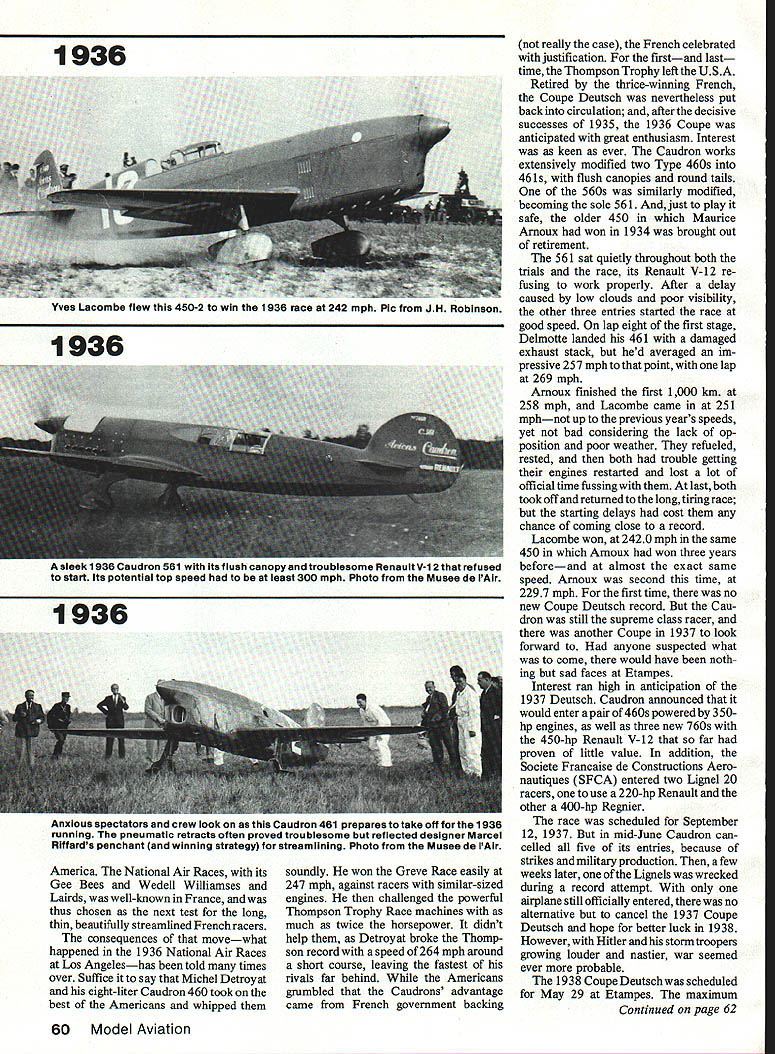
Buoyed by 1935–36 successes, Caudron modified two Type 460s into 461s with flush canopies and round tails; one Type 560 became the sole 561. The 450 in which Arnoux had won earlier was returned to service. Rainy weather, mechanical problems, and visibility delays affected the 1936 Coupe: one 561 sat idle with V‑12 troubles, and Delmotte landed with a damaged exhaust stack after averaging 257 mph to that point. Delmotte finished with an average of 275.89 mph, Lacombe at 263.6 mph, and Arnoux at 217 mph. Lacombe won the event at 242.0 mph (in the same 450 Arnoux had won in earlier years). For the first time there was no new Coupe Deutsch record, but the Caudron remained the supreme class racer.
1937–1939: Decline and cancellation
Interest ran high for 1937. Caudron planned a pair of 460s with 350‑hp engines and three new 560s with 450‑hp Renault V‑12s. The Société Française de Constructions Aéronautiques (SFCA) entered two Lignel 20 racers (220‑hp Renault and 400‑hp Regnier variants). The race was scheduled for September 12, 1937, but Caudron cancelled all five of its entries in mid‑June because of strikes and military production. A Lignel wrecked during a record attempt; with only one official entry left, the 1937 Coupe Deutsch was cancelled.
Although the French planned a 1938 race, political tensions mounted. The 1938 Coupe Deutsch was scheduled for May 29 at Étampes with piston displacement lowered from eight liters (488 cu in) to 6.5 liters (397 cu in). Qualifying criteria were a 500‑km run at a minimum of 350 km/hr (218 mph) and takeoff/landing in less than 1,640 ft over a three‑foot barrier.
Caudron had shifted priorities toward military conversions, but other entries appeared:
- SFCA: two Lignel 30s (280 hp Regnier inverted in‑line fours), one fixed gear and one retractable.
- Bugatti: two radical designs by Louis de Monge using 3.2‑liter Bugatti car engines positioned behind the pilot, driving counter‑rotating propellers via shafts along the cockpit sides. These racers featured flush canopies, Y‑tails, reverse‑flow cooling, and very small wing areas (64.5 sq. ft. and 43 sq. ft.). With at least 500 hp and minimal drag, they might have reached ~300 mph.
Strikes at the Regnier factory prevented delivery of the Lignels and the Bugattis were far from complete, so the 1938 Coupe was cancelled.
Despite plans for a 1939 race on October 1, war loomed. By July 12, 1939 nine racers had been proposed in various stages of design or as projects:
- Three Mistral 30s powered by the new Chaumont‑Béarn 12‑cylinder opposed engine (nominally 450 hp) — models only, not full size.
- Two CAPRA firm designs (successor to Ateliers Bernard).
- One unspecified Bugatti project.
- A Regnier V‑12 design (380 hp).
- A Max Holste 20.
- A Payen Flechair (a futuristic delta‑wing concept, possibly with small tandem engines driving counter‑rotating propellers).
The 1939 Coupe Deutsch was scheduled for October 1, but World War II intervened. With the German invasion of Poland on September 1, 1939, the race was cancelled—and though some projects continued in sketch or model form, only the Payen is thought to have been built.
Legacy and what might have been
The Coupe Deutsch began as the intended land‑plane counterpart to the Schneider Trophy and became the stage for some truly memorable Caudron racers. Had Caudron faced serious competition from foreign builders or other French firms, the Coupe might have achieved the intended international stature.
Maurice Arnoux's 100‑km FAI record lap of 291.66 mph in 1935 remains a striking measure of the Caudrons' speed. For comparison, the FAI world record for a similar weight class over 100 km is 271.13 mph, set by Robert Thalman in the 300‑hp Swearingen SX‑300 at Fond du Lac, WI, in 1984. Because record classes differ slightly, both Arnoux's and Thalman's records stand.
The Coupe Deutsch formula was excellent and could be resurrected today. Modern engines such as Lycoming's 200‑hp O‑360 fit the 6.5‑liter limit, and Continental's O‑470 or Lycoming's O‑480 fit the eight‑liter limit. Any of these engines in a modern, composite, highly streamlined airframe should easily surpass the Coupe Deutsch records and could launch a very interesting new era—if anyone chose to try.
But that is perhaps foolish dreaming.
Transcribed from original scans by AI. Minor OCR errors may remain.

