
Covering with Silk
Clarence Haught
Silk is the original high-strength covering material, and it remains cherished by modelers who learn a few simple techniques. Follow these tips and you should succeed on your first try.
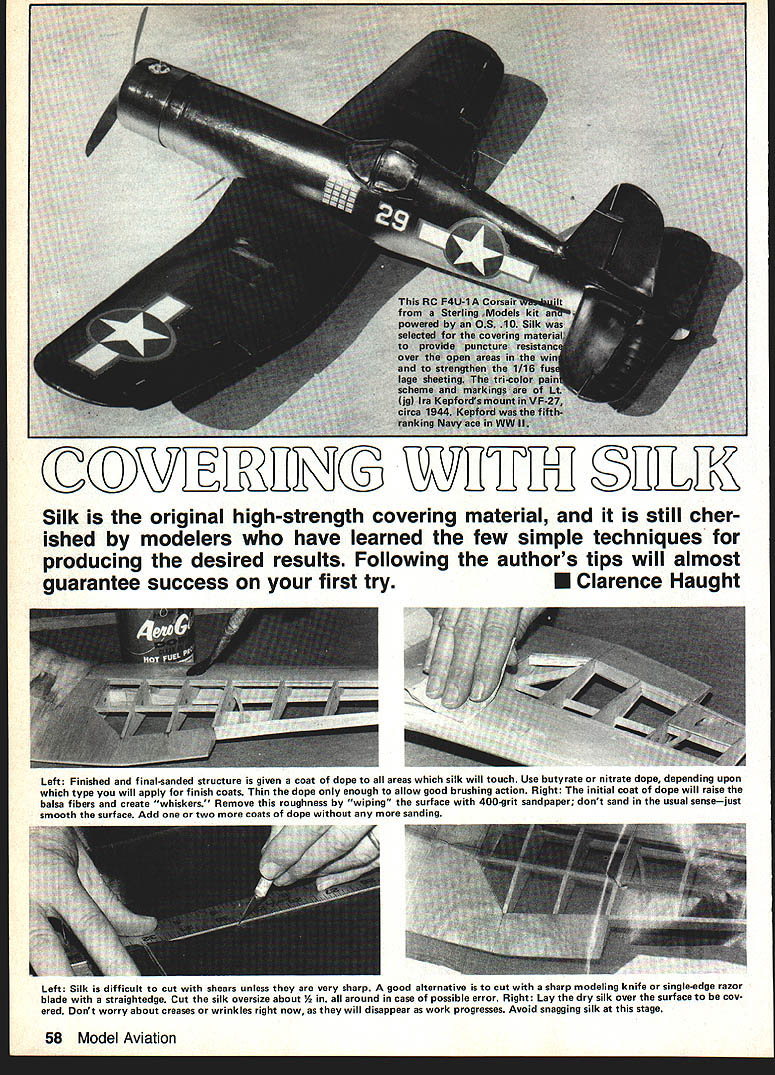
Who can ignore the beauty of bright sunlight shining through colored silk covering as a model sails overhead? Nothing matches the splendor of silk. Colored silkspan, Japanese tissue, and transparent plastics all have their charm, but silk is queen. As the first durable covering material, silk has endured where many substitutes have not. Weight for weight, it provides high strength, adds torsional rigidity, is easy to repair, and has long life.
Available in many colors, silk needs only a clear dope finish to provide a lightweight, attractive covering. Trim can be added as painted stripes or by applying carefully cut pieces of Japanese tissue during finishing.
Why some modelers shy away from silk
Many modelers' early experiences with silk are unpleasant because of a few common mistakes. Typical problems include:
- Silk full of creases and hard to cut.
- Fibers snagging on rough hands or scissors.
- Poor adhesion to balsa with dope.
- Uneven shrinking when sprayed with water.
- Dope running through fabric and producing blisters on the back side.
- Long sealing time due to multiple coats of dope.
You need not suffer these frustrations — learn a couple of simple techniques and the covering job will be satisfying and enjoyable.
Two basic rules
- Work silk when it is wet.
- Apply the first coat of dope with a foam brush.
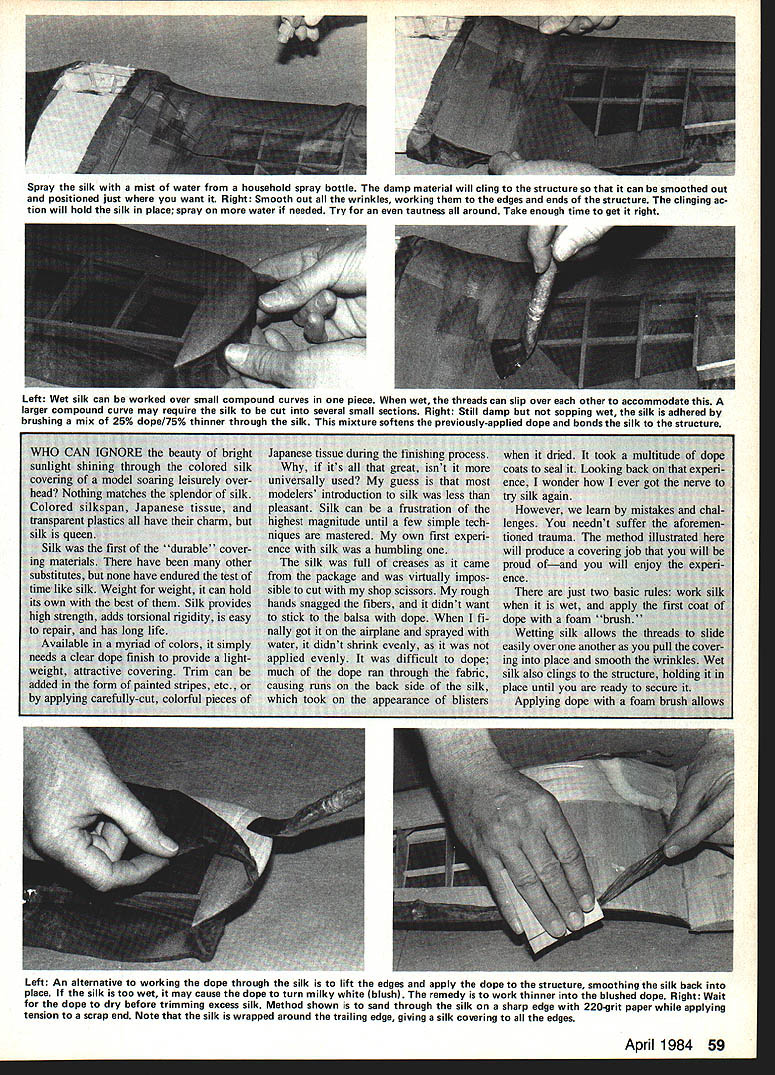
Wetting silk allows the threads to slide over one another as you pull the covering into place, helping to smooth wrinkles. Wet silk clings to the structure until you secure it. Applying the first coat of dope with a foam brush lets the dope be brushed through the silk into the wood without dragging the fabric and creating blisters. After the initial coat you may return to a conventional bristle brush for subsequent coats.
Materials and tools
- Colored silk (silkspan)
- Japanese tissue for trim
- Tracing paper (for sandwiching tissue when cutting)
- Spray bottle with water
- Disposable foam brush (for first coat)
- Bristle brush (for later coats)
- Model dope (nitrate or butyrate)
- Thinner and/or lacquer thinner (blush retardant)
- Razor blade or sharp scissors/knife for trimming
- Flood lamp or hair dryer (optional for speeding drying)
Preparation
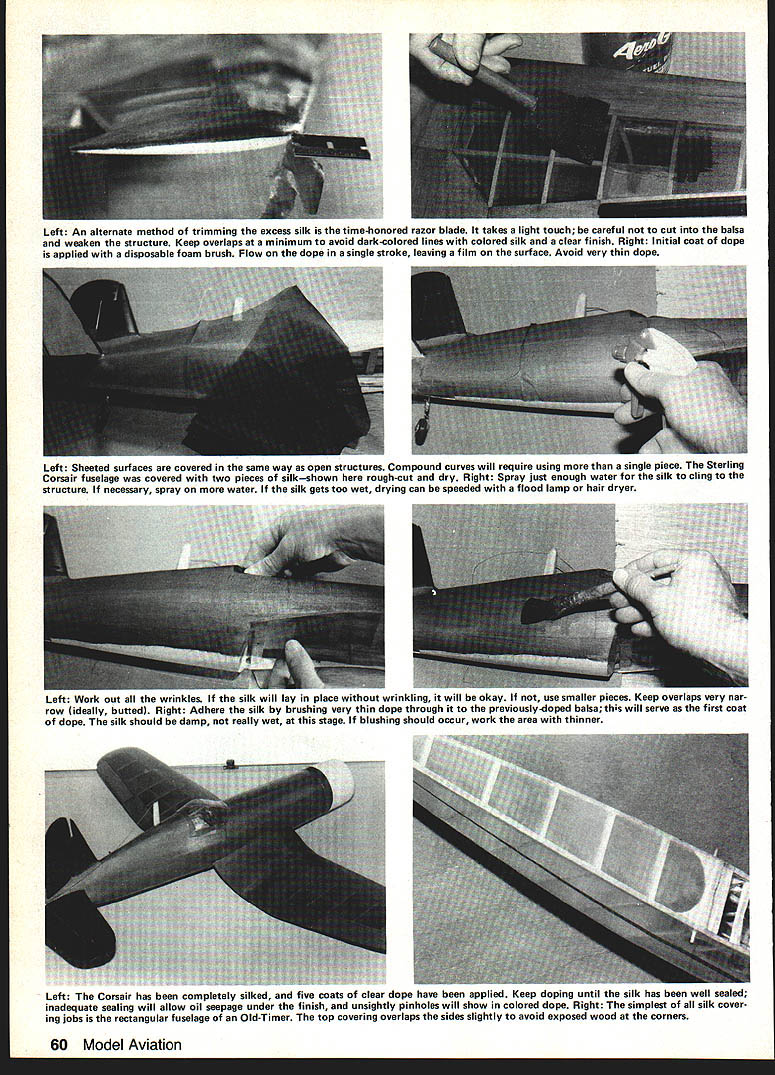
- Begin with the silk roughly cut to shape. For compound curves (e.g., fuselages) you will likely need more than one piece.
- If the silk is creased in the package, dampen it to help smooth the wrinkles before fitting.
- Keep overlaps very narrow — ideally butted — to avoid dark-colored lines showing under a clear finish.
Step-by-step covering procedure
- Lay the silk over the structure dry to determine fit and to locate wrinkles. If a piece will not lay without excessive wrinkling, use smaller pieces.
- Spray just enough water so the silk clings to the structure. The silk should be damp, not dripping. If it becomes too wet, speed drying with a flood lamp or hair dryer can help.
- Work out wrinkles while the silk is wet. Threads can slide and lay smoothly when damp.
- Adhere the silk by brushing very thin dope through it with a disposable foam brush, working in a single stroke so you "lay on" a film instead of dragging the dope. Avoid very thin dope that won't seal.
- Enough dope will penetrate the silk to gain a sufficient bond; do not overwork the fabric.
- After the initial coat, allow drying and then continue with additional coats using a bristle brush. Keep applying coats until the silk is well sealed — inadequate sealing allows oil seepage and results in pinholes with colored dope.
- Sheeted surfaces are covered the same way as open structures. Compound curves may require multiple silk pieces joined with narrow overlaps.
Trimming and decorative details
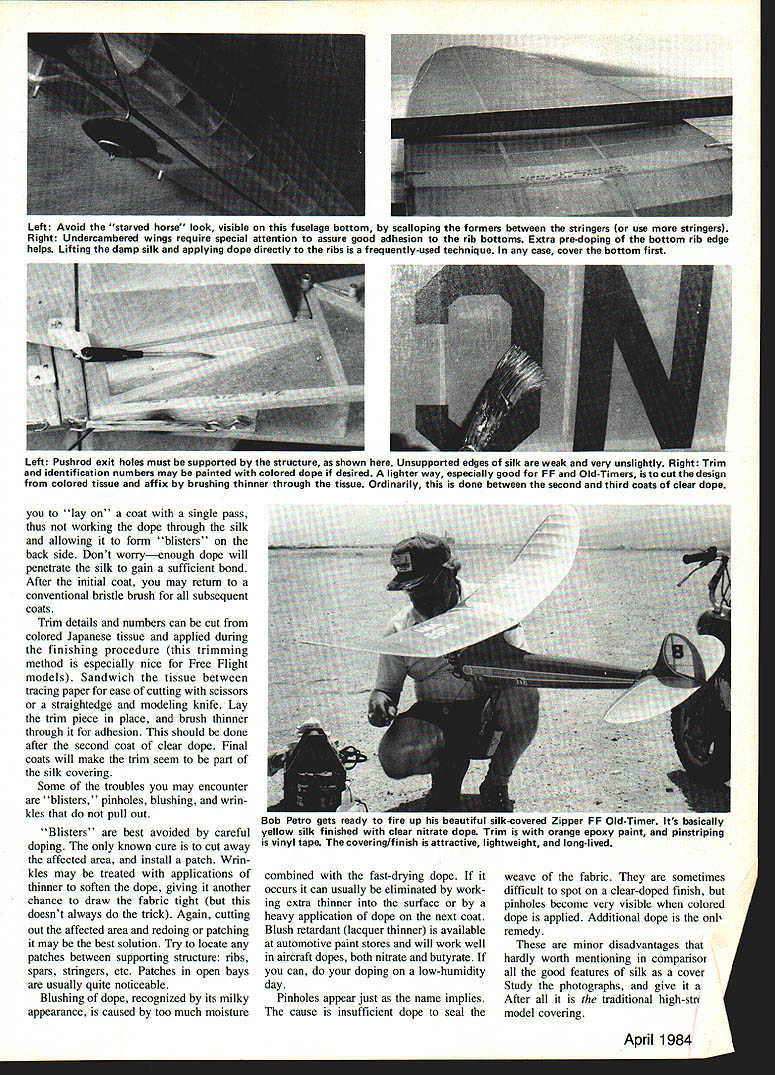
- Trim details and numbers can be cut from colored Japanese tissue and applied during finishing. This is especially nice for Free Flight models.
- Sandwich the tissue between tracing paper to ease cutting with scissors, a straightedge, or a modeling knife.
- Lay the trim piece in place after the second coat of clear dope, and brush thinner through it to adhere. Final coats will make the trim appear integral to the silk covering.
- An alternate method of trimming excess silk is the razor blade. It takes a light touch — be careful not to cut into the balsa and weaken the structure.
Common problems and remedies
- Blisters: Usually caused by improper doping. The only reliable cure is to cut away the affected area and install a patch. Try to locate patches between supporting structure (ribs, spars, stringers) to hide them. Patches in open bays are often noticeable.
- Wrinkles that won't pull out: Apply thinner to soften the dope and give it another chance to draw the fabric tight. If that fails, cut out and redo or patch the area.
- Blushing: Recognized by a milky appearance, blushing is caused by too much moisture combined with fast-drying dope. Remedies include working extra thinner into the surface or applying a heavy coat of dope next time. Blush retardant (lacquer thinner) is available at automotive paint stores and works with both nitrate and butyrate dopes. Do your doping on a low-humidity day if possible.
- Pinholes: Caused by insufficient dope to seal the weave. They can be hard to spot on clear finishes but become obvious with colored dope. The only remedy is additional dope.
Final notes
- Keep overlaps at a minimum to avoid visible lines with colored silk and a clear finish.
- The simplest silk covering jobs are rectangular fuselages where the top slightly overlaps the sides to avoid exposed wood at corners.
- Practice the wet-fitting and foam-brush first-coat method; it will greatly reduce common problems and make silk a pleasure to work with.
These are minor disadvantages compared with all the good features of silk as a cover. Study these methods, give silk a try, and enjoy the traditional high-strength model covering.
Transcribed from original scans by AI. Minor OCR errors may remain.

