
Cranfield
It's a familiar-looking place with an unfamiliar feeling. Or maybe it's an unfamiliar-looking place with a familiar feeling. Either way, it's neither an unpleasant feeling nor an unfriendly place. Rather, it's like something you've seen before that's been transported to a new setting.
The PFA International Rally
Called a "rally" in British nomenclature, the PFA International Rally (Popular Flying Association) held annually at Cranfield Aerodrome near London is the British answer to Oshkosh. The PFA rally is, quite simply, the biggest fly-in in England and is second only in international importance to the Experimental Aircraft Association's folk festival at Oshkosh. In fact, as a few years older, the PFA is almost a smaller version of the U.S. EAA.
Despite the name, this rally is not a contest; you won't find navigation or on-time scoring. What you see instead is a throng of brightly colored aeroplanes (the British pronunciation of "airplanes") parked in long rows, visitors talking about building and rebuilding airplanes, taking pictures, and buying souvenirs — in short, much like Oshkosh.
The Aerodrome
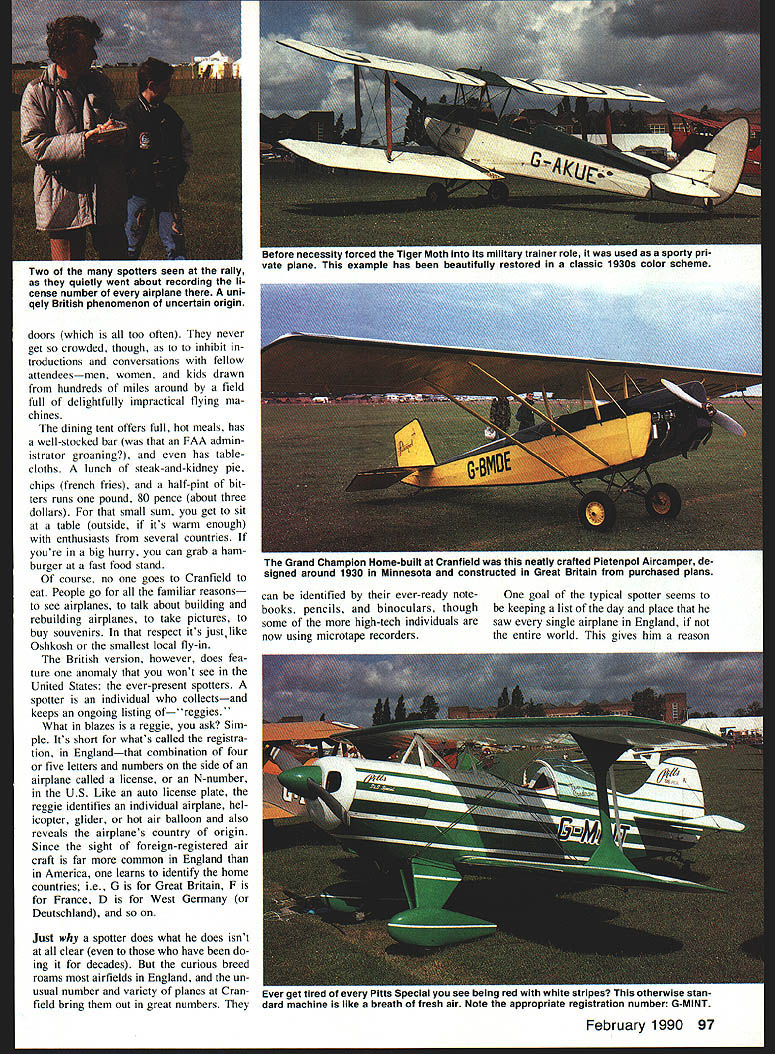
Cranfield Aerodrome is a well-equipped airport in the center of England. Though called an "aerodrome" (which can imply an old-fashioned grass field), Cranfield has modern facilities, including two 6,000 ft hard-surfaced runways. Its central location in a compact country makes it convenient for attendees from many regions.
Tents and Amenities
- Two large marquees (tents) dominate the non-flying activities:
- One houses commercial and noncommercial displays — avionics, instruments, association memberships (for example, the International Auster Pilot Club).
- The other serves as the dining hall.
- Smaller tents and stalls sell books, photographs, models, badges, patches, decals, and other memorabilia.
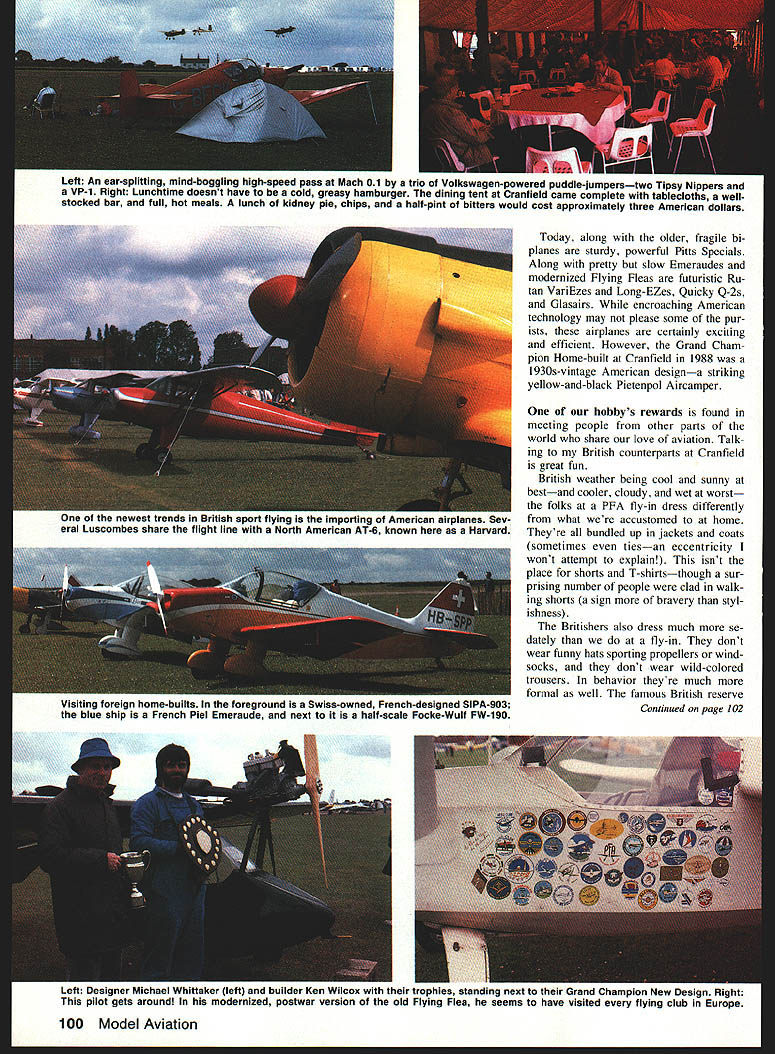
- The dining tent offers full hot meals, a well-stocked bar, and table service. A sample lunch in the era described: steak-and-kidney pie, chips (French fries), and a half-pint of bitters for about £1.80 (roughly three dollars). Fast-food stands also serve hamburgers for those in a hurry.
- Tents usually stay busy, especially when rain chases everyone indoors, but they rarely get crowded enough to inhibit conversations and introductions.
Spotters
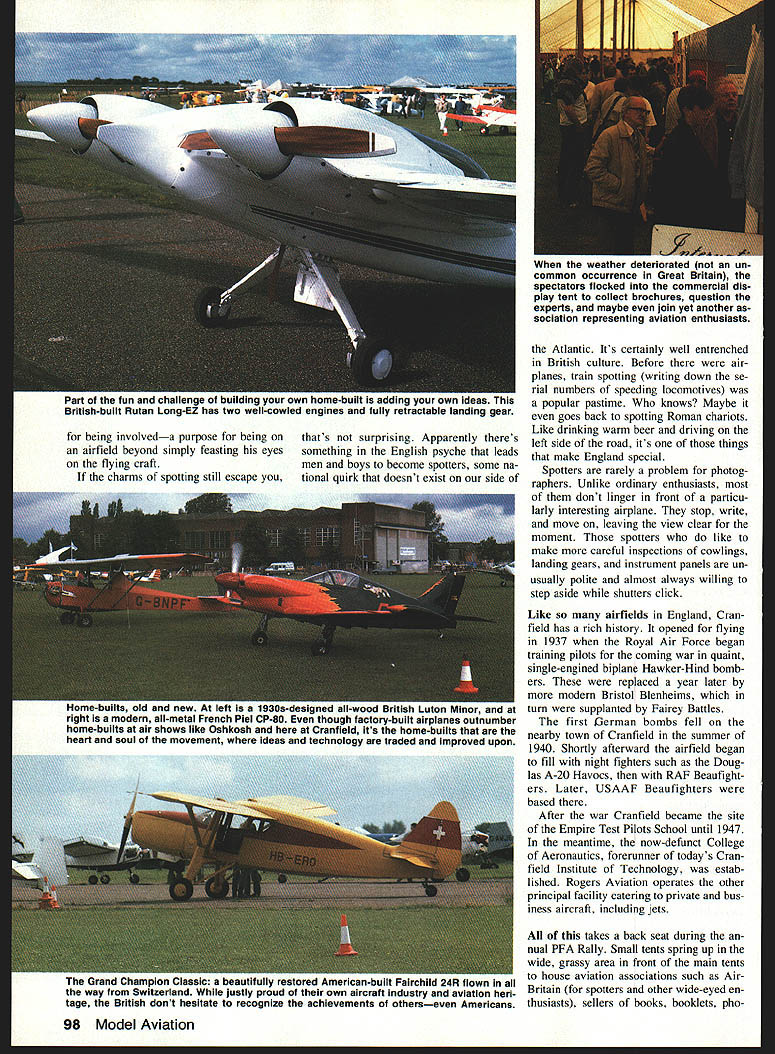
One distinctive British phenomenon at airfields is the spotter. Spotters keep ongoing lists called "reggies" — short for registration. A reggie is the combination of letters and numbers on the side of an aeroplane (equivalent to a U.S. N-number), and it identifies the aircraft and its country of origin (for example: G = Great Britain, F = France, D = West Germany/Deutschland).
- Spotters roam airfields with notebooks, pencils, binoculars, or micro-tape recorders.
- Their goal is often to record the day and place they saw a particular airplane, giving them a purpose beyond simply admiring the aircraft.
- Spotters are usually unobtrusive: they stop, write, and move on, rarely blocking photographers. Those who inspect details closely are typically polite and willing to step aside.
If spotting still seems odd, consider that it fits a long British tradition of recording serial numbers — train spotting being a notable predecessor.
Aircraft on Display
Cranfield brings together a wide variety of aircraft. Major groupings include:
- Ordinary "spam-cans":
- Everyday general aviation types used for traveling and transport (e.g., Cessnas, Pipers). Though common now, some may become classics in the future.
- Vintage and classic aircraft:
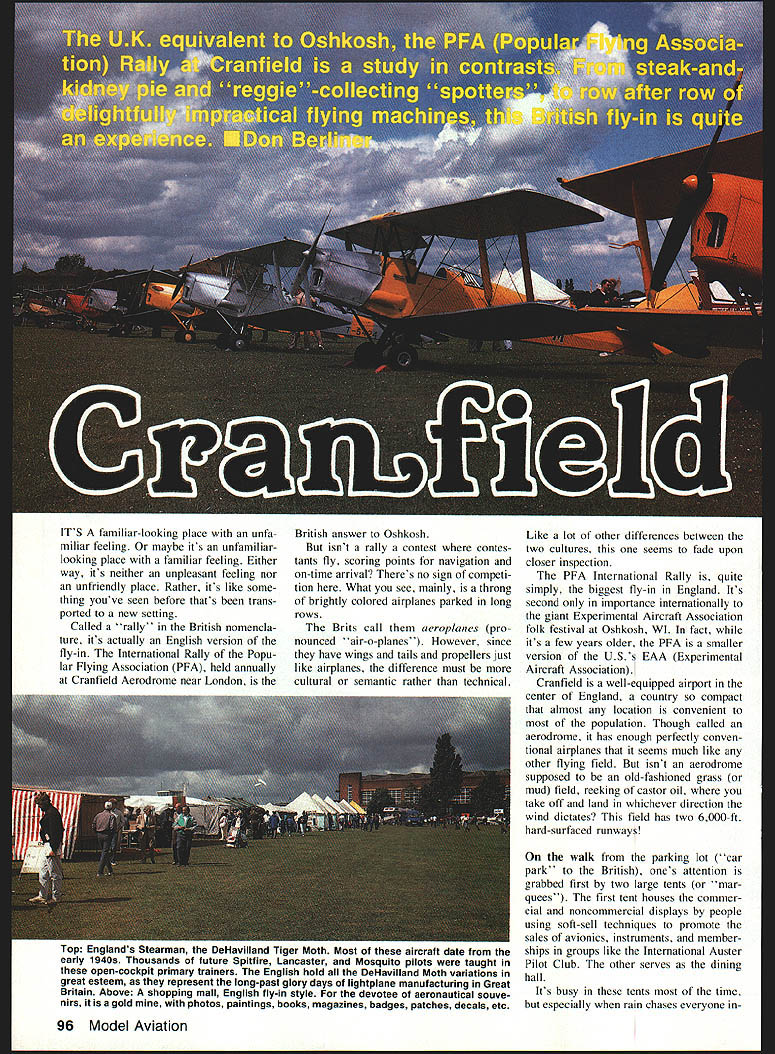
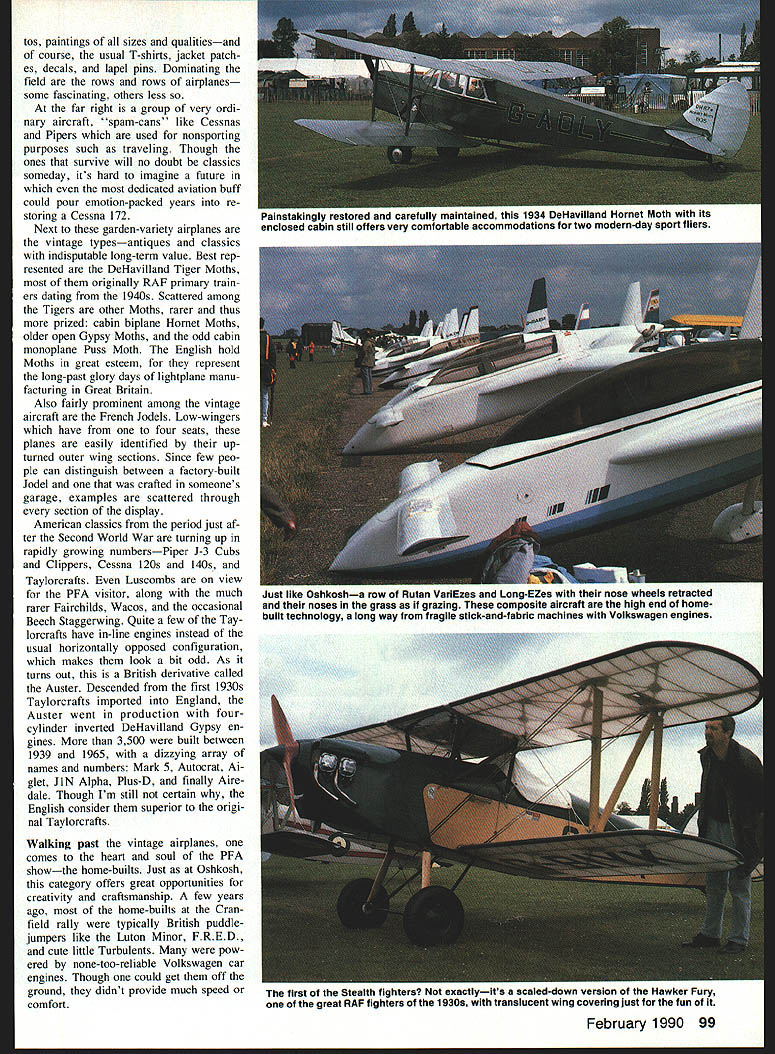
- De Havilland Tiger Moths (most were RAF primary trainers from the 1940s).
- Other Moths: Hornet Moths (cabin biplanes), Gypsy Moths (open), Puss Moths (cabin monoplanes).
- French Jodels (low-wingers with upturned outer wing sections), found both factory-built and homebuilt.
- American post‑WWII classics:
- Piper J‑3 Cubs and Clippers, Cessna 120s and 140s, Taylorcrafts, Luscombes, Fairchilds, Wacos, occasional Beech Staggerwings.
- Many Taylorcrafts in Britain evolved into the Auster family (four-cylinder inverted De Havilland Gipsy engines), produced in many variants (e.g., Mark 5, Autocrat, Aiglet, J/1N Alpha, Plus‑D, Airedale).
- Home-builts and modern sport aircraft:
- Traditional British homebuilts (Luton Minor, F.R.E.D., Turbulents) alongside newer, more powerful types.
- Sturdy biplanes like Pitts Specials.
- Recreational and experimental designs: Emeraudes, modernized Flying Fleas, Rutan VariEze and Long-EZ, Quickie Q‑2s, Glasairs.
- The 1988 Grand Champion home-built at Cranfield was a 1930s American Pietenpol Aircamper (yellow-and-black).
Home-built aircraft showcase creativity and craftsmanship — a central attraction much like at Oshkosh.
History of Cranfield
- Cranfield opened for flying in 1937 when the Royal Air Force began training pilots in Hawker Hind biplanes.
- It later hosted Bristol Blenheims, Fairey Battles, and, during WWII, night fighters such as Douglas A-20 Havocs and RAF Beaufighters. USAAF Beaufighters were also based there.
- After the war, Cranfield became the site of the Empire Test Pilots' School until 1947.
- The College of Aeronautics (forerunner to today's Cranfield Institute of Technology) was established nearby.
- Rogers Aviation operates another principal facility at Cranfield, catering to private and business aircraft, including jets.
Visitors and Culture
- British weather at PFA events is typically cool and can be wet, so attendees dress accordingly: jackets, coats, and occasionally ties. Shorts and T-shirts are less common, though some wear walking shorts.
- British attendees tend to dress and behave more sedately and reservedly than Americans. They may not initiate casual conversations as readily, so visitors should be prepared to break the ice.
- Because Great Britain has far fewer aircraft overall than the United States, the emphasis at PFA rallies is on the importance and individuality of each aeroplane rather than sheer numbers.
Size and Scale
- Recent PFA Rallies attract around a thousand airplanes (weather permitting), roughly comparable to 1960s U.S. fly-ins prior to Oshkosh's enormous growth.
- This size allows visitors to see and study many aircraft and to talk with owners and builders — a manageable and often more rewarding scale than events with tens of thousands of aircraft.
Travel and Contact Information
- For more information, write to:
- Popular Flying Association
- Terminal Building
- Shoreham Airport
- Shoreham‑by‑Sea, Sussex BN4 5FF, England
- Telephone: 0273‑461616
- Directions from London:
- Take the M1 motorway to junction 13.
- Turn left; go two miles to Salford.
- Turn right; go 2½ miles to Cranfield.
Conclusion
Scale modelers and casual enthusiasts alike will find Cranfield rewarding. Whether you enjoy the sights and sounds of an airfield full of flying machines, the craftsmanship of home-builts, the charm of vintage types, or cultural differences in how the English "do it," a PFA Rally at Cranfield is well worth a visit. Why not go see for yourself how the English do it?
Transcribed from original scans by AI. Minor OCR errors may remain.

