
Curtiss Goshawk
By John R. Walker
Peanut Scale models on the order of the Fike may be unbeatable for flight duration, but they aren't half as much fun as flying a plane with "character." The Goshawk has plenty of that... and it's fun!
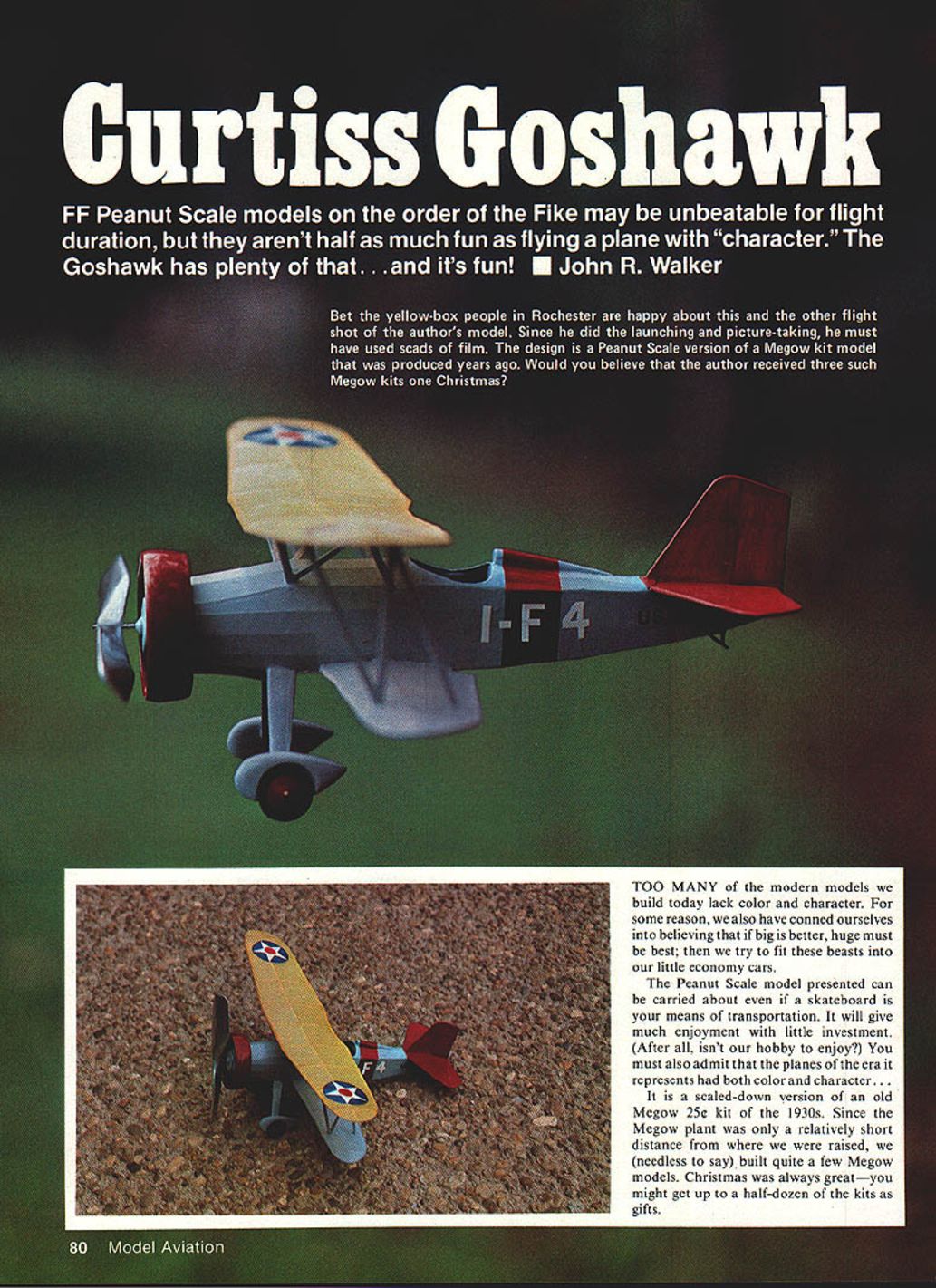
Bet the yellow-box people in Rochester are happy about this and the other flight shot of the author's model. Since he did the launching and picture-taking, he must have used scads of film. The design is a Peanut Scale version of a Megow kit model that was produced years ago. Would you believe that the author received three such Megow kits one Christmas?
Too many of the modern models we build today lack color and character. For some reason, we also have conned ourselves into believing that if big is better, huge must be best; then we try to fit these beasts into our little economy cars.
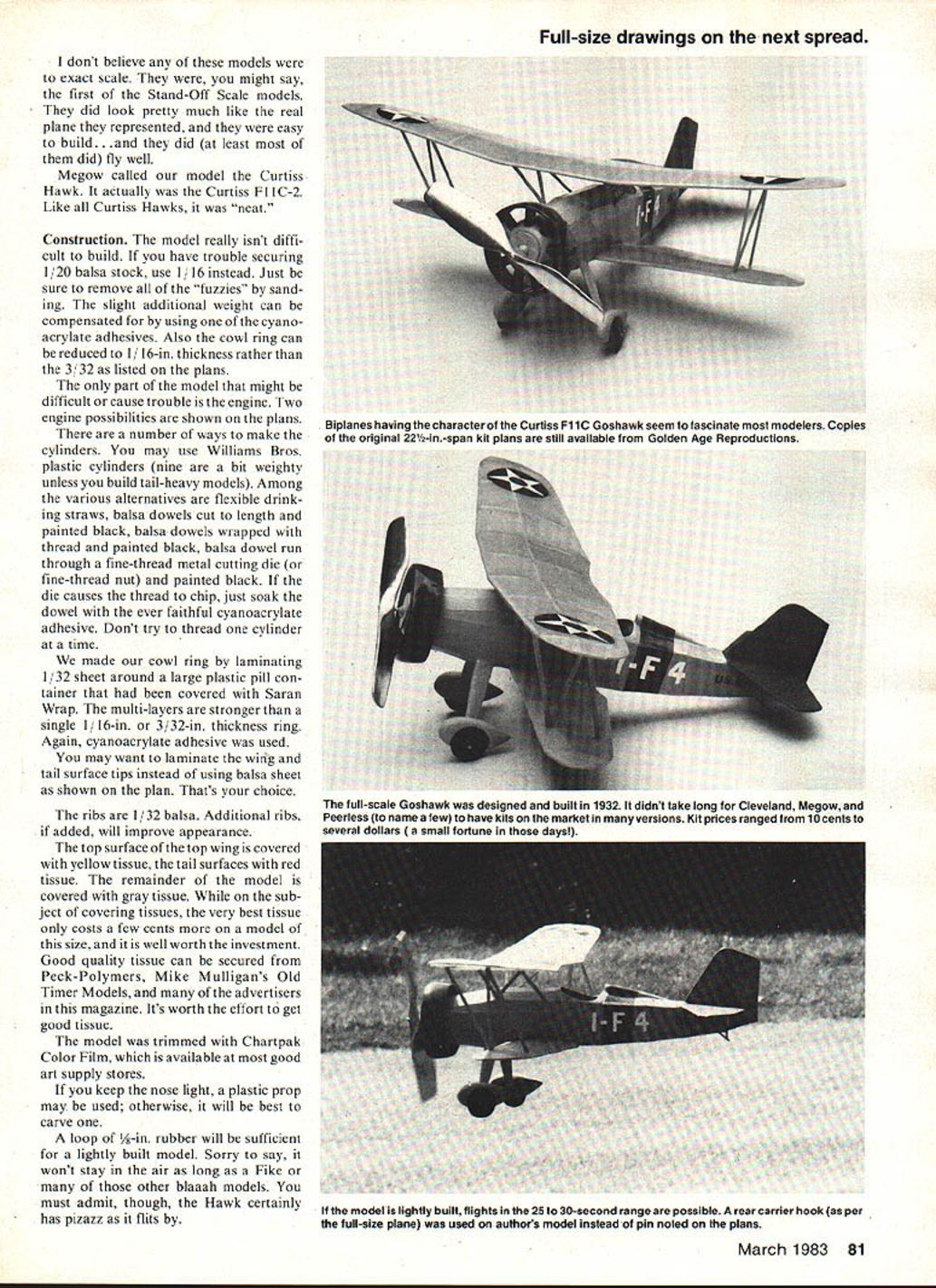
The Peanut Scale model presented can be carried about even if a skateboard is your means of transportation. It will give much enjoyment with little investment. (After all, isn't our hobby to enjoy?) You must also admit that the planes of the era it represents had both color and character.
It is a scaled-down version of an old Megow 25c kit of the 1930s. Since the Megow plant was only a relatively short distance from where we were raised, we (needless to say) built quite a few Megow models. Christmas was always great—you might get up to a half-dozen of the kits as gifts.
I don't believe any of these models were to exact scale. They were, you might say, the first of the Stand-Off Scale models. They did look pretty much like the real plane they represented, and they were easy to build ... and they did (at least most of them did) fly well.
Megow called our model the Curtiss Hawk. It actually was the Curtiss F11C-2. Like all Curtiss Hawks, it was "neat."
Construction
The model really isn't difficult to build. If you have trouble securing 1/20 balsa stock, use 1/16 instead. Just be sure to remove all of the "fuzzies" by sanding. The slight additional weight can be compensated for by using one of the cyanoacrylate adhesives. Also, the cowl ring can be reduced to 1/16-in. thickness rather than the 3/32 as listed on the plans.
The only part of the model that might be difficult or cause trouble is the engine. Two engine possibilities are shown on the plans.
There are a number of ways to make the cylinders:
- Use Williams Bros. plastic cylinders (note: these are a bit weighty unless you build tail-heavy models).
- Flexible drinking straws (soda straws).
- Balsa dowels cut to length and painted black.
- Balsa dowels wrapped with thread and painted black.
- Balsa dowel run through a fine-thread metal cutting die (or a fine-thread nut) and painted black. If the die causes the thread to chip, soak the dowel with cyanoacrylate adhesive. Don't try to thread one cylinder at a time.
We made our cowl ring by laminating 1/32 sheet around a large plastic pill container that had been covered with Saran Wrap. The multi-layers are stronger than a single 1/16-in. or 3/32-in. thickness ring. Again, cyanoacrylate adhesive was used.
You may want to laminate the wing and tail surface tips instead of using balsa sheet as shown on the plan — that's your choice.
The ribs are 1/32 balsa. Additional ribs, if added, will improve appearance.
The top surface of the top wing is covered with yellow tissue, the tail surfaces with red tissue. The remainder of the model is covered with gray tissue. While on the subject of covering tissues, the very best tissue only costs a few cents more on a model of this size, and it is well worth the investment. Good quality tissue can be secured from Peck-Polymers, Mike Mulligan's Old Timer Models, and many of the advertisers in this magazine. It's worth the effort to get good tissue.
The model was trimmed with Chartpak Color Film, which is available at most good art supply stores.
If you keep the nose light, a plastic prop may be used; otherwise, it will be best to carve one.
A loop of 1/8-in. rubber will be sufficient for a lightly built model. It won't stay in the air as long as a Fike or many of those other balsa models, but the Hawk certainly has pizzazz as it flits by.
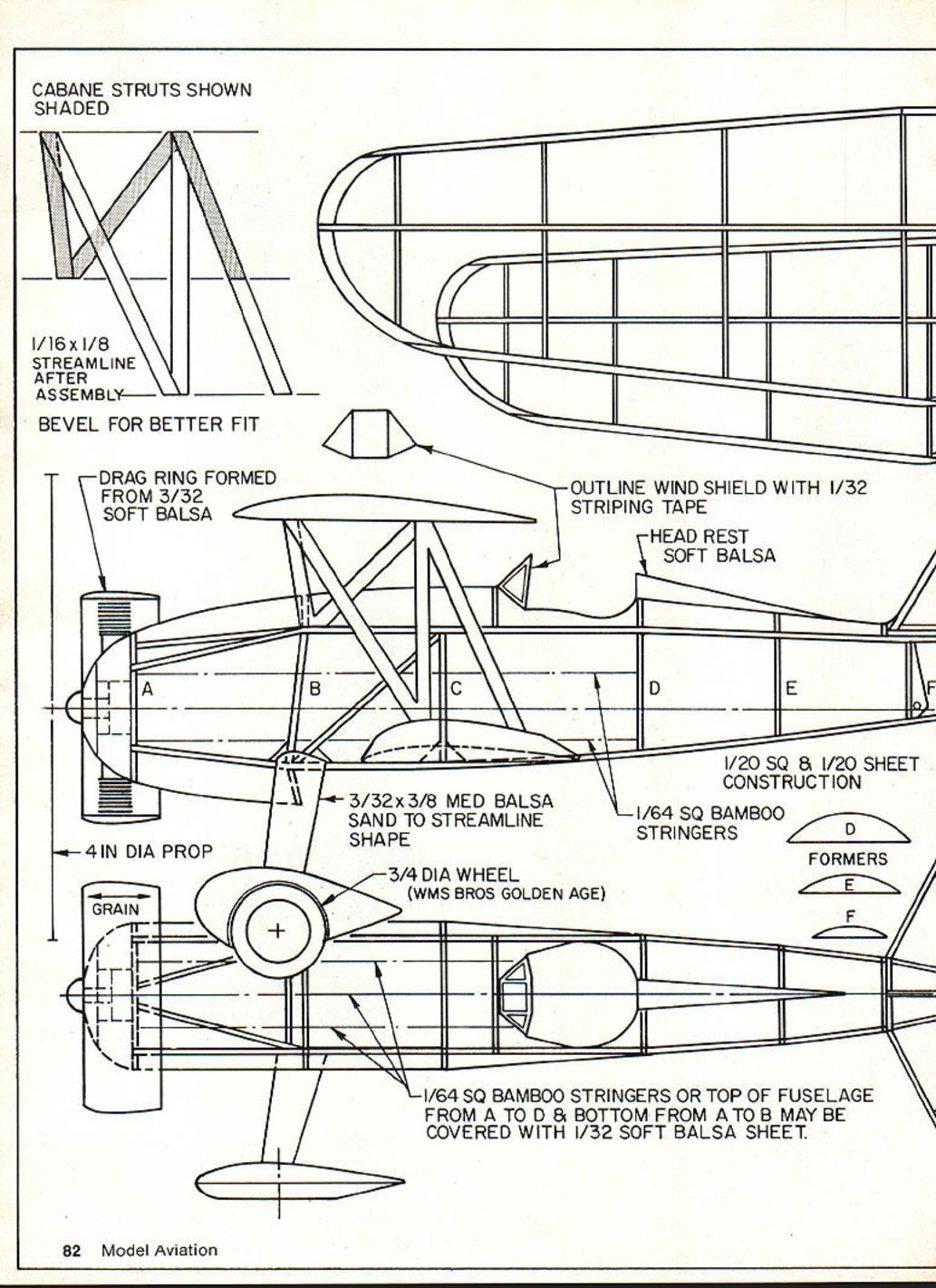
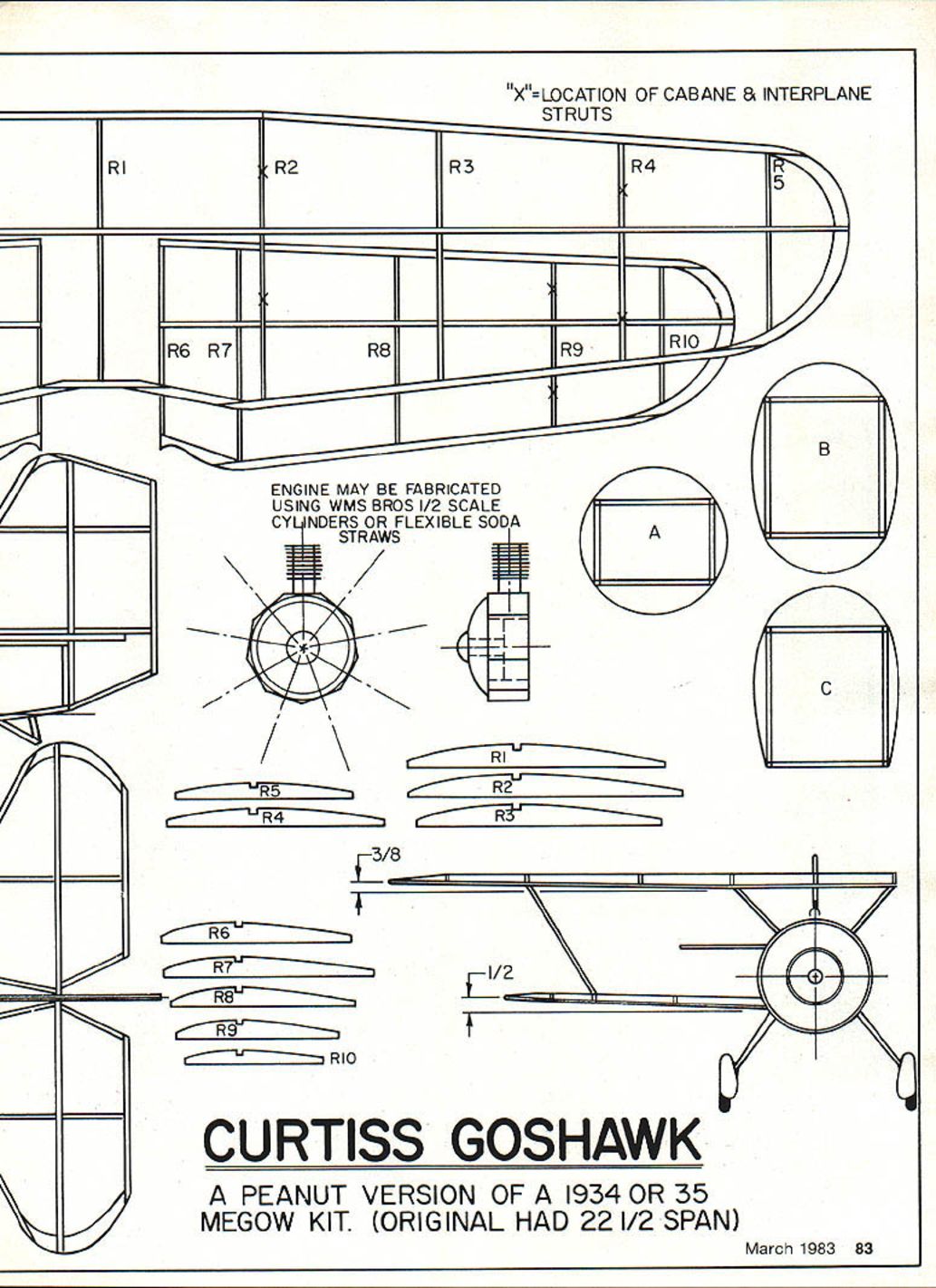
Curtiss Goshawk — Plans and Detail Notes
- "X" = location of cabane & interplane struts.
- Cabane struts shown shaded.
- Engine may be fabricated using Wms. Bros. 1/2-scale cylinders or flexible soda straws.
- 1/16 x 1/8 streamline after assembly.
- Bevel for better fit.
- Drag ring formed from 3/32 soft balsa.
- Outline windshield with 1/32 striping tape.
- Head rest: soft balsa.
- 1/20 sq & 1/20 sheet construction.
- 1/64 sq bamboo stringers.
- 3/32 x 3/8 medium balsa; sand to streamline shape.
- 3/4-in. diameter wheel (Wms. Bros. Golden Age).
- 4-in. diameter prop.
- Grain direction noted on plans.
- 1/64 sq bamboo stringers on top of fuselage from A to D & bottom from A to B may be covered with 1/32 soft balsa sheet.
- Formers D, E, F.
- Peanut version of 1934 or '35 Megow kit. Original had 22-1/2-in. span.
Transcribed from original scans by AI. Minor OCR errors may remain.

