
Custom Unlimited Racers
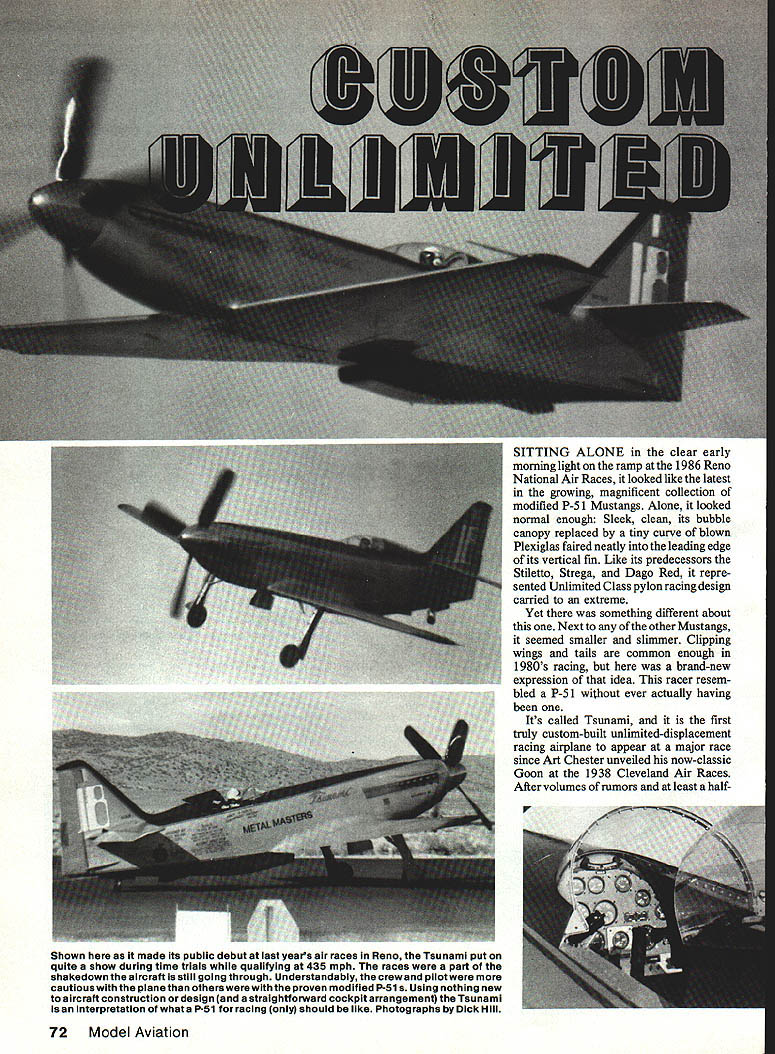
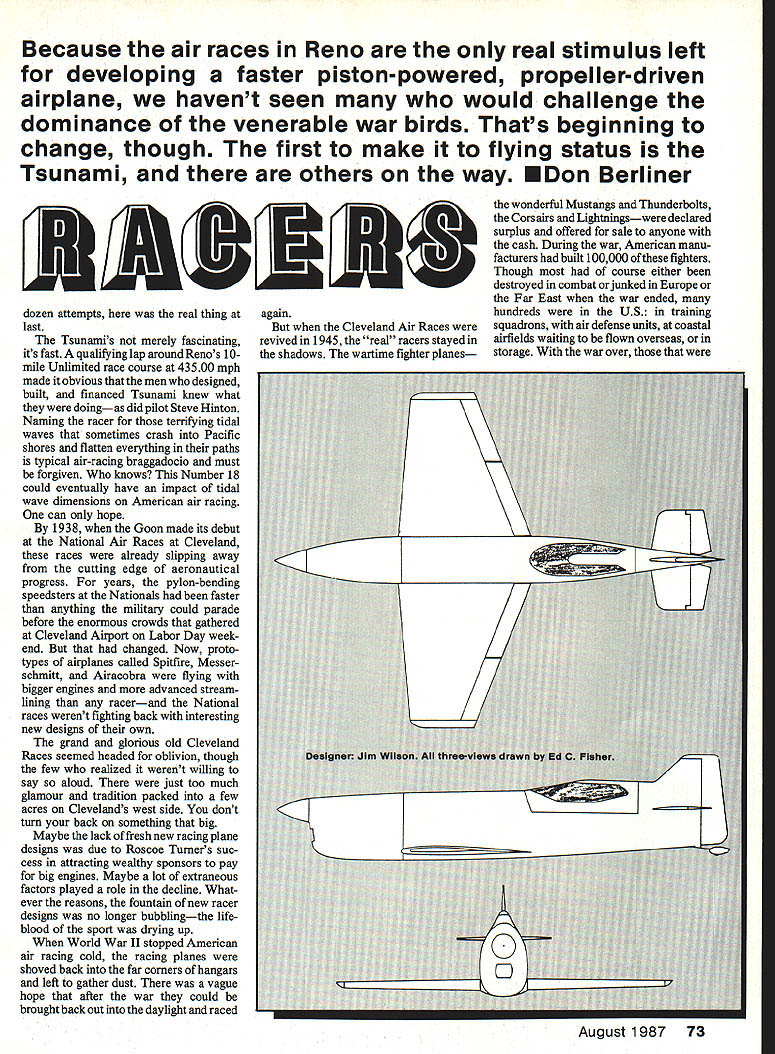
Sitting alone in the clear early morning light on the ramp at the 1986 Reno National Air Races, it looked like the latest in the growing, magnificent collection of modified P-51 Mustangs. Sleek and clean, its bubble canopy replaced by a tiny curved blown Plexiglas faired neatly into the leading edge of its vertical fin, it resembled other Unlimited Class racers such as Stiletto, Strega, and Dago Red. Yet next to any of those Mustangs it seemed smaller and slimmer — a brand‑new expression of clipped wings and tails. This racer resembled a P‑51 without ever actually having been one.
It's called Tsunami, and it is the first truly custom‑built unlimited‑displacement racing airplane to appear at a major race since Art Chester unveiled his now‑classic Goon at the 1938 Cleveland Air Races. After years of rumors and a half‑dozen attempts, Tsunami arrived as more than a curiosity: its fast qualifying lap around Reno's 10‑mile Unlimited race course — 435.00 mph — made obvious that the men who designed, built, and financed Tsunami knew what they were doing, as did pilot Steve Hinton. Naming the racer after tidal waves is classic air‑racing braggadocio, but Number 18 could eventually have tidal‑wave dimensions of impact on American air racing.
History: From the Goon to Warbird Dominance
By 1938, when Chester's Goon made its debut at Cleveland, pylon racing had begun to slip from the cutting edge of aeronautical progress. For years the Nationals had featured purpose‑built speedsters that outperformed military types, but by the late 1930s prototypes such as the Spitfire, Messerschmitt, and Airacobra were flying with larger engines and advanced streamlining. The Nationals weren't countering with new designs, and the grand old Cleveland Races seemed headed for decline.
World War II halted American air racing. After the war, thousands of surplus fighters — Mustangs, Thunderbolts, Corsairs, Lightnings — flooded the market. In 1945–1946 it took relatively little cash to buy a single‑engine fighter; ex‑fighters could be had for about $1,000 apiece, a twin‑engined P‑38 for about $1,500. The former military pilots who bought them promptly used them for racing. At the 1946 Cleveland Races the course was dominated by near‑stock and modified military fighters: those fast, durable warbirds eclipsed the prewar sport racers and redefined the Unlimited field.
Postwar Revival and the Rise of Warbirds
Unlimited Class racing did not reemerge in full until the 1960s. In 1964 Bill Stead — a Reno cattle rancher, Unlimited hydroplane champion, and Grumman Bearcat owner — organized a race at Sky Ranch near Sparks, Nevada. The sight of Mustangs and Bearcats tearing around a 5,000‑ft desert plateau recalled the old Nationals; within a few years these cut‑down, souped‑up fighters were routinely exceeding 425 mph in 100‑mile races.
As the warbirds were refined, emphasis shifted from streamlining to brute power. Examples like Cook Cleland's F2G Corsairs with huge Wasp Major engines demonstrated that cubic inches often beat finesse. Hawker Sea Furies and other large, American‑powered fighters followed, and engine power became the arms race of Unlimited competition. The approach worked — but it also pushed engines to their limits and raised acquisition and operating costs.
The Case for Custom Unlimited Racers
Warbirds were powerful and durable, but they were heavy and fundamentally 1940s designs. Modifying them had clear diminishing returns: engines were stressed to failure, and costs ballooned. A custom‑built Unlimited could be much smaller and lighter, reducing drag and engine strain and potentially offering equal or greater performance with less stress on components.
That promise drew designers and builders to the idea of purpose‑built Unlimited racers: machines optimized from the outset for pylon flight at 400–500+ mph rather than adapted from wartime fighters. But building and proving such a plane is expensive and technically demanding; early projects often stalled or encountered difficult problems (cooling, for example) in the high‑power regime.
Early Custom Projects
- Richard Minges (Fayetteville, NC) began a custom Unlimited in 1970 to use a 550‑hp Ranger V‑12, resembling a Bell XP‑77; the project ended when Minges died in 1971.
- Jim Wilson (Dallas, TX) started a similar project that advanced farther but then stalled; it has reportedly been restarted by another builder.
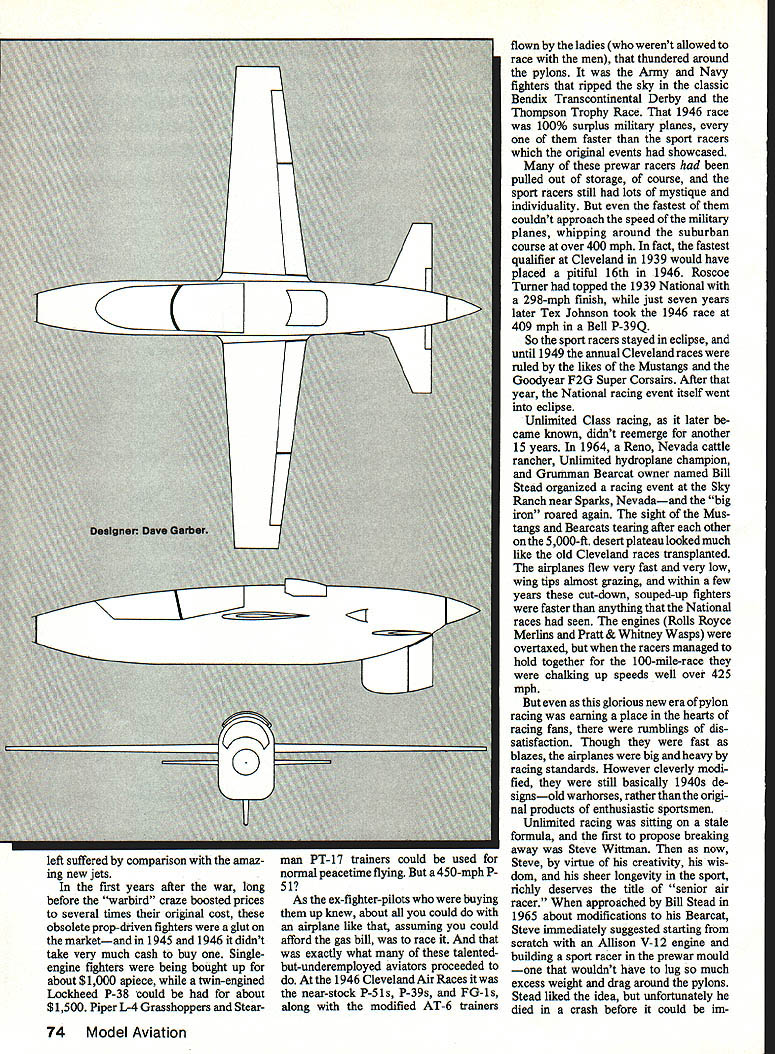
- Dave Garber (Pan Am pilot, Miami) designed a radical twin‑engine racer with supercharged Mazda rotary engines front and rear: about 600 hp total, an 11½‑ft wingspan, flush canopy, and an 1,100‑lb empty weight. Cooling problems plagued development for years; the plane flew several times and showed promise, and reports indicate cooling issues have been addressed and work resumed.
Despite interest and engineering talent, no custom had yet displaced the warbirds at Reno until the mid‑1980s.
The Tsunami Project
The serious custom effort that culminated in Tsunami brought together top talent. Lockheed's "Skunk Works" development group enlisted designer Bruce Boland to solve the problems inherent in a high‑speed custom Unlimited. Collaborators included veteran Unlimited racer John Sandberg, Lockheed engineers Pete Law and Ray Poe, and metal craftsman Phil Greenberg.
- Work on Tsunami began in earnest in 1979, after the team completed the Red Baron RB‑51 (a Mustang with a Rolls‑Royce Griffon and counter‑rotating props).
- Tsunami proved more complex and expensive than anticipated; the original 1983 first‑flight goal slipped to 1986. The maiden flight occurred just weeks before the Reno races.
- Performance and dimensions: Tsunami qualified at 435.00 mph around Reno’s 10‑mile Unlimited course. It has a 27½‑ft wingspan (versus 30–31 ft for standard racing Mustangs) and a wing area of 146 sq ft (about 50% less than a Mustang's 210–225 sq ft). That reduction in wing area and associated drag, when combined with a 2,400‑hp Merlin, suggested a theoretical top speed near 525 mph.
After nearly fifty years since the Goon, a new custom‑built Unlimited had become a reality. Tsunami remains fundamentally conventional in materials and powerplant, but its successful development and race performance demonstrated the viability of custom designs in the Unlimited category.
Materials, New Designs, and the Future
Newer materials and construction techniques broaden the possibilities for custom Unlimiteds. Composites such as carbon fiber are lighter and can be molded into more efficient shapes; Burt Rutan's work with VariEze and Voyager highlighted how composites enable unusual, highly efficient designs. Likewise, innovations in high power‑to‑weight engines from other motorsports offer potential advantages if adapted for aircraft use.
Examples of what might be possible:
- Jim Miller’s pusher‑engined GEM 260 Formula One demonstrated exceptional efficiency: 228 mph over 300 miles on 130 hp with the landing gear down. With a 900‑hp hot‑rod engine and retractable gear, similar concepts might theoretically reach 475 mph.
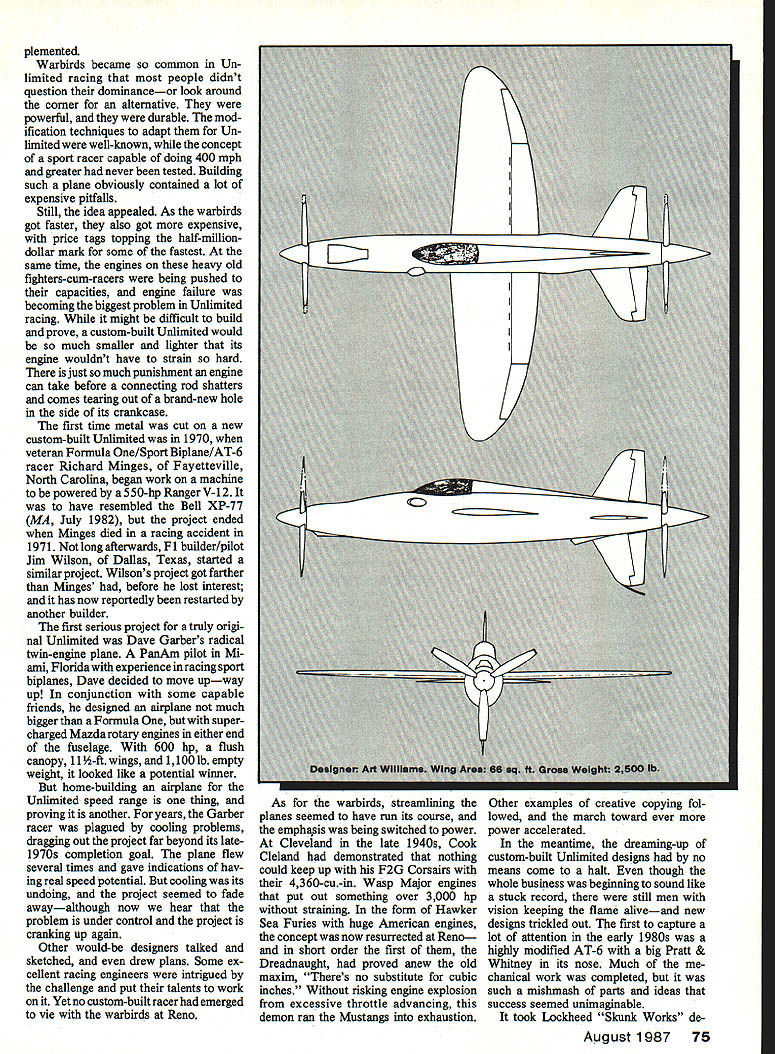
- Art Williams’ 1974 twin‑450‑hp engine design targeted 480 mph; with modern composites and weight reductions (perhaps 100–200 lb saved) such a concept would allow smaller wings, less induced drag, and a smoother airframe for further speed gains.
Conclusion
If Tsunami can approach or exceed 500 mph (reports suggest it reached about 490 mph on a test flight before Reno), then advanced, efficient custom designs should be able to surpass warbird performance on less power and with less stress. Not every builder will be able to make the leap from Formula One‑class construction to the 450–500+ mph range; early failures and crashes are a likely part of the development path — as they have been in automobile racing and in the history of air racing itself.
Because Reno helped stimulate the development of faster piston, propeller‑driven airplanes, we've begun to see a shift away from pure warbird dominance. Tsunami and other custom efforts have shown that purpose‑built Unlimited racers are practical and competitive, and they may pave the way for still more efficient and advanced racers in the years ahead.
Transcribed from original scans by AI. Minor OCR errors may remain.

