
Dart Kitten
By Don Berliner
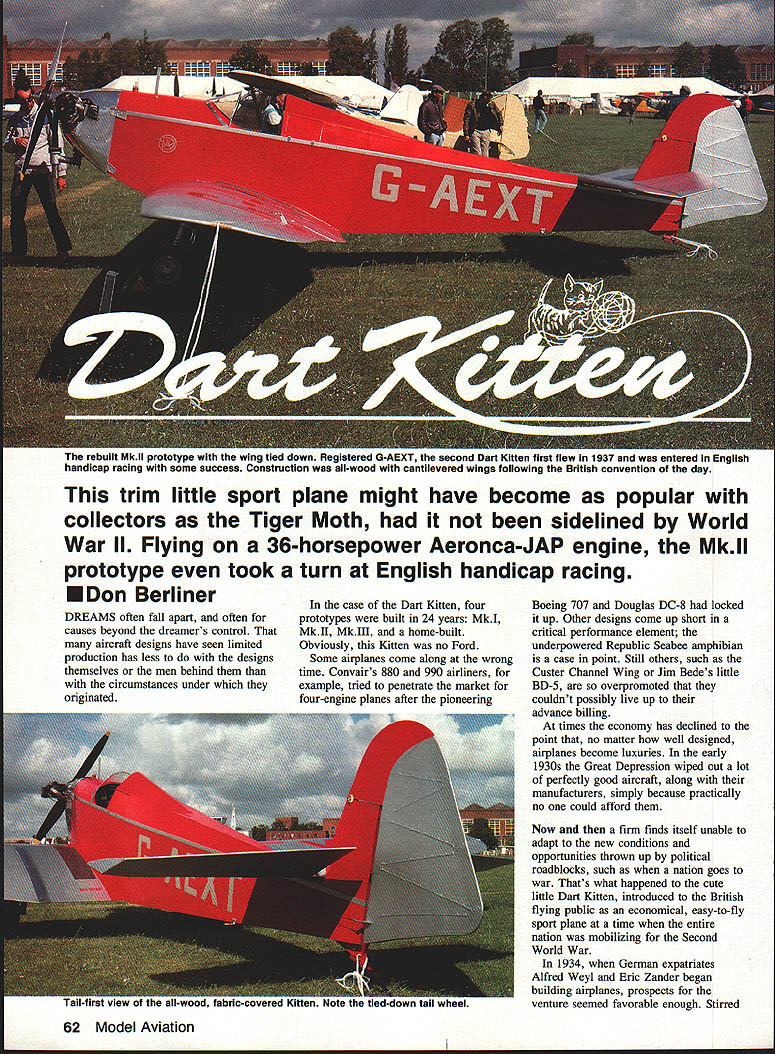
This trim little sport plane might have become as popular with collectors as the Tiger Moth, had it not been sidelined by World War II. Flying on a 36-horsepower Aeronca-JAP engine, the Mk.II prototype even took a turn at English handicap racing.
DREAMS often fall apart, and often for causes beyond the dreamer's control. That many aircraft designs have seen limited production has less to do with the designs themselves or the men behind them than with the circumstances under which they originated.
In the case of the Dart Kitten, four prototypes were built in 24 years: Mk.I, Mk.II, Mk.III, and a home-built example. Obviously, this Kitten was no Ford.
Some airplanes come along at the wrong time. Convair's 880 and 990 airliners, for example, tried to penetrate the market for four-engine planes after the pioneering Boeing 707 and Douglas DC-8 had locked it up. Other designs come up short in a critical performance element; the underpowered Republic Seabee amphibian is a case in point. Still others, such as the Custer Channel Wing or Jim Bede's little BD-5, were so overpromoted that they couldn't possibly live up to their advance billing.
At times the economy has declined to the point that, no matter how well designed, airplanes become luxuries. In the early 1930s the Great Depression wiped out a lot of perfectly good aircraft, along with their manufacturers, simply because practically no one could afford them.
Now and then a firm finds itself unable to adapt to the new conditions and opportunities thrown up by political roadblocks, such as when a nation goes to war. That's what happened to the cute little Dart Kitten, introduced to the British flying public as an economical, easy-to-fly sport plane at a time when the entire nation was mobilizing for the Second World War.
Origins
In 1934, German expatriates Alfred Weyl and Eric Zander began building aircraft. Stirred by such feats as Charles Lindbergh's and others' long-distance flights and by the speed flights of Supermarine and Macchi seaplanes, the public's interest in aviation reached a peak, and the second great war did not yet seem inevitable.
The two Germans produced several gliders. The Flying Flea followed, and reproductions of old gliders led to a move into powered gliders. In 1936 they changed the name of the company to Dart Aircraft Ltd. Located at Dunstable, north of London, Dunstable had been a gliding centre for many years.
Dart Aircraft's first effort, the Dart Pup, was a swept-wing parasol-style aircraft with a pusher-mounted 27-hp two-stroke flat-four Ava engine from France, of all-wood construction. The Pup was conventional and included folding wings for convenient storage. First flown in July 1936, the Pup immediately demonstrated the need for more power. Installation of a 36-hp Bristol Cherub III engine boosted takeoff and cruise performance, but the prototype was lost in a takeoff accident in 1938.
Weyl and Zander continued to build powered gliders, one of which survived until after the war. Their growing experience strongly suggested that success lay in the direction of more conventional airplanes. Design of what was to become the Kitten began in the summer of 1936, with construction completed by Christmas of that year.
Design and development
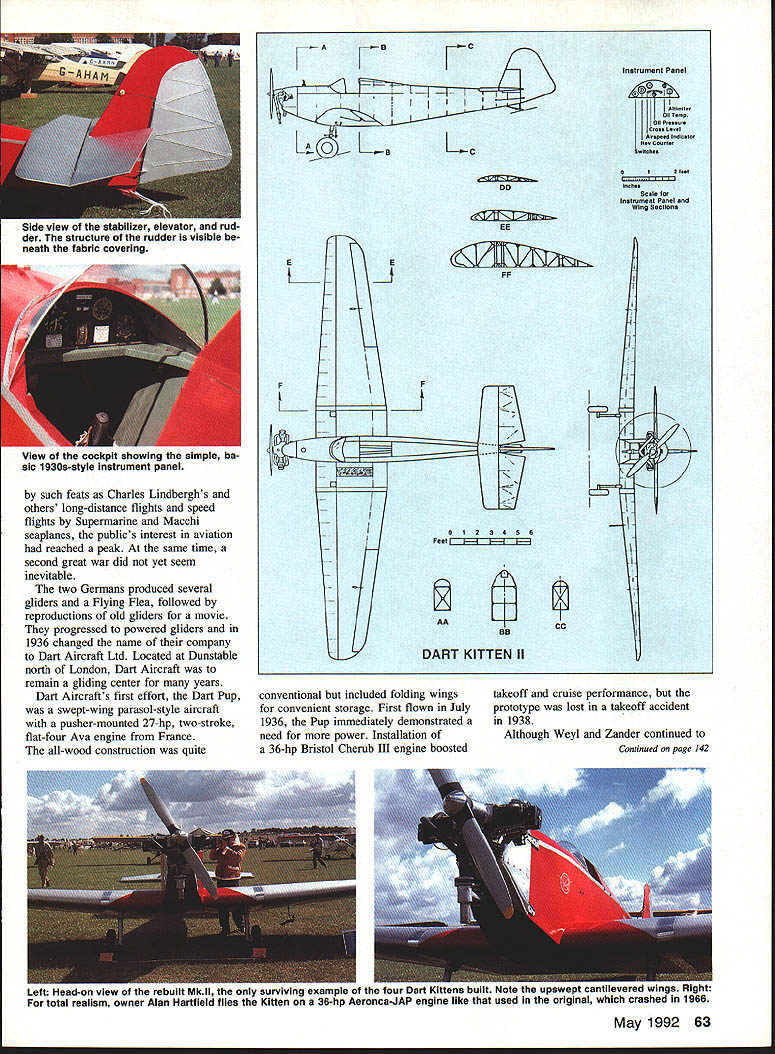
In keeping with a British design convention that was to continue for many years, the Mk.I prototype had cantilever wings and wood construction throughout. It was a trim little machine. One Kitten first flew in early 1937 using the 17-hp Ava engine from the Pup. It flew well despite being underpowered—the Ava produced more decibels than horsepower and had an annoying vibration. Cruising at about 65 mph, topping out at 75–80 mph, and stalling at just 37 mph, the airplane was considered a good buy at around $1,700 complete.
To satisfy the obvious need for greater power, the Mk.II was equipped with a 36-hp Aeronca-JAP engine, built on license in England. The quieter Aeronca added a solid 20 mph to the Kitten's cruising speed and improved its takeoff performance.
- Mk.I — prototype, wooden cantilever construction.
- Mk.II — fitted with 36-hp Aeronca-JAP; improved speed and takeoff.
- Mk.III — produced in 1951 with wheel brakes and other refinements.
- Home-built — an amateur-built example completed later.
Racing and wartime
Within weeks of its first flying, a Kitten was being prepared for racing—not the wild and woolly sort that Americans were doing with Gee Bees and Wedell-Williams racers, but English handicap racing. Under this system, all kinds of airplanes—racers, antiques, even small airliners—could be thrown onto a racecourse together, their wide differences in speed balanced out by carefully staggered takeoff times.
Sporting a canopy and wheel pants, the Kitten Mk.II was less than a month old when it was entered in the May 29, 1937 air race from London to the Isle of Man. Engine trouble prevented the pilot, F. D. Bradbrooke, from completing the 250-mile race, but the plane was subsequently flown in other handicap races with some success.
Unable to obtain the government contracts that were necessary for survival, Dart Aircraft folded after the war began in September 1939. Weyl, still a German citizen, was interned on the Isle of Man as an enemy alien. Zander had wisely taken out British citizenship. The Dart company went into hibernation and did its own repairs.
Postwar fate and restorations
The prototype Mk.I spent the war years parked at a small airfield. After the war it was fitted with a 36-hp Aeronca-JAP engine and flew until it crashed in 1952. The Mk.II was also stored during the war and emerged in late 1945; after passing through several owners it later crashed in the mid-1960s.
In 1951 Alfred Weyl built a third Kitten. Registered G-AMPJ, the Mk.III differed from the successful Mk.II in having wheel brakes, long a novelty on British lightplanes. Weyl also produced major components for sale to kit buyers. Weyl's plan to put the Mk.III into production was sidelined when a suitable small engine could not be found. Discouraged, he committed suicide in 1965. The Mk.III crashed a year later.
Somehow, the remains of interesting old airplanes beg to be put back together and flown again. The Mk.II was crashed by a friend of owner Ron Long in the mid-1960s. Long kept the wreckage at his farm. About a dozen years later, pilot and vintage-airplane enthusiast Melvyn Rice bought what was left: the rear fuselage, tail surfaces, and some metal fittings. Together with parts of kits produced by Weyl in 1951 for amateur builders, this formed the basis for a major rebuilding project.
Rice tracked down aircraft mechanic Eric Burkitt, who had worked as an apprentice for the Dart company in the mid-1930s, and put him to work making an airplane from a pile of old pieces. A new owner, Clive Stubbings, completed this labor of love in the fall of 1985.
Stubbings, an experienced commercial pilot and instructor, took the restored Kitten on its first flight since the mid-1960s and celebrated its return with his helpers. Stubbings was killed in an unrelated crash in 1986, and a few months later the airplane passed into the hands of another owner, Alan Hartfield. Hartfield flies the Kitten to air displays and fly‑ins, showing today's new breed of sport flier that exotic composite materials and radical shapes aren't the only way to have fun.
Pilot impressions and reputation
"I find the Dart Kitten very pleasant and enjoyable to fly," Hartfield says. "Flown with normal care and attention, with respect for its age, it is actually easy to fly and very safe. The 36-hp JAP engine does give a good amount of vibration and has to be treated with respect."
Because there have been so many people killed while owning or being closely concerned with the Dart Kitten, it has become known in some circles of British light aviation as a "jinx" aeroplane. Indeed, there are several people who would not own one and who consider that my days are numbered. Fortunately, I do not believe in this school of thought at all—total balderdash.
Legacy
Had it not been for Hitler's military buildup in the mid-1930s, hundreds of Dart Kittens might have rolled off the assembly line, destined to be no less coveted by collectors and restorers than De Havilland Tiger Moths. Instead, only Alan Hartfield's Mk.II survives today. It's a rarity that has proved well worth reviving.
Transcribed from original scans by AI. Minor OCR errors may remain.

