
A Day with Project Snapshot
Project Snapshot continues to search for interesting photo subjects. The challenges of getting clearance and taking the photos have become the author's specialties. Photographing NASA's Enterprise Space Shuttle was the latest triumph. — Luther Hux
Plan and opportunity
My plan for the weekend of June 12, 1983, was a restful camping retreat. That changed when the newspaper announced the arrival of Space Shuttle Enterprise at Dulles International Airport. Taking aerials of a space shuttle had long been at the top of my wish list, but the long drive to Florida and the slim chance of convincing NASA to let me fly at its facility made the photos seem impossible. Then the opportunity came to me: the shuttle would be only about 20 miles away at an airport where I had previously flown Snapshot.
The NASA 747 and shuttle had just completed a European tour and were making a few stops in the U.S. as they returned to home base.
Arrangements at Dulles
Dulles Operations' response to my request for aerial photos of Enterprise was that I should make myself available, but there would be no guarantees. Hank Cloutier, operations officer, wanted to help but there was a lot of activity and ceremony planned.
I immediately prepared my equipment as if the photo flight had been approved. I loaded the motor home and headed for Dulles Airport. Arrangements were made to camp overnight so I would be ahead of the crowd expected for the 8 a.m. shuttle arrival. As the evening passed, the projected crowd began to grow: the estimated 100,000 soon rose to 250,000.
As my wife, Dawn, and I stood on the observation deck planning Snapshot's flight, we met Hank Cloutier doing some planning. He described some of the many special requests that had swamped his office. "It's getting to be a madhouse, but I will try to help you get the photos if I can," he encouraged us.
By bedtime radio announcers were predicting that 500,000 people would be heading to Dulles the next morning to see the landing.
The crowd and the flyby
Come morning, there was a long line of cars flowing off the access road to the runway that had been converted to a parking lot, but the crowd at the airport itself seemed too thin to match the forecasts. At first it appeared that Washingtonians were not sufficiently impressed with the space shuttle to get up that early on a Sunday morning. The evening news, however, told a different story. People had lined the Capital Beltway and Dulles Access Road to watch the low-altitude flyby that followed those routes. Out-of-towners were surprised by people sitting in lawn chairs and milling around the highway as if at a drive-in theater.
Much of Washington saw the majestic flyby, but only about 75,000 traveled to Dulles Airport for a close-up look. The news media, with its ever-rising forecasts, may have discouraged some locals from making the trip. Many of the estimates were apparently based on turnouts in European cities.
Those who did drive to Dulles were treated to a touch-and-go by the NASA duo. The powerful 747 landed and took off as if there were no cargo aboard; in fact, ballast was packed in the 747's cargo bays to counterbalance the shuttle's tremendous weight.
For food concessioners the smaller-than-expected crowd was bad news. They had ordered 300,000 hot dogs and precooked 100,000 of them. There was a special sale on hot dogs the next day.
Preparing for the flight
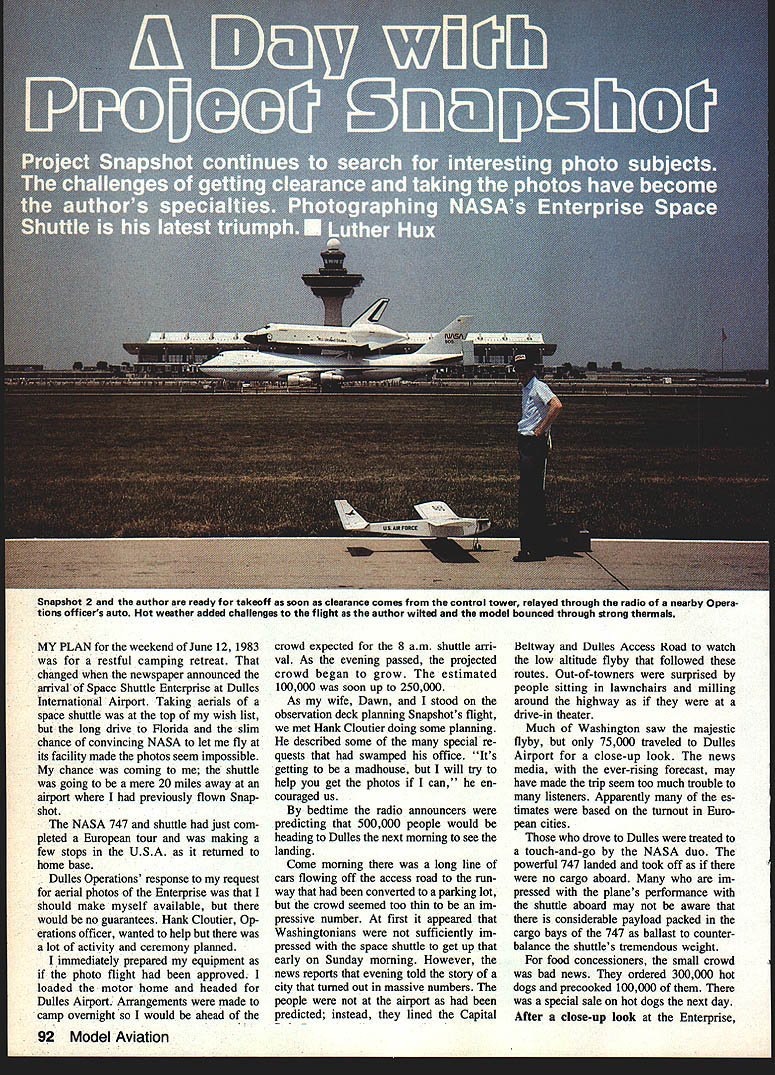
After a close-up look at Enterprise, we were ready for takeoff as soon as clearance came from the control tower, relayed through the radio of a nearby operations officer's auto. Hot weather added challenges to the flight as the author wilted and the model bounced through strong thermals.
Finally we were greeted, "Are you ready?" Did I have to ask? We hurried back to the motor home, drove out to meet the operations officer, and followed his vehicle onto the runway and flight area—a large grass field between the aircraft parking ramp and the shuttle visitors' center. On the other side of the shuttle, next to a terminal building, was the underflight area—except for us.
The Snapshot model was quickly pulled out, fueled, and checked; the checklist helped prevent mistakes as we hurried through the last items. Clearance from the tower came to take off.
The flight
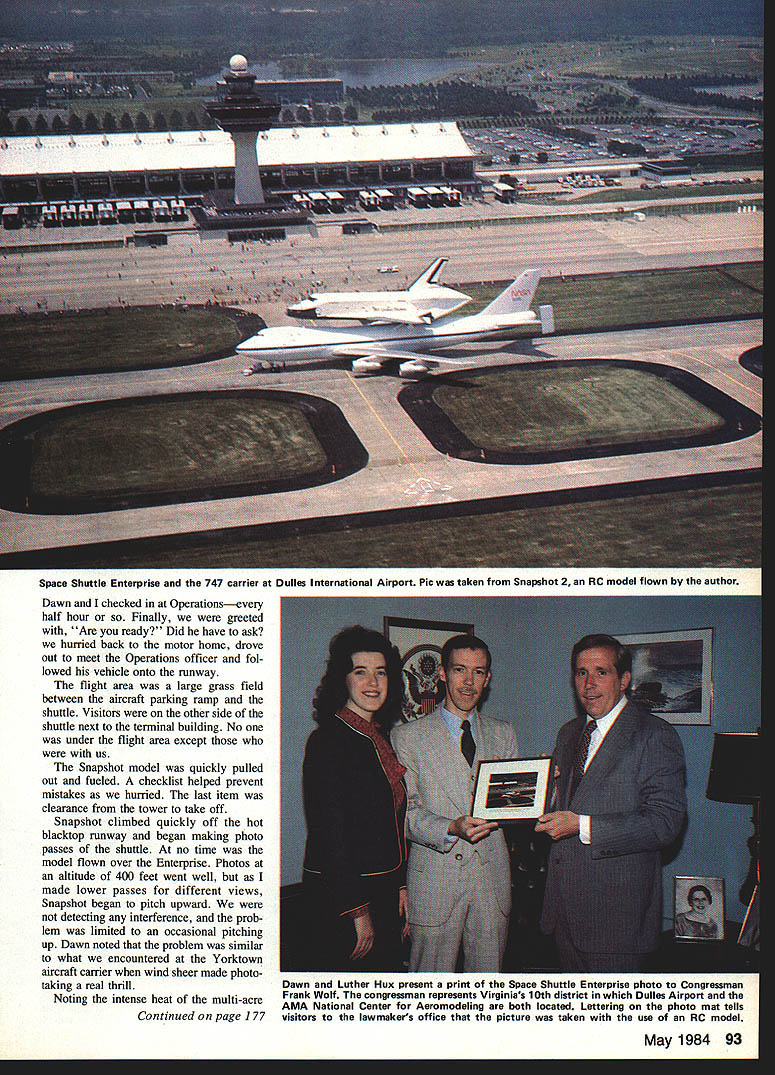
Snapshot climbed quickly off the hot blacktop runway and began making photo passes of the shuttle. At no time was the model flown over Enterprise. Photos taken at an altitude of about 400 feet went well; we made lower passes for different views.
Partway through the flight the model began to pitch upward occasionally, indicating an interference problem that limited it to intermittent pitching. Dawn noted the problem was similar to what she had encountered on the Yorktown aircraft carrier—wind shear made the photo-taking a real thrill.
Noting the intense heat of the multi-acre parking ramp, we decided the problem was a thermal reaction. Since there was no sign of poor response in the elevator, we chose to continue the 15-minute flight and finish the roll of film. The landing went without a flaw. I was uneasy about the roller-coaster nature of the flight, but my main reason for not making another flight to expose a second roll of film was that the heat had gotten to me.
Results and distribution of the photos
I usually get a high percentage of good frames, but this roll contained only a few quality pictures. The choppy flight accounted for many slightly blurred photos. The best slides were loaned to the FAA so prints could be made for Dulles PR and management. Sharing the slides was a "thank you" for allowing me to fly at the FAA-owned airport.
Slides were then requested by NASA's PR office for a brochure about Enterprise's European tour. A print was requested by Hurst Bowers, AMA Museum curator, to mount next to NASA's RC Enterprise test model on display at the National Center for Aeromodeling in Reston, VA. Other prints will be displayed at:
- NASA's Visitor's Center in Washington, DC
- Goddard Visitor's Center in Greenbelt, MD
Each photo is identified as having been taken from an RC model.
Congressional connection
Dulles is located in Virginia's 10th U.S. congressional district, represented by Congressman Frank Wolf. Because of the congressman's efforts to promote greater use of Dulles and his use of RC models during his first election campaign, I arranged to present him with a print of Enterprise at Dulles. This photo also carries the Snapshot byline, telling future congressional visitors that the photo was taken from an RC model.
The congressman's scrapbook contains the March 1981 Model Aviation article on the RC hot-air balloon used at campaign meetings. The AMA staff has contacted the congressman on several issues that affect the hobby, and he has arranged to visit AMA headquarters and see the new museum.
Transcribed from original scans by AI. Minor OCR errors may remain.

