
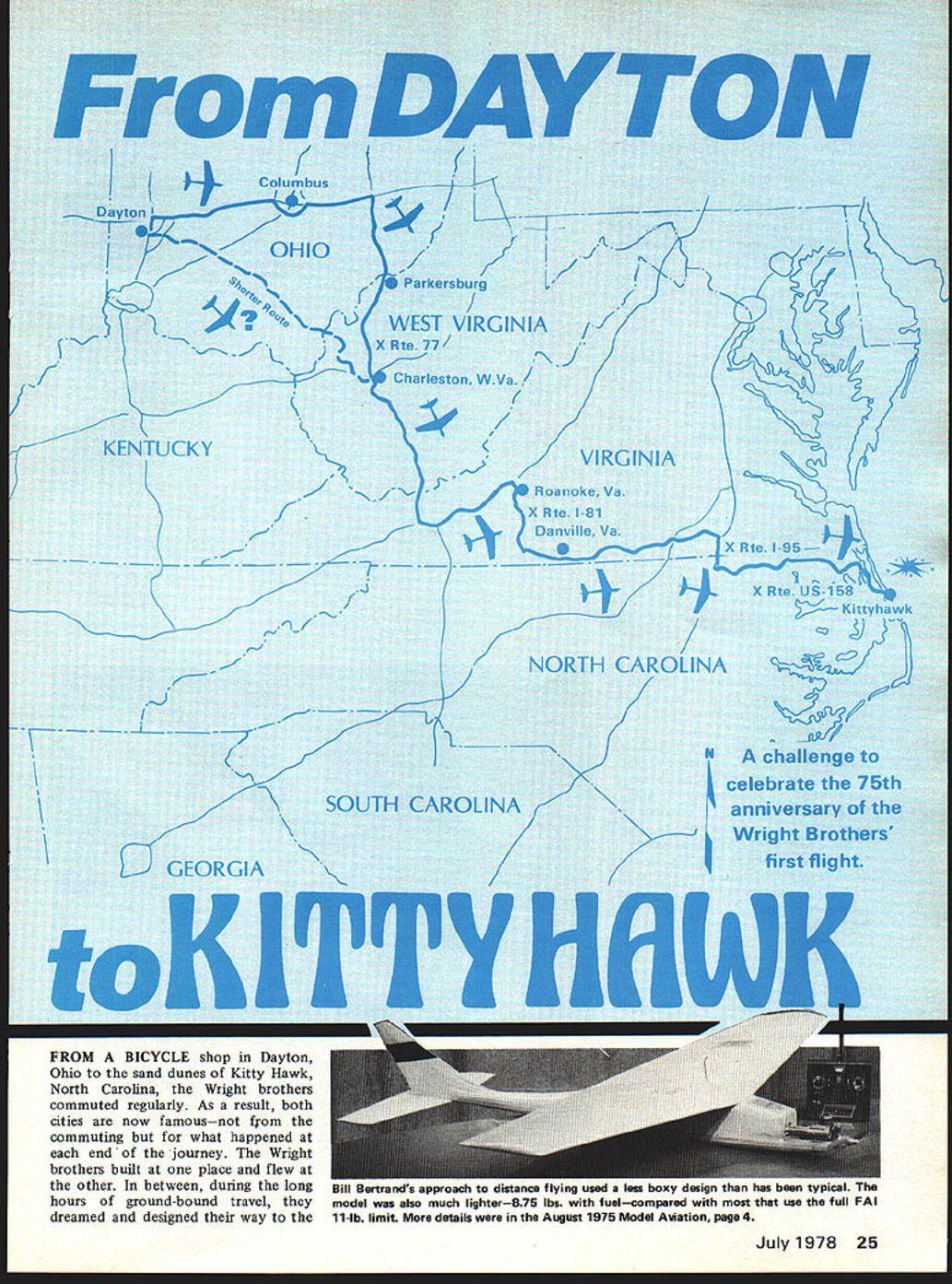

From DAYTON to KITTYHAWK
FROM A BICYCLE shop in Dayton, Ohio to the sand dunes of Kitty Hawk, North Carolina, the Wright brothers commuted regularly. As a result, both cities are now famous—not from the commuting but for what happened at each end of the journey. The Wright brothers built at one place and flew at the other. In between, during the long hours of ground-bound travel, they dreamed and designed their way to the great day in 1903 when they finally succeeded in achieving powered flight.
Thus the route between Dayton and Kitty Hawk is symbolic. It stands as a challenge. The distance—straight line—is over 500 miles. It can be flown with a model in a couple of legs; perhaps even non-stop. Such a model flight is within our grasp; attainable with current technology.
Look at what Bob and Doris Rich did in 1975. They went from Kitty Hawk to Oceanside, California! They didn't do it non-stop, but they put in enough cross-country flights to prove that such flying is feasible. Consider what they did with conservative flying that didn't push the potential:
- Total days in flight: 23
- Average flight time per day: 3 hours
- Total in-flight air time: 68 hours, 48 minutes
- Total miles flown: 3026.7
- Average speed: 51 mph
- Total takeoffs and landings: 118
- Total fuel consumed: 16.5 gallons
- Airplane: Goldberg Senior Falcon with 32-oz. fuel tank.
One of modeling's great pioneers, Leo Weiss, has taken a close look at the Dayton to Kitty Hawk challenge. Here's what he said in a recent letter:
An R/C non-stop race, Dayton, Ohio to Kitty Hawk, NC would certainly be a fitting commemorative for model aviation's Diamond Anniversary year.
A real question is: Can it be done? Superficially viewed, the answer seems to be yes. The straight-line distance is 570 statute miles. Even a "normal" allowance for road miles, say plus 15%, brings the distance to 655 miles.
Theory takes attainable range well beyond that number. In fact, I've made it out to be in the transcontinental range, based only on well-established energy considerations. I've filled pages of my notes (in 1975) on this subject, and I gather others have similarly played with the numbers. They're unbelievable—but after playing with them a bit, the results gradually approach credibility. However, upon getting into the practicalities of specific courses, a rather different picture emerges.
In 1975, I analyzed a number of routes that might represent noteworthy (i.e., attention-provoking) routes, tied in to either AMA events, national events, or the like. Among them were: Denver-Dayton, San Diego-Savannah (shortest, coast-to-coast), Dayton-Washington, and Dayton-Kitty Hawk. Without question, the Dayton-Kitty Hawk route is the most difficult. However, I don't believe it is beyond achievement; merely very tough.
The problems of such a flight are formidable, given the idea that control would be from the surface, in a car. Airplane tracking is, leaving aside some legal and other questions, no basket of grapes. Anyone who could pull off that stunt would win the grapes, basket and all, but the attempt could be a sour one, indeed.
Here are some facts re the ground-guided route:
a) Given the idea that secondary road travel is out as a practical matter, the route, via principal roads from Dayton to Kitty Hawk, adds up to a whopping 812 miles without detours, etc.
b) Worse than that, the route is like a golf course consisting only of a tee, rough, bunkers, and a cup. There's barely a section of major road that lies slightly parallel to the straight-line route. It's up, down, side to side, and I wouldn't doubt helical at some points. Very scenic, though.
Here's a route I worked out. This is just "for example." There are other ways to go, but in this particular year, perhaps no better place:
Fix Block Miles Cum. Miles Route Dayton 0 0 Start Columbus 70 70 I-70 X Rte. 77 76 146 I-77 Parkersburg 56 202 I-77 Charleston, WV 74 276 I-77 X Rte. I-81 116 392 I-77 Roanoke, VA 78 470 I-81 Danville, VA 84 554 US-220–US-58 X Rte. 1-95 114 668 US-58 X Rte. US-158 17 685 US-158 or US-301 Kitty Hawk 127 812 US-158
* US-35 and I-64 to Charleston, WV could be a better bet, and likely is—assuming US-35 is improved over the way I remember it from many years ago. This route would be 50 miles shorter, cutting diagonally across Ohio.
There are subtleties—awkward ones. One of them, even at an average ground speed of 50 mph, it's at least a 15-hour trip. That creates a problem—take off in the dark, land in the dark, or cross the mountains in the dark. Nearly an hour of sun time will be lost on the trip.
And with good winds and guidance by a mother plane, "mama bird" would have to be able to fly at not more than 50 mph airspeed for at least nine hours. Don't know of an existing airplane quite up to that. Like the model, it could be built, but there's a question of time and money. I think I'd rule out guidance from the air on other grounds anyway.
To me, all this adds to the intrinsic value of the entire scheme. With man-made objects now on their way to the outermost planets, and with what's gone before in space, it strikes me that something on this order might just have the right ingredients to stir up some jaded juices in the public.
As Leo expressed it the Dayton–Kitty Hawk flight is a great challenge. Fortunately, we have some experiences in long-distance flying going for us.
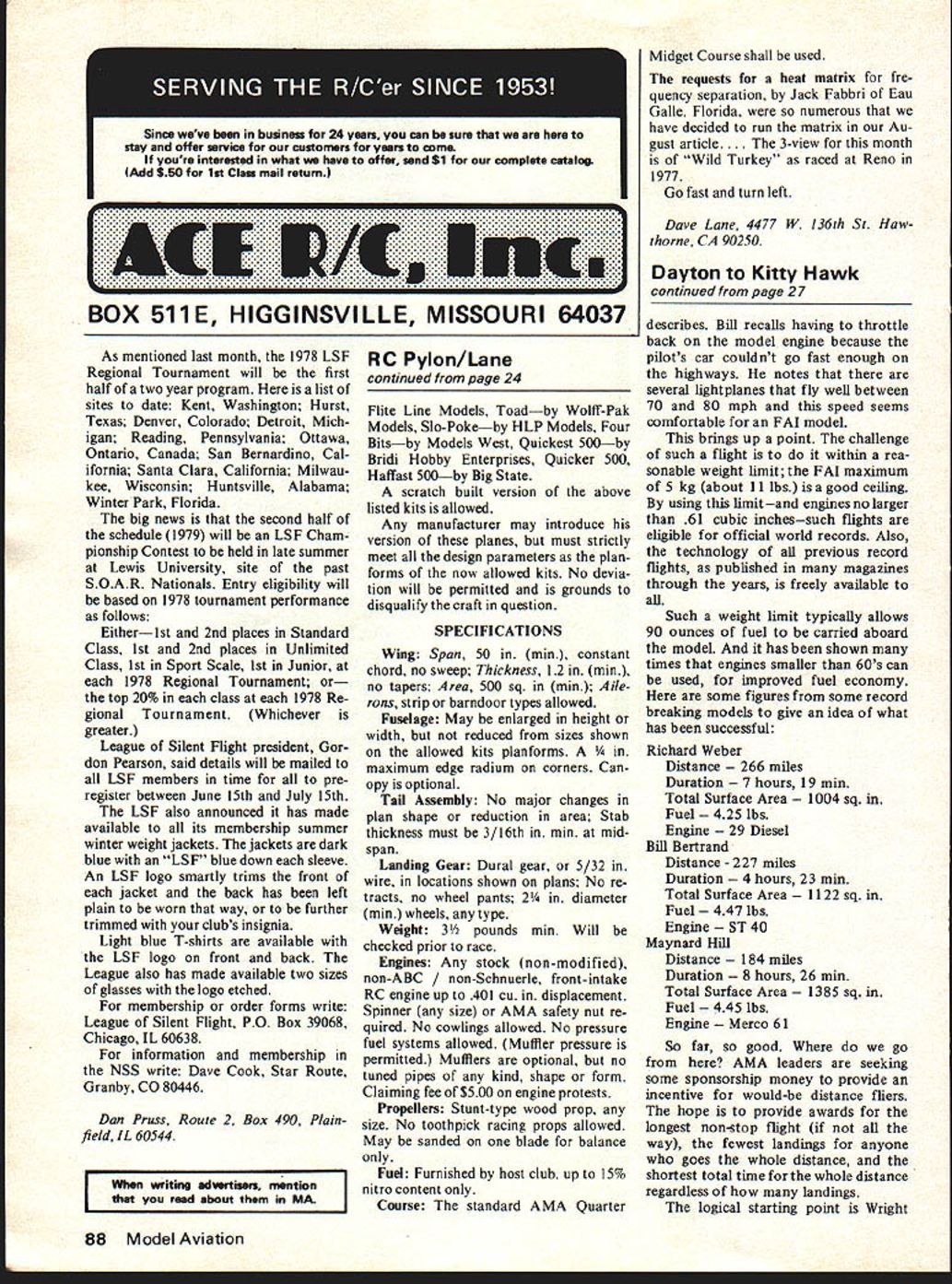
Maynard Hill, holder of many distance and duration records, agrees that a non-stop flight of this distance is well within current means. He notes that most successful record flights have ended with much fuel unused. Richard Weber, who picked up where Maynard left off in the record activity for distance and duration, also has noted flight potential considerably greater than utilized to date.
Bill Bertrand, another experienced distance flier, disagrees with Weiss about piloting from an airplane. He thinks it's the best way to go and faster than Leo. describes. Bill recalls having to throttle back on the model engine because the pilot's car couldn't go fast enough on the highways. He notes that there are several lightplanes that fly well between 70 and 80 mph and this speed seems comfortable for an FAI model.
This brings up a point. The challenge of such a flight is to do it within a reasonable weight limit; the FAI maximum of 5 kg (about 11 lbs.) is a good ceiling. By using this limit—and engines no larger than .61 cubic inches—such flights are eligible for official world records. Also, the technology of all previous record flights, as published in many magazines through the years, is freely available to all.
Such a weight limit typically allows 90 ounces of fuel to be carried aboard the model. And it has been shown many times that engines smaller than 60's can be used, for improved fuel economy. Here are some figures from some record breaking models to give an idea of what has been successful:
- Richard Weber
Distance — 266 miles Duration — 7 hours, 19 min. Total Surface Area — 1004 sq. in. Fuel — 4.25 lbs. Engine — .29 Diesel
- Bill Bertrand
Distance — 227 miles Duration — 4 hours, 23 min. Total Surface Area — 1122 sq. in. Fuel — 4.47 lbs. Engine — ST 40
- Maynard Hill
Distance — 184 miles Duration — 8 hours, 26 min. Total Surface Area — 1385 sq. in. Fuel — 4.45 lbs. Engine — Merco 61
So far, so good. Where do we go from here? AMA leaders are seeking some sponsorship money to provide an incentive for world-class distance flights. The hope is to provide awards for the longest non-stop flight (if not all the way), the fewest landings for anyone who goes the whole distance, and the shortest total time for the whole distance regardless of how many landings.
The logical starting point is Wright Field at Dayton, Ohio, site of the '76 National Championships. Discussions currently are underway for possible use of this site. No problem at the other end; Kitty Hawk has an airstrip at the Wright Brothers Memorial.
Also being explored is a time period for attempts; perhaps between August 19 (National Aviation Day) and December 17 (anniversary of the Wright brothers flight in 1903).
Obviously, many details need to be developed. In the meantime, lots of dreaming and scheming can be done by would-be record-setters, maybe even model building and test flying. The basic need is to practice cross-country flying, even if only for short distances. Flying from a car (or plane) obviously is a different situation from flying at a contest or the club field.
More on all this will be reported next month. Until then, anyone interested in getting involved is requested to write a note to AMA HQ — we will try to get an information exchange going to keep all interested parties up-to-date on project progress. In the meantime, you might refer to the August 1975 issue of Model Aviation regarding transcontinental flying, or any more recent issues describing record breaking distance or duration flights. Note: The October '76 issue tells how Richard Weber flew for 10 hours and 48 minutes while setting a new closed course distance record of 424 miles.
Transcribed from original scans by AI. Minor OCR errors may remain.

